On the Feast of the Nativity of Christ, His Holiness Patriarch Kirill visited St. Alexis Hospital in Moscow

В праздник Рождества Христова Святейший Патриарх Кирилл посетил больницу святителя Алексия в Москве
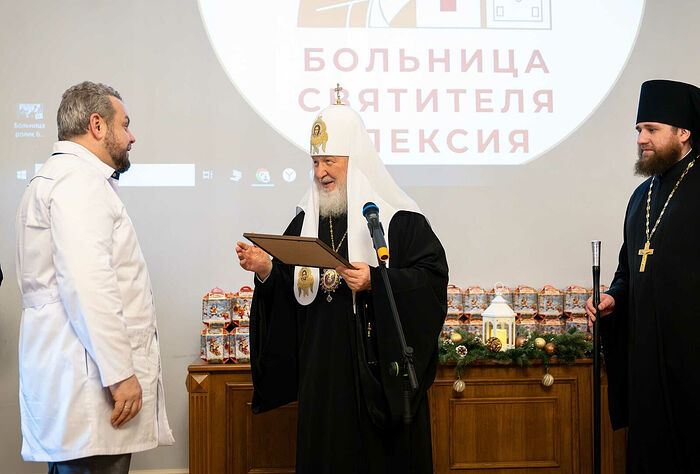
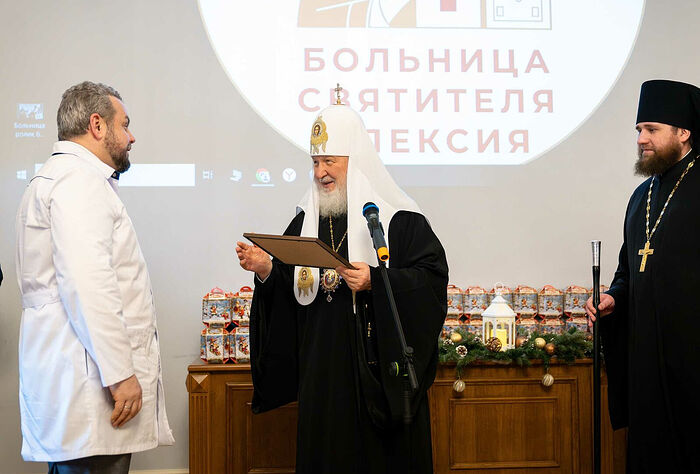
On January 7, 2024, the Feast of the Nativity of Christ, His Holiness Patriarch Kirill of Moscow and All Russia visited the Central Clinical Hospital of St. Alexis, Metropolitan of Moscow, in the Russian capital, Patriarchy.ru reports. This is His Holiness Patriarch Kirill's second official visit to St. Alexis Hospital. In 2017, also on the Feast of the Nativity of Christ, His Holiness visited the opened palliative care department. The Primate of the Russian Orthodox Church blessed the further development of this area in the regions and the opening of the Training Center for the training of specialists in palliative care. With this he defined a new and extremely important direction of the hospital's activities. This time His Holiness was welcomed at the hospital by: Deputy Chairman of the State Duma of the Federal Assembly of the Russian Federation A.Yu. Kuznetsova; Minister of Health of the Russian Federation M.A. Murashko; Director of the Health Department of the Government of the Russian Federation I.N. Kagramanyan; Head of the Federal Medical and Biological Agency of Russia V.I. Skvortsova; First Deputy Minister of Health of the Russian Federation A.N. Plutnitsky; Senior Vice President - Financial Director of MMC Norilsk Nickel S.G. Malyshev; Chairman of the Synodal Department for Church Charity and Social Ministry, Chairman of the Commission on Hospital Ministry of the City of Norilsk Nickel. Bishop Panteleimon of Vereisky, Bishop of Moscow; Chairman of the Synodal Department for Relations between the Church and Society and the Media V.R. Legoida; Chief Doctor of St. Alexis Hospital A.Y. Zarov; Chairman of the Supervisory Board of the All-Russian Public Movement "Russia the Orthodox" M.M. Ivanov. Zarov; Chairman of the Supervisory Board of the All-Russian Public Movement "Russia the Orthodox" M.M. Ivanov. His Holiness Patriarch Kirill first visited building No. 5. The Primate of the Russian Orthodox Church and his entourage toured the "Hello, Mother" center for maternity care and abortion prevention. N.I. Moskvitina, a member of the Commission on Demography, Protection of Family, Children and Traditional Family Values of the Public Chamber of the Russian Federation, gave comments. Then there was a tour of radial diagnostics rooms (MRI and CT) with new medical equipment. A.Y. Zarov told about the work of radiation diagnostics rooms. Zarov. His Holiness went to building No. 2, where he inspected the rooms and wards of the newly formed cardiology department. Then in Building No. 3 His Holiness Patriarch Kirill visited the Church of the Tikhvin Icon of the Mother of God - one of the two hospital temples of the Patriarchal suburb located on the territory of St. Alexis Hospital. In 2020, it became the main church of the Commission for Hospital Ministry under the Diocesan Council of Moscow. The temple was attended by hospital priests from Moscow (city) diocese. His Holiness Patriarch Kirill addressed the audience with the Most High Patriarchal Word: "Your Eminence! Dear Fathers, brothers and sisters! I am very happy to have the opportunity to visit this place and meet with you - the clergy who are now carrying out a very responsible ministry: visiting hospitals, providing spiritual support to the wounded, often in a very difficult physical condition, to those who especially need spiritual support. Probably few of us thought a few years ago that the Moscow clergy would be entrusted with the mission to visit hospitals where our soldiers who were wounded in actual combat operations are treated. I am deeply convinced that pastoral ministry in such places requires an appropriate spiritual attitude. I had to visit wounded soldiers, and this is what I caught myself thinking as I entered the ward where our young men were lying in a very difficult physical condition. At first it was very difficult for me to find some words. After all, one cannot say anything unnecessary, nothing wrong, nothing artificial - one should say only what will be accepted by both mind and heart. And the Lord somehow made me understand, and the conversation took place. But I realized that this is a very responsible pastoral ministry - to come to the soldiers, especially the young ones who lost their health, lost their arms, lost their legs.... This requires special words that must come from the heart, from the mind. In no case should there be a mechanistic approach, some kind of stamps: you come and say the same thing as in the neighboring ward, as if it were prepared. Of course, special sensitivity, insight, and spiritual intuition are needed here. I would like to wish you, my dear fathers, that this is how you approach each wounded person, not otherwise. But we all have weaknesses, we are all limited in some way - this is human nature. That is why you should always precede your visits with a prayer - a heartfelt prayer addressed to the Lord - so that He would give you guidance and help you to find the right words. After all, a lot depends on your words when it comes to interacting with seriously wounded young people. Some of them are in a desperate state, I have had such meetings. A young man has become disabled, lost limbs, and he has a wife, a child ... You can imagine what is going on in his mind, but on the other hand, no one but a priest will be able to find the right words, to say something that can calm him down and lift his spirit. Once again I want to emphasize: these cannot be artificial words, spoken according to some scheme. In each case there must be special words. Therefore, you cannot rely on your wisdom, on your education, on your experience. Before every encounter with such people, one must ask the Lord for help, that He may open the mind to realize what is happening, to assess the situation in which the priest finds himself when he comes into contact with such a severely wounded person; and that the right words may be found. I would also like to say that this cannot be learned and you cannot get used to it. If you get used to it, it is a very bad symptom, it is the way to a petrified insensibility. Where you get used to it, the feeling goes away, but a priest cannot have feelings that go away. A surgeon must have them, but a priest never has them! A priest must empathize. Only then will his words be correct, honest and reach the consciousness and heart of the one to whom they are addressed. Realizing the responsibility and complexity of your ministry, I am glad to have the opportunity to meet with you today and share my understanding of what I think pastoral ministry should be in relation to those who have suffered in the course of hostilities. In memory of my stay in this holy place, I would like to present the Vladimir image of the Mother of God. Offer prayers before it for the medical staff and patients, who often have nothing left but to hope in God. And for this hope not to be shamed, there should be a fervent prayer of the priest who has taken upon himself the responsibility of being the shepherding seriously ill and sometimes dying people. And may the Lord help you, my dear fathers, in this difficult obedience. God's blessing be with you all. And again and again I ask you to fully realize the great responsibility that falls on you as shepherds". His Holiness presented the Vladimir Icon of the Mother of God to the church. In the palliative care unit, the Primate of the Russian Church visited the wards, and His Holiness briefly communicated with the patients being treated in the unit. In the lobby of the polyclinic, His Holiness Patriarch Kirill familiarized himself with an exhibition of photographic works on the activities of the volunteers of St. Alexis Hospital in Donbas - doctors and nurses. Then in the assembly hall, His Holiness Patriarch Kirill of Moscow and All Russia met with the management, staff and patients of the hospital. Also participating in the meeting were volunteers and sisters of mercy, who were trained at special courses organized by the hospital and who help in military hospitals in Moscow and the Moscow region. At the beginning of the meeting, a video about the hospital's activities was shown. Then His Holiness Patriarch Kirill addressed the audience with a word: "Vladyka Panteleimon! High representatives of the state authorities! Dear brothers and sisters! It is a great joy for me to be here and to see what was shown in this movie. Once again, I want to say that the decision to establish a church hospital in the city of Moscow was not an easy one. Many people warned me about the failure of this endeavor, assuring me that there was no need for such a hospital, that medical care in Moscow was already at a good level, and that this hospital would bring nothing to the Church, but perhaps only set the Church up, because neither the medical staff nor the equipment would be at the proper level. There were many such arguments, but by the grace of God our church hospital still took place, and it is well known how much good and important things are happening within these walls today. I would like to thank everyone who works here - doctors, administrative staff, and, of course, nurses. The very fact of the existence of the church hospital is very important, especially for people of deep faith who need medical help. When they find themselves in a church hospital, the walls help them, they feel at home. But even if there is a person who has nothing to do with the Church or religion in general, I think it is good for such a person to come into contact with believing doctors and staff. All of this is nothing but a testimony that the Lord is calling us. not only that we believe with our minds, but that we put our faith into good works. Every person is called to do good works. Faith without works is dead (James 2:20) - that is what the word of God teaches us; and here, in this place, the commandment to do good works is realized in the most extensive way. I think everyone who works here should remember that they are doing much more than providing medical services. Because in this case, medical services are provided within the walls of a church institution. By this they will know that you are my disciples, if you have love for one another," the Lord teaches us (John 13:35). By the way you treat the sick, by the way you carry out your ministry, by the way you are faithful to your duty, those who are treated in this hospital will know that you are Orthodox people. And first of all, I would like to wish all those who work here God's help and the realization of great responsibility - not only for the health of those who come here, but also for what happens in the minds of people, especially unchurched, unbelievers, when they get to a church medical institution. I would like everyone to remember these words: you have a double responsibility. On the one hand, to provide modern high-tech medical care; on the other hand, to testify that faith without works is dead. May you God strengthens everyone on this path. And this path is a salvation path. The salvation we are talking about begins here on earth and only then passes into eternity. If a person is not saved here, nothing will be possible there, the doors are closed. Everything is accomplished here on earth, and those who work here are given a wonderful chance to ask the Lord for forgiveness for their mistakes and sins through their good deeds and love for people. I would like to sincerely thank all those who work here - medical, technical and administrative staff. First of all, I would like to thank you for the good feeling you have in your hearts towards those who need your help. And thank you, Vladyka Panteleimon, for your spiritual care. God grant you all to carry on with dignity the ministry to which the Lord has called you. A special word to the volunteers. A volunteer is someone who willingly goes to do good deeds. When a person does them by duty, works, gets a salary - this is also very good. But when you work voluntarily, without enjoying any privileges, without receiving material rewards, it is a pure good deed, without which faith is dead. That is why I want to support you once again in your intention to do this good deed, which will undoubtedly be reflected good in your life. Blessings God bless you all!" As a gift to the hospital, His Holiness Patriarch Kirill gave a certificate for a cardiac registrar, from the "Russia the Orthodox" Foundation, to all the staff - icons of the Savior with the Patriarch's blessing, as well as sweet gifts. In turn, Bishop Panteleimon thanked His Holiness for his support of the hospital's activities and presented a copy of a mosaic depicting two doves from the Italian city of Ravenna on behalf of the hospital's management and staff. In conclusion, His Holiness Patriarch Kirill said: "I thank you for your kind words and for the gift. This is a very famous mosaic, I had the opportunity to contemplate it in Ravenna and I will be happy to see this wonderful image in my cell. And once again I thank all of you, my dear ones, for your labors, for your inspiration, for your willingness to bring good to people. Faith without works is dead, and the Lord will judge us first of all by our works. Not by what we declare, but by what we do. And you do, and therefore you will find hope for salvation, and besides, I am sure, satisfaction from these deeds already here, in earthly life. You are surrounded by people's gratitude, and, dare I say, by the gratitude of the Church. I ask you to continue this wonderful good deed - to bring real help to people. To those who are in a very difficult, difficult, and sometimes even critical, as we have seen today. May God protect you all!" * * * At St. Alexis Hospital, the "Hello, Mother" pregnancy counseling support room opens today. Its main goal is to protect motherhood, prevent abortions and preserve pregnancy. In the center will conduct reception doctors obstetrician-gynecologists and doctors of ultrasound diagnostics. Expectant mothers will be able to consult a specialist or get a second opinion in case of complicated pregnancy. If necessary, doctors of other specialties will be involved: endocrinologists, cardiologists, psychotherapists. The office is being opened jointly with the Women for Life Foundation. * * * The Radiation Diagnostics Center is equipped with a modern 128-slice multispiral computed tomography (CT) scanner and a high-field magnetic resonance tomography (MRI) scanner. The center provides outpatient medical care. It was organized during the pandemic when the hospital was actively engaged in COVID-19 diagnosis and pneumonia treatment. * * * St. Alexius Hospital is preparing to open a cardiology department. It is designed for 30 beds and has a cardiac intensive care unit with 4 beds. Thanks to the availability of such equipment as a modern angiograph and various diagnostic equipment in the department it is possible to any advanced research and treatment of heart disease. * * * The palliative care unit of St. Alexis Hospital has 45 beds. It provides medical assistance and skilled care to people with serious incurable diseases. For example, it is a terminal stage of cancer, consequences of severe strokes and traumas. Such diseases cannot be cured, but it is possible to significantly improve the patient's quality of life. Medical care is complemented by such important components as human participation and spiritual support. The palliative hospital was opened at St. Alexis Hospital in 2016 with the support of the Ministry of Health of the Russian Federation. It was the first palliative care unit in Russia, where patients received care regardless of registration and place of residence. The provision of palliative care was a revival of the mission to help seriously ill patients that was established when the hospital was built in 1903. In 2017, on the feast of the Nativity of Christ, His Holiness Patriarch Kirill visited the newly opened palliative care unit. The Primate blessed the establishment of the Training Center for the training of palliative care specialists and the development of activities in the regions. In 2018, the hospital opened a Training Center for the training of nurses for nursing care, and starting from 2020 The hospital is now a major center for palliative care. Today the hospital is a major center for palliative care. The activities of St. Alexis Hospital to develop palliative care in the regions are carried out jointly with the Ministry of Health of the Russian Federation and with the support and blessing of His Holiness Patriarch Kirill.
Share:
On the Feast of the Nativity of Christ, His Holiness Patriarch Kirill visited St. Alexis Hospital in Moscow On the Feast of the Nativity of Christ, His Holiness Patriarch Kirill visited St. Alexis Hospital in Moscow On January 7, 2024, the Feast of the Nativity of Christ, His Holiness Patriarch Kirill of Moscow and All Russia visited the Central Clinical Hospital of St. Alexis, Metropolitan of Moscow, in the Russian capital, Patriarchy.ru reports. This is His Holiness Patriarch Kirill's second official visit to St. Alexis Hospital. In 2017, also on the Feast of the Nativity of Christ, His Holiness visited the opened palliative care department. The Primate of the Russian Orthodox Church blessed the further development of this area in the regions and the opening of the Training Center for the training of specialists in palliative care. With this he defined a new and extremely important direction of the hospital's activities. This time His Holiness was welcomed at the hospital by: Deputy Chairman of the State Duma of the Federal Assembly of the Russian Federation A.Yu. Kuznetsova; Minister of Health of the Russian Federation M.A. Murashko; Director of the Health Department of the Government of the Russian Federation I.N. Kagramanyan; Head of the Federal Medical and Biological Agency of Russia V.I. Skvortsova; First Deputy Minister of Health of the Russian Federation A.N. Plutnitsky; Senior Vice President - Financial Director of MMC Norilsk Nickel S.G. Malyshev; Chairman of the Synodal Department for Church Charity and Social Ministry, Chairman of the Commission on Hospital Ministry of the City of Norilsk Nickel. Bishop Panteleimon of Vereisky, Bishop of Moscow; Chairman of the Synodal Department for Relations between the Church and Society and the Media V.R. Legoida; Chief Doctor of St. Alexis Hospital A.Y. Zarov; Chairman of the Supervisory Board of the All-Russian Public Movement "Russia the Orthodox" M.M. Ivanov. Zarov; Chairman of the Supervisory Board of the All-Russian Public Movement "Russia the Orthodox" M.M. Ivanov. His Holiness Patriarch Kirill first visited building No. 5. The Primate of the Russian Orthodox Church and his entourage toured the "Hello, Mother" center for maternity care and abortion prevention. N.I. Moskvitina, a member of the Commission on Demography, Protection of Family, Children and Traditional Family Values of the Public Chamber of the Russian Federation, gave comments. Then there was a tour of radial diagnostics rooms (MRI and CT) with new medical equipment. A.Y. Zarov told about the work of radiation diagnostics rooms. Zarov. His Holiness went to building No. 2, where he inspected the rooms and wards of the newly formed cardiology department. Then in Building No. 3 His Holiness Patriarch Kirill visited the Church of the Tikhvin Icon of the Mother of God - one of the two hospital temples of the Patriarchal suburb located on the territory of St. Alexis Hospital. In 2020, it became the main church of the Commission for Hospital Ministry under the Diocesan Council of Moscow. The temple was attended by hospital priests from Moscow (city) diocese. His Holiness Patriarch Kirill addressed the audience with the Most High Patriarchal Word: "Your Eminence! Dear Fathers, brothers and sisters! I am very happy to have the opportunity to visit this place and meet with you - the clergy who are now carrying out a very responsible ministry: visiting hospitals, providing spiritual support to the wounded, often in a very difficult physical condition, to those who especially need spiritual support. Probably few of us thought a few years ago that the Moscow clergy would be entrusted with the mission to visit hospitals where our soldiers who were wounded in actual combat operations are treated. I am deeply convinced that pastoral ministry in such places requires an appropriate spiritual attitude. I had to visit wounded soldiers, and this is what I caught myself thinking as I entered the ward where our young men were lying in a very difficult physical condition. At first it was very difficult for me to find some words. After all, one cannot say anything unnecessary, nothing wrong, nothing artificial - one should say only what will be accepted by both mind and heart. And the Lord somehow made me understand, and the conversation took place. But I realized that this is a very responsible pastoral ministry - to come to the soldiers, especially the young ones who lost their health, lost their arms, lost their legs.... This requires special words that must come from the heart, from the mind. In no case should there be a mechanistic approach, some kind of stamps: you come and say the same thing as in the neighboring ward, as if it were prepared. Of course, special sensitivity, insight, and spiritual intuition are needed here. I would like to wish you, my dear fathers, that this is how you approach each wounded person, not otherwise. But we all have weaknesses, we are all limited in some way - this is human nature. That is why you should always precede your visits with a prayer - a heartfelt prayer addressed to the Lord - so that He would give you guidance and help you to find the right words. After all, a lot depends on your words when it comes to interacting with seriously wounded young people. Some of them are in a desperate state, I have had such meetings. A young man has become disabled, lost limbs, and he has a wife, a child ... You can imagine what is going on in his mind, but on the other hand, no one but a priest will be able to find the right words, to say something that can calm him down and lift his spirit. Once again I want to emphasize: these cannot be artificial words, spoken according to some scheme. In each case there must be special words. Therefore, you cannot rely on your wisdom, on your education, on your experience. Before every encounter with such people, one must ask the Lord for help, that He may open the mind to realize what is happening, to assess the situation in which the priest finds himself when he comes into contact with such a severely wounded person; and that the right words may be found. I would also like to say that this cannot be learned and you cannot get used to it. If you get used to it, it is a very bad symptom, it is the way to a petrified insensibility. Where you get used to it, the feeling goes away, but a priest cannot have feelings that go away. A surgeon must have them, but a priest never has them! A priest must empathize. Only then will his words be correct, honest and reach the consciousness and heart of the one to whom they are addressed. Realizing the responsibility and complexity of your ministry, I am glad to have the opportunity to meet with you today and share my understanding of what I think pastoral ministry should be in relation to those who have suffered in the course of hostilities. In memory of my stay in this holy place, I would like to present the Vladimir image of the Mother of God. Offer prayers before it for the medical staff and patients, who often have nothing left but to hope in God. And for this hope not to be shamed, there should be a fervent prayer of the priest who has taken upon himself the responsibility of being the shepherding seriously ill and sometimes dying people. And may the Lord help you, my dear fathers, in this difficult obedience. God's blessing be with you all. And again and again I ask you to fully realize the great responsibility that falls on you as shepherds". His Holiness presented the Vladimir Icon of the Mother of God to the church. In the palliative care unit, the Primate of the Russian Church visited the wards, and His Holiness briefly communicated with the patients being treated in the unit. In the lobby of the polyclinic, His Holiness Patriarch Kirill familiarized himself with an exhibition of photographic works on the activities of the volunteers of St. Alexis Hospital in Donbas - doctors and nurses. Then in the assembly hall, His Holiness Patriarch Kirill of Moscow and All Russia met with the management, staff and patients of the hospital. Also participating in the meeting were volunteers and sisters of mercy, who were trained at special courses organized by the hospital and who help in military hospitals in Moscow and the Moscow region. At the beginning of the meeting, a video about the hospital's activities was shown. Then His Holiness Patriarch Kirill addressed the audience with a word: "Vladyka Panteleimon! High representatives of the state authorities! Dear brothers and sisters! It is a great joy for me to be here and to see what was shown in this movie. Once again, I want to say that the decision to establish a church hospital in the city of Moscow was not an easy one. Many people warned me about the failure of this endeavor, assuring me that there was no need for such a hospital, that medical care in Moscow was already at a good level, and that this hospital would bring nothing to the Church, but perhaps only set the Church up, because neither the medical staff nor the equipment would be at the proper level. There were many such arguments, but by the grace of God our church hospital still took place, and it is well known how much good and important things are happening within these walls today. I would like to thank everyone who works here - doctors, administrative staff, and, of course, nurses. The very fact of the existence of the church hospital is very important, especially for people of deep faith who need medical help. When they find themselves in a church hospital, the walls help them, they feel at home. But even if there is a person who has nothing to do with the Church or religion in general, I think it is good for such a person to come into contact with believing doctors and staff. All of this is nothing but a testimony that the Lord is calling us. not only that we believe with our minds, but that we put our faith into good works. Every person is called to do good works. Faith without works is dead (James 2:20) - that is what the word of God teaches us; and here, in this place, the commandment to do good works is realized in the most extensive way. I think everyone who works here should remember that they are doing much more than providing medical services. Because in this case, medical services are provided within the walls of a church institution. By this they will know that you are my disciples, if you have love for one another," the Lord teaches us (John 13:35). By the way you treat the sick, by the way you carry out your ministry, by the way you are faithful to your duty, those who are treated in this hospital will know that you are Orthodox people. And first of all, I would like to wish all those who work here God's help and the realization of great responsibility - not only for the health of those who come here, but also for what happens in the minds of people, especially unchurched, unbelievers, when they get to a church medical institution. I would like everyone to remember these words: you have a double responsibility. On the one hand, to provide modern high-tech medical care; on the other hand, to testify that faith without works is dead. May you God strengthens everyone on this path. And this path is a salvation path. The salvation we are talking about begins here on earth and only then passes into eternity. If a person is not saved here, nothing will be possible there, the doors are closed. Everything is accomplished here on earth, and those who work here are given a wonderful chance to ask the Lord for forgiveness for their mistakes and sins through their good deeds and love for people. I would like to sincerely thank all those who work here - medical, technical and administrative staff. First of all, I would like to thank you for the good feeling you have in your hearts towards those who need your help. And thank you, Vladyka Panteleimon, for your spiritual care. God grant you all to carry on with dignity the ministry to which the Lord has called you. A special word to the volunteers. A volunteer is someone who willingly goes to do good deeds. When a person does them by duty, works, gets a salary - this is also very good. But when you work voluntarily, without enjoying any privileges, without receiving material rewards, it is a pure good deed, without which faith is dead. That is why I want to support you once again in your intention to do this good deed, which will undoubtedly be reflected good in your life. Blessings God bless you all!" As a gift to the hospital, His Holiness Patriarch Kirill gave a certificate for a cardiac registrar, from the "Russia the Orthodox" Foundation, to all the staff - icons of the Savior with the Patriarch's blessing, as well as sweet gifts. In turn, Bishop Panteleimon thanked His Holiness for his support of the hospital's activities and presented a copy of a mosaic depicting two doves from the Italian city of Ravenna on behalf of the hospital's management and staff. In conclusion, His Holiness Patriarch Kirill said: "I thank you for your kind words and for the gift. This is a very famous mosaic, I had the opportunity to contemplate it in Ravenna and I will be happy to see this wonderful image in my cell. And once again I thank all of you, my dear ones, for your labors, for your inspiration, for your willingness to bring good to people. Faith without works is dead, and the Lord will judge us first of all by our works. Not by what we declare, but by what we do. And you do, and therefore you will find hope for salvation, and besides, I am sure, satisfaction from these deeds already here, in earthly life. You are surrounded by people's gratitude, and, dare I say, by the gratitude of the Church. I ask you to continue this wonderful good deed - to bring real help to people. To those who are in a very difficult, difficult, and sometimes even critical, as we have seen today. May God protect you all!" * * * At St. Alexis Hospital, the "Hello, Mother" pregnancy counseling support room opens today. Its main goal is to protect motherhood, prevent abortions and preserve pregnancy. In the center will conduct reception doctors obstetrician-gynecologists and doctors of ultrasound diagnostics. Expectant mothers will be able to consult a specialist or get a second opinion in case of complicated pregnancy. If necessary, doctors of other specialties will be involved: endocrinologists, cardiologists, psychotherapists. The office is being opened jointly with the Women for Life Foundation. * * * The Radiation Diagnostics Center is equipped with a modern 128-slice multispiral computed tomography (CT) scanner and a high-field magnetic resonance tomography (MRI) scanner. The center provides outpatient medical care. It was organized during the pandemic when the hospital was actively engaged in COVID-19 diagnosis and pneumonia treatment. * * * St. Alexius Hospital is preparing to open a cardiology department. It is designed for 30 beds and has a cardiac intensive care unit with 4 beds. Thanks to the availability of such equipment as a modern angiograph and various diagnostic equipment in the department it is possible to any advanced research and treatment of heart disease. * * * The palliative care unit of St. Alexis Hospital has 45 beds. It provides medical assistance and skilled care to people with serious incurable diseases. For example, it is a terminal stage of cancer, consequences of severe strokes and traumas. Such diseases cannot be cured, but it is possible to significantly improve the patient's quality of life. Medical care is complemented by such important components as human participation and spiritual support. The palliative hospital was opened at St. Alexis Hospital in 2016 with the support of the Ministry of Health of the Russian Federation. It was the first palliative care unit in Russia, where patients received care regardless of registration and place of residence. The provision of palliative care was a revival of the mission to help seriously ill patients that was established when the hospital was built in 1903. In 2017, on the feast of the Nativity of Christ, His Holiness Patriarch Kirill visited the newly opened palliative care unit. The Primate blessed the establishment of the Training Center for the training of palliative care specialists and the development of activities in the regions. In 2018, the hospital opened a Training Center for the training of nurses for nursing care, and starting from 2020 The hospital is now a major center for palliative care. Today the hospital is a major center for palliative care. The activities of St. Alexis Hospital to develop palliative care in the regions are carried out jointly with the Ministry of Health of the Russian Federation and with the support and blessing of His Holiness Patriarch Kirill.
On January 7, 2024, the Feast of the Nativity of Christ, His Holiness Patriarch Kirill of Moscow and All Russia visited the Central Clinical Hospital of St. Alexis, Metropolitan of Moscow, in the Russian capital, Patriarchy.ru reports. This is His Holiness Patriarch Kirill's second official visit to St. Alexis Hospital. In 2017, also on the Feast of the Nativity of Christ, His Holiness visited the opened palliative care department. The Primate of the Russian Orthodox Church blessed the further development of this area in the regions and the opening of the Training Center for the training of specialists in palliative care. With this he defined a new and extremely important direction of the hospital's activities. This time His Holiness was welcomed at the hospital by: Deputy Chairman of the State Duma of the Federal Assembly of the Russian Federation A.Yu. Kuznetsova; Minister of Health of the Russian Federation M.A. Murashko; Director of the Health Department of the Government of the Russian Federation I.N. Kagramanyan; Head of the Federal Medical and Biological Agency of Russia V.I. Skvortsova; First Deputy Minister of Health of the Russian Federation A.N. Plutnitsky; Senior Vice President - Financial Director of MMC Norilsk Nickel S.G. Malyshev; Chairman of the Synodal Department for Church Charity and Social Ministry, Chairman of the Commission on Hospital Ministry of the City of Norilsk Nickel. Bishop Panteleimon of Vereisky, Bishop of Moscow; Chairman of the Synodal Department for Relations between the Church and Society and the Media V.R. Legoida; Chief Doctor of St. Alexis Hospital A.Y. Zarov; Chairman of the Supervisory Board of the All-Russian Public Movement "Russia the Orthodox" M.M. Ivanov. Zarov; Chairman of the Supervisory Board of the All-Russian Public Movement "Russia the Orthodox" M.M. Ivanov. His Holiness Patriarch Kirill first visited building No. 5. The Primate of the Russian Orthodox Church and his entourage toured the "Hello, Mother" center for maternity care and abortion prevention. N.I. Moskvitina, a member of the Commission on Demography, Protection of Family, Children and Traditional Family Values of the Public Chamber of the Russian Federation, gave comments. Then there was a tour of radial diagnostics rooms (MRI and CT) with new medical equipment. A.Y. Zarov told about the work of radiation diagnostics rooms. Zarov. His Holiness went to building No. 2, where he inspected the rooms and wards of the newly formed cardiology department. Then in Building No. 3 His Holiness Patriarch Kirill visited the Church of the Tikhvin Icon of the Mother of God - one of the two hospital temples of the Patriarchal suburb located on the territory of St. Alexis Hospital. In 2020, it became the main church of the Commission for Hospital Ministry under the Diocesan Council of Moscow. The temple was attended by hospital priests from Moscow (city) diocese. His Holiness Patriarch Kirill addressed the audience with the Most High Patriarchal Word: "Your Eminence! Dear Fathers, brothers and sisters! I am very happy to have the opportunity to visit this place and meet with you - the clergy who are now carrying out a very responsible ministry: visiting hospitals, providing spiritual support to the wounded, often in a very difficult physical condition, to those who especially need spiritual support. Probably few of us thought a few years ago that the Moscow clergy would be entrusted with the mission to visit hospitals where our soldiers who were wounded in actual combat operations are treated. I am deeply convinced that pastoral ministry in such places requires an appropriate spiritual attitude. I had to visit wounded soldiers, and this is what I caught myself thinking as I entered the ward where our young men were lying in a very difficult physical condition. At first it was very difficult for me to find some words. After all, one cannot say anything unnecessary, nothing wrong, nothing artificial - one should say only what will be accepted by both mind and heart. And the Lord somehow made me understand, and the conversation took place. But I realized that this is a very responsible pastoral ministry - to come to the soldiers, especially the young ones who lost their health, lost their arms, lost their legs.... This requires special words that must come from the heart, from the mind. In no case should there be a mechanistic approach, some kind of stamps: you come and say the same thing as in the neighboring ward, as if it were prepared. Of course, special sensitivity, insight, and spiritual intuition are needed here. I would like to wish you, my dear fathers, that this is how you approach each wounded person, not otherwise. But we all have weaknesses, we are all limited in some way - this is human nature. That is why you should always precede your visits with a prayer - a heartfelt prayer addressed to the Lord - so that He would give you guidance and help you to find the right words. After all, a lot depends on your words when it comes to interacting with seriously wounded young people. Some of them are in a desperate state, I have had such meetings. A young man has become disabled, lost limbs, and he has a wife, a child ... You can imagine what is going on in his mind, but on the other hand, no one but a priest will be able to find the right words, to say something that can calm him down and lift his spirit. Once again I want to emphasize: these cannot be artificial words, spoken according to some scheme. In each case there must be special words. Therefore, you cannot rely on your wisdom, on your education, on your experience. Before every encounter with such people, one must ask the Lord for help, that He may open the mind to realize what is happening, to assess the situation in which the priest finds himself when he comes into contact with such a severely wounded person; and that the right words may be found. I would also like to say that this cannot be learned and you cannot get used to it. If you get used to it, it is a very bad symptom, it is the way to a petrified insensibility. Where you get used to it, the feeling goes away, but a priest cannot have feelings that go away. A surgeon must have them, but a priest never has them! A priest must empathize. Only then will his words be correct, honest and reach the consciousness and heart of the one to whom they are addressed. Realizing the responsibility and complexity of your ministry, I am glad to have the opportunity to meet with you today and share my understanding of what I think pastoral ministry should be in relation to those who have suffered in the course of hostilities. In memory of my stay in this holy place, I would like to present the Vladimir image of the Mother of God. Offer prayers before it for the medical staff and patients, who often have nothing left but to hope in God. And for this hope not to be shamed, there should be a fervent prayer of the priest who has taken upon himself the responsibility of being the shepherding seriously ill and sometimes dying people. And may the Lord help you, my dear fathers, in this difficult obedience. God's blessing be with you all. And again and again I ask you to fully realize the great responsibility that falls on you as shepherds". His Holiness presented the Vladimir Icon of the Mother of God to the church. In the palliative care unit, the Primate of the Russian Church visited the wards, and His Holiness briefly communicated with the patients being treated in the unit. In the lobby of the polyclinic, His Holiness Patriarch Kirill familiarized himself with an exhibition of photographic works on the activities of the volunteers of St. Alexis Hospital in Donbas - doctors and nurses. Then in the assembly hall, His Holiness Patriarch Kirill of Moscow and All Russia met with the management, staff and patients of the hospital. Also participating in the meeting were volunteers and sisters of mercy, who were trained at special courses organized by the hospital and who help in military hospitals in Moscow and the Moscow region. At the beginning of the meeting, a video about the hospital's activities was shown. Then His Holiness Patriarch Kirill addressed the audience with a word: "Vladyka Panteleimon! High representatives of the state authorities! Dear brothers and sisters! It is a great joy for me to be here and to see what was shown in this movie. Once again, I want to say that the decision to establish a church hospital in the city of Moscow was not an easy one. Many people warned me about the failure of this endeavor, assuring me that there was no need for such a hospital, that medical care in Moscow was already at a good level, and that this hospital would bring nothing to the Church, but perhaps only set the Church up, because neither the medical staff nor the equipment would be at the proper level. There were many such arguments, but by the grace of God our church hospital still took place, and it is well known how much good and important things are happening within these walls today. I would like to thank everyone who works here - doctors, administrative staff, and, of course, nurses. The very fact of the existence of the church hospital is very important, especially for people of deep faith who need medical help. When they find themselves in a church hospital, the walls help them, they feel at home. But even if there is a person who has nothing to do with the Church or religion in general, I think it is good for such a person to come into contact with believing doctors and staff. All of this is nothing but a testimony that the Lord is calling us. not only that we believe with our minds, but that we put our faith into good works. Every person is called to do good works. Faith without works is dead (James 2:20) - that is what the word of God teaches us; and here, in this place, the commandment to do good works is realized in the most extensive way. I think everyone who works here should remember that they are doing much more than providing medical services. Because in this case, medical services are provided within the walls of a church institution. By this they will know that you are my disciples, if you have love for one another," the Lord teaches us (John 13:35). By the way you treat the sick, by the way you carry out your ministry, by the way you are faithful to your duty, those who are treated in this hospital will know that you are Orthodox people. And first of all, I would like to wish all those who work here God's help and the realization of great responsibility - not only for the health of those who come here, but also for what happens in the minds of people, especially unchurched, unbelievers, when they get to a church medical institution. I would like everyone to remember these words: you have a double responsibility. On the one hand, to provide modern high-tech medical care; on the other hand, to testify that faith without works is dead. May you God strengthens everyone on this path. And this path is a salvation path. The salvation we are talking about begins here on earth and only then passes into eternity. If a person is not saved here, nothing will be possible there, the doors are closed. Everything is accomplished here on earth, and those who work here are given a wonderful chance to ask the Lord for forgiveness for their mistakes and sins through their good deeds and love for people. I would like to sincerely thank all those who work here - medical, technical and administrative staff. First of all, I would like to thank you for the good feeling you have in your hearts towards those who need your help. And thank you, Vladyka Panteleimon, for your spiritual care. God grant you all to carry on with dignity the ministry to which the Lord has called you. A special word to the volunteers. A volunteer is someone who willingly goes to do good deeds. When a person does them by duty, works, gets a salary - this is also very good. But when you work voluntarily, without enjoying any privileges, without receiving material rewards, it is a pure good deed, without which faith is dead. That is why I want to support you once again in your intention to do this good deed, which will undoubtedly be reflected good in your life. Blessings God bless you all!" As a gift to the hospital, His Holiness Patriarch Kirill gave a certificate for a cardiac registrar, from the "Russia the Orthodox" Foundation, to all the staff - icons of the Savior with the Patriarch's blessing, as well as sweet gifts. In turn, Bishop Panteleimon thanked His Holiness for his support of the hospital's activities and presented a copy of a mosaic depicting two doves from the Italian city of Ravenna on behalf of the hospital's management and staff. In conclusion, His Holiness Patriarch Kirill said: "I thank you for your kind words and for the gift. This is a very famous mosaic, I had the opportunity to contemplate it in Ravenna and I will be happy to see this wonderful image in my cell. And once again I thank all of you, my dear ones, for your labors, for your inspiration, for your willingness to bring good to people. Faith without works is dead, and the Lord will judge us first of all by our works. Not by what we declare, but by what we do. And you do, and therefore you will find hope for salvation, and besides, I am sure, satisfaction from these deeds already here, in earthly life. You are surrounded by people's gratitude, and, dare I say, by the gratitude of the Church. I ask you to continue this wonderful good deed - to bring real help to people. To those who are in a very difficult, difficult, and sometimes even critical, as we have seen today. May God protect you all!" * * * At St. Alexis Hospital, the "Hello, Mother" pregnancy counseling support room opens today. Its main goal is to protect motherhood, prevent abortions and preserve pregnancy. In the center will conduct reception doctors obstetrician-gynecologists and doctors of ultrasound diagnostics. Expectant mothers will be able to consult a specialist or get a second opinion in case of complicated pregnancy. If necessary, doctors of other specialties will be involved: endocrinologists, cardiologists, psychotherapists. The office is being opened jointly with the Women for Life Foundation. * * * The Radiation Diagnostics Center is equipped with a modern 128-slice multispiral computed tomography (CT) scanner and a high-field magnetic resonance tomography (MRI) scanner. The center provides outpatient medical care. It was organized during the pandemic when the hospital was actively engaged in COVID-19 diagnosis and pneumonia treatment. * * * St. Alexius Hospital is preparing to open a cardiology department. It is designed for 30 beds and has a cardiac intensive care unit with 4 beds. Thanks to the availability of such equipment as a modern angiograph and various diagnostic equipment in the department it is possible to any advanced research and treatment of heart disease. * * * The palliative care unit of St. Alexis Hospital has 45 beds. It provides medical assistance and skilled care to people with serious incurable diseases. For example, it is a terminal stage of cancer, consequences of severe strokes and traumas. Such diseases cannot be cured, but it is possible to significantly improve the patient's quality of life. Medical care is complemented by such important components as human participation and spiritual support. The palliative hospital was opened at St. Alexis Hospital in 2016 with the support of the Ministry of Health of the Russian Federation. It was the first palliative care unit in Russia, where patients received care regardless of registration and place of residence. The provision of palliative care was a revival of the mission to help seriously ill patients that was established when the hospital was built in 1903. In 2017, on the feast of the Nativity of Christ, His Holiness Patriarch Kirill visited the newly opened palliative care unit. The Primate blessed the establishment of the Training Center for the training of palliative care specialists and the development of activities in the regions. In 2018, the hospital opened a Training Center for the training of nurses for nursing care, and starting from 2020 The hospital is now a major center for palliative care. Today the hospital is a major center for palliative care. The activities of St. Alexis Hospital to develop palliative care in the regions are carried out jointly with the Ministry of Health of the Russian Federation and with the support and blessing of His Holiness Patriarch Kirill.