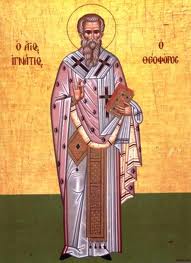
Today our Church honors St. Ignatius the Theologian on the occasion of the collection of his remains. He is the second bishop of Antioch and a disciple of John the Theologian. Also today we honor the memory of the martyrs Philotheos, Hyperechius, Abibus, Julian, Romanus, James and Parigorius, who died at Samosata.
Ignatius accepted martyrdom in Rome at the beginning of the 2nd century AD. His holy remains, that is, what remained of the teeth of the beasts into which he was cast, were collected by pious Christians and carried to Antioch as a blessing to the faithful who had been deprived of their shepherd. This feast is ancient, as evidenced by the dedication of St. John Chrysostom associated with it.
St. Ignatius proved presumptuous in overcoming theory in practice. He has been characterized as "the extremism of the theologians". "Come, O wise one, who came from the world, but to God you turn to heaven, crowned with grace."
The honor with which the Orthodox Church surrounds holy relics is not devoid of its doctrine of resurrection and eternal life, since the VII Ecumenical Council, based on the words of St. John Damascene, declared that the same honor should be given to the Holy Scriptures. refer to the Holy Cross, holy relics and holy icons. The reason is obvious and has to do with the truth that Christ took matter, sanctified it, and made it incorruptible. Holy relics, images and even The clothes, shoes or other objects of the Saints are not carriers of magical energy, but are partakers of the grace with which God bestows on those who love Him and are satisfied with their works.
Attention, prudence and discernment are needed on our part to properly evaluate and handle these sacred relics, in accordance with the teaching of the Church and the instructions of our Hierarchs. And to avoid any instrumentalization of these sacred objects.
Let us beseech him the God-bearing martyr Ignatius, bishop of the then glorious city of Antioch in Syria: "and now thy divine relics, after the return of Phaedra, thou hast spread their rays on the earth since evening; by means of ambassadors from decay and danger they redeem, by faith, thy venerable memory."
Always with the grace of the Risen Jesus Christ.
Ignatius accepted martyrdom in Rome at the beginning of the 2nd century AD. His holy remains, that is, what remained of the teeth of the beasts into which he was cast, were collected by pious Christians and carried to Antioch as a blessing to the faithful who had been deprived of their shepherd. This feast is ancient, as evidenced by the dedication of St. John Chrysostom associated with it.
St. Ignatius proved presumptuous in overcoming theory in practice. He has been characterized as "the extremism of the theologians". "Come, O wise one, who came from the world, but to God you turn to heaven, crowned with grace."
The honor with which the Orthodox Church surrounds holy relics is not devoid of its doctrine of resurrection and eternal life, since the VII Ecumenical Council, based on the words of St. John Damascene, declared that the same honor should be given to the Holy Scriptures. refer to the Holy Cross, holy relics and holy icons. The reason is obvious and has to do with the truth that Christ took matter, sanctified it, and made it incorruptible. Holy relics, images and even The clothes, shoes or other objects of the Saints are not carriers of magical energy, but are partakers of the grace with which God bestows on those who love Him and are satisfied with their works.
Attention, prudence and discernment are needed on our part to properly evaluate and handle these sacred relics, in accordance with the teaching of the Church and the instructions of our Hierarchs. And to avoid any instrumentalization of these sacred objects.
Let us beseech him the God-bearing martyr Ignatius, bishop of the then glorious city of Antioch in Syria: "and now thy divine relics, after the return of Phaedra, thou hast spread their rays on the earth since evening; by means of ambassadors from decay and danger they redeem, by faith, thy venerable memory."
Always with the grace of the Risen Jesus Christ.
Share: