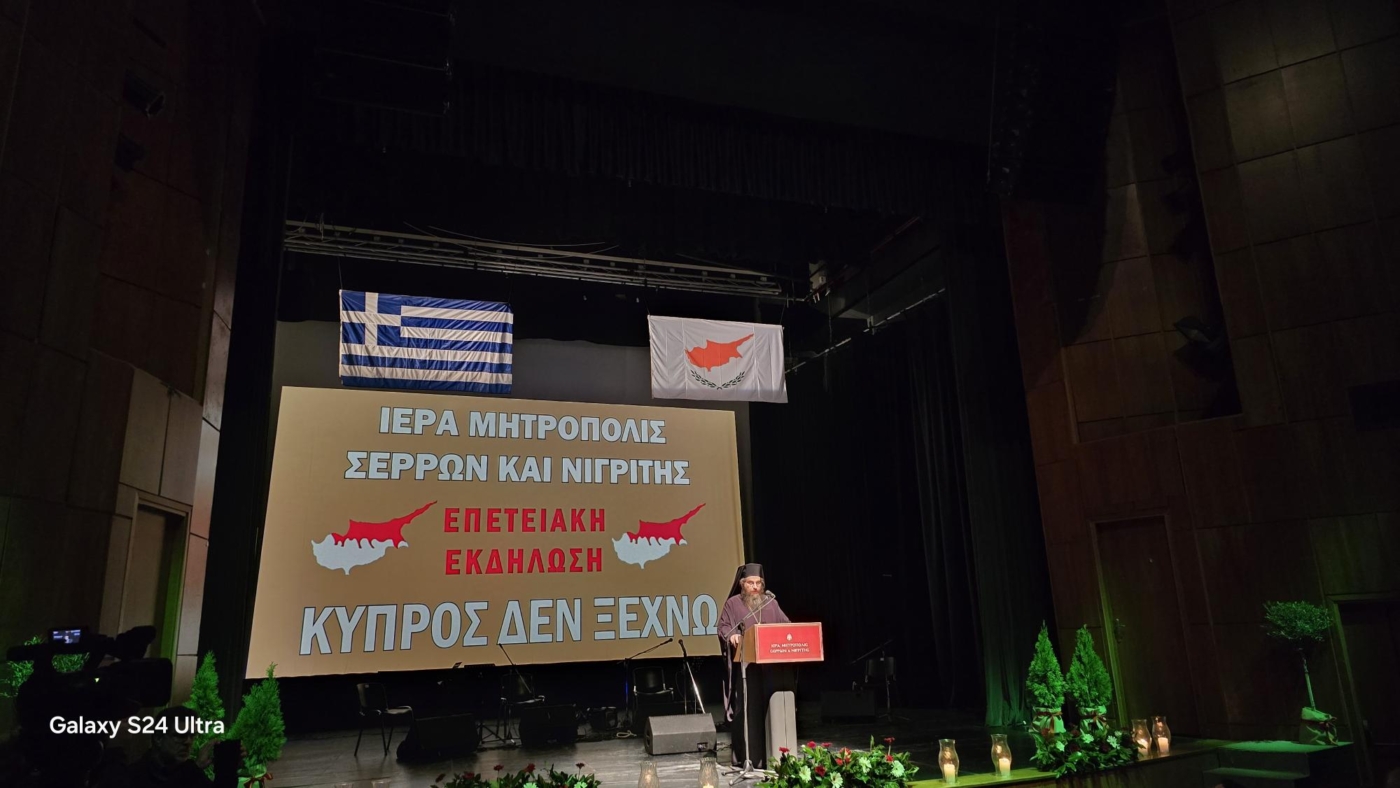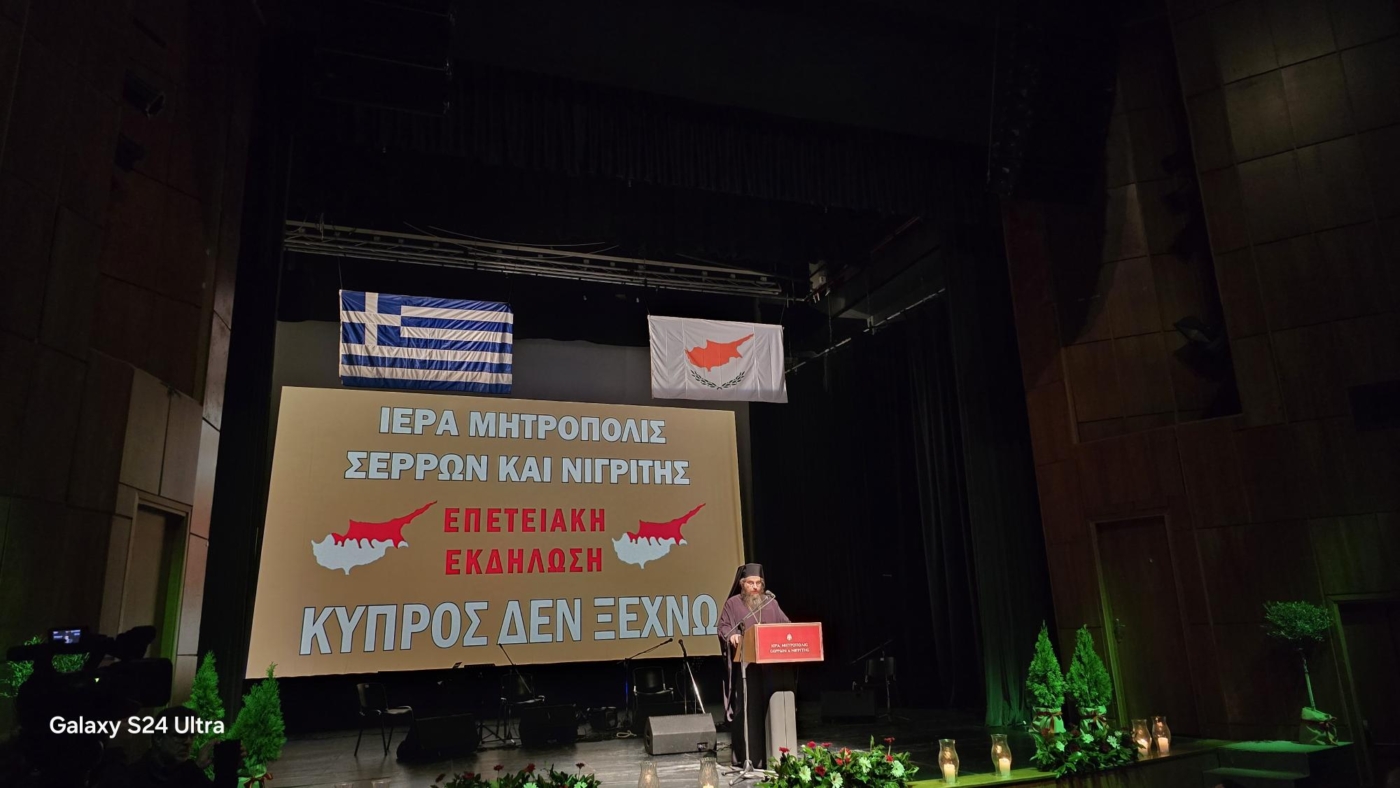
I feel a special excitement that overwhelms me being in front of you, the Greek brothers of Macedonia, at this magnificent gathering called "I do not forget". I thank you all for giving me the opportunity to speak about Cyprus and the dangers that surround it.
Before elaborating on these dangers that surround us, I would like to try with you to briefly delve into our Greek past, into the more than 35 centuries of the Greek past of Cyprus and its historical connection with all other parts of Hellenism. In this way, the responsibility of all of us for its salvation will be emphasized.
From the 15th century BC, the Mycenaeans settled permanently in Cyprus, which was rapidly Hellenized. Since then, the destinies of Cyprus have been linked to those of the entire Greek people, and together they have gone through sorrows and joys throughout these centuries. Since then Cyprus has remained Greek, never losing its Greek character.
Tradition wishes that the heroes of the Trojan War founded city-kingdoms in Cyprus: Teucre founded Salamis, Agapinor founded Paphos, Cepheus founded Kyrenia, Golgos founded Golgos, etc.
Later, Athenian Kimon campaigns and liberates Cyprus from the Persians (461 B.C.).
Later, the Cypriot kings place their fleet at the disposal of M. Alexander and contribute to the decisive contribution to the conquest of Tyre.
After the death of M. Alexander, Cyprus came under the rule of the Ptolemies, and later, like the rest of Greece, came under the rule of the Romans. Here are the happy, free years when Cyprus was part of our Byzantine Empire. The Franks followed from 1192, and the Turks from 1571. As we know, the same fate befell other Greek parts.
During the Roman Empire period, namely in 45 AD, Cyprus was visited by the Apostles Paul, Barnabas and Mark, and it quickly became Christianized. Its Church was recognized as autocephalous by the 3rd Ecumenical Council in 431, and later, around the end of the 5th century, its archbishop was granted royal privileges by the Emperor, effectively becoming his representative on this end of the Byzantine Empire. To this day, the Archbishop of Cyprus wears a purple robe, a royal scepter instead of a crutch, and signs in cinnabar, i.e., red ink, like the emperor.
In the great effort of the 1821 revolt for freedom, Cyprus could not be left behind. However, its position in the center of the Sultanate prevented it from raising an armed rebellion. The revolt would be immediately crushed bloodily by forces landing from M. Asia, Egypt, Syria. That is why Cyprus aided the struggle with money, food and arms. The daily virtual funerals at St. John's Cathedral in Nicosia remained became a proverb. Inside the coffins, weapons were transported, which traveled through an underground tunnel to the Pankyprus High School across the road, and from there to the northern coast, where they reached the ships ferrying them to revolutionary Greece. Canaris himself is reported to have twice approached the now occupied Lapithos for this purpose.
Cyprus paid a high price for its participation in the struggle for revival. On July 9, 1821, Archbishop Kyprianos was hanged and three metropolitans were beheaded. In six days, from July 9 to July 14, the Turks killed 486 clergy and laymen and prominent figures.
When the borders of the new free state were being formed, the Cypriots officially appealed to Kapodistrias and unsuccessfully asked for Cyprus to be included in it. However, this was not our only misfortune. We had, unfortunately, the greatest misfortune of changing dynasties. In 1878 Cyprus was ceded by Turkey to England. I am sure that if this change had not taken place, in the victorious wars of 1912-1913, the Greek navy in that magnificent expedition would have liberated Cyprus as well, as it did for many other Turkish-occupied islands.
It is a fact that we underestimated our new conquerors. We thought that very soon the British would cede Cyprus to Greece, as they had done earlier, in 1864, with the Ionian Islands. But we had denied. And in their person we found the harshest slavery, more grievous even than Turkish slavery. And our present evil spirit has arisen from the English and their policy of dissension.
I will not mention our epic liberation struggle of 1955-1959 due to lack of time. I will only say that during the 4 glorious years of that epic struggle, from 1955 to 1959, all the previous achievements of the race came alive in the faces of new heroes. Oxenthiou with the "molon lave" he offered to the British, alone, and not with 300 others, defeated Leonidas. Matsis with his inimitable answer to the dynast "we fight for money, but for virtue" reminded Constantine Paleologos. Ambar Liopetriou replaced Hani of Gravius.
Despite the heroism and sacrifices of our people, England has unfortunately imposed a diminished independence on us after previously involving Turkey and elevating the 18%- minority Turkish Cypriots into a community by granting them disproportionate rights over their population.
The Republic of Cyprus thus established functioned with many difficulties for three years when the Turkish Cypriot uprising occurred. However, in the turmoil that followed, the government of President Archbishop Makarios managed to be recognized by the United Nations as the legitimate government of Cyprus, even though the Turkish Cypriots withdrew out of it, which is still happening today.
On July 20, 1974, Turkey brutally invaded Cyprus in the wake of the coup carried out five days earlier by the Athens Junta and EOKA II of Cyprus against the legitimate government of Cyprus. 37% of Cyprus' territory was occupied, 40% of the population expelled from their homes, 560 churches desecrated and destroyed, 6,000 Greek Cypriots killed, 2,000 missing and many crimes committed. This was followed by the systematic expulsion of all Greeks remaining in the occupied territories (less than 300 Greek Cypriots live there today) and the resettlement of hundreds of thousands of settlers in our towns and villages.
The crime of the Junta and EOKA II is beyond doubt serious. They opened the back doors to Attila. They have handed over half of Cyprus to Turkey. However, tonight I would like to analyze what Turkey's permanent objectives were and are, so that we have no illusions about our future path and supposed solution.
In 1920, when the Greek army was still in M. Asia, in this titanic attempt to liberate the Greek population, and although the prospects of the time pointed to a successful outcome of this effort, Mustafa Kemal gathered the Turks who opposed the Sultan and held the so-called Great National Assembly of Ankara. One of the first decisions of this of the National Assembly was: the return of Cyprus. Take it again, i.e. Cyprus. We said that in 1878 the Turks were forced to cede Cyprus to England. Since 1920 they have been striving to get it back. Since then, the goal has remained the same no matter how many governments have changed: democratic, dictatorial, nationalist, socialist.
The other goals set then were to rebuild part of Syria, part of Iraq and other territories. And they are being carried out without exception by Turkey.
In 1956, while our liberation struggle was going on, which was conducted with the sole purpose of uniting Cyprus with Greece, the motherland, the Turks, who were involved by the British as an interested party in the Cyprus issue, appointed a new then statesman, Nihat Erim, the preparation of a plan, a road map, for the "restoration of Cyprus". Nihat Erim, who later became Prime Minister of Turkey, presented the plan bearing his name to then Prime Minister Menderes and then Foreign Minister Zorl, and it was accepted as Turkey's plan for Cyprus. The plan has since been implemented without rejection by all Turkish governments.
The plan envisages the reconstruction of Cyprus in six phases with the realization of six separate goals. Unfortunately for Turkey, five phases have already been successfully completed. The last goal remains, the realization of which we must prevent at all costs.
The first objective was to prevent Cyprus from ceding to Greece. As we have said, the struggle for the unification of Cyprus with Greece continued. Their aim was accomplished, for despite the success of our struggle, a reduced independence was imposed on us by the machinations of England.
The second aim was for Turkey to acquire legal rights over Cyprus. Turkey had no such rights as it had renounced them in the Treaty of Lausanne. This objective of theirs was also realized through the Zurich-London terms imposed on us. Turkey was given the right to be the guarantor of the new state and to have in Cyprus the military unit TURDYK (Turkish Forces of Cyprus).
The third objective was to gather the Turkish Cypriots scattered throughout Cyprus into enclaves so that they would form cohesive, homogeneous masses, not subject to any government and governing themselves. To a large extent they succeeded in doing so during the Turkish uprising of 1963. Armed groups of Turkish Cypriots forced their compatriots to leave the mixed villages where they lived peacefully with Greek Cypriots and settle in isolated areas in Nicosia, Larnaca, Famagusta, Limassol. Paphos, but also in some rural areas. In this way, they would acquire a state structure and would not be to show obedience to the legitimate state.
The fourth objective was to eliminate, as mentioned, their numerical disadvantage. There were 18% and we were 82%. Nihat Erim indicated that the population should be moved out of Turkey so that they would not fear the outcome of any referendum. And they achieved that goal. After the Turkish invasion, they moved and are still moving hundreds of thousands of settlers to the occupied parts of our homeland. Colonization, of course, is illegal and constitutes a war crime. However, the Turks are working with a long-term perspective, hoping to change the situation.
Today they do not officially disclose the number of settlers. When there are some differences between them, then they talk about the real numbers. About 3 months ago, when the two "sides" in the occupied territories came into conflict, it was revealed that the number of settlers is now up to a million. So they are larger than us.
Legally and illegally, you know, it belongs to other states. If other states at some point decide that their interests are better served by Turkey, they will recognize the settlers as legal residents of Cyprus because Turkey will demand it. And then rest assured that Turkey will ask for a united state and a referendum. And since most of them will be Turks, they will be to ask for an alliance with Turkey.
Turkey did so again at Alexandretta.Alexandretta was a province of Syria. In 1908, France, which had Syria as its colony, together with England, seeing the approach of the First World War and wishing to bring Turkey to its side, gave it a controlling role in the province of Alexandretta. At the time, this province was home to 8,000 Turks and 2.5 million Arabs (Syrians). In 31 years, in 1939, Turkey changed the demographic character of the region. It expelled the Arabs, removed the Turks, asked for and won permission from the then League of Nations to hold a referendum. And since the majority were Turks, the solution was: union with Turkey. Since then, Alexandretta has been a province of Turkey.
We must avoid at all costs the Alexandrization of Cyprus by universally and constantly condemning the colonization of Cyprus.
The fifth objective was to gain military control of the region. With 45,000 occupation troops, 400 tanks in Cyprus, ships hammering in our EEZ and airplanes violating daily the airspace of not only Cyprus but Greece as well, no one doubts that they have achieved this goal too.
Their sixth goal, which is full political control of Cyprus, remains unfulfilled. Turkey has not been able to realize this because we are a state, recognized by the United Nations and the European Union, a member of these international organizations. We are governed by the Republic of Cyprus.
That is why Turkey, whenever it wants to continue negotiations, aims and demands the abolition of the Republic of Cyprus and the creation of a new state from scratch, consisting of an integrated Greek Cypriot state and an integrated Turkish Cypriot state. There is no doubt that if he succeeds in doing so, Turkey will immediately create problems. We will not be able then to convene the Security Council or the UN General Assembly or address Europe, as we do now, without the consent of the Turks, because we will not be a state but a community. Then we will become a pawn in the hands of Turkey, and Turkization will not be long in coming.
Therefore, Turkey's timeless and permanent goal is the occupation and Turkification of the whole of Cyprus. He did not come for half of Cyprus and he did not come to protect the rights of Turkish Cypriots. I think you all know that former Turkish Prime Minister Davutoglu clearly states that even if a Turk did not exist in Cyprus, Turkey's interest in the island would be a given.
By the above I do not diminish the responsibility of our side, which committed an anti-people and treacherous coup. If we had been of the same opinion and had not constantly undermined our own state, with his skill and prestige, Archbishop Macarius would repel the plans of the Turks.
Cyprus is undoubtedly now at the most critical stage of its national life. Cypriot Hellenism is now on the verge of being wiped out from the place where it has lived for 35 centuries.
It is our duty to resist the realization of Turkish aims and thwart them.
I believe this is the right opportunity, given the impasse in the negotiations, to take a sober assessment of our course. Let us look at our mistakes and find a way out of the deadlocks.
The negotiations, as they continue, lead to nothing. They lead, rather, to the Turkification of the place. The occupying power's plan was to derail our issue, to disorient themselves and the foreigners. Every retreat leads to new claims by the Turks, since, as we said, their constant aim is to occupy and Turkify the whole of Cyprus.
We should all, as human beings, begin to reposition our problem in its correct dimension, as a problem of invasion and occupation, despite the difficulties that our solution will entail, due to the long period of time that has elapsed since the invasion. Those who doubt the efficacy of such efforts should carefully consider both historical and current reality: today's struggles, as always, do not depend on numbers or even on military superiority. As Thucydides rightly points out, since ancient times wars have usually not developed as their initiators predicted. Unforeseen and unstable factors emphasize the weaknesses of large countries and the capabilities of small ones. Moreover, the modern world is becoming more and more aware of human rights every day. And it is impossible for the world community, and especially Europe, to continue to pretend to protect animal welfare and preserve the environment, and to turn a blind eye to the denigration of human life and the collapse of human dignity.
We must therefore redefine our problem as one of invasion and occupation, demanding liberation rather than mere reunification. Can our European partners resist such a fully documented demand?
What is the most reasonable and disarming thing, even for those hostile to us, to demand for our people what all other Europeans and all free people in general enjoy?
If every European has the right to free movement everywhere, all over Europe, why should we not have this right in our own country?
If every European is free to live wherever he wants throughout Europe, why can't we have that right in our own country? return to their villages and towns?
If all Europeans have the right to purchase real estate in all European countries, why don't we get our property back?
And if the principle of "one man one vote" applies everywhere, why should 18% be imposed 82% and through various "vetoes" paralyze the State?"
We must consistently make our above demands while demanding the withdrawal of all occupation troops and all settlers. Can our European partners say that all this concerns only them and not us? However, since we agree to negotiate discounts on our rights, we give them the perfect alibi for not being interested in a proper, democratic and just solution to our problem. "Find them," we are told, "and we will accept whatever you agree to."
Every time the "threats of death and the dangers of hell" surrounded Hellenism, it was saved by two factors: a) the Remnant, however small, which remained steadfast in the values and traditions of the nation and became the dough to leaven "all the fire" and b) God, who always came to help us in our own endeavors.
Both of these factors still exist today. Let us use them to save our country and our children. Let us, all Greeks, let us join our forces and efforts to save Cyprus. If, if, if not born, Cyprus falls, the deconstruction of the whole of Greece will begin. The Aegean, Thrace, Macedonia will follow.... In our own endeavors, God will surely come to our aid. God helps those who help themselves first.
Thank you again.
Before elaborating on these dangers that surround us, I would like to try with you to briefly delve into our Greek past, into the more than 35 centuries of the Greek past of Cyprus and its historical connection with all other parts of Hellenism. In this way, the responsibility of all of us for its salvation will be emphasized.
From the 15th century BC, the Mycenaeans settled permanently in Cyprus, which was rapidly Hellenized. Since then, the destinies of Cyprus have been linked to those of the entire Greek people, and together they have gone through sorrows and joys throughout these centuries. Since then Cyprus has remained Greek, never losing its Greek character.
Tradition wishes that the heroes of the Trojan War founded city-kingdoms in Cyprus: Teucre founded Salamis, Agapinor founded Paphos, Cepheus founded Kyrenia, Golgos founded Golgos, etc.
Later, Athenian Kimon campaigns and liberates Cyprus from the Persians (461 B.C.).
Later, the Cypriot kings place their fleet at the disposal of M. Alexander and contribute to the decisive contribution to the conquest of Tyre.
After the death of M. Alexander, Cyprus came under the rule of the Ptolemies, and later, like the rest of Greece, came under the rule of the Romans. Here are the happy, free years when Cyprus was part of our Byzantine Empire. The Franks followed from 1192, and the Turks from 1571. As we know, the same fate befell other Greek parts.
During the Roman Empire period, namely in 45 AD, Cyprus was visited by the Apostles Paul, Barnabas and Mark, and it quickly became Christianized. Its Church was recognized as autocephalous by the 3rd Ecumenical Council in 431, and later, around the end of the 5th century, its archbishop was granted royal privileges by the Emperor, effectively becoming his representative on this end of the Byzantine Empire. To this day, the Archbishop of Cyprus wears a purple robe, a royal scepter instead of a crutch, and signs in cinnabar, i.e., red ink, like the emperor.
In the great effort of the 1821 revolt for freedom, Cyprus could not be left behind. However, its position in the center of the Sultanate prevented it from raising an armed rebellion. The revolt would be immediately crushed bloodily by forces landing from M. Asia, Egypt, Syria. That is why Cyprus aided the struggle with money, food and arms. The daily virtual funerals at St. John's Cathedral in Nicosia remained became a proverb. Inside the coffins, weapons were transported, which traveled through an underground tunnel to the Pankyprus High School across the road, and from there to the northern coast, where they reached the ships ferrying them to revolutionary Greece. Canaris himself is reported to have twice approached the now occupied Lapithos for this purpose.
Cyprus paid a high price for its participation in the struggle for revival. On July 9, 1821, Archbishop Kyprianos was hanged and three metropolitans were beheaded. In six days, from July 9 to July 14, the Turks killed 486 clergy and laymen and prominent figures.
When the borders of the new free state were being formed, the Cypriots officially appealed to Kapodistrias and unsuccessfully asked for Cyprus to be included in it. However, this was not our only misfortune. We had, unfortunately, the greatest misfortune of changing dynasties. In 1878 Cyprus was ceded by Turkey to England. I am sure that if this change had not taken place, in the victorious wars of 1912-1913, the Greek navy in that magnificent expedition would have liberated Cyprus as well, as it did for many other Turkish-occupied islands.
It is a fact that we underestimated our new conquerors. We thought that very soon the British would cede Cyprus to Greece, as they had done earlier, in 1864, with the Ionian Islands. But we had denied. And in their person we found the harshest slavery, more grievous even than Turkish slavery. And our present evil spirit has arisen from the English and their policy of dissension.
I will not mention our epic liberation struggle of 1955-1959 due to lack of time. I will only say that during the 4 glorious years of that epic struggle, from 1955 to 1959, all the previous achievements of the race came alive in the faces of new heroes. Oxenthiou with the "molon lave" he offered to the British, alone, and not with 300 others, defeated Leonidas. Matsis with his inimitable answer to the dynast "we fight for money, but for virtue" reminded Constantine Paleologos. Ambar Liopetriou replaced Hani of Gravius.
Despite the heroism and sacrifices of our people, England has unfortunately imposed a diminished independence on us after previously involving Turkey and elevating the 18%- minority Turkish Cypriots into a community by granting them disproportionate rights over their population.
The Republic of Cyprus thus established functioned with many difficulties for three years when the Turkish Cypriot uprising occurred. However, in the turmoil that followed, the government of President Archbishop Makarios managed to be recognized by the United Nations as the legitimate government of Cyprus, even though the Turkish Cypriots withdrew out of it, which is still happening today.
On July 20, 1974, Turkey brutally invaded Cyprus in the wake of the coup carried out five days earlier by the Athens Junta and EOKA II of Cyprus against the legitimate government of Cyprus. 37% of Cyprus' territory was occupied, 40% of the population expelled from their homes, 560 churches desecrated and destroyed, 6,000 Greek Cypriots killed, 2,000 missing and many crimes committed. This was followed by the systematic expulsion of all Greeks remaining in the occupied territories (less than 300 Greek Cypriots live there today) and the resettlement of hundreds of thousands of settlers in our towns and villages.
The crime of the Junta and EOKA II is beyond doubt serious. They opened the back doors to Attila. They have handed over half of Cyprus to Turkey. However, tonight I would like to analyze what Turkey's permanent objectives were and are, so that we have no illusions about our future path and supposed solution.
In 1920, when the Greek army was still in M. Asia, in this titanic attempt to liberate the Greek population, and although the prospects of the time pointed to a successful outcome of this effort, Mustafa Kemal gathered the Turks who opposed the Sultan and held the so-called Great National Assembly of Ankara. One of the first decisions of this of the National Assembly was: the return of Cyprus. Take it again, i.e. Cyprus. We said that in 1878 the Turks were forced to cede Cyprus to England. Since 1920 they have been striving to get it back. Since then, the goal has remained the same no matter how many governments have changed: democratic, dictatorial, nationalist, socialist.
The other goals set then were to rebuild part of Syria, part of Iraq and other territories. And they are being carried out without exception by Turkey.
In 1956, while our liberation struggle was going on, which was conducted with the sole purpose of uniting Cyprus with Greece, the motherland, the Turks, who were involved by the British as an interested party in the Cyprus issue, appointed a new then statesman, Nihat Erim, the preparation of a plan, a road map, for the "restoration of Cyprus". Nihat Erim, who later became Prime Minister of Turkey, presented the plan bearing his name to then Prime Minister Menderes and then Foreign Minister Zorl, and it was accepted as Turkey's plan for Cyprus. The plan has since been implemented without rejection by all Turkish governments.
The plan envisages the reconstruction of Cyprus in six phases with the realization of six separate goals. Unfortunately for Turkey, five phases have already been successfully completed. The last goal remains, the realization of which we must prevent at all costs.
The first objective was to prevent Cyprus from ceding to Greece. As we have said, the struggle for the unification of Cyprus with Greece continued. Their aim was accomplished, for despite the success of our struggle, a reduced independence was imposed on us by the machinations of England.
The second aim was for Turkey to acquire legal rights over Cyprus. Turkey had no such rights as it had renounced them in the Treaty of Lausanne. This objective of theirs was also realized through the Zurich-London terms imposed on us. Turkey was given the right to be the guarantor of the new state and to have in Cyprus the military unit TURDYK (Turkish Forces of Cyprus).
The third objective was to gather the Turkish Cypriots scattered throughout Cyprus into enclaves so that they would form cohesive, homogeneous masses, not subject to any government and governing themselves. To a large extent they succeeded in doing so during the Turkish uprising of 1963. Armed groups of Turkish Cypriots forced their compatriots to leave the mixed villages where they lived peacefully with Greek Cypriots and settle in isolated areas in Nicosia, Larnaca, Famagusta, Limassol. Paphos, but also in some rural areas. In this way, they would acquire a state structure and would not be to show obedience to the legitimate state.
The fourth objective was to eliminate, as mentioned, their numerical disadvantage. There were 18% and we were 82%. Nihat Erim indicated that the population should be moved out of Turkey so that they would not fear the outcome of any referendum. And they achieved that goal. After the Turkish invasion, they moved and are still moving hundreds of thousands of settlers to the occupied parts of our homeland. Colonization, of course, is illegal and constitutes a war crime. However, the Turks are working with a long-term perspective, hoping to change the situation.
Today they do not officially disclose the number of settlers. When there are some differences between them, then they talk about the real numbers. About 3 months ago, when the two "sides" in the occupied territories came into conflict, it was revealed that the number of settlers is now up to a million. So they are larger than us.
Legally and illegally, you know, it belongs to other states. If other states at some point decide that their interests are better served by Turkey, they will recognize the settlers as legal residents of Cyprus because Turkey will demand it. And then rest assured that Turkey will ask for a united state and a referendum. And since most of them will be Turks, they will be to ask for an alliance with Turkey.
Turkey did so again at Alexandretta.Alexandretta was a province of Syria. In 1908, France, which had Syria as its colony, together with England, seeing the approach of the First World War and wishing to bring Turkey to its side, gave it a controlling role in the province of Alexandretta. At the time, this province was home to 8,000 Turks and 2.5 million Arabs (Syrians). In 31 years, in 1939, Turkey changed the demographic character of the region. It expelled the Arabs, removed the Turks, asked for and won permission from the then League of Nations to hold a referendum. And since the majority were Turks, the solution was: union with Turkey. Since then, Alexandretta has been a province of Turkey.
We must avoid at all costs the Alexandrization of Cyprus by universally and constantly condemning the colonization of Cyprus.
The fifth objective was to gain military control of the region. With 45,000 occupation troops, 400 tanks in Cyprus, ships hammering in our EEZ and airplanes violating daily the airspace of not only Cyprus but Greece as well, no one doubts that they have achieved this goal too.
Their sixth goal, which is full political control of Cyprus, remains unfulfilled. Turkey has not been able to realize this because we are a state, recognized by the United Nations and the European Union, a member of these international organizations. We are governed by the Republic of Cyprus.
That is why Turkey, whenever it wants to continue negotiations, aims and demands the abolition of the Republic of Cyprus and the creation of a new state from scratch, consisting of an integrated Greek Cypriot state and an integrated Turkish Cypriot state. There is no doubt that if he succeeds in doing so, Turkey will immediately create problems. We will not be able then to convene the Security Council or the UN General Assembly or address Europe, as we do now, without the consent of the Turks, because we will not be a state but a community. Then we will become a pawn in the hands of Turkey, and Turkization will not be long in coming.
Therefore, Turkey's timeless and permanent goal is the occupation and Turkification of the whole of Cyprus. He did not come for half of Cyprus and he did not come to protect the rights of Turkish Cypriots. I think you all know that former Turkish Prime Minister Davutoglu clearly states that even if a Turk did not exist in Cyprus, Turkey's interest in the island would be a given.
By the above I do not diminish the responsibility of our side, which committed an anti-people and treacherous coup. If we had been of the same opinion and had not constantly undermined our own state, with his skill and prestige, Archbishop Macarius would repel the plans of the Turks.
Cyprus is undoubtedly now at the most critical stage of its national life. Cypriot Hellenism is now on the verge of being wiped out from the place where it has lived for 35 centuries.
It is our duty to resist the realization of Turkish aims and thwart them.
I believe this is the right opportunity, given the impasse in the negotiations, to take a sober assessment of our course. Let us look at our mistakes and find a way out of the deadlocks.
The negotiations, as they continue, lead to nothing. They lead, rather, to the Turkification of the place. The occupying power's plan was to derail our issue, to disorient themselves and the foreigners. Every retreat leads to new claims by the Turks, since, as we said, their constant aim is to occupy and Turkify the whole of Cyprus.
We should all, as human beings, begin to reposition our problem in its correct dimension, as a problem of invasion and occupation, despite the difficulties that our solution will entail, due to the long period of time that has elapsed since the invasion. Those who doubt the efficacy of such efforts should carefully consider both historical and current reality: today's struggles, as always, do not depend on numbers or even on military superiority. As Thucydides rightly points out, since ancient times wars have usually not developed as their initiators predicted. Unforeseen and unstable factors emphasize the weaknesses of large countries and the capabilities of small ones. Moreover, the modern world is becoming more and more aware of human rights every day. And it is impossible for the world community, and especially Europe, to continue to pretend to protect animal welfare and preserve the environment, and to turn a blind eye to the denigration of human life and the collapse of human dignity.
We must therefore redefine our problem as one of invasion and occupation, demanding liberation rather than mere reunification. Can our European partners resist such a fully documented demand?
What is the most reasonable and disarming thing, even for those hostile to us, to demand for our people what all other Europeans and all free people in general enjoy?
If every European has the right to free movement everywhere, all over Europe, why should we not have this right in our own country?
If every European is free to live wherever he wants throughout Europe, why can't we have that right in our own country? return to their villages and towns?
If all Europeans have the right to purchase real estate in all European countries, why don't we get our property back?
And if the principle of "one man one vote" applies everywhere, why should 18% be imposed 82% and through various "vetoes" paralyze the State?"
We must consistently make our above demands while demanding the withdrawal of all occupation troops and all settlers. Can our European partners say that all this concerns only them and not us? However, since we agree to negotiate discounts on our rights, we give them the perfect alibi for not being interested in a proper, democratic and just solution to our problem. "Find them," we are told, "and we will accept whatever you agree to."
Every time the "threats of death and the dangers of hell" surrounded Hellenism, it was saved by two factors: a) the Remnant, however small, which remained steadfast in the values and traditions of the nation and became the dough to leaven "all the fire" and b) God, who always came to help us in our own endeavors.
Both of these factors still exist today. Let us use them to save our country and our children. Let us, all Greeks, let us join our forces and efforts to save Cyprus. If, if, if not born, Cyprus falls, the deconstruction of the whole of Greece will begin. The Aegean, Thrace, Macedonia will follow.... In our own endeavors, God will surely come to our aid. God helps those who help themselves first.
Thank you again.
Share: