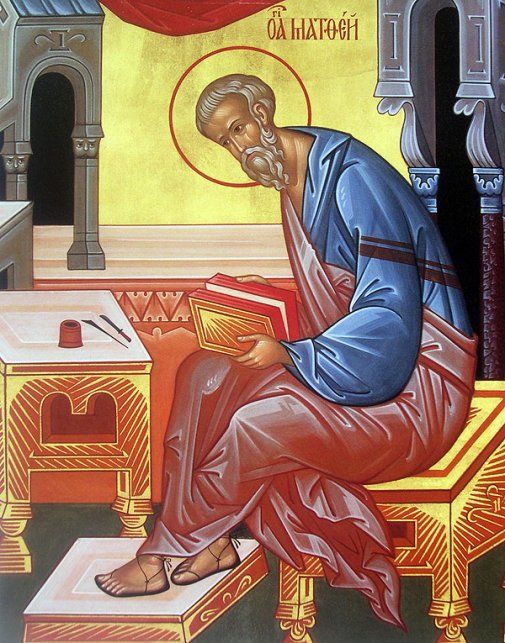
Today our Church honors the memory of the Holy Apostle and Evangelist Matthew, who was the son of Alphaeus, came from Galilee, and before becoming a disciple of Christ was called Levis. As he himself mentions, quoting the list of the twelve apostles, he practiced the disgraceful profession of a tax collector, that is, he was a tax collector, from which he made a great fortune.
The Evangelist Matthew wanted to emphasize the virtue of humility in his life and so he personally refers to the profession he practiced.
However, as soon as he heard Jesus say to him, "Follow me," he left everything, repented, and became a preacher of the gospel. This radically changed the course of his life. The hymn writer points out to the evangelist Matthew, "You threw off the yoke of the tax collector, you accepted the yoke of justice."
He preached the gospel first among tax collectors and his relatives and then among the Gentiles, many of whom he succeeded in leading to the true faith. He also preached the Gospel in Ethiopia, where he was martyred.
The Evangelist Matthew is the author of the first book in order of the entire 27 books of the New Testament, that is, the Gospel of Matthew.
In the kondak of the feast the singer says: "Thou hast cast off the yoke of the tax collector, thou hast taken the yoke of justice, and hast shown thyself an excellent merchant, possessing riches, wisdom from above; whence thou proclaimest the word of the of truth, and with scepters shall your soul be exalted, you have signed, in time of crisis." (Kondak. verse 4. He was lifted up on the Cross).
By the grace of the Holy Spirit in the Church, all things are possible for the salvation of man. Individuals and situations are also transformed as long as a person is distinguished by a spirit of repentance and humility. Another such living example from the first moment of the Church in its historical development as a way of life and salvation is the person of the Evangelist Matthew.
The Evangelist Matthew wanted to emphasize the virtue of humility in his life and so he personally refers to the profession he practiced.
However, as soon as he heard Jesus say to him, "Follow me," he left everything, repented, and became a preacher of the gospel. This radically changed the course of his life. The hymn writer points out to the evangelist Matthew, "You threw off the yoke of the tax collector, you accepted the yoke of justice."
He preached the gospel first among tax collectors and his relatives and then among the Gentiles, many of whom he succeeded in leading to the true faith. He also preached the Gospel in Ethiopia, where he was martyred.
The Evangelist Matthew is the author of the first book in order of the entire 27 books of the New Testament, that is, the Gospel of Matthew.
In the kondak of the feast the singer says: "Thou hast cast off the yoke of the tax collector, thou hast taken the yoke of justice, and hast shown thyself an excellent merchant, possessing riches, wisdom from above; whence thou proclaimest the word of the of truth, and with scepters shall your soul be exalted, you have signed, in time of crisis." (Kondak. verse 4. He was lifted up on the Cross).
By the grace of the Holy Spirit in the Church, all things are possible for the salvation of man. Individuals and situations are also transformed as long as a person is distinguished by a spirit of repentance and humility. Another such living example from the first moment of the Church in its historical development as a way of life and salvation is the person of the Evangelist Matthew.
Share: