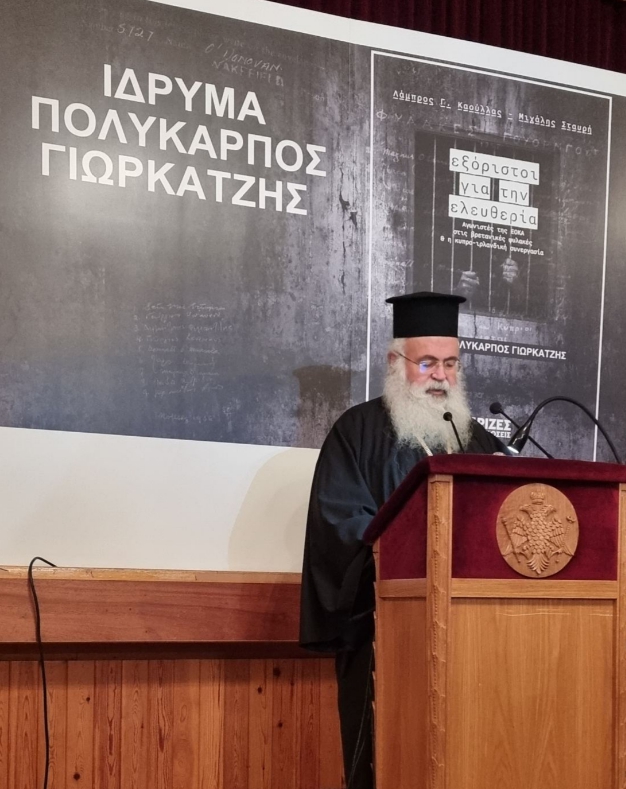
I am particularly pleased to welcome the launch of the book by Lambros G. Koullas and Michalis Stavris entitled "Exiles for Freedom: EOKA fighters in British prisons and Cyprus-Ireland cooperation".
The present study seeks to highlight a less publicized aspect of the period of the EOKA national liberation struggle 1955-1959. In particular, it describes the transportation and detention of 31 Greek Cypriot EOKA fighters in British prisons between August 1956 and November 1958. The British authorities carried out this action with the main purpose of expelling from Cyprus prominent members of EOKA, people who could organize and lead the armed struggle against British colonialism and were able to escape from prisons and detention centers in Cyprus.
Through the pages of the book, the reader is able to learn about what happened during the militants' incarceration in British prisons, the harsh conditions of the exiled fighters, their daily life in prison, the suffering and hostile attitudes of the prison guards and other sentences they had to face. Among the imprisoned activists were also people I know personally, such as Petros Stylianou, Renos Kyriakidis and Mr. Tasos Sofokleous. I have heard on numerous occasions in our private meetings about the pathetic the conditions and desperate situation they were in far from the blue sky of their homeland, in a "foreign land", as they themselves called it. Nevertheless, they did not bend or give up their values and ideals. Tough fighters, strong, straightforward and undaunted, with a positive attitude, they continued their struggle even in prison.
Also notable is the reference to the relationship formed between Cypriot fighters and Irish fighters when they were cellmates in British prisons. The long struggle of the Irish against the British Empire, which the Greeks of Cyprus also fought with arms, and the parallels between the history of the two nations served to develop a relationship of camaraderie and fraternal friendship between the fighters. EOKA and IRA. This led to the Irish taking it upon themselves to inform the British public about events in Cyprus and the nature of the Cyprus problem.
As the authors of this work enlighten us, prominent Irish politicians, bodies and organizations showed instinctive sympathy for the EOKA struggle and did not hesitate to express their support for the Greek Cypriot request for national reconstruction. Special mention should be made of Archbishop Makarios' meeting with Sean McBride, a leading member of the IRA, in Athens in April 1957. At the meeting Makarios expressed Thanks to the Irish people for their moral support and understanding in the struggle of the Greeks of Cyprus.
No doubt the messages sent by today's presentation are many. Looking at the title of the book "Exiles for Freedom", one immediately realizes this. It emphasizes, above all, the heroic miracle of the 1955 epic, which was the unique and extremely dynamic breakthrough of Cypriot Hellenism to realize its historical request for unification with Mother Greece. This struggle was the sum of all the desires of Cypriot Hellenism. And in this struggle the virtues of our Greek Race and the willingness of our youth to "die for the friend of the Fatherland and the beloved Eleftheria" shone once again.
In the pages of the Book we realize that
the freedom we enjoy, to the extent that we have it, was not given to us by any outsider. It was won for us by our forefathers, our fathers, our brothers through struggle and sacrifice. And it is our responsibility to reclaim what we have lost and to complete what they left unfinished.
Especially today, when the enemy is unfortunately not at the gates but within the walls of our country and seeks to penetrate our souls, we must accept without further ado the fighting spirit shown by our heroes and realize that our national survival in Cyprus depends on the constant The vigilance of our physical and mental strength, and our energization by the unique struggle of EOKA. From the example of our ancestors we can base our outlook on the future, the continuation of our journey, and the certainty of our survival in the land of our fathers.
Seeing the indifference of many and the propensity of some party leaders to accept any solution to our national problem that would jeopardize our national survival, we wonder what happened to the vitality and energy of the '55. We do not believe that the "bones of the Greeks" lack the great creative forces that from time to time produce masterpieces of Greek history. But it takes people to bring them to the surface every time Hellenism finds itself at a historical crossroads and in need of an awakening. That's exactly what Lambros Koullas and Michalis Stavris do with their book.
In conclusion, I congratulate the authors for their worthy work. I also congratulate the Polykarpos Yiorkatsis Foundation for this publication and its other notable publications that aim to highlight the history of the national liberation struggle of EOKA. Initiatives such as these are to be commended precisely because they set an excellent example for the younger generation as well. It is my wish that their goals, which are the goals of all of us, will soon be achieved for the the awakening of our conscience, the liberation of our homeland, and the completion of the work of the Cypriot fighters who are being talked about tonight.
May the memory of those who have left us be eternal and the survivors enjoy our honor and respect.
The present study seeks to highlight a less publicized aspect of the period of the EOKA national liberation struggle 1955-1959. In particular, it describes the transportation and detention of 31 Greek Cypriot EOKA fighters in British prisons between August 1956 and November 1958. The British authorities carried out this action with the main purpose of expelling from Cyprus prominent members of EOKA, people who could organize and lead the armed struggle against British colonialism and were able to escape from prisons and detention centers in Cyprus.
Through the pages of the book, the reader is able to learn about what happened during the militants' incarceration in British prisons, the harsh conditions of the exiled fighters, their daily life in prison, the suffering and hostile attitudes of the prison guards and other sentences they had to face. Among the imprisoned activists were also people I know personally, such as Petros Stylianou, Renos Kyriakidis and Mr. Tasos Sofokleous. I have heard on numerous occasions in our private meetings about the pathetic the conditions and desperate situation they were in far from the blue sky of their homeland, in a "foreign land", as they themselves called it. Nevertheless, they did not bend or give up their values and ideals. Tough fighters, strong, straightforward and undaunted, with a positive attitude, they continued their struggle even in prison.
Also notable is the reference to the relationship formed between Cypriot fighters and Irish fighters when they were cellmates in British prisons. The long struggle of the Irish against the British Empire, which the Greeks of Cyprus also fought with arms, and the parallels between the history of the two nations served to develop a relationship of camaraderie and fraternal friendship between the fighters. EOKA and IRA. This led to the Irish taking it upon themselves to inform the British public about events in Cyprus and the nature of the Cyprus problem.
As the authors of this work enlighten us, prominent Irish politicians, bodies and organizations showed instinctive sympathy for the EOKA struggle and did not hesitate to express their support for the Greek Cypriot request for national reconstruction. Special mention should be made of Archbishop Makarios' meeting with Sean McBride, a leading member of the IRA, in Athens in April 1957. At the meeting Makarios expressed Thanks to the Irish people for their moral support and understanding in the struggle of the Greeks of Cyprus.
No doubt the messages sent by today's presentation are many. Looking at the title of the book "Exiles for Freedom", one immediately realizes this. It emphasizes, above all, the heroic miracle of the 1955 epic, which was the unique and extremely dynamic breakthrough of Cypriot Hellenism to realize its historical request for unification with Mother Greece. This struggle was the sum of all the desires of Cypriot Hellenism. And in this struggle the virtues of our Greek Race and the willingness of our youth to "die for the friend of the Fatherland and the beloved Eleftheria" shone once again.
In the pages of the Book we realize that
the freedom we enjoy, to the extent that we have it, was not given to us by any outsider. It was won for us by our forefathers, our fathers, our brothers through struggle and sacrifice. And it is our responsibility to reclaim what we have lost and to complete what they left unfinished.
Especially today, when the enemy is unfortunately not at the gates but within the walls of our country and seeks to penetrate our souls, we must accept without further ado the fighting spirit shown by our heroes and realize that our national survival in Cyprus depends on the constant The vigilance of our physical and mental strength, and our energization by the unique struggle of EOKA. From the example of our ancestors we can base our outlook on the future, the continuation of our journey, and the certainty of our survival in the land of our fathers.
Seeing the indifference of many and the propensity of some party leaders to accept any solution to our national problem that would jeopardize our national survival, we wonder what happened to the vitality and energy of the '55. We do not believe that the "bones of the Greeks" lack the great creative forces that from time to time produce masterpieces of Greek history. But it takes people to bring them to the surface every time Hellenism finds itself at a historical crossroads and in need of an awakening. That's exactly what Lambros Koullas and Michalis Stavris do with their book.
In conclusion, I congratulate the authors for their worthy work. I also congratulate the Polykarpos Yiorkatsis Foundation for this publication and its other notable publications that aim to highlight the history of the national liberation struggle of EOKA. Initiatives such as these are to be commended precisely because they set an excellent example for the younger generation as well. It is my wish that their goals, which are the goals of all of us, will soon be achieved for the the awakening of our conscience, the liberation of our homeland, and the completion of the work of the Cypriot fighters who are being talked about tonight.
May the memory of those who have left us be eternal and the survivors enjoy our honor and respect.
Share: