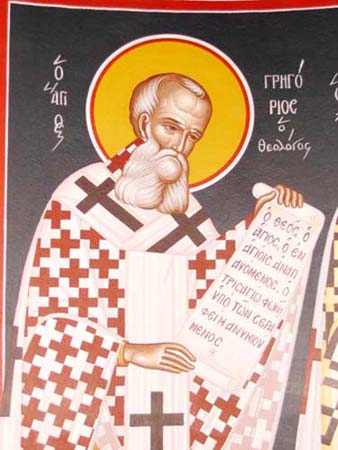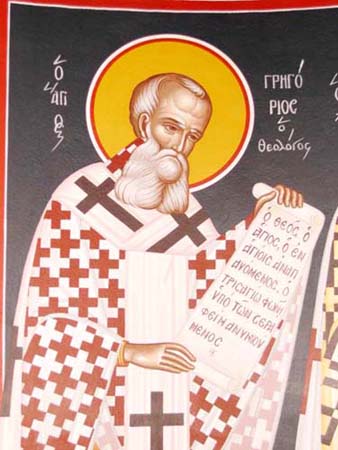
Today the Church honors the memory of the great Church Father and Teacher St. Gregory, Archbishop of Constantinople the Theologian (or Nazianzus) "the second Epistetus, the bird of the Word."
One of the greatest figures of Christianity and theology, St. Gregory was born in Nazianzo, Cappadocia, in 330 AD. From his father, the bishop of Nazianzu, also Gregory, he was taught the first letters, and from his mother Nonna he received a pious upbringing.
During his studies he became friends with M. Vasilios, and with him practiced for a time at the Ascetiriou, which they themselves had established near the river Iris in Pontus. The great needs of the Church and the problems created by various sects compelled him to return to Cappadocia, where he was ordained deacon and elder and against his will became Bishop of Sasim.
His virtuous life, his rhetorical skill, his amazing poetry and theological writings, and his struggle against the Arians helped him become Archbishop of Constantinople and distinguished himself as president during the work of the Second Ecumenical Council, which condemned the pneumatologies.
He resigned from the See of Constantinople and the presidency of the Synod when he found himself questioned by some of his fellow bishops, thus becoming an example of humility and true love for the Church. After his death in 390 AD. The Church, praising his temperament, his labors and his struggle for orthodoxy, named him Theologian, as only John the Theologian had been called before that time.
St. Gregory the Theologian, or Nazianzin, as he is otherwise called, writes: "What is the Kingdom of God? A theory of God, praise and hymns with angels."
Stylianos Papadopoulos, an academic teacher and scholar of St. Gregory's work, characterized him as "the wounded eagle of theology." He was indeed an eagle of theology, an eagle of the Holy Trinity, but also wounded by the envy and arrogance of men.
This is the general course of the great men of the Church through the centuries. They do not identify with falsehood, hypocrisy, or praise. On the contrary, conscious of their own weakness, they live in patience, in stability, in the light that comes from the unique example of the sacrifice of the Redeemer and the imitators of the Saints, such as the great Father and Teacher of the Church, Gregory the Theologian, whom we honor today.
It should be noted that he is celebrated along with two other great luminaries of ecumenism, John Chrysostom and Mega Basil, on January 30.
A small church of St. Gregory the Theologian exists in the Turkish-occupied city of Kyrenia.
Bishop Grigoriou of Mesaoria
One of the greatest figures of Christianity and theology, St. Gregory was born in Nazianzo, Cappadocia, in 330 AD. From his father, the bishop of Nazianzu, also Gregory, he was taught the first letters, and from his mother Nonna he received a pious upbringing.
During his studies he became friends with M. Vasilios, and with him practiced for a time at the Ascetiriou, which they themselves had established near the river Iris in Pontus. The great needs of the Church and the problems created by various sects compelled him to return to Cappadocia, where he was ordained deacon and elder and against his will became Bishop of Sasim.
His virtuous life, his rhetorical skill, his amazing poetry and theological writings, and his struggle against the Arians helped him become Archbishop of Constantinople and distinguished himself as president during the work of the Second Ecumenical Council, which condemned the pneumatologies.
He resigned from the See of Constantinople and the presidency of the Synod when he found himself questioned by some of his fellow bishops, thus becoming an example of humility and true love for the Church. After his death in 390 AD. The Church, praising his temperament, his labors and his struggle for orthodoxy, named him Theologian, as only John the Theologian had been called before that time.
St. Gregory the Theologian, or Nazianzin, as he is otherwise called, writes: "What is the Kingdom of God? A theory of God, praise and hymns with angels."
Stylianos Papadopoulos, an academic teacher and scholar of St. Gregory's work, characterized him as "the wounded eagle of theology." He was indeed an eagle of theology, an eagle of the Holy Trinity, but also wounded by the envy and arrogance of men.
This is the general course of the great men of the Church through the centuries. They do not identify with falsehood, hypocrisy, or praise. On the contrary, conscious of their own weakness, they live in patience, in stability, in the light that comes from the unique example of the sacrifice of the Redeemer and the imitators of the Saints, such as the great Father and Teacher of the Church, Gregory the Theologian, whom we honor today.
It should be noted that he is celebrated along with two other great luminaries of ecumenism, John Chrysostom and Mega Basil, on January 30.
A small church of St. Gregory the Theologian exists in the Turkish-occupied city of Kyrenia.
Bishop Grigoriou of Mesaoria
Share: