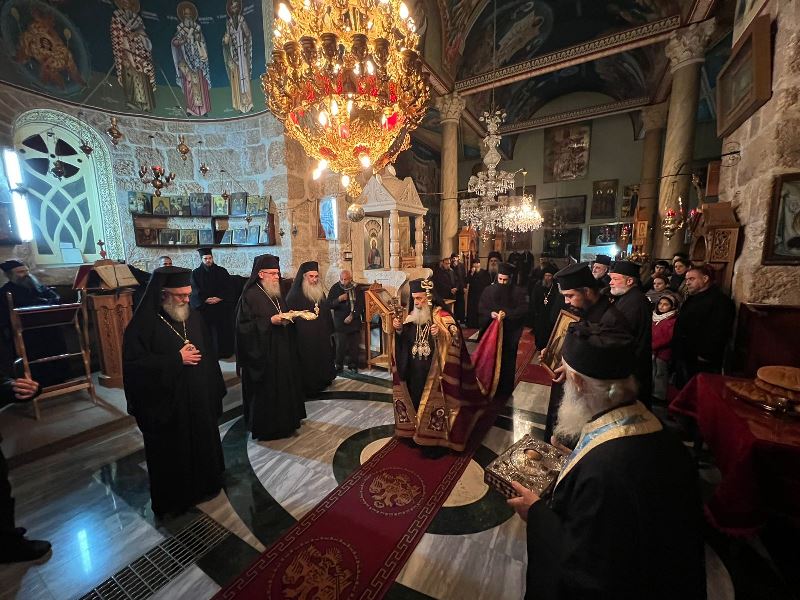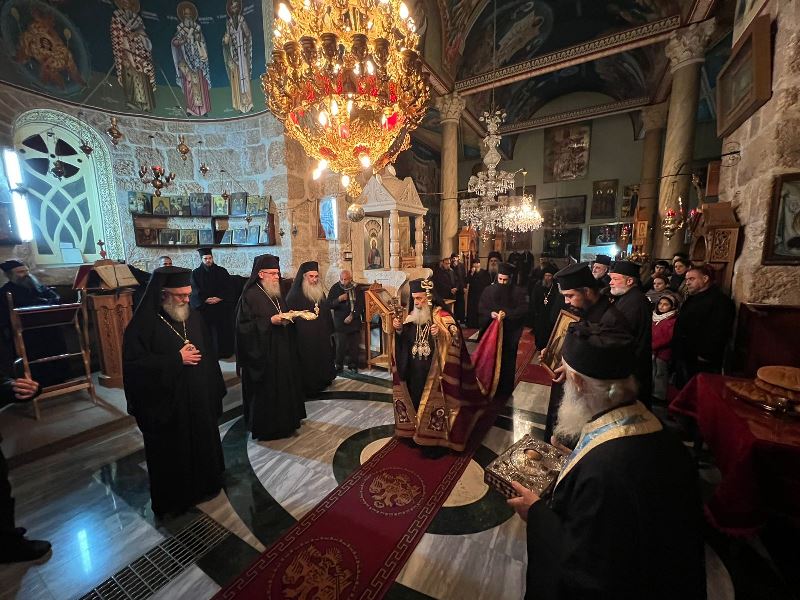
On Wednesday, January 11 / 24, 2024, the Patriarchate commemorated our Holy Father Theodosius the Cinematographer in the holy monastery founded by him and bearing his name, in the Judean Desert, a few kilometers from Bethlehem and the Monastery of St. Sava.
During this feast, the whole Church, especially the Jerusalem Church, remembers that the Venerable Theodosius came from his native Mogarissa in Cappadocia to the Holy Land in 451.
He also initially asceticized in the vicinity of Jerusalem in the holy monastery of Ikelia, and then in extreme asceticism in the desert, in the cave where the Magi slept, "returning by another way to his homeland." There by prayer and humility he received illumination from the Holy Spirit, so that he directed to life in Christ a multitude of monks who begged him to found this monastery as a kinovium, that is, a monastery in which novice monks abide in patience, dormitory, and obedience until they prove worthy of the solitary life in the Lavra.
In this monastery the monks were engaged in manual labor, by means of which they satisfied the needs of the poor and needy. The condition of entry to the monastery: "Let no lazy person enter". About 400 monks lived in this monastery, and St. Sophronius and St. Modestus, Patriarch of Jerusalem, also lived there. St. Theodosius was appointed the exarch of the dormitory life, and the head of the Lavra hagiography is St. Savva.
Together with St. Sava, his compatriot, they supported the decisions of the Fourth Ecumenical Council of 451 that Christ God has one hypostasis and two natures.
In this monastery, where there is the tomb of the saint, His Divine Beatitude Our Father and Patriarch Theophilos of Jerusalem celebrated the all-night vigil with the Divine Liturgy. He was served by Their Eminences, Archbishops Aristarchus of Constantine and Theodosius of Sebastia, Metropolitan Joachim of Elenopolis, Archimandrite Evdokim, the confessor of St. Sava Monastery, Archimandrites Ignatius, Nectarius and Christodoul, and priests from Bethlehem, Beit Jala and Beit Shahur. Due to the war, only a few faithful Christians attended the vigil.
Before Holy Communion, His Beatitude preaches the divine word, as follows:
"To the divine height of your hands, pillar, monk, you have appeared light-bearing, shining with prayerful dawns: to Heaven you have directed your thought, and being a partaker of the inexpressible, you have covered the whole, Christ God begging to grant us great mercy" - exclaims the songster of the Church.
Beloved brothers in Christ,
Pious Christians.
Christ, who appeared to us at the Jordan, has gathered us all to this holy place where he dwelt in a cave St. Theodosius founded this marvelous monastery so that we may celebrate his holy memory in the Eucharist.
Abba Theodosius founded the great Kinovium, inhabited by a multitude of people, superior to all in Palestine, a work accomplished by the good pleasure of God the Father with Christ and by the inspiration of the Holy Spirit, according to the biographer of the saint Presbyter Cyril of Scythopolis.
Originating from the city of Mogarissa of Cappadocia, St. Theodosius came to the Holy Land and became "the great glory of Palestine, the pride of the desert and the pillar of the monastic schema, the commander and defender of the right dogmas, the leader and defender of the monastic rule," according to his biographer.
His song-writer also confirms this: "To the head of the Forerunner, resembling Christ by obedience, and by a great humility, Father Theodosius, you have become an unshakable pillar of virtue". "Having served the Virgin and the Mother of Christ God, you received the undefeatable grace of the Spirit, Father Theodosius, and overthrew the invisible enemies."
Indeed, St. Theodosius "built up an unshakable pillar on virtue" and "received undefeatable grace by the Spirit" because he knew that he had in "himself a possession in heaven that abides and is better" (cf. Heb. 10:34). The way and manner of our Father Theodosius to attain "the possession in heaven which abides and is better" consisted in his humility and obedience to the the image of the only begotten Son and Word of God the Father, our Lord Jesus Christ, who, "though He were a Son, yet learned obedience from these things which He suffered, and was made perfect unto all them that obey Him, who are guilty of eternal salvation" (Hebrews 5:8-9), preaches the wise Paul.
The characteristic of Christ's obedience is His willingness to obey. "But our disposition is not sufficient if we do not perform the deed; for the deed is the proof of the disposition," says St. Gregory the Theologian.
The action of obedience is indeed a proof of disposition, because obedience is distinguished into slavery to sin, leading to death, and into obedience to Christ, leading to righteousness, guiding into the Kingdom of God, says the Great Photios, interpreting the words of St. Paul: "Do you not know whether you are slaves to obedience, whether you obey him, or whether you obey sin unto death, or whether you obey him unto righteousness?" (Rom. 6:16).
Our Godly Father Theodosius became a worthy servant and minister of Christ's truth through the introduction of the dormitory way of monasticism, as St. Theodosius sought not only his own adoration, but also those who came running to the monastery he founded. "In this way God created us so that we might become partakers of the Divine nature and of His eternity, and by this we may become like Him through adoration by grace," says the St. Maximus the Confessor.
And "deification by grace" is nothing else than a gift or communion with the Holy Spirit, as St. Cyril of Alexandria says, interpreting the words of Christ: "Come, for all things are ready" (Lk. 14:17) "God and the Father in Christ has prepared for those who dwell on earth the goods He has given to the world, the forgiveness of sins, communion with the Holy Spirit, the splendor of adoption, and the Kingdom of Heaven". These spiritual goods that God has prepared for earthly, i.e. us, people, were achieved by St. Theodosius. Every person who loves God with all his heart and with all his mind is called to these blessings and can acquire them.
It is noteworthy that the one who truly loves God is the one who has reached the highest degree of spiritual perfection, as divine St. Paul preaches, saying: "But we speak wisdom in those who are perfect, but wisdom not of this age, nor of the princes of this age that pass away, but [...] what God has prepared for those who love Him." (1 Cor. 2: 7-9). Accordingly, the psalmist pleads with God, saying, "Send Thy light and Thy truth: this Thou hast guided me, and brought me into Thy holy mountain and into Thy villages."(Ps. 42:3).
This divine light, that is, the Holy Spirit, God the Father sent to His only begotten Son, our Lord Jesus Christ, in the form of a dove in the Jordan River at His baptism by John the Baptist for the salvation of our souls. "The saving grace of God was manifested. all men," says the divine Paul. And the songster cries out and says: "Today Christ came to the Jordan to be baptized, today John touches the top of the Lord. This marvelous mystery was preached and confessed also by St. Theodosius, as his songster writes: "He who cleanses the world is baptized, for my sake God the man in me was God in me, who in two natures, Theodosius, blessed one, preached you". Also: "Your teachings, Theodosius, in two natures we preach Christ, two wills leading, natural and effective and self-existent, in God baptized in the flesh."
But we, my beloved brothers, beseech our Venerable Father Theodosius with the Blessed Virgin Mary and the Most Holy Mother of God that they intercede before the Lord for our souls and peace in the Holy Land and for the cessation of the fire in Gaza. And following the divine Paul, let us say: "The saving grace of God is revealed to all men, chastening us, that we may deny ungodliness and worldly lusts, and live chastely and righteously and godly in this present age, waiting for the blessed hope and the appearing of the glory of our great God and Savior Jesus Christ" (Titus. 2: 11-13). Long and peaceful years."
After the Divine Liturgy, the active, hardworking, diligent restorer of the monastery, Archimandrite Ierofei, offered refreshments to His Beatitude and his escort.
His Beatitude blessed him, wishing him long life and continued heroic service in the monastery where he has served for over forty years.
During this feast, the whole Church, especially the Jerusalem Church, remembers that the Venerable Theodosius came from his native Mogarissa in Cappadocia to the Holy Land in 451.
He also initially asceticized in the vicinity of Jerusalem in the holy monastery of Ikelia, and then in extreme asceticism in the desert, in the cave where the Magi slept, "returning by another way to his homeland." There by prayer and humility he received illumination from the Holy Spirit, so that he directed to life in Christ a multitude of monks who begged him to found this monastery as a kinovium, that is, a monastery in which novice monks abide in patience, dormitory, and obedience until they prove worthy of the solitary life in the Lavra.
In this monastery the monks were engaged in manual labor, by means of which they satisfied the needs of the poor and needy. The condition of entry to the monastery: "Let no lazy person enter". About 400 monks lived in this monastery, and St. Sophronius and St. Modestus, Patriarch of Jerusalem, also lived there. St. Theodosius was appointed the exarch of the dormitory life, and the head of the Lavra hagiography is St. Savva.
Together with St. Sava, his compatriot, they supported the decisions of the Fourth Ecumenical Council of 451 that Christ God has one hypostasis and two natures.
In this monastery, where there is the tomb of the saint, His Divine Beatitude Our Father and Patriarch Theophilos of Jerusalem celebrated the all-night vigil with the Divine Liturgy. He was served by Their Eminences, Archbishops Aristarchus of Constantine and Theodosius of Sebastia, Metropolitan Joachim of Elenopolis, Archimandrite Evdokim, the confessor of St. Sava Monastery, Archimandrites Ignatius, Nectarius and Christodoul, and priests from Bethlehem, Beit Jala and Beit Shahur. Due to the war, only a few faithful Christians attended the vigil.
Before Holy Communion, His Beatitude preaches the divine word, as follows:
"To the divine height of your hands, pillar, monk, you have appeared light-bearing, shining with prayerful dawns: to Heaven you have directed your thought, and being a partaker of the inexpressible, you have covered the whole, Christ God begging to grant us great mercy" - exclaims the songster of the Church.
Beloved brothers in Christ,
Pious Christians.
Christ, who appeared to us at the Jordan, has gathered us all to this holy place where he dwelt in a cave St. Theodosius founded this marvelous monastery so that we may celebrate his holy memory in the Eucharist.
Abba Theodosius founded the great Kinovium, inhabited by a multitude of people, superior to all in Palestine, a work accomplished by the good pleasure of God the Father with Christ and by the inspiration of the Holy Spirit, according to the biographer of the saint Presbyter Cyril of Scythopolis.
Originating from the city of Mogarissa of Cappadocia, St. Theodosius came to the Holy Land and became "the great glory of Palestine, the pride of the desert and the pillar of the monastic schema, the commander and defender of the right dogmas, the leader and defender of the monastic rule," according to his biographer.
His song-writer also confirms this: "To the head of the Forerunner, resembling Christ by obedience, and by a great humility, Father Theodosius, you have become an unshakable pillar of virtue". "Having served the Virgin and the Mother of Christ God, you received the undefeatable grace of the Spirit, Father Theodosius, and overthrew the invisible enemies."
Indeed, St. Theodosius "built up an unshakable pillar on virtue" and "received undefeatable grace by the Spirit" because he knew that he had in "himself a possession in heaven that abides and is better" (cf. Heb. 10:34). The way and manner of our Father Theodosius to attain "the possession in heaven which abides and is better" consisted in his humility and obedience to the the image of the only begotten Son and Word of God the Father, our Lord Jesus Christ, who, "though He were a Son, yet learned obedience from these things which He suffered, and was made perfect unto all them that obey Him, who are guilty of eternal salvation" (Hebrews 5:8-9), preaches the wise Paul.
The characteristic of Christ's obedience is His willingness to obey. "But our disposition is not sufficient if we do not perform the deed; for the deed is the proof of the disposition," says St. Gregory the Theologian.
The action of obedience is indeed a proof of disposition, because obedience is distinguished into slavery to sin, leading to death, and into obedience to Christ, leading to righteousness, guiding into the Kingdom of God, says the Great Photios, interpreting the words of St. Paul: "Do you not know whether you are slaves to obedience, whether you obey him, or whether you obey sin unto death, or whether you obey him unto righteousness?" (Rom. 6:16).
Our Godly Father Theodosius became a worthy servant and minister of Christ's truth through the introduction of the dormitory way of monasticism, as St. Theodosius sought not only his own adoration, but also those who came running to the monastery he founded. "In this way God created us so that we might become partakers of the Divine nature and of His eternity, and by this we may become like Him through adoration by grace," says the St. Maximus the Confessor.
And "deification by grace" is nothing else than a gift or communion with the Holy Spirit, as St. Cyril of Alexandria says, interpreting the words of Christ: "Come, for all things are ready" (Lk. 14:17) "God and the Father in Christ has prepared for those who dwell on earth the goods He has given to the world, the forgiveness of sins, communion with the Holy Spirit, the splendor of adoption, and the Kingdom of Heaven". These spiritual goods that God has prepared for earthly, i.e. us, people, were achieved by St. Theodosius. Every person who loves God with all his heart and with all his mind is called to these blessings and can acquire them.
It is noteworthy that the one who truly loves God is the one who has reached the highest degree of spiritual perfection, as divine St. Paul preaches, saying: "But we speak wisdom in those who are perfect, but wisdom not of this age, nor of the princes of this age that pass away, but [...] what God has prepared for those who love Him." (1 Cor. 2: 7-9). Accordingly, the psalmist pleads with God, saying, "Send Thy light and Thy truth: this Thou hast guided me, and brought me into Thy holy mountain and into Thy villages."(Ps. 42:3).
This divine light, that is, the Holy Spirit, God the Father sent to His only begotten Son, our Lord Jesus Christ, in the form of a dove in the Jordan River at His baptism by John the Baptist for the salvation of our souls. "The saving grace of God was manifested. all men," says the divine Paul. And the songster cries out and says: "Today Christ came to the Jordan to be baptized, today John touches the top of the Lord. This marvelous mystery was preached and confessed also by St. Theodosius, as his songster writes: "He who cleanses the world is baptized, for my sake God the man in me was God in me, who in two natures, Theodosius, blessed one, preached you". Also: "Your teachings, Theodosius, in two natures we preach Christ, two wills leading, natural and effective and self-existent, in God baptized in the flesh."
But we, my beloved brothers, beseech our Venerable Father Theodosius with the Blessed Virgin Mary and the Most Holy Mother of God that they intercede before the Lord for our souls and peace in the Holy Land and for the cessation of the fire in Gaza. And following the divine Paul, let us say: "The saving grace of God is revealed to all men, chastening us, that we may deny ungodliness and worldly lusts, and live chastely and righteously and godly in this present age, waiting for the blessed hope and the appearing of the glory of our great God and Savior Jesus Christ" (Titus. 2: 11-13). Long and peaceful years."
After the Divine Liturgy, the active, hardworking, diligent restorer of the monastery, Archimandrite Ierofei, offered refreshments to His Beatitude and his escort.
His Beatitude blessed him, wishing him long life and continued heroic service in the monastery where he has served for over forty years.
Share: