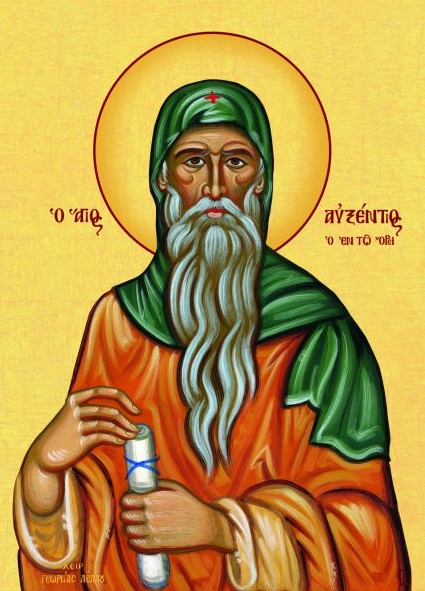
Today our Holy Church honors the memory of Saints Abraham, Auxentius and Maron and the Holy Martyrs Philimon and Philip, Bishops of Gaza.
St. Abrahamius lived during the time of Emperor Theodosius the Great (395-408 AD ). He came from the city of Cirros in Syria and was brought up in the teaching and admonition of the Lord. When he learned that in a village in Lebanon all the inhabitants were pagans, he went there and by his teaching, his Christian life and his charitable work, after he himself had paid taxes to the tax collectors who oppressed the people, attracted many pagans to the Christian faith. The Christians built a church in their village and asked the saint to ordain them as priests.
After three years of action, he returned to his cell and from there traveled to the city of Carre in Palestine, where he was made bishop, trying his best to bring its pagan inhabitants to the true faith.
The fame of his holiness and church activity reached Vasilevusa, where he was invited by Emperor Theodosius, who wished to see him personally. There the saint slept peacefully. By royal command his honest remains were sent with great honors to the city of Carre, where he was buried. The Life of St. Abraham was written by Cyros Theodoritus.
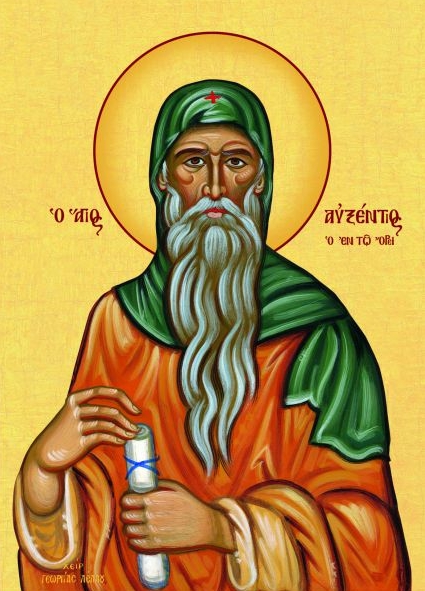
St. Auxentius lived in Constantinople during the reign of Theodosius II the Younger and held the office of scholar. He was characterized by deep piety, biblical presence, integrity, appearance, and moral richness. His peaceful and monastic disposition and love of the ascetic life prompted him to become a monk. Thus she renounced the honors and offices of a queen and withdrew to some remote mountain where she became an ascetic.
At the same time he was engaged in the study and research of the Bible. His reputation for rare virtues and profound theological education was such that he was invited as a mere monk to the work of the Fourth Ecumenical Council at Chalcedon in 451 A.D., during which the God-bearing Fathers dealt with heresies and, above all, condemned the atrocities of Archimandrite Eutychus and Archbishop Nestorius.
Every day many came to St. Auxentius in his hermitage to comfort and heal them. Several Christians also approached him to express their respect and gratitude to him by offering him gifts and food, which the saint then distributed to the poor.
St. Auxentius rested in his old age, remaining another proof of true sacrifice and life experience. An example to follow for those who freely desire to lead an angelic life in male and female monasteries.
Another example is. St. Maron, whom we also glorify today, who was a disciple of St. John Chrysostom. St. Maron lived before the 5th century A.D. His love for God and total devotion to the theory of the Uncreated Light led him to enter the monastic life, placing his hermitage on a mountaintop in the city of Kirros in Antioch.
Bishop Gregoriou of Mesaoria
St. Abrahamius lived during the time of Emperor Theodosius the Great (395-408 AD ). He came from the city of Cirros in Syria and was brought up in the teaching and admonition of the Lord. When he learned that in a village in Lebanon all the inhabitants were pagans, he went there and by his teaching, his Christian life and his charitable work, after he himself had paid taxes to the tax collectors who oppressed the people, attracted many pagans to the Christian faith. The Christians built a church in their village and asked the saint to ordain them as priests.
After three years of action, he returned to his cell and from there traveled to the city of Carre in Palestine, where he was made bishop, trying his best to bring its pagan inhabitants to the true faith.
The fame of his holiness and church activity reached Vasilevusa, where he was invited by Emperor Theodosius, who wished to see him personally. There the saint slept peacefully. By royal command his honest remains were sent with great honors to the city of Carre, where he was buried. The Life of St. Abraham was written by Cyros Theodoritus.
St. Auxentius lived in Constantinople during the reign of Theodosius II the Younger and held the office of scholar. He was characterized by deep piety, biblical presence, integrity, appearance, and moral richness. His peaceful and monastic disposition and love of the ascetic life prompted him to become a monk. Thus she renounced the honors and offices of a queen and withdrew to some remote mountain where she became an ascetic.
At the same time he was engaged in the study and research of the Bible. His reputation for rare virtues and profound theological education was such that he was invited as a mere monk to the work of the Fourth Ecumenical Council at Chalcedon in 451 A.D., during which the God-bearing Fathers dealt with heresies and, above all, condemned the atrocities of Archimandrite Eutychus and Archbishop Nestorius.
Every day many came to St. Auxentius in his hermitage to comfort and heal them. Several Christians also approached him to express their respect and gratitude to him by offering him gifts and food, which the saint then distributed to the poor.
St. Auxentius rested in his old age, remaining another proof of true sacrifice and life experience. An example to follow for those who freely desire to lead an angelic life in male and female monasteries.
Another example is. St. Maron, whom we also glorify today, who was a disciple of St. John Chrysostom. St. Maron lived before the 5th century A.D. His love for God and total devotion to the theory of the Uncreated Light led him to enter the monastic life, placing his hermitage on a mountaintop in the city of Kirros in Antioch.
Bishop Gregoriou of Mesaoria
Share: