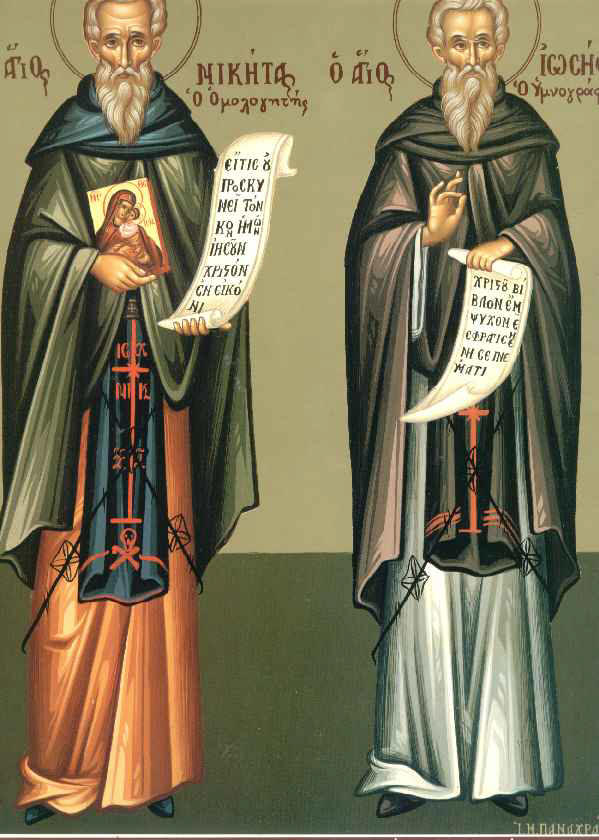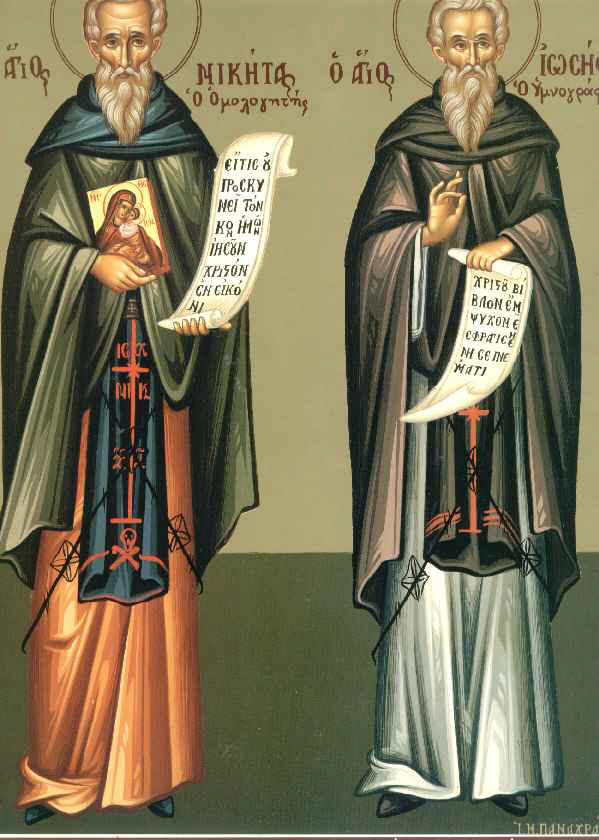
Today the Church honors the memory of St. Nikita the Confessor, abbot of the monastery of Midiki, St. Joseph the Singer, the martyrs Bithynius, Hlavka, Dios and Elpidophoros, and the New Martyr Paul of Russia, who was released.
St. Joseph was born in Sicily to a family of virtuous parents. After the death of his father, he retired to Thessaloniki, where he became a monk and then was ordained an elder. He distinguished himself by calligraphy and composing famous church hymns.
Later he went to Constantinople and was exiled to Rome for his reaction to the decrees of the iconoclasts. He later returned to Constantinople and fell asleep in old age in 842 AD.
St. Joseph's great hymnographic work consists of the Canons, which abound in manuscripts and printed books. His contribution to the hymnographic completion of the Octoichus is decisive, since it covered most of the week, with the exception of Sunday, whose Canons were compiled by Cosmas Melodos and John Damascene.
In the "Mineia" (12 books, one for the feasts of each month) St. Joseph is the most richly represented hymn-writer, since they preserve 165 of his Canons with a unified structure, praising the Saints of Monday, usually a feast day. character, given that the known feasts had previously concluded hymnographically.
Of course, the Canon is particularly moving akathist song (which is shown on the Fridays of Great Lent we are experiencing) in which Joseph the Hymn Writer follows the Hirmus of St. John Damascene and praises the Theotokos with an endless series of epithets and images, such as "the unburned cane", "the light dweller", "to all things a refuge and a moat and a stronghold and a holy refuge", "the spacious tent of the Word", "the highest heaven, the foundation of the earth", "clouds full of light", "the Rose of amaranth", "the Fragrant Apple" and many others.
Let us honor our chosen songwriters and cantors who lovingly compose hymns and services for contemporary Saints and by the art of singing correctly convey the meaning and spiritually uplift all of us, the faithful of our Church.
Man is prepared by all the means of the sanctifying acts of the Church to experience the great, solemn and salvific events of Holy Week, the Cross, the self-inflicted death and the three-day resurrection.
The Pre-Sanctified Divine Liturgy is celebrated in the morning and the Great Supper is celebrated in the evening.
St. Joseph was born in Sicily to a family of virtuous parents. After the death of his father, he retired to Thessaloniki, where he became a monk and then was ordained an elder. He distinguished himself by calligraphy and composing famous church hymns.
Later he went to Constantinople and was exiled to Rome for his reaction to the decrees of the iconoclasts. He later returned to Constantinople and fell asleep in old age in 842 AD.
St. Joseph's great hymnographic work consists of the Canons, which abound in manuscripts and printed books. His contribution to the hymnographic completion of the Octoichus is decisive, since it covered most of the week, with the exception of Sunday, whose Canons were compiled by Cosmas Melodos and John Damascene.
In the "Mineia" (12 books, one for the feasts of each month) St. Joseph is the most richly represented hymn-writer, since they preserve 165 of his Canons with a unified structure, praising the Saints of Monday, usually a feast day. character, given that the known feasts had previously concluded hymnographically.
Of course, the Canon is particularly moving akathist song (which is shown on the Fridays of Great Lent we are experiencing) in which Joseph the Hymn Writer follows the Hirmus of St. John Damascene and praises the Theotokos with an endless series of epithets and images, such as "the unburned cane", "the light dweller", "to all things a refuge and a moat and a stronghold and a holy refuge", "the spacious tent of the Word", "the highest heaven, the foundation of the earth", "clouds full of light", "the Rose of amaranth", "the Fragrant Apple" and many others.
Let us honor our chosen songwriters and cantors who lovingly compose hymns and services for contemporary Saints and by the art of singing correctly convey the meaning and spiritually uplift all of us, the faithful of our Church.
Man is prepared by all the means of the sanctifying acts of the Church to experience the great, solemn and salvific events of Holy Week, the Cross, the self-inflicted death and the three-day resurrection.
The Pre-Sanctified Divine Liturgy is celebrated in the morning and the Great Supper is celebrated in the evening.
Share: