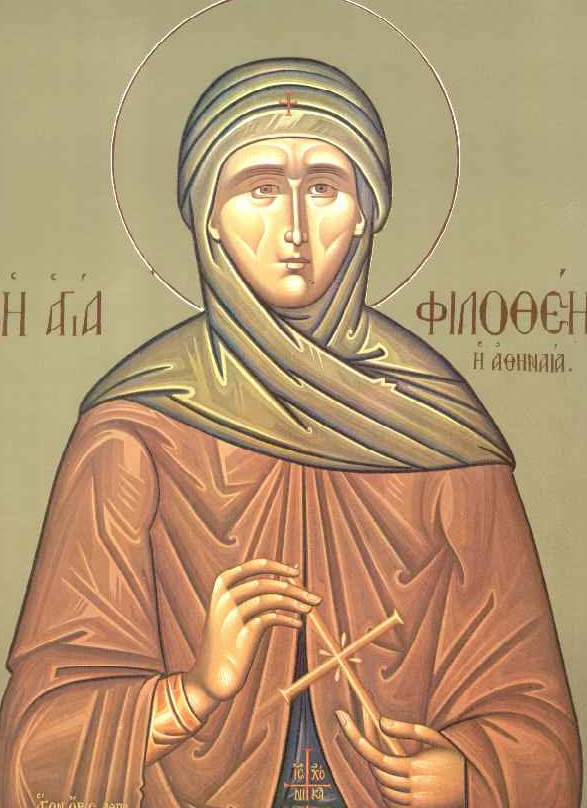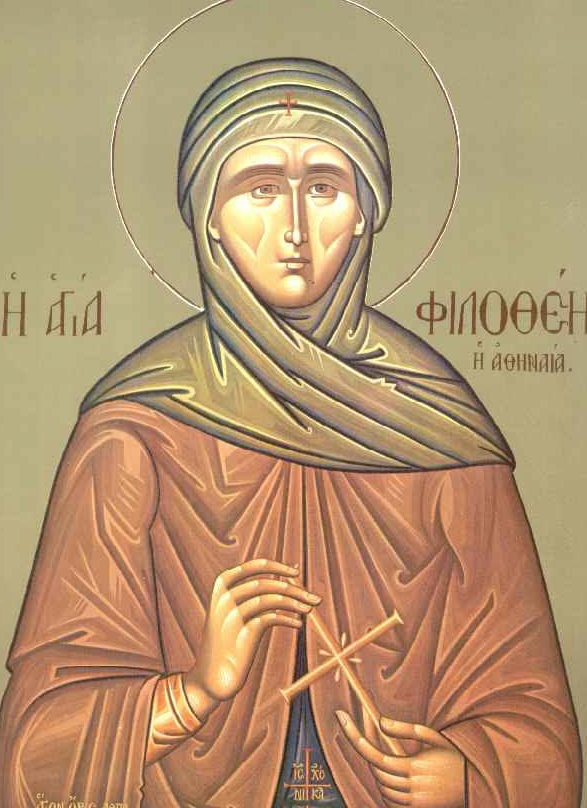
Today, February 19, 2024, the Church honors the memory of the Apostles Archippus and Philemon and Hosea Philothea of Athens, born in 1522 AD. in Athens. Her mother was barren and after diligent and constant prayer she gave birth to a saint.
The parents of Agia Philotheos, along with a Christian upbringing, gave her an excellent education. Thus Rigula (i.e. Paraskevula), as was her lay name, excelled in spiritual matters. At the age of 14, she was married off against her will to one of the rulers of Athens. Later, after the death of her parents and husband, she devoted herself entirely to Christ, became a nun and took the name Philothea.
Initially he built a nunnery to which he gave the name of St. Andrew. This monastery existed in Athens for many years. Her example of dedicating herself to Christ was followed by other young women. In a short time the monastery reached two hundred sisters. There all those suffering from slavery find protection, the sick find healing, the hungry find food, the elderly find support and the orphans find affection.
Hosea Philotei, despite the reaction of the Turks, builds various charitable institutions, hospitals and orphanages. She teaches with her words and her life. Her special concern is to save young Greek women from Islamization. Her work, national and religious, has transcended Athens and has become known throughout Greece.
But the whole action of Agia Philothea has enraged the Turks. She is arrested, and with spiritual courage she confesses her faith in Christ as God, the true and perfect man. Eventually, with God's help, he is released.
Now free, she returned to her convent. Seizing every spiritual opportunity, he attained extreme perfection in both practice and theory, and thus, by the grace of the Holy Spirit, he claimed to work miracles.
The Turks tried in vain to stop its actions. On October 2, 1588, they came to the monastery he had built in Patisia, invaded the church, seized the saint, beat her, and left her half dead outside the monastery.
Outside the temple there is a column where Philothea was bound and scourged. The nuns took her to her crypt in Calogrese. She fell asleep on February 19, 1589 AD. Her holy relic is today in the cathedral of Athens in the capital.
The social work of Agia Philothea, centuries later, remains a relevant testimony of the Church's daily activity for the sake of suffering people.
The parents of Agia Philotheos, along with a Christian upbringing, gave her an excellent education. Thus Rigula (i.e. Paraskevula), as was her lay name, excelled in spiritual matters. At the age of 14, she was married off against her will to one of the rulers of Athens. Later, after the death of her parents and husband, she devoted herself entirely to Christ, became a nun and took the name Philothea.
Initially he built a nunnery to which he gave the name of St. Andrew. This monastery existed in Athens for many years. Her example of dedicating herself to Christ was followed by other young women. In a short time the monastery reached two hundred sisters. There all those suffering from slavery find protection, the sick find healing, the hungry find food, the elderly find support and the orphans find affection.
Hosea Philotei, despite the reaction of the Turks, builds various charitable institutions, hospitals and orphanages. She teaches with her words and her life. Her special concern is to save young Greek women from Islamization. Her work, national and religious, has transcended Athens and has become known throughout Greece.
But the whole action of Agia Philothea has enraged the Turks. She is arrested, and with spiritual courage she confesses her faith in Christ as God, the true and perfect man. Eventually, with God's help, he is released.
Now free, she returned to her convent. Seizing every spiritual opportunity, he attained extreme perfection in both practice and theory, and thus, by the grace of the Holy Spirit, he claimed to work miracles.
The Turks tried in vain to stop its actions. On October 2, 1588, they came to the monastery he had built in Patisia, invaded the church, seized the saint, beat her, and left her half dead outside the monastery.
Outside the temple there is a column where Philothea was bound and scourged. The nuns took her to her crypt in Calogrese. She fell asleep on February 19, 1589 AD. Her holy relic is today in the cathedral of Athens in the capital.
The social work of Agia Philothea, centuries later, remains a relevant testimony of the Church's daily activity for the sake of suffering people.
Share: