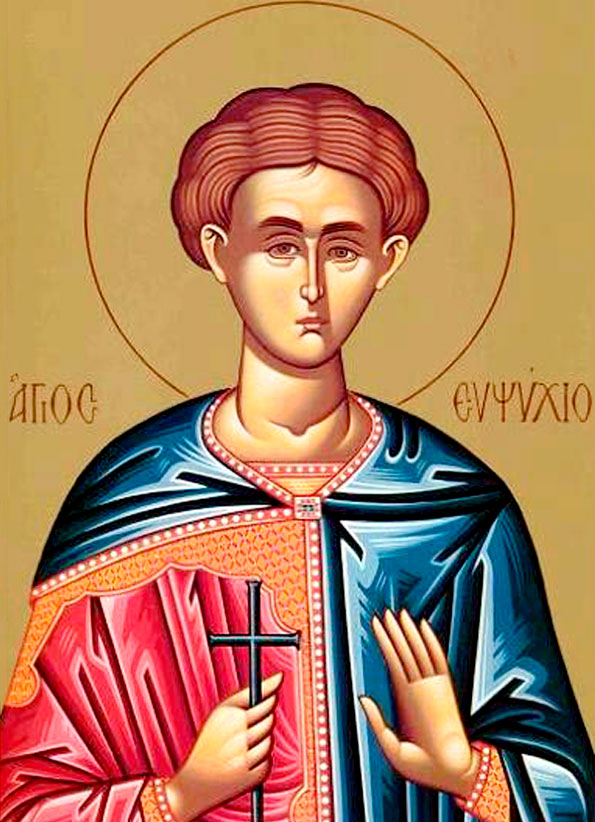
Today, April 9, our Church honors the memory of the martyr Eupsychius of Caesarea, St. Abdius and the 300 prisoners who died in Persia, the holy martyrs Raphael the Archimandrite, Nicholas the Deacon, Irina Neanidova, Lesbos and those who took part with them in sports, whose feast has been postponed to Easter Tuesday, May 7 this year
.
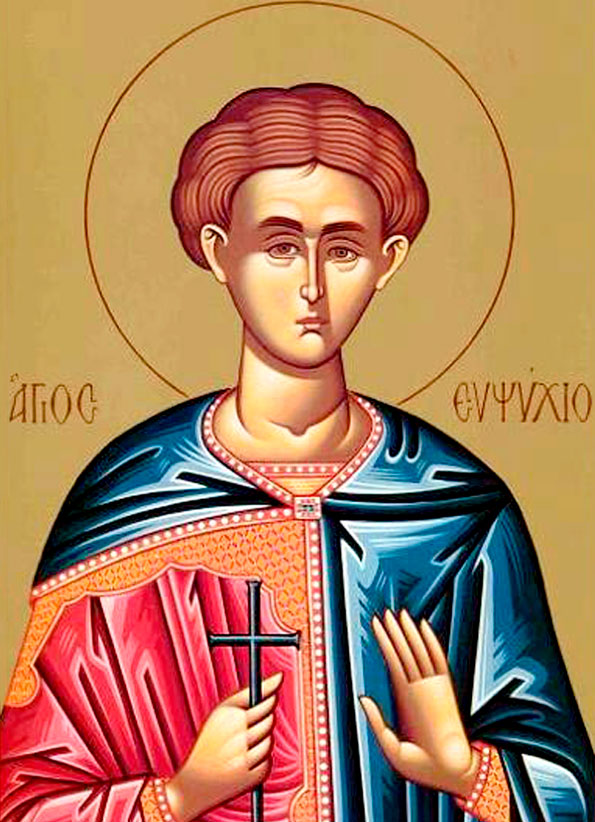
Hagios Eupsychios lived during the time of Emperor Julian the Criminal, who persecuted Christians with all his might and tried to restore the belief in idols. Eupsychius was a man consumed with zeal for his faith, so he could not bear the sight of the trampling and flouting of orthodox doctrine and the triumph of the worship of lifeless idols. That is why, when in Caesarea of Cappadocia Julian built a temple of the goddess Tyche, which was defiantly worshipped by the pagans, Eupsychius took some other brave young men with him and they destroyed the little idol of the goddess, wishing to condemn the superstition.
He was arrested and taken before an official of the city, to whom he defiantly lied about his actions, accusing Julian of having no right to change the Christian faith for which so much blood of martyrs and confessors of the faith had been shed during the years of Roman persecution.
Of course, St. Eupsychius knew that his act would be punished. Indeed, his companions were sentenced to torture and He was sentenced to death by beheading as the head of the whole enterprise. Thus, by his disobedience he won the imperishable crown of martyrdom and eternal values of the Kingdom of God on the throne of the Holy Trinity instead of perishable life.
The wish of St. Ephrem of Syros, repeated during these days of Great Lent, reveals to us the whole meaning of the spiritual feat of the Saints of our Church.
"Lord and despot of my life, do not show me the spirit of idleness, curiosity, humanity and argot. Give me, your servant, a spirit of sobriety, humility, patience and love.
Yes, lord king, grant that they may see my faults and not criticize my brother, for thou art blessed forever and ever. Amen'.
The Church of St. Eupsychius is located in Pomos, a neighborhood of Paphos.
Bishop Grigoriou of Mesaori
.
Hagios Eupsychios lived during the time of Emperor Julian the Criminal, who persecuted Christians with all his might and tried to restore the belief in idols. Eupsychius was a man consumed with zeal for his faith, so he could not bear the sight of the trampling and flouting of orthodox doctrine and the triumph of the worship of lifeless idols. That is why, when in Caesarea of Cappadocia Julian built a temple of the goddess Tyche, which was defiantly worshipped by the pagans, Eupsychius took some other brave young men with him and they destroyed the little idol of the goddess, wishing to condemn the superstition.
He was arrested and taken before an official of the city, to whom he defiantly lied about his actions, accusing Julian of having no right to change the Christian faith for which so much blood of martyrs and confessors of the faith had been shed during the years of Roman persecution.
Of course, St. Eupsychius knew that his act would be punished. Indeed, his companions were sentenced to torture and He was sentenced to death by beheading as the head of the whole enterprise. Thus, by his disobedience he won the imperishable crown of martyrdom and eternal values of the Kingdom of God on the throne of the Holy Trinity instead of perishable life.
The wish of St. Ephrem of Syros, repeated during these days of Great Lent, reveals to us the whole meaning of the spiritual feat of the Saints of our Church.
"Lord and despot of my life, do not show me the spirit of idleness, curiosity, humanity and argot. Give me, your servant, a spirit of sobriety, humility, patience and love.
Yes, lord king, grant that they may see my faults and not criticize my brother, for thou art blessed forever and ever. Amen'.
The Church of St. Eupsychius is located in Pomos, a neighborhood of Paphos.
Bishop Grigoriou of Mesaori
Share: