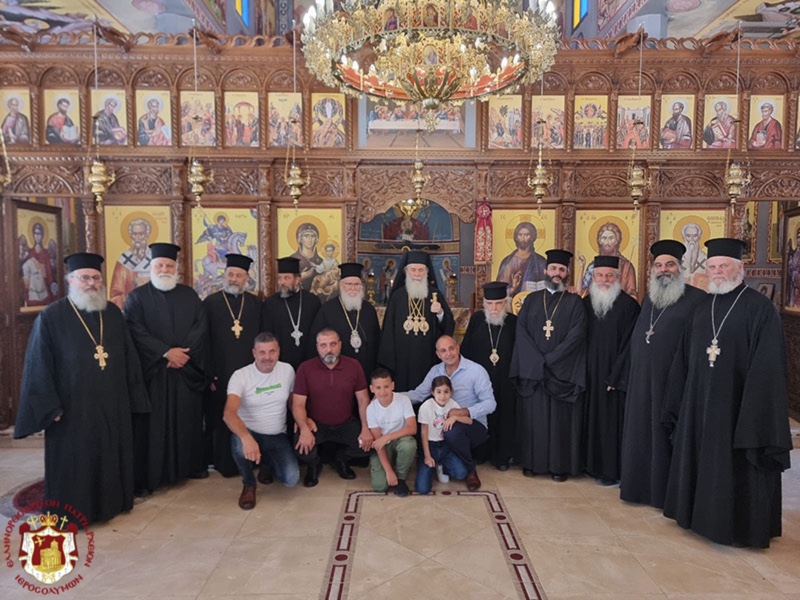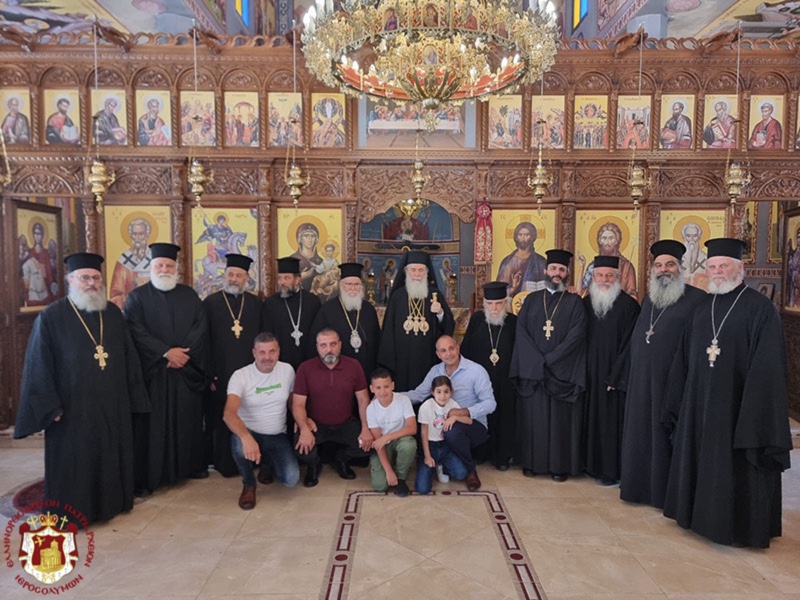
On Sunday, June 3 / 16, 2024, the Week of the Holy Fathers of the First Ecumenical Council, His Divine Beatitude Our Father and Patriarch Theophilus of Jerusalem presided over the Divine Liturgy in the Holy Church of St. George of the community of Turan, a village near Nazareth.
Their Eminences Metropolitan Kyriac of Nazareth, Archbishop Aristarchus of Constantine, priests headed by the Senior Kamarasis Archimandrite Nektariy, priests of the Russian-speaking flock of the Patriarchate Archdeacon Mark and Hierodeacon Evlogy served with His Beatitude. Many Orthodox believers of this parish participated in the service, and the choir of this parish sang under the direction of His Eminence Archbishop Aristovul of Madava in different languages.
Before Holy Communion, His Beatitude preached the divine word with the following sermon:
"The holy fathers, who from the end of the universe have gathered together, the Father and the Son and the Holy Spirit, the One Being taught and the One Nature, and the mystery of theology clearly handed down to the Church: praising them we praise them with faith, saying: O divine host, God-talking armor bearers of the Lord's militia, stars of much light in the mental firmament, mysterious pillars of Zion, peace-inspiring flowers of heaven, all-golden mouth of the Word, praise of Nicea, adornment of the universe, diligently Pray for our souls," exclaims the singer of the Church.
Beloved brothers in Christ!
Pious Christians,
The grace of the Holy Spirit has gathered us all today in this holy temple of your city of Turan, that we may commemorate the First Ecumenical Council of three hundred and eighteen God-bearing Fathers, who theologized and proved that the Son of God truly became perfect man, and thus proclaimed and confessed Him to be perfect man and perfect God, consubstantial and one with God the Father.
This Ecumenical Council was convened at Nicea by the Roman Orthodox Emperor Constantine the Great in 325, who was present there and sat with the Holy Fathers at their prompting. At this Council, on the one hand, the blasphemies of the Deacon Arius, who denied the divinity of the Son of God and declared Him to be a "creature" and born "out of nothingness," were condemned, and on the other hand, he was excommunicated and banished from the divine-human body of the Church and deprived of his dignity.
It should be noted that the heretical teaching of Arius became the source of all subsequent heresies created by "men speaking erroneously" (cf. Acts 20:30) and "who preached the faith, but sinned" (cf. 1 Tim. 6:21). In other words, heretics are those who pervert the Holy Scriptures and the sound faith handed down to us by the holy disciples and apostles Our Savior Jesus Christ, as divine Paul preaches: "There will be a time when they will not listen to sound doctrine, but will choose their own teachers according to their own lusts, and will turn away their ears from the truth, and will be led away to fables" (2 Tim. 4:3-4).
The possessors of sound faith are the successors of the Apostles, that is, the Bishops ordained and placed by their honest hands, to whom Blessed Paul commands: "Take heed, therefore, to yourselves and to all the flock, in which the Holy Spirit has made you bishops, to shepherd the Church of God and of God, which He purchased with His own blood." (Acts 20:28).
These are the Holy Spirit-bearing Fathers who have guarded our saving right and sound faith by theologizing at Ecumenical and Local Holy Councils.
This is why the God-bearing Paul calls himself a Father, because he has begotten many children in the Holy Spirit, as he says, addressing the Corinthians, "But though (i) many are the fathers of Christ, yet not many are the fathers: of Christ Jesus by the gospel I have begotten you."(1 Cor. 4:15). Interpreting this word of Paul, the great Origen says, "The father is the one who first sowed Christianity, and the nurturer is the one who then received the child and guided him." (1 Cor. 4:15). (Read more: the father is the one who spread and preached the Christian faith, in the nurturer is the one who receives the child and takes care of its Christian upbringing).
The fellowship in the Holy Spirit and the continuity between the Holy Apostles and the Fathers of the Church is clearly expressed by the songster of the Church: "The apostle preaching, and the fathers dogmata, the Church sealed the one faith, which also wears the garment of truth, which comes from above theology, corrects and glorifies the great sacrament of godliness."
Indeed, the Church of Christ expresses and glorifies the great mystery of piety, viz. the mystery of the Incarnation of the Son and Word of God, our Lord Jesus Christ, from the pure blood of the Theotokos and Mary, through her bishops and our God-bearing Fathers, clothed with power from on high, which was given to the Apostles after the Lord's Ascension into heaven: "And behold, I send the promise of my Father upon you: but ye shall sit in the city of Jerusalem, until ye be clothed with power from on high."(Lk. 24:49).
In this power from above, in the illumination of the Holy Spirit, the Christ-bearing Fathers of the Church clothed themselves, who gathered the First Ecumenical Council in Nicea, proclaimed with one mouth and one voice the Son and the Word of God consubstantial with the Father, God true of God true, and wrote the blessed and honorable Creed.
The Creed, which was amended by the Second Ecumenical Council in Constantinople in 381 AD, is a "good testament" (2 Tim. 1:14), i.e., the good and precious treasure of evangelical teaching which Christ entrusted to the spirit-bearing Fathers of the Church. Let us also listen to the great Basil: "We do not accept any new confession of faith made by others, and we ourselves dare not put forward the works of our own minds, lest we turn the words of piety into human words. But what the Holy Fathers have taught us, we proclaim to those who ask."
An important model of the Holy Fathers of the Church and the dogmas of her saving faith is what the idolaters and persecutors of our Holy Father Polycarp Bishop of Smyrna said at the time of his martyrdom, "Polycarp confessed himself a Christian." When this was said, the whole crowd of peoples and Jews living in Smyrna cried out in fury and with a great voice: "He is the teacher of Asia, the Father of Christians, the destroyer of our gods, teaching many not to sacrifice nor to worship."
In the person of the Father of the Church, the Holy Holy Martyr Polycarp Bishop of Smyrna portrays the prophetic and apostolic character of the Holy Fathers of the Church in the redemptive work of the Church in the world. The Holy and God-bearing Fathers of the Church are the pledge of pure and sound faith, i.e., our Orthodox faith, which defines, or better said, reveals the way of life of us Christians.
Therefore, the Church of Christ today honors the preachers of faith together with the great Apostles to the glory and thanksgiving of God, but in the confirmation of our Orthodox faith by the intercessions of the The Most Blessed Virgin Mary and Our Lady of the Holy Virgin Mary. Following the song-writer, we say: "Glorified art thou Christ our God, who hast founded our fathers as lights on earth, and by them hast guided us all to the true faith: O Mother of God of many blessings, glory be to thee. Amen. Years of long and peaceful life."
Then followed the reception and meal which the Community had arranged in honor of His Beatitude and His escort.
This was followed by a visit to the family of the Romeo-Orthodox Mrs. Rawan Saad, who is assisting the Patriarchate with the Internet project.
Their Eminences Metropolitan Kyriac of Nazareth, Archbishop Aristarchus of Constantine, priests headed by the Senior Kamarasis Archimandrite Nektariy, priests of the Russian-speaking flock of the Patriarchate Archdeacon Mark and Hierodeacon Evlogy served with His Beatitude. Many Orthodox believers of this parish participated in the service, and the choir of this parish sang under the direction of His Eminence Archbishop Aristovul of Madava in different languages.
Before Holy Communion, His Beatitude preached the divine word with the following sermon:
"The holy fathers, who from the end of the universe have gathered together, the Father and the Son and the Holy Spirit, the One Being taught and the One Nature, and the mystery of theology clearly handed down to the Church: praising them we praise them with faith, saying: O divine host, God-talking armor bearers of the Lord's militia, stars of much light in the mental firmament, mysterious pillars of Zion, peace-inspiring flowers of heaven, all-golden mouth of the Word, praise of Nicea, adornment of the universe, diligently Pray for our souls," exclaims the singer of the Church.
Beloved brothers in Christ!
Pious Christians,
The grace of the Holy Spirit has gathered us all today in this holy temple of your city of Turan, that we may commemorate the First Ecumenical Council of three hundred and eighteen God-bearing Fathers, who theologized and proved that the Son of God truly became perfect man, and thus proclaimed and confessed Him to be perfect man and perfect God, consubstantial and one with God the Father.
This Ecumenical Council was convened at Nicea by the Roman Orthodox Emperor Constantine the Great in 325, who was present there and sat with the Holy Fathers at their prompting. At this Council, on the one hand, the blasphemies of the Deacon Arius, who denied the divinity of the Son of God and declared Him to be a "creature" and born "out of nothingness," were condemned, and on the other hand, he was excommunicated and banished from the divine-human body of the Church and deprived of his dignity.
It should be noted that the heretical teaching of Arius became the source of all subsequent heresies created by "men speaking erroneously" (cf. Acts 20:30) and "who preached the faith, but sinned" (cf. 1 Tim. 6:21). In other words, heretics are those who pervert the Holy Scriptures and the sound faith handed down to us by the holy disciples and apostles Our Savior Jesus Christ, as divine Paul preaches: "There will be a time when they will not listen to sound doctrine, but will choose their own teachers according to their own lusts, and will turn away their ears from the truth, and will be led away to fables" (2 Tim. 4:3-4).
The possessors of sound faith are the successors of the Apostles, that is, the Bishops ordained and placed by their honest hands, to whom Blessed Paul commands: "Take heed, therefore, to yourselves and to all the flock, in which the Holy Spirit has made you bishops, to shepherd the Church of God and of God, which He purchased with His own blood." (Acts 20:28).
These are the Holy Spirit-bearing Fathers who have guarded our saving right and sound faith by theologizing at Ecumenical and Local Holy Councils.
This is why the God-bearing Paul calls himself a Father, because he has begotten many children in the Holy Spirit, as he says, addressing the Corinthians, "But though (i) many are the fathers of Christ, yet not many are the fathers: of Christ Jesus by the gospel I have begotten you."(1 Cor. 4:15). Interpreting this word of Paul, the great Origen says, "The father is the one who first sowed Christianity, and the nurturer is the one who then received the child and guided him." (1 Cor. 4:15). (Read more: the father is the one who spread and preached the Christian faith, in the nurturer is the one who receives the child and takes care of its Christian upbringing).
The fellowship in the Holy Spirit and the continuity between the Holy Apostles and the Fathers of the Church is clearly expressed by the songster of the Church: "The apostle preaching, and the fathers dogmata, the Church sealed the one faith, which also wears the garment of truth, which comes from above theology, corrects and glorifies the great sacrament of godliness."
Indeed, the Church of Christ expresses and glorifies the great mystery of piety, viz. the mystery of the Incarnation of the Son and Word of God, our Lord Jesus Christ, from the pure blood of the Theotokos and Mary, through her bishops and our God-bearing Fathers, clothed with power from on high, which was given to the Apostles after the Lord's Ascension into heaven: "And behold, I send the promise of my Father upon you: but ye shall sit in the city of Jerusalem, until ye be clothed with power from on high."(Lk. 24:49).
In this power from above, in the illumination of the Holy Spirit, the Christ-bearing Fathers of the Church clothed themselves, who gathered the First Ecumenical Council in Nicea, proclaimed with one mouth and one voice the Son and the Word of God consubstantial with the Father, God true of God true, and wrote the blessed and honorable Creed.
The Creed, which was amended by the Second Ecumenical Council in Constantinople in 381 AD, is a "good testament" (2 Tim. 1:14), i.e., the good and precious treasure of evangelical teaching which Christ entrusted to the spirit-bearing Fathers of the Church. Let us also listen to the great Basil: "We do not accept any new confession of faith made by others, and we ourselves dare not put forward the works of our own minds, lest we turn the words of piety into human words. But what the Holy Fathers have taught us, we proclaim to those who ask."
An important model of the Holy Fathers of the Church and the dogmas of her saving faith is what the idolaters and persecutors of our Holy Father Polycarp Bishop of Smyrna said at the time of his martyrdom, "Polycarp confessed himself a Christian." When this was said, the whole crowd of peoples and Jews living in Smyrna cried out in fury and with a great voice: "He is the teacher of Asia, the Father of Christians, the destroyer of our gods, teaching many not to sacrifice nor to worship."
In the person of the Father of the Church, the Holy Holy Martyr Polycarp Bishop of Smyrna portrays the prophetic and apostolic character of the Holy Fathers of the Church in the redemptive work of the Church in the world. The Holy and God-bearing Fathers of the Church are the pledge of pure and sound faith, i.e., our Orthodox faith, which defines, or better said, reveals the way of life of us Christians.
Therefore, the Church of Christ today honors the preachers of faith together with the great Apostles to the glory and thanksgiving of God, but in the confirmation of our Orthodox faith by the intercessions of the The Most Blessed Virgin Mary and Our Lady of the Holy Virgin Mary. Following the song-writer, we say: "Glorified art thou Christ our God, who hast founded our fathers as lights on earth, and by them hast guided us all to the true faith: O Mother of God of many blessings, glory be to thee. Amen. Years of long and peaceful life."
Then followed the reception and meal which the Community had arranged in honor of His Beatitude and His escort.
This was followed by a visit to the family of the Romeo-Orthodox Mrs. Rawan Saad, who is assisting the Patriarchate with the Internet project.
Share: