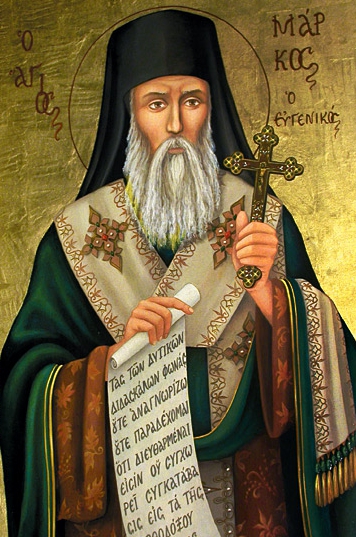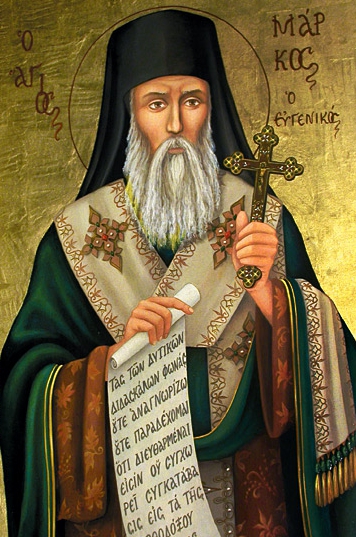
Our Church honors the memory of St. Mark, Bishop of Ephesus of Eugene.
He studied theology and philosophy. He studied under the most famous teachers of his time, Ioannis Ortasmenos and the mathematician and philosopher Georgios Gemistos Plethonas. Among his classmates was his later nemesis, Cardinal Vissarion, who was an advocate of the unification of the Eastern and Western Churches.
Mark the Noble distinguished himself as a teacher of rhetoric. Among his students was George Gennadius Scholarios (the first Patriarch after the fall of the City).
At the age of 25 he left his worldly career and became a monk in a monastery in Prikiponisia, and in 1436 AD. was elected Archbishop of Ephesus.
He followed Emperor John Paleologos and Patriarch Joseph to Ferrara and Florence, where the Synod for the unification of the Eastern and Western Churches was held. There Marcos showed himself the most ardent and strongest defender of Orthodoxy, refusing to sign the condition of pseudo-unification, because he was guided by the pure interest of a friend of the One Holy Soborna and Apostolic Church.
May 4, 1440 AD. St. Mark was forced to flee from Vasilevousa, as his life was in danger. He went to Ephesus, which was under the rule of the Turks. There, after herding his flock for some time, he sat on the The ship was bound for Mount Athos, where he decided to spend the rest of his life. But when the ship docked on Lemnos, Agios was arrested by imperial order and imprisoned for two years.
After his release from prison, St. Mark returned to Constantinople due to illness. From the monastery of Agios Georgios of Manganos he led the struggle against the unionists, wrote letters and urged the faithful to preserve the right faith and not to cooperate with the frivolous unionists.
Persecution, exhaustion and pressure worsened his health, causing him to emigrate to the Lord when he was only 52 years old.
Bishop Grigoriou of Mesaoria
He studied theology and philosophy. He studied under the most famous teachers of his time, Ioannis Ortasmenos and the mathematician and philosopher Georgios Gemistos Plethonas. Among his classmates was his later nemesis, Cardinal Vissarion, who was an advocate of the unification of the Eastern and Western Churches.
Mark the Noble distinguished himself as a teacher of rhetoric. Among his students was George Gennadius Scholarios (the first Patriarch after the fall of the City).
At the age of 25 he left his worldly career and became a monk in a monastery in Prikiponisia, and in 1436 AD. was elected Archbishop of Ephesus.
He followed Emperor John Paleologos and Patriarch Joseph to Ferrara and Florence, where the Synod for the unification of the Eastern and Western Churches was held. There Marcos showed himself the most ardent and strongest defender of Orthodoxy, refusing to sign the condition of pseudo-unification, because he was guided by the pure interest of a friend of the One Holy Soborna and Apostolic Church.
May 4, 1440 AD. St. Mark was forced to flee from Vasilevousa, as his life was in danger. He went to Ephesus, which was under the rule of the Turks. There, after herding his flock for some time, he sat on the The ship was bound for Mount Athos, where he decided to spend the rest of his life. But when the ship docked on Lemnos, Agios was arrested by imperial order and imprisoned for two years.
After his release from prison, St. Mark returned to Constantinople due to illness. From the monastery of Agios Georgios of Manganos he led the struggle against the unionists, wrote letters and urged the faithful to preserve the right faith and not to cooperate with the frivolous unionists.
Persecution, exhaustion and pressure worsened his health, causing him to emigrate to the Lord when he was only 52 years old.
Bishop Grigoriou of Mesaoria
Share: