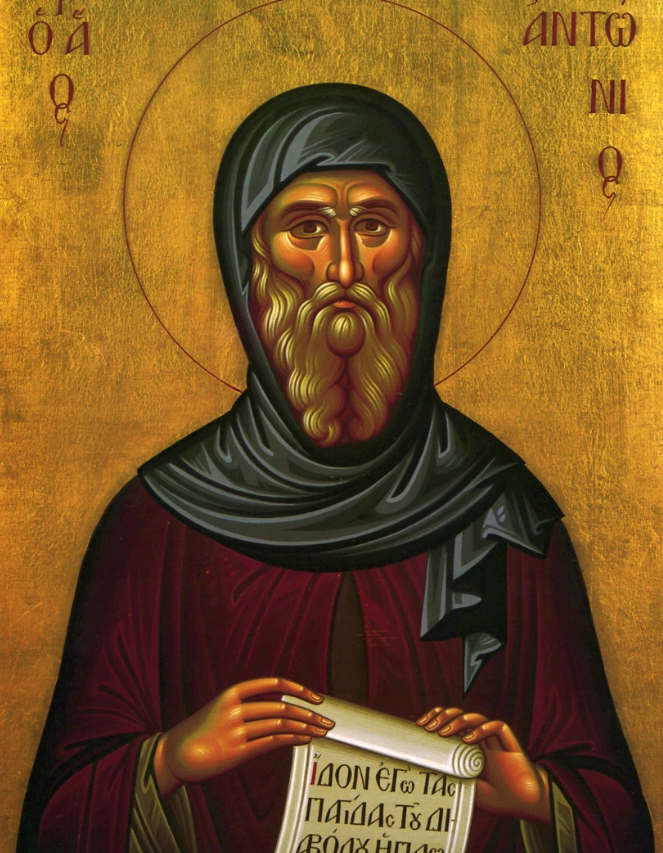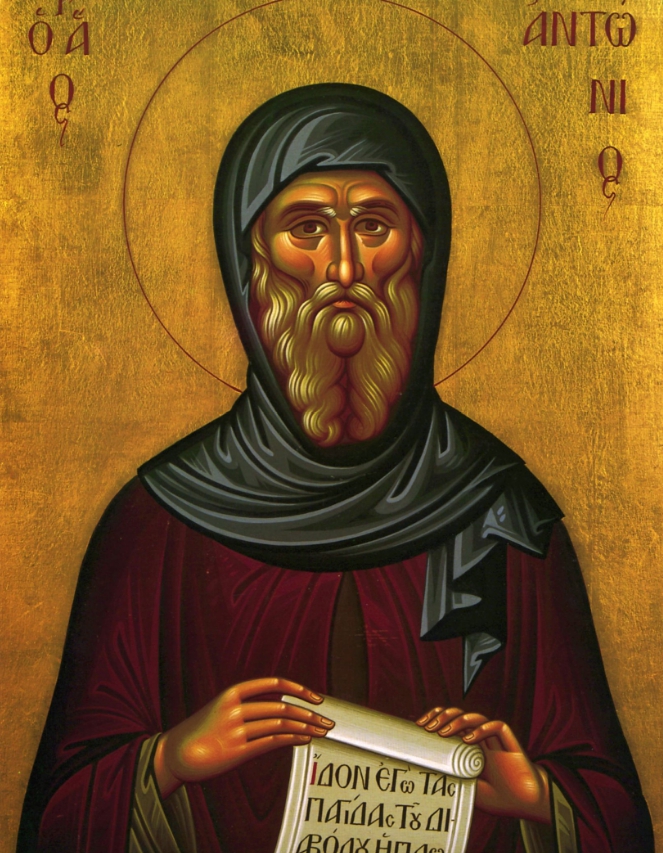
Today the Church honors the memory of St. Anthony, the teacher of the monastic state of Blessed and Theophorus, who is rightly called the Great, because he truly taught and accomplished great things. He became the teacher of great Saints, but also the prototype of the true personality of man. We also honor the memory of the Great Martyr George, who came from Janina.
"Rejoice ascetics, leader, born and invincible champion, for suffering cut off at the root and demons rushing in, you bravely triumphed,..., the power of the Cross, the Savior, and invincible, you manifested strength; which girded yourself, you overcame all things, disobeying the divine, in the fleshly form..."
Anthony the Great was born in Upper Egypt in 251 AD. and revealed "from his mother's womb a sanctified vessel and house of the Holy Spirit." At a young age, he consciously resolved to make a total commitment to the will of God through monasticism. He gave away his possessions to the poor and withdrew first near his home, then to an area close to his village, and finally withdrew into the depths of the desert, where he lived for more than 80 years, until his last sleep, completely dedicated to spiritual practice.
His life, written by his disciple Athanasius the Great, Archbishop of Alexandria, is a harbinger of salvation and a spiritual guide not only for monks, but for everyone Of a struggling man. Of the many God-inspired words spoken by Anthony the Great, let us remember and preserve the following:
"Temperance, non-resistance, prudence, determination, patience, and the like higher and virtuous powers are given to us by God. He has given them to us that we may have them as an antidote and resistance to the vices corresponding to them. If we use these powers and always have them at hand, we will realize that nothing difficult, sad or unbearable happens to us anymore. Because we will realize that everything is human and overcome by the virtues we have. This is not what people with untrained souls think about. They don't think that everything is done right and as it should be, for our benefit, for our virtues to shine and for us to be crowned with God."
It is a fact that the sooner a person realizes the futility of covetous pursuit of material and perishable things, the sooner he will begin to make proper use of the gifts and endowments of the Holy Spirit.
Today is celebrated, among other things, the Church of St. Anthony in Nicosia within the walls of the Metocha Holy Basilica of the Stavropigian Monastery of the Apostle Barnabas, as well as the Church of St. Anthony in the city of Limassol and in the occupied communities of Massari and Agios Nikolaos Lefkonikou.
"Rejoice ascetics, leader, born and invincible champion, for suffering cut off at the root and demons rushing in, you bravely triumphed,..., the power of the Cross, the Savior, and invincible, you manifested strength; which girded yourself, you overcame all things, disobeying the divine, in the fleshly form..."
Anthony the Great was born in Upper Egypt in 251 AD. and revealed "from his mother's womb a sanctified vessel and house of the Holy Spirit." At a young age, he consciously resolved to make a total commitment to the will of God through monasticism. He gave away his possessions to the poor and withdrew first near his home, then to an area close to his village, and finally withdrew into the depths of the desert, where he lived for more than 80 years, until his last sleep, completely dedicated to spiritual practice.
His life, written by his disciple Athanasius the Great, Archbishop of Alexandria, is a harbinger of salvation and a spiritual guide not only for monks, but for everyone Of a struggling man. Of the many God-inspired words spoken by Anthony the Great, let us remember and preserve the following:
"Temperance, non-resistance, prudence, determination, patience, and the like higher and virtuous powers are given to us by God. He has given them to us that we may have them as an antidote and resistance to the vices corresponding to them. If we use these powers and always have them at hand, we will realize that nothing difficult, sad or unbearable happens to us anymore. Because we will realize that everything is human and overcome by the virtues we have. This is not what people with untrained souls think about. They don't think that everything is done right and as it should be, for our benefit, for our virtues to shine and for us to be crowned with God."
It is a fact that the sooner a person realizes the futility of covetous pursuit of material and perishable things, the sooner he will begin to make proper use of the gifts and endowments of the Holy Spirit.
Today is celebrated, among other things, the Church of St. Anthony in Nicosia within the walls of the Metocha Holy Basilica of the Stavropigian Monastery of the Apostle Barnabas, as well as the Church of St. Anthony in the city of Limassol and in the occupied communities of Massari and Agios Nikolaos Lefkonikou.
Share: