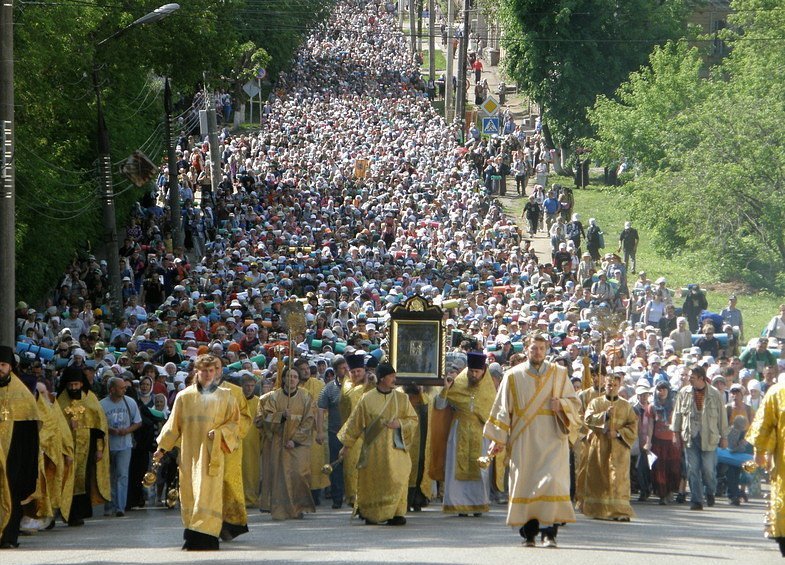
For people who grew up in a godless time, the procession may well cause associations with demonstrations during Soviet holidays, and among modern youth - with flash mobs designed to draw public attention to a particular problem or event. However, the participants in the prayer processions, for which the name of the processions of the cross has been fixed for centuries, are not going to demonstrate anything to anyone: Those for whom they set out on this path - the Lord, the saints and the Heavenly Powers - see the heart of each of them through and through. Which, of course, does not exclude the missionary benefits of the processions of the cross, hundreds of which take place every year in Christian-populated cities and towns around the world. Why exactly a move? Why not sitting, lying, not dancing, finally - after all, any of these actions, if necessary, can be filled with a religious meaning? The fact is that since the ancient times of our civilization, a way of life has been known as a path that, if possible, must be passed with dignity to the end. And what does it mean to live with dignity in the Christian sense? First of all - to live, remembering God, who knows the words, deeds and intentions of a person at every moment of his life. It is this passage of life that symbolizes the procession of the cross among Christians.
Religious procession around the temple And the reasons for doing it can be very different. As the history of the Church testifies, from the first centuries of Christianity, believers with lighted candles in their hands walked around the church on the feast of the bright Resurrection of Christ, as if following the myrrh-bearing wives. This tradition has survived to this day - such processions of the cross are usually called regular, that is, timed to coincide with the annual circle of services and the church calendar. They are performed either around the temple 'anti-saline', that is, counterclockwise, or from the temple to a certain point - for example, to the font on the feast of Epiphany. The tradition of religious processions became widespread at the turn of the Ancient World and the Middle Ages. Tradition links the authorship of the first rite of the procession with the name of St. John Chrysostom. The heresy of Arianism, which was widespread in that era, introduced entertainment meetings on Sundays; in order to remind people how it truly befits Christians to praise God, and the rite of this, so to speak, dynamic worship was drawn up. But this is in form - in terms of content, it is considered a lithium, that is, an augmented, intensified prayer. During the procession of the cross, the words of the Gospel are heard, prayer petitions are raised - litanies, church hymns are sung. The purpose of all these actions is to introduce those in the movement of believers into a special prayer state, into a special spiritual rhythm. That is why during the procession, conversations are excluded (except for the shortest phrases if necessary), and even more so - smoking, quarrels, idle gazing at people and surrounding landscapes. In 1882, Metropolitan Filaret of Moscow wrote a special instruction for the faithful of Russia 'How to behave during a procession'. It contains, among others, the following words: “When you enter the procession of the cross, think that you are walking under the leadership of the saints, whose icons are walking in it, and that you are drawing closer to the Lord Himself ... prayer, and if you do not hear from a distance, call upon the Lord God and His saints, known to you in the manner of prayer. Do not enter into conversations with those accompanying you, but answer the beginning of the conversation with a silent bow or a short, only necessary word. '
Children's procession in St. Petersburg
Velikoretsky religious procession
If you penetrate deeper into the thickness of the centuries, you can find many events in the Holy Scriptures and Tradition, each of which can be considered a kind of prototype of the procession. The Jews had a tradition on the Feast of Tabernacles to walk seven times with palm branches in their hands a special place in the synagogue - almemar. All of its inhabitants took part in the solemn bringing of the Ark to Jerusalem by the king and the prophet David. Finally, the Savior Himself, surrounded by the apostles, entered the Holy City on a young colt, and the people of Israel spread branches to those walking under their feet with joyful exclamations and trumpets. There are also examples of not so peaceful, but still sincerely pious processions. The Roman emperor Constantine the Great, believing the heavenly sign of the cross and the words 'Conquer by this', ordered his soldiers to depict crosses on their shields - and won the battle that followed. We can also recall the seven-day tour of Jericho by the army of Joshua, ahead of which the Ark of the Covenant followed: on the seventh day, when the Israelites began to blow their trumpets and shout unanimously, the city wall collapsed and Jericho surrendered. But why is the procession called the cross? Because in front of such a procession they always carry the main symbol of Christianity - the cross. Although, to be absolutely precise, first comes the sexton with a lighted lantern, symbolizing the truth of God, dissolving the darkness of sinfulness. And already behind him they carry the altar cross and the image of the Mother of God, and then - banners, special church banners. Then come the chanters, sextons with candles, deacons with censers, and after them, in pairs, priests. In the last pair of them, the one on the right carries the Gospel, and the one on the left carries an icon. The laity marching behind the clergy follow with prayer singing, rather tightly so that no strangers cross the paths of the participants in the procession. Before the beginning of the godless era, this, of course, would not have occurred to anyone, but today it is sometimes required to specifically ask passers-by to let the entire procession pass.
Godfather flight over the flooded Amur region
Rafting on the Cross For the well-being of the Kuznetsk land
In addition to regular religious processions dedicated to holidays and memorable days, extraordinary ones are also held. They can be associated with wars, epidemics, civil unrest. The times when St. John Chrysostom created the liturgical rite of the cross procession, according to the chroniclers, were marked by many natural and man-made disasters: earthquakes, fires, floods, riots ... In those days people clearly understood that many of these things connected with a distorted human worldview, from which sinful actions, rash words, passionate feelings and wrong intentions arise - and, as a result, the reaction of the world of God to all this. Therefore, composing the sequence of the procession with the cross, the saint also provided for the possibility of a procession of repentance, pleading, pleading with the Creator to correct the ways of people and calm the anger of the elements. Such processions of the cross take place today. And more and more often, new reasons for their conduct known for centuries are being added: the scourge of drug addiction and indiscriminate drunkenness, the epidemic of divorce and abandonment of children to their fate, the frenzy of politicians obsessed with a spirit of resistance, capable of provoking fratricide on a national and even planetary scale with their words and deeds ... To prevent this from happening, but the alarming tendencies in society began to decline, and participants in prayer processions with a cross in front take to the streets of cities. Sometimes these processions consist only of children and adolescents, which gives such processions a special mood. After all, children, as you know, to a greater extent retained the feeling of the world of God, as a miracle - while we, adults, in our everyday hustle and bustle, rarely even think about such things.
In terms of its duration, the procession can take from several minutes, if it follows around the temple, to several days or even weeks. In the latter case, it would also be quite right to call it a pilgrimage journey, during which a person inevitably changes - to a greater or lesser extent, sometimes imperceptibly to others, but it is quite obvious to himself: an understanding of the essence of the problems existing in his life comes to him, answers to long ago the questions that tormented him, and the situation around him after passing such a path begins to change noticeably ... Perhaps the most famous of the multi-day processions of the cross existing in modern Russia is Velikoretsky, the tradition of which is rooted in the events of the fourteenth century far from us. More precisely, in 1383, when the miraculous icon of St. Nicholas the Pleasant was found. She, surrounded by a radiance, similar to the light of many candles, was found at the source of waters, returning home at night, by a pious man named Semyon Agalakov. Soon miraculous healings of the sick began to take place in his village. The fame of the miraculous image quickly spread throughout Russia. A pilgrimage began to the icon, which was transferred to Khlynov. Every year, on the day the icon was found, believers solemnly carried the holy image (very large and weight) with a procession to the place of its acquisition - and then returned to the Khlynovsky temple. The places along which the route ran were so wild that in the early years the crucifixes had to overcome part of the way by water, and the other part - making their way through the forest thicket. The Velikoretskaya icon is mentioned in many Russian chronicles. In the 16th century, Tsar Ivan IV, nicknamed the Terrible, solemnly met her in Moscow. Even in godless times, the tradition of the procession from Khlynov to the place where the revered image was acquired was not interrupted - however, those processions were very few in number, and their participants were often detained by the police ...
Religious procession of bikers, Izhevsk After the end of the Soviet era, the tradition of the Velikoretsky religious procession has returned to its former strength. Today, thousands of people from all over Russia and even from outside Russia take part in the annual prayer procession. In order to overcome the 150-kilometer route on foot, considerable strength is required, and not only physical, but also spiritual. Nevertheless, the number of people at the Velikoretsky religious procession nowadays only increases from year to year. Residents of villages, past which the route of the pilgrimage procession runs, kneel down and cross themselves when the godparents the move passes by. And at the final point of the journey - on the site of the finding of the miraculous image of St. Nicholas, Archbishop of Myra in Lycia - a small chapel was built not so long ago. In our time of rapid technological progress and all kinds of innovations, people go on religious processions not only on foot on dry land. They sail in boats and boats on lakes and rivers, sometimes going ashore for common prayer - and the length of such a route can be hundreds of kilometers. Recently, the tradition of such a “cross-rafting”, after long decades of oblivion, has been revived on the land of Kuzbass. In Yaroslavl, bikers, accompanied by priests, go around all the entrances to the city - prayers are served at the worship crosses installed there, for which believers ask that as few compatriots as possible die and be injured in road accidents. In many cities of Russia, Ukraine. In Belarus and some other countries, bishops, priests and representatives of local authorities together make a 'flight of the cross', rising up in helicopters, then describing a circle in the sky, and invoking the blessing of God on this earth, this city, and everyone living in it ... So forms of this phenomenon of church life can be very different, but its essence remains unchanged: it is in the general effort of people, raising from above by its nature, in the unified will of many, prompting a person to take a step towards his Creator. V. Sergienko
Why do people go to the processionWhy do people go to the procession For people who grew up in a godless time, the procession may well cause associations with demonstrations during Soviet holidays, and among modern youth - with flash mobs designed to draw public attention to a particular problem or event. However, the participants in the prayer processions, for which the name of the processions of the cross has been fixed for centuries, are not going to demonstrate anything to anyone: Those for whom they set out on this path - the Lord, the saints and the Heavenly Powers - see the heart of each of them through and through. Which, of course, does not exclude the missionary benefits of the processions of the cross, hundreds of which take place every year in Christian-populated cities and towns around the world. Why exactly a move? Why not sitting, lying, not dancing, finally - after all, any of these actions, if necessary, can be filled with a religious meaning? The fact is that since the ancient times of our civilization, a way of life has been known as a path that, if possible, must be passed with dignity to the end. And what does it mean to live with dignity in the Christian sense? First of all - to live, remembering God, who knows the words, deeds and intentions of a person at every moment of his life. It is this passage of life that symbolizes the procession of the cross among Christians. Religious procession around the temple And the reasons for doing it can be very different. As the history of the Church testifies, from the first centuries of Christianity, believers with lighted candles in their hands walked around the church on the feast of the bright Resurrection of Christ, as if following the myrrh-bearing wives. This tradition has survived to this day - such processions of the cross are usually called regular, that is, timed to coincide with the annual circle of services and the church calendar. They are performed either around the temple 'anti-saline', that is, counterclockwise, or from the temple to a certain point - for example, to the font on the feast of Epiphany. The tradition of religious processions became widespread at the turn of the Ancient World and the Middle Ages. Tradition links the authorship of the first rite of the procession with the name of St. John Chrysostom. The heresy of Arianism, which was widespread in that era, introduced entertainment meetings on Sundays; in order to remind people how it truly befits Christians to praise God, and the rite of this, so to speak, dynamic worship was drawn up. But this is in form - in terms of content, it is considered a lithium, that is, an augmented, intensified prayer. During the procession of the cross, the words of the Gospel are heard, prayer petitions are raised - litanies, church hymns are sung. The purpose of all these actions is to introduce those in the movement of believers into a special prayer state, into a special spiritual rhythm. That is why during the procession, conversations are excluded (except for the shortest phrases if necessary), and even more so - smoking, quarrels, idle gazing at people and surrounding landscapes. In 1882, Metropolitan Filaret of Moscow wrote a special instruction for the faithful of Russia 'How to behave during a procession'. It contains, among others, the following words: “When you enter the procession of the cross, think that you are walking under the leadership of the saints, whose icons are walking in it, and that you are drawing closer to the Lord Himself ... prayer, and if you do not hear from a distance, call upon the Lord God and His saints, known to you in the manner of prayer. Do not enter into conversations with those accompanying you, but answer the beginning of the conversation with a silent bow or a short, only necessary word. ' Children's procession in St. Petersburg Velikoretsky religious procession If you penetrate deeper into the thickness of the centuries, you can find many events in the Holy Scriptures and Tradition, each of which can be considered a kind of prototype of the procession. The Jews had a tradition on the Feast of Tabernacles to walk seven times with palm branches in their hands a special place in the synagogue - almemar. All of its inhabitants took part in the solemn bringing of the Ark to Jerusalem by the king and the prophet David. Finally, the Savior Himself, surrounded by the apostles, entered the Holy City on a young colt, and the people of Israel spread branches to those walking under their feet with joyful exclamations and trumpets. There are also examples of not so peaceful, but still sincerely pious processions. The Roman emperor Constantine the Great, believing the heavenly sign of the cross and the words 'Conquer by this', ordered his soldiers to depict crosses on their shields - and won the battle that followed. We can also recall the seven-day tour of Jericho by the army of Joshua, ahead of which the Ark of the Covenant followed: on the seventh day, when the Israelites began to blow their trumpets and shout unanimously, the city wall collapsed and Jericho surrendered. But why is the procession called the cross? Because in front of such a procession they always carry the main symbol of Christianity - the cross. Although, to be absolutely precise, first comes the sexton with a lighted lantern, symbolizing the truth of God, dissolving the darkness of sinfulness. And already behind him they carry the altar cross and the image of the Mother of God, and then - banners, special church banners. Then come the chanters, sextons with candles, deacons with censers, and after them, in pairs, priests. In the last pair of them, the one on the right carries the Gospel, and the one on the left carries an icon. The laity marching behind the clergy follow with prayer singing, rather tightly so that no strangers cross the paths of the participants in the procession. Before the beginning of the godless era, this, of course, would not have occurred to anyone, but today it is sometimes required to specifically ask passers-by to let the entire procession pass. Godfather flight over the flooded Amur region Rafting on the Cross For the well-being of the Kuznetsk land In addition to regular religious processions dedicated to holidays and memorable days, extraordinary ones are also held. They can be associated with wars, epidemics, civil unrest. The times when St. John Chrysostom created the liturgical rite of the cross procession, according to the chroniclers, were marked by many natural and man-made disasters: earthquakes, fires, floods, riots ... In those days people clearly understood that many of these things connected with a distorted human worldview, from which sinful actions, rash words, passionate feelings and wrong intentions arise - and, as a result, the reaction of the world of God to all this. Therefore, composing the sequence of the procession with the cross, the saint also provided for the possibility of a procession of repentance, pleading, pleading with the Creator to correct the ways of people and calm the anger of the elements. Such processions of the cross take place today. And more and more often, new reasons for their conduct known for centuries are being added: the scourge of drug addiction and indiscriminate drunkenness, the epidemic of divorce and abandonment of children to their fate, the frenzy of politicians obsessed with a spirit of resistance, capable of provoking fratricide on a national and even planetary scale with their words and deeds ... To prevent this from happening, but the alarming tendencies in society began to decline, and participants in prayer processions with a cross in front take to the streets of cities. Sometimes these processions consist only of children and adolescents, which gives such processions a special mood. After all, children, as you know, to a greater extent retained the feeling of the world of God, as a miracle - while we, adults, in our everyday hustle and bustle, rarely even think about such things. In terms of its duration, the procession can take from several minutes, if it follows around the temple, to several days or even weeks. In the latter case, it would also be quite right to call it a pilgrimage journey, during which a person inevitably changes - to a greater or lesser extent, sometimes imperceptibly to others, but it is quite obvious to himself: an understanding of the essence of the problems existing in his life comes to him, answers to long ago the questions that tormented him, and the situation around him after passing such a path begins to change noticeably ... Perhaps the most famous of the multi-day processions of the cross existing in modern Russia is Velikoretsky, the tradition of which is rooted in the events of the fourteenth century far from us. More precisely, in 1383, when the miraculous icon of St. Nicholas the Pleasant was found. She, surrounded by a radiance, similar to the light of many candles, was found at the source of waters, returning home at night, by a pious man named Semyon Agalakov. Soon miraculous healings of the sick began to take place in his village. The fame of the miraculous image quickly spread throughout Russia. A pilgrimage began to the icon, which was transferred to Khlynov. Every year, on the day the icon was found, believers solemnly carried the holy image (very large and weight) with a procession to the place of its acquisition - and then returned to the Khlynovsky temple. The places along which the route ran were so wild that in the early years the crucifixes had to overcome part of the way by water, and the other part - making their way through the forest thicket. The Velikoretskaya icon is mentioned in many Russian chronicles. In the 16th century, Tsar Ivan IV, nicknamed the Terrible, solemnly met her in Moscow. Even in godless times, the tradition of the procession from Khlynov to the place where the revered image was acquired was not interrupted - however, those processions were very few in number, and their participants were often detained by the police ... Religious procession of bikers, Izhevsk After the end of the Soviet era, the tradition of the Velikoretsky religious procession has returned to its former strength. Today, thousands of people from all over Russia and even from outside Russia take part in the annual prayer procession. In order to overcome the 150-kilometer route on foot, considerable strength is required, and not only physical, but also spiritual. Nevertheless, the number of people at the Velikoretsky religious procession nowadays only increases from year to year. Residents of villages, past which the route of the pilgrimage procession runs, kneel down and cross themselves when the godparents the move passes by. And at the final point of the journey - on the site of the finding of the miraculous image of St. Nicholas, Archbishop of Myra in Lycia - a small chapel was built not so long ago. In our time of rapid technological progress and all kinds of innovations, people go on religious processions not only on foot on dry land. They sail in boats and boats on lakes and rivers, sometimes going ashore for common prayer - and the length of such a route can be hundreds of kilometers. Recently, the tradition of such a “cross-rafting”, after long decades of oblivion, has been revived on the land of Kuzbass. In Yaroslavl, bikers, accompanied by priests, go around all the entrances to the city - prayers are served at the worship crosses installed there, for which believers ask that as few compatriots as possible die and be injured in road accidents. In many cities of Russia, Ukraine. In Belarus and some other countries, bishops, priests and representatives of local authorities together make a 'flight of the cross', rising up in helicopters, then describing a circle in the sky, and invoking the blessing of God on this earth, this city, and everyone living in it ... So forms of this phenomenon of church life can be very different, but its essence remains unchanged: it is in the general effort of people, raising from above by its nature, in the unified will of many, prompting a person to take a step towards his Creator. V. SergienkoСвеча Иерусалима -en
For people who grew up in a godless time, the procession may well cause associations with demonstrations during Soviet holidays, and among modern youth - with flash mobs designed to draw public attention to a particular problem or event. However, the participants in the prayer processions, for which the name of the processions of the cross has been fixed for centuries, are not going to demonstrate anything to anyone: Those for whom they set out on this path - the Lord, the saints and the Heavenly Powers - see the heart of each of them through and through. Which, of course, does not exclude the missionary benefits of the processions of the cross, hundreds of which take place every year in Christian-populated cities and towns around the world. Why exactly a move? Why not sitting, lying, not dancing, finally - after all, any of these actions, if necessary, can be filled with a religious meaning? The fact is that since the ancient times of our civilization, a way of life has been known as a path that, if possible, must be passed with dignity to the end. And what does it mean to live with dignity in the Christian sense? First of all - to live, remembering God, who knows the words, deeds and intentions of a person at every moment of his life. It is this passage of life that symbolizes the procession of the cross among Christians. Religious procession around the temple And the reasons for doing it can be very different. As the history of the Church testifies, from the first centuries of Christianity, believers with lighted candles in their hands walked around the church on the feast of the bright Resurrection of Christ, as if following the myrrh-bearing wives. This tradition has survived to this day - such processions of the cross are usually called regular, that is, timed to coincide with the annual circle of services and the church calendar. They are performed either around the temple 'anti-saline', that is, counterclockwise, or from the temple to a certain point - for example, to the font on the feast of Epiphany. The tradition of religious processions became widespread at the turn of the Ancient World and the Middle Ages. Tradition links the authorship of the first rite of the procession with the name of St. John Chrysostom. The heresy of Arianism, which was widespread in that era, introduced entertainment meetings on Sundays; in order to remind people how it truly befits Christians to praise God, and the rite of this, so to speak, dynamic worship was drawn up. But this is in form - in terms of content, it is considered a lithium, that is, an augmented, intensified prayer. During the procession of the cross, the words of the Gospel are heard, prayer petitions are raised - litanies, church hymns are sung. The purpose of all these actions is to introduce those in the movement of believers into a special prayer state, into a special spiritual rhythm. That is why during the procession, conversations are excluded (except for the shortest phrases if necessary), and even more so - smoking, quarrels, idle gazing at people and surrounding landscapes. In 1882, Metropolitan Filaret of Moscow wrote a special instruction for the faithful of Russia 'How to behave during a procession'. It contains, among others, the following words: “When you enter the procession of the cross, think that you are walking under the leadership of the saints, whose icons are walking in it, and that you are drawing closer to the Lord Himself ... prayer, and if you do not hear from a distance, call upon the Lord God and His saints, known to you in the manner of prayer. Do not enter into conversations with those accompanying you, but answer the beginning of the conversation with a silent bow or a short, only necessary word. ' Children's procession in St. Petersburg Velikoretsky religious procession If you penetrate deeper into the thickness of the centuries, you can find many events in the Holy Scriptures and Tradition, each of which can be considered a kind of prototype of the procession. The Jews had a tradition on the Feast of Tabernacles to walk seven times with palm branches in their hands a special place in the synagogue - almemar. All of its inhabitants took part in the solemn bringing of the Ark to Jerusalem by the king and the prophet David. Finally, the Savior Himself, surrounded by the apostles, entered the Holy City on a young colt, and the people of Israel spread branches to those walking under their feet with joyful exclamations and trumpets. There are also examples of not so peaceful, but still sincerely pious processions. The Roman emperor Constantine the Great, believing the heavenly sign of the cross and the words 'Conquer by this', ordered his soldiers to depict crosses on their shields - and won the battle that followed. We can also recall the seven-day tour of Jericho by the army of Joshua, ahead of which the Ark of the Covenant followed: on the seventh day, when the Israelites began to blow their trumpets and shout unanimously, the city wall collapsed and Jericho surrendered. But why is the procession called the cross? Because in front of such a procession they always carry the main symbol of Christianity - the cross. Although, to be absolutely precise, first comes the sexton with a lighted lantern, symbolizing the truth of God, dissolving the darkness of sinfulness. And already behind him they carry the altar cross and the image of the Mother of God, and then - banners, special church banners. Then come the chanters, sextons with candles, deacons with censers, and after them, in pairs, priests. In the last pair of them, the one on the right carries the Gospel, and the one on the left carries an icon. The laity marching behind the clergy follow with prayer singing, rather tightly so that no strangers cross the paths of the participants in the procession. Before the beginning of the godless era, this, of course, would not have occurred to anyone, but today it is sometimes required to specifically ask passers-by to let the entire procession pass. Godfather flight over the flooded Amur region Rafting on the Cross For the well-being of the Kuznetsk land In addition to regular religious processions dedicated to holidays and memorable days, extraordinary ones are also held. They can be associated with wars, epidemics, civil unrest. The times when St. John Chrysostom created the liturgical rite of the cross procession, according to the chroniclers, were marked by many natural and man-made disasters: earthquakes, fires, floods, riots ... In those days people clearly understood that many of these things connected with a distorted human worldview, from which sinful actions, rash words, passionate feelings and wrong intentions arise - and, as a result, the reaction of the world of God to all this. Therefore, composing the sequence of the procession with the cross, the saint also provided for the possibility of a procession of repentance, pleading, pleading with the Creator to correct the ways of people and calm the anger of the elements. Such processions of the cross take place today. And more and more often, new reasons for their conduct known for centuries are being added: the scourge of drug addiction and indiscriminate drunkenness, the epidemic of divorce and abandonment of children to their fate, the frenzy of politicians obsessed with a spirit of resistance, capable of provoking fratricide on a national and even planetary scale with their words and deeds ... To prevent this from happening, but the alarming tendencies in society began to decline, and participants in prayer processions with a cross in front take to the streets of cities. Sometimes these processions consist only of children and adolescents, which gives such processions a special mood. After all, children, as you know, to a greater extent retained the feeling of the world of God, as a miracle - while we, adults, in our everyday hustle and bustle, rarely even think about such things. In terms of its duration, the procession can take from several minutes, if it follows around the temple, to several days or even weeks. In the latter case, it would also be quite right to call it a pilgrimage journey, during which a person inevitably changes - to a greater or lesser extent, sometimes imperceptibly to others, but it is quite obvious to himself: an understanding of the essence of the problems existing in his life comes to him, answers to long ago the questions that tormented him, and the situation around him after passing such a path begins to change noticeably ... Perhaps the most famous of the multi-day processions of the cross existing in modern Russia is Velikoretsky, the tradition of which is rooted in the events of the fourteenth century far from us. More precisely, in 1383, when the miraculous icon of St. Nicholas the Pleasant was found. She, surrounded by a radiance, similar to the light of many candles, was found at the source of waters, returning home at night, by a pious man named Semyon Agalakov. Soon miraculous healings of the sick began to take place in his village. The fame of the miraculous image quickly spread throughout Russia. A pilgrimage began to the icon, which was transferred to Khlynov. Every year, on the day the icon was found, believers solemnly carried the holy image (very large and weight) with a procession to the place of its acquisition - and then returned to the Khlynovsky temple. The places along which the route ran were so wild that in the early years the crucifixes had to overcome part of the way by water, and the other part - making their way through the forest thicket. The Velikoretskaya icon is mentioned in many Russian chronicles. In the 16th century, Tsar Ivan IV, nicknamed the Terrible, solemnly met her in Moscow. Even in godless times, the tradition of the procession from Khlynov to the place where the revered image was acquired was not interrupted - however, those processions were very few in number, and their participants were often detained by the police ... Religious procession of bikers, Izhevsk After the end of the Soviet era, the tradition of the Velikoretsky religious procession has returned to its former strength. Today, thousands of people from all over Russia and even from outside Russia take part in the annual prayer procession. In order to overcome the 150-kilometer route on foot, considerable strength is required, and not only physical, but also spiritual. Nevertheless, the number of people at the Velikoretsky religious procession nowadays only increases from year to year. Residents of villages, past which the route of the pilgrimage procession runs, kneel down and cross themselves when the godparents the move passes by. And at the final point of the journey - on the site of the finding of the miraculous image of St. Nicholas, Archbishop of Myra in Lycia - a small chapel was built not so long ago. In our time of rapid technological progress and all kinds of innovations, people go on religious processions not only on foot on dry land. They sail in boats and boats on lakes and rivers, sometimes going ashore for common prayer - and the length of such a route can be hundreds of kilometers. Recently, the tradition of such a “cross-rafting”, after long decades of oblivion, has been revived on the land of Kuzbass. In Yaroslavl, bikers, accompanied by priests, go around all the entrances to the city - prayers are served at the worship crosses installed there, for which believers ask that as few compatriots as possible die and be injured in road accidents. In many cities of Russia, Ukraine. In Belarus and some other countries, bishops, priests and representatives of local authorities together make a 'flight of the cross', rising up in helicopters, then describing a circle in the sky, and invoking the blessing of God on this earth, this city, and everyone living in it ... So forms of this phenomenon of church life can be very different, but its essence remains unchanged: it is in the general effort of people, raising from above by its nature, in the unified will of many, prompting a person to take a step towards his Creator. V. Sergienko