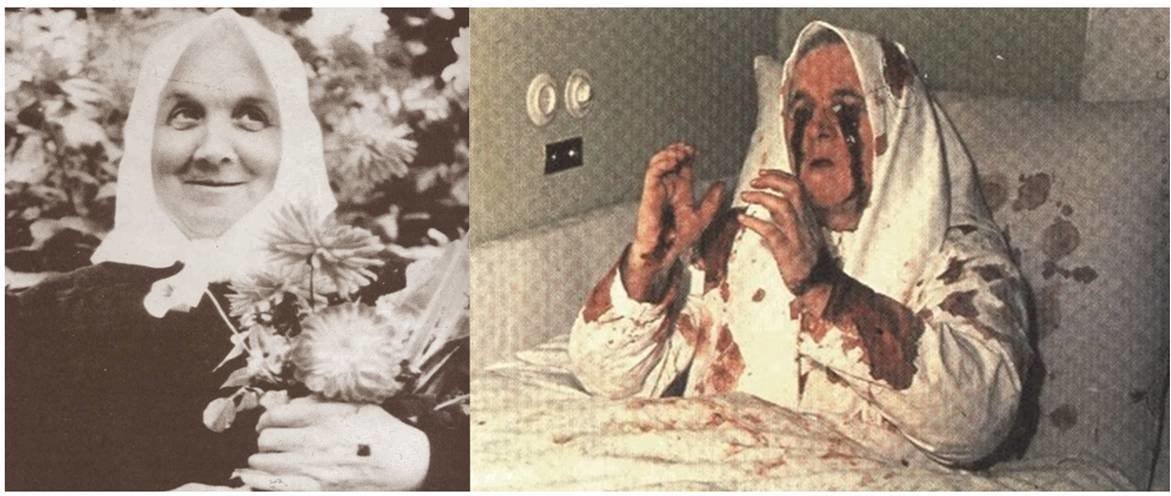
Stigmata - wounds spontaneously opening in Catholic believers and similar to those that were once inflicted on the Savior during His torment of the Cross and on the way to them - is a mysterious and little-studied phenomenon. In the fate of the Bavarian peasant woman Therese Neumann, stigmatism was combined with an even more surprising phenomenon: for about thirty-five years, a deeply religious woman did not take any food or drink, eating exclusively the Holy Communion.
Teresa was born either on 8 or 9 April 1989 in the Bavarian wilderness, in a poor family of a seamstress and tailor, Anna and Ferdinand, and was the first of their eleven children. All the ancestors of the girl and her numerous relatives earned their living by hard peasant labor - and the same occupation, it seemed, was prepared for her from childhood. As a teenager, she worked as a maid on her uncle's farm - and from the age of seventeen, when the manager was called to the front of the First World War, she herself ran the household. When a fire broke out in the barn, Teresa was the first to rush to extinguish it - and fought the fire so selflessly that she fell from the chair she had to stand on in order to reach the fire. Actually, from this fall in her life, a series of changes began, which can equally rightly be called both painful and wonderful.
Soon, young Teresa began to experience excruciating headache attacks and sudden weakness, which were replaced by convulsive seizures. The girl had to return to her parents' house, but here her condition only worsened. The girl developed paralysis. By 1919, she was completely blind. Doctors who visited Teresa stated that they could not cope with a progressive disease.
The bedridden Teresa had the main thing - her fervent faith. Every day, the girl, experiencing terrible suffering, prayed not for deliverance from them - but that Teresa of Lisieux, who wrote the book 'The Story of a Soul' and died in 1897 from tuberculosis ... finally happened, Teresa Neumann woke up feeling that someone was stroking her pillow. She opened her eyes and realized that she was seeing again. It was 1923.
But the paralysis is still there. On the contrary, the convulsions that twisted the girl's body became more and more unbearable. In 1925, Teresa could only lie on her back. Bedsores appeared, the left leg began to fester badly - and the doctors advised me to prepare for its amputation. However, the Lord judged differently. On May 17, Teresa sat on the bed herself, then with the help of her family she got up and walked a few steps. While this was happening, the girl saw a beautiful radiance, from within which a voice was heard asking her: do you want to get well? Teresa silently replied that she saw the good that comes from God, and He knows better what is best for her. After a short pause, she again heard a voice in her mind that said, “You can sit down. Try it, you will succeed. You can also walk, but you will still suffer a lot ... Suffer to save more souls. '
Two weeks later, Teresa, overcoming herself, got ready and went to church. At the market, a crowd of fellow villagers was waiting for her, who learned about the miraculous healing of the girl, who, as it was believed before, had very little to live ... five thousand people coming from all over the world - however, she will receive no more than eight of them.
As promised, the girl continued to suffer. In the fall, Teresa was diagnosed with appendicitis, which threatened to break through and required immediate removal. However, the girl instead called the priest and asked him to pray to her heavenly patroness in the following words: “Saint Teresa, you can help me. You helped me often. I don't care, but look what's wrong with my belly. ' The cleric of the village church, with the zeal of which he was only capable, fulfilled the request - and soon Teresa saw the light again. And I heard a voice: “You will not be cut. Get up, go straight to church and thank God! ' The girl did just that - and the next day the doctor who examined her the day before was shocked: there was no trace of the inflammation, Teresa was completely healthy!
Theresa's visions continued. With their arrival, it seemed, not only her consciousness, but also her body was changing. On Christmas Day 1926, the girl completely refused food, and the next September - and from drinking. Both of them replaced the Holy Communion, which she now received daily.
The Catholic girl, who does not take food or water, aroused the excitement of the representatives of the medical and scientific community. Four nurses, under oath, promised to tell only the truth, in shifts, in pairs, were on duty next to her: they watched, measuring everything down to the volume of liquid for morning and evening mouthwash.
It was around this time that Theresa developed the stigmata. This was preceded by a vision, during which the girl mystically contemplated the blood and sweat of the Savior on the Mount of Olives. After that, Teresa herself developed a bleeding wound on the left side of the chest. Non-healing wounds similar to it were also opened on the hands, on the legs, on the head, and throughout the body - slightly smaller stigmata, as if from blows from a whip. On Good Friday, wounds appeared on the shoulders Teresa - similar to those that could have been with Jesus Christ, who carried the cross to Calvary. On this day, the girl's suffering was especially strong, she was visited by visions on the theme of the Way of the Cross - and bloody tears flowed from her eyes ...
When the stigmata began to bleed, the blood from Teresa's wounds and eyes poured out so abundantly that doctors wondered: from the point of view of medicine, the girl should have died of blood loss long ago - but this did not happen. As for the refusal to eat and drink, for fifteen days of medical observations, to which Teresa agreed (the experiment took place on the hottest days of summer), her weight first dropped from 55 to 51.2 kilograms, then stabilized at 52.5 kilograms - and at the end returned to its baseline.
At one time, Dr. Franz Meyer, who observed Teresa, wrote in a letter to Bishop Michel Buchberger: “As for the stigmata (Teresa), I must emphasize that wounds that remain practically unchanged for eleven years, which never become inflamed, but on the other hand do not respond to treatment with drugs , cannot be of a natural nature. '
As for the mystical visions of Teresa, they were of all kinds. In addition to the Passion of Christ, she mystically contemplated scenes from the life of the Ever-Virgin Mary, the apostles and saints, saw the fate of the souls of the dead and fall of angels. The events that she observed could occur both at this moment in time and in the distant past. In a deep trance state, Teresa attended the Opening of the Holy Year in Rome, a ceremony in Lourdes. Lisieux, Fatime ... Those who were at that time next to her - and among these people there were many scientists, including linguists - heard the words in different languages, which Teresa repeated. Once a girl clearly pronounced in Aramaic: 'Father, into Thy hands I commit my spirit!' It was the same language that was spoken in Palestine during the Savior's earthly life. Of course, a peasant girl from Bavaria could not know him - just as she could not know many other languages, the words of which she spoke during a trance. Actually, she did not know any languages except German and the very rudiments of Latin at all. What can we say, for example, about a rare dialect of French, which is spoken only in the Pyrenees - it was he who was identified by prominent scientists Professor Wutz and Dr. Gerlich, who were next to Teresa during one of her visions. Interestingly, when the sacrament was placed in Teresa's mouth, the visions immediately stopped. To visit it again after a while.
Interestingly, the Catholic Church was extremely skeptical of the stigmatism and visions of Teresa Neumann during her lifetime, recommending that believers refrain from visiting her home in Connersreuth. Nevertheless, people walked, some driven by faith, others by pure curiosity. It is noteworthy that Teresa, as a rule, did not accept openly non-believers, as well as those who came again. Although she was considered almost sagacious, Teresa did not utter prophecies about the fate of the world and did not indulge in spiritual instruction. Remaining a simple native of the Bavarian hinterland, she, as a rule, told people only about those simple things that she herself adhered to: treating her neighbor with mercy and patience, going to church, regularly confessing and accepting the Mysteries of Christ - that's all that, by and large account is required for salvation. And these simple words, and often just being next to an amazing Christian woman, worked miracles. Catholics and Protestants who visited Teresa were strengthened in their faith. Jews, who formerly professed Judaism or were indifferent to any religion in general, received holy baptism. Journalists who wanted to catch a woman cheating returned with nothing, converted to Catholicism, and led their families to faith. There are a lot of such cases recorded - mostly these are first-person stories, in which people sincerely share the extraordinary experience that they themselves experienced.
There are also known cases when Teresa Neumann agreed to become the godmother for the new Christians. Representatives of other religions who visited Teresa left her under an incredibly strong impression. World renowned Indian thinker Paramahansa Yogananda, in his autobiography, says that he visited “the great Catholic mystic, Theresa Neumann of Konnersreuth,” and describes this visit in detail. And Wikipedia, placing an article on Teresa Neumann at the beginning of the 21st century, defines her occupation as 'mystic, farm laborer.'
Theresa Neumann's heart stopped beating on September 18, 1962. The body of an amazing woman, revered by millions of people around the world, was buried in the Konnersroit cemetery. Her grave, as expected, became a place where thousands of pilgrims from different countries flock every year. According to the will of Teresa during her lifetime, the monastery of Ceresianum was built on donations made by people who visited her, after her departure to the Lord. Theresa is named after the information and communication center in Konnersreuth. Back in the middle of the 2000s, the Bishop of Regensburg Ludwig Müller initiated the process of beatification of Theresa Neumann in the Vatican. By that time, more than forty thousand people had already signed the petition asking to be canonized. In the fifteen years that have passed since then, interest in the life of an amazing native of Bavaria in the world has grown significantly.
Teresa was born either on 8 or 9 April 1989 in the Bavarian wilderness, in a poor family of a seamstress and tailor, Anna and Ferdinand, and was the first of their eleven children. All the ancestors of the girl and her numerous relatives earned their living by hard peasant labor - and the same occupation, it seemed, was prepared for her from childhood. As a teenager, she worked as a maid on her uncle's farm - and from the age of seventeen, when the manager was called to the front of the First World War, she herself ran the household. When a fire broke out in the barn, Teresa was the first to rush to extinguish it - and fought the fire so selflessly that she fell from the chair she had to stand on in order to reach the fire. Actually, from this fall in her life, a series of changes began, which can equally rightly be called both painful and wonderful.
Soon, young Teresa began to experience excruciating headache attacks and sudden weakness, which were replaced by convulsive seizures. The girl had to return to her parents' house, but here her condition only worsened. The girl developed paralysis. By 1919, she was completely blind. Doctors who visited Teresa stated that they could not cope with a progressive disease.
The bedridden Teresa had the main thing - her fervent faith. Every day, the girl, experiencing terrible suffering, prayed not for deliverance from them - but that Teresa of Lisieux, who wrote the book 'The Story of a Soul' and died in 1897 from tuberculosis ... finally happened, Teresa Neumann woke up feeling that someone was stroking her pillow. She opened her eyes and realized that she was seeing again. It was 1923.
But the paralysis is still there. On the contrary, the convulsions that twisted the girl's body became more and more unbearable. In 1925, Teresa could only lie on her back. Bedsores appeared, the left leg began to fester badly - and the doctors advised me to prepare for its amputation. However, the Lord judged differently. On May 17, Teresa sat on the bed herself, then with the help of her family she got up and walked a few steps. While this was happening, the girl saw a beautiful radiance, from within which a voice was heard asking her: do you want to get well? Teresa silently replied that she saw the good that comes from God, and He knows better what is best for her. After a short pause, she again heard a voice in her mind that said, “You can sit down. Try it, you will succeed. You can also walk, but you will still suffer a lot ... Suffer to save more souls. '
Two weeks later, Teresa, overcoming herself, got ready and went to church. At the market, a crowd of fellow villagers was waiting for her, who learned about the miraculous healing of the girl, who, as it was believed before, had very little to live ... five thousand people coming from all over the world - however, she will receive no more than eight of them.
As promised, the girl continued to suffer. In the fall, Teresa was diagnosed with appendicitis, which threatened to break through and required immediate removal. However, the girl instead called the priest and asked him to pray to her heavenly patroness in the following words: “Saint Teresa, you can help me. You helped me often. I don't care, but look what's wrong with my belly. ' The cleric of the village church, with the zeal of which he was only capable, fulfilled the request - and soon Teresa saw the light again. And I heard a voice: “You will not be cut. Get up, go straight to church and thank God! ' The girl did just that - and the next day the doctor who examined her the day before was shocked: there was no trace of the inflammation, Teresa was completely healthy!
Theresa's visions continued. With their arrival, it seemed, not only her consciousness, but also her body was changing. On Christmas Day 1926, the girl completely refused food, and the next September - and from drinking. Both of them replaced the Holy Communion, which she now received daily.
The Catholic girl, who does not take food or water, aroused the excitement of the representatives of the medical and scientific community. Four nurses, under oath, promised to tell only the truth, in shifts, in pairs, were on duty next to her: they watched, measuring everything down to the volume of liquid for morning and evening mouthwash.
It was around this time that Theresa developed the stigmata. This was preceded by a vision, during which the girl mystically contemplated the blood and sweat of the Savior on the Mount of Olives. After that, Teresa herself developed a bleeding wound on the left side of the chest. Non-healing wounds similar to it were also opened on the hands, on the legs, on the head, and throughout the body - slightly smaller stigmata, as if from blows from a whip. On Good Friday, wounds appeared on the shoulders Teresa - similar to those that could have been with Jesus Christ, who carried the cross to Calvary. On this day, the girl's suffering was especially strong, she was visited by visions on the theme of the Way of the Cross - and bloody tears flowed from her eyes ...
When the stigmata began to bleed, the blood from Teresa's wounds and eyes poured out so abundantly that doctors wondered: from the point of view of medicine, the girl should have died of blood loss long ago - but this did not happen. As for the refusal to eat and drink, for fifteen days of medical observations, to which Teresa agreed (the experiment took place on the hottest days of summer), her weight first dropped from 55 to 51.2 kilograms, then stabilized at 52.5 kilograms - and at the end returned to its baseline.
At one time, Dr. Franz Meyer, who observed Teresa, wrote in a letter to Bishop Michel Buchberger: “As for the stigmata (Teresa), I must emphasize that wounds that remain practically unchanged for eleven years, which never become inflamed, but on the other hand do not respond to treatment with drugs , cannot be of a natural nature. '
As for the mystical visions of Teresa, they were of all kinds. In addition to the Passion of Christ, she mystically contemplated scenes from the life of the Ever-Virgin Mary, the apostles and saints, saw the fate of the souls of the dead and fall of angels. The events that she observed could occur both at this moment in time and in the distant past. In a deep trance state, Teresa attended the Opening of the Holy Year in Rome, a ceremony in Lourdes. Lisieux, Fatime ... Those who were at that time next to her - and among these people there were many scientists, including linguists - heard the words in different languages, which Teresa repeated. Once a girl clearly pronounced in Aramaic: 'Father, into Thy hands I commit my spirit!' It was the same language that was spoken in Palestine during the Savior's earthly life. Of course, a peasant girl from Bavaria could not know him - just as she could not know many other languages, the words of which she spoke during a trance. Actually, she did not know any languages except German and the very rudiments of Latin at all. What can we say, for example, about a rare dialect of French, which is spoken only in the Pyrenees - it was he who was identified by prominent scientists Professor Wutz and Dr. Gerlich, who were next to Teresa during one of her visions. Interestingly, when the sacrament was placed in Teresa's mouth, the visions immediately stopped. To visit it again after a while.
Interestingly, the Catholic Church was extremely skeptical of the stigmatism and visions of Teresa Neumann during her lifetime, recommending that believers refrain from visiting her home in Connersreuth. Nevertheless, people walked, some driven by faith, others by pure curiosity. It is noteworthy that Teresa, as a rule, did not accept openly non-believers, as well as those who came again. Although she was considered almost sagacious, Teresa did not utter prophecies about the fate of the world and did not indulge in spiritual instruction. Remaining a simple native of the Bavarian hinterland, she, as a rule, told people only about those simple things that she herself adhered to: treating her neighbor with mercy and patience, going to church, regularly confessing and accepting the Mysteries of Christ - that's all that, by and large account is required for salvation. And these simple words, and often just being next to an amazing Christian woman, worked miracles. Catholics and Protestants who visited Teresa were strengthened in their faith. Jews, who formerly professed Judaism or were indifferent to any religion in general, received holy baptism. Journalists who wanted to catch a woman cheating returned with nothing, converted to Catholicism, and led their families to faith. There are a lot of such cases recorded - mostly these are first-person stories, in which people sincerely share the extraordinary experience that they themselves experienced.
There are also known cases when Teresa Neumann agreed to become the godmother for the new Christians. Representatives of other religions who visited Teresa left her under an incredibly strong impression. World renowned Indian thinker Paramahansa Yogananda, in his autobiography, says that he visited “the great Catholic mystic, Theresa Neumann of Konnersreuth,” and describes this visit in detail. And Wikipedia, placing an article on Teresa Neumann at the beginning of the 21st century, defines her occupation as 'mystic, farm laborer.'
Theresa Neumann's heart stopped beating on September 18, 1962. The body of an amazing woman, revered by millions of people around the world, was buried in the Konnersroit cemetery. Her grave, as expected, became a place where thousands of pilgrims from different countries flock every year. According to the will of Teresa during her lifetime, the monastery of Ceresianum was built on donations made by people who visited her, after her departure to the Lord. Theresa is named after the information and communication center in Konnersreuth. Back in the middle of the 2000s, the Bishop of Regensburg Ludwig Müller initiated the process of beatification of Theresa Neumann in the Vatican. By that time, more than forty thousand people had already signed the petition asking to be canonized. In the fifteen years that have passed since then, interest in the life of an amazing native of Bavaria in the world has grown significantly.
Share: