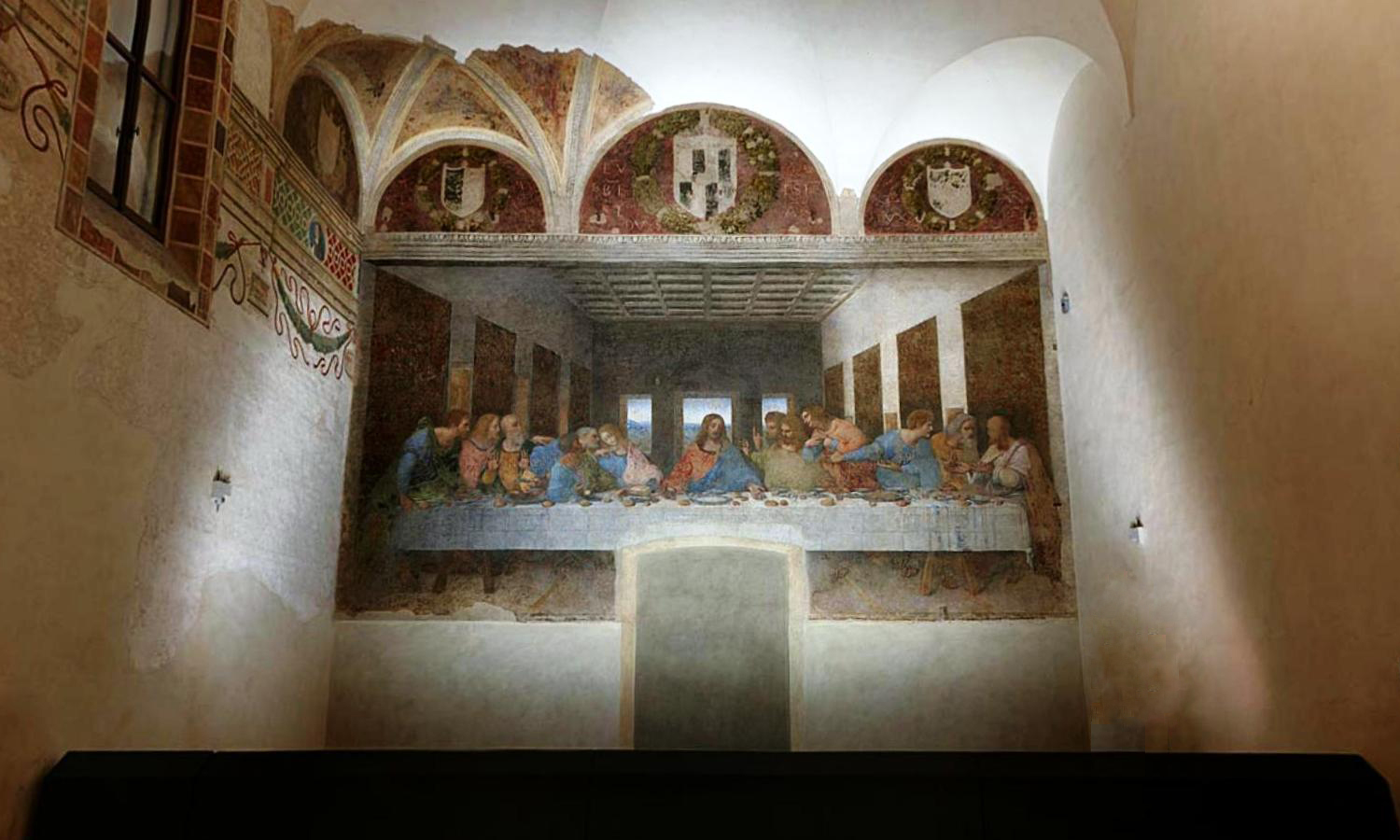
This fresco in the refectory of the Milan church of Santa Maria della Grazie is perhaps the most discussed work in the history of Christian culture, and at the same time - a turning point in the work of the greatest Florentine: Milan, whose authorities invited him to paint a new church, made a strong impression on him and significantly influenced to his artistic style. The last meal of the Lord Jesus Christ with the disciples is a plot that inspired many Renaissance artists to create their own versions of this gospel scene. The great Leonardo also addressed him. To create the painting, he used an original technique: after applying putty and resin with a hot tool, he covered the wall with a thin layer of white, mixed with yellow clay, which made it possible to obtain an absolutely even background. In addition, if da Vinci painted his previous paintings with tempera paints, this time his choice fell on oil paints. He has been working on The Last Supper for quite a long time: from 1495 to 1497, sometimes he does not let go of his brush for days, then he ponders in inaction over the already written part of the image. In the course of work on the fresco, the artist makes many changes and additions - fortunately, oil paints allowed this to be done. The location of the 'Last Supper' is such that from the window of the wall located perpendicular to it on light is pouring into the fresco. One gets the impression that the beholder is watching the last meal of the Savior with the apostles through slightly misted glass. Rather, it was created: in our time, the window is closed so that the sun's rays and street humidity do not destroy the fresco. The artist's intention is thus violated, and the image does not look as impressive as before. Working with oil, in addition to its advantages, also has serious disadvantages. Just a couple of years after the work was completed, da Vinci saw his creation fade. The original method by which the mural was created, among other things, was fraught with the fact that the paint dries too quickly. The increased humidity in the refectory also reflected in the image not in the best way. A decade later, Leonardo was forced to become the first restorer of the painting. The first of many - after all, over the next three centuries, it was restored eight times! The layers of paint that were applied over and over again by the restorers over the original have seriously distorted the original image on the wall. But the greatest damage to the fresco was caused by the monks, who in the 17th century decided to make a doorway in the wall of the refectory, the top of which was on the lower part of the 'Last Supper'. Now it is impossible to restore the lost part of the picture, including the Savior's legs. IN In 1726, Michelangelo Belotti proposed a unique way of restoring the fresco with the help of some 'miraculous product' capable of returning the image to its original appearance - but only worsened the appearance of the masterpiece. In the year 1730, Pietro Mazza took over the work - as a result, the restorer simply stained the painting. Other attempts to work with Leonardo's creation were no more successful. The French monarchs, incessantly fighting for political influence in northern Italy, more than once wanted to take the 'Last Supper' to their homeland along with the wall. It is not known what this intention would result in, but by the grace of God this did not happen. Even the Emperor Napoleon failed to take away the ingenious creation of da Vinci from Milan. By the way, it was he who first ordered that the refectory was always locked in order to preserve the 'Last Supper'. However, his subordinates, who were not noticed in their love of beauty, simply dropped the doors and began to use the premises as a stable. In 1943, a turning point for the course of World War II, when Allied aircraft bombed the city in the summer, the wall with Leonardo's masterpiece miraculously remained intact - while the other three walls and the roof turned into heaps of rubble and debris. But the war ended - and long restoration work began in the church of Santa Maria della Grazie. The fresco by Leonardo da Vinci has been restored since special care. They removed the paint lightly applied during the previous restorations, removed mold, dust particles and other layers. When the restorers finally got to the original, they were in for a shock: barely half of the original painting remained on the wall! .. Finally, in 1999, after twenty-one years of restoration work, Leonardo da Vinci's masterpiece was again opened to human eyes. His colors came to life; modern masters even managed to reproduce the feeling of inner light, which, according to the idea of the genius, shone in the fresco. After the last restoration, the room in which the 'Last Supper' is located was literally filled with devices and systems that maintain the optimum temperature and humidity level at any time of the year. Those wishing to see the immortal creation of da Vinci enter the hall once every quarter of an hour in groups of no more than 25 people. 'The Last Supper' by Leonardo da Vinci hides many patterns that are not noticeable at first glance, and also gives rise to in the minds of every generation of people contemplating this masterpiece, a lot of questions - and sometimes pure speculation. One of the most famous among the latter is the conclusion that, next to the Savior, the picture allegedly depicts not the Apostle John the Theologian, but someone else, whose face, very feminine, resembles another - depicted in an earlier (1494) painting by Leonardo 'Madonna in the grotto' ... However, if the right hand of the Divine Teacher da Vinci placed not His beloved disciple, then where is he in the picture? The belonging of the hand above the table, gripping the knife, remains mysterious - it is unclear to which of the apostles it belongs. There are many other mysteries associated with the 'Last Supper' by Leonardo da Vinci, to which there are no answers to this day. Will the clues be found over time - the future will show. V. Sergienko
Share: