Tabgha: a place where loaves and fishes multiply. Church on seven sources
5 April 2019
The Greek name for this place - Geptabechon - indicates seven springs, the waters of which flow here into the Sea of Galilee. However, modern pilgrims arriving in the Holy Land are more familiar with the name Tabgha: it was here, according to Tradition, that the Savior performed the miracle of the multiplication of loaves and fish, described in the Gospels of the holy apostles Matthew and Mark, when five thousand people were fed with a seemingly negligible amount of food ...
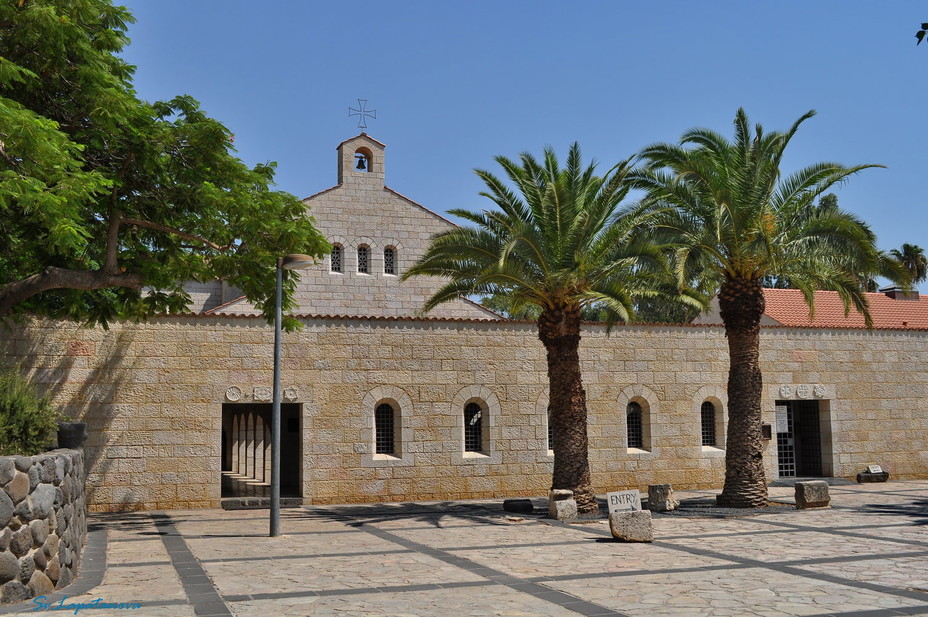
One of the most frequently visited holy places in Galilee by pilgrims is Tabgha with the Church of the Multiplication of Loaves and Fish. Turning left from Tiberias and passing Magdala (Migdal) - the birthplace of Mary Magdalene - the traveler will soon find himself at the very place where the Lord Jesus Christ performed one of His most famous miracles, feeding a huge number of people who came to listen to His sermon with several loaves and a couple of fish. Today, there is a Catholic church built in the 80s of the last century, but it is far from the first in a row on this site. The very first small temple measuring 18 by 9.8 meters in remembrance of the Multiplication of Loaves and Fish was built here back in 350. The mention of him was preserved in a well-known Christian source - the notes of the pilgrim Egeria, who visited these places. in 383. The stone on which food was multiplied by the prayer of the Savior, the pilgrim testifies, was used in her time as an altar - in fact, the entire temple was built around this revered shrine. The remains of this temple, or rather, parts of its foundation, can be seen even today: in a modern church they are carefully placed under strong, thick glass in the floor.
Multiplication stone for loaves and fish
5th century mosaics, under glass - part of an ancient building
In the first centuries of our era, Tabgha was a sparsely populated place near the Sea of Galilee (lake), inhabited mainly by Jewish Christians, who passed on from generation to generation family stories about the miracles performed by the Savior. In addition to the Stone of Multiplication, they also knew a cave near the cliff, associated with the Sermon on the Mount, and a rocky ledge by the lake, on which the Risen Son of God appeared to people. Already in 450, the first church was rebuilt in the Byzantine style, with an altar oriented to the east. It is more spacious than the first - services were performed in it until 614, when it was destroyed during the invasion of the Persians. Visited here in 670 the bishop Arkulf saw in its place only a large number of columns lying near the springs. Since then and until relatively recent times, the remains of the Byzantine temple were hidden deeper and deeper from human eyes under a layer of soil. It wasn't until 1888 that this piece of land was acquired by the German Catholic Society for Palestinian Missions. And four years later, large-scale archaeological research began on it, which lasted several decades. In 1932, Archaeologists Mader and Schneider unearthed ancient masonry with well-preserved early Christian floor mosaics. A basket with five loaves of bread and two fish symbolized a miracle that once happened here; other mosaics depicted lakeside birds and water flowers common in the area. Art critics note that the Egyptian style can be traced in the mosaic images. Perhaps it is associated with the name of Patriarch Martyrius (478 - 486), who lived for some time in Egypt - it is his name that is mentioned in one of the mosaic inscriptions.
The interior of the temple The current three-nave church of the Multiplication of Loaves and Fishes was built in 1982 on the foundations of a Byzantine temple and is, in fact, a reproduction of it. In the same year, Bishop Heffner of Cologne consecrated it - he also gave it to the local the parish is an elaborate processional cross. Outside and inside, the modern temple is very bright, neat and deliberately simple - probably so that the attention of everyone who enters first turns to the main thing: to the Stone of Multiplication, located under the altar, as well as to the ancient mosaics preserved here in large numbers. By the way, in this small church two popes celebrated Mass: Paul VI and John Paul II during their visits to the Holy Land.
In the middle of the churchyard, already decorated with modern mosaics with geometric patterns, there is an amazing fountain with many fish, large and small. Seven taps, from which water runs into it, are also made in the form of fish - they symbolize the seven sources of Tabgha. A picturesque olive tree grows above the fountain. Also noteworthy are the nearby fragments of the former temple buildings, as well as ancient millstones, which were apparently used in the local parish economy. The courtyard is decorated with green spaces and many bright flowers, including water ones. The Temple of the Multiplication of Loaves and Fishes in Tabgha, together with the courtyard and the area around it, belong to the German Catholic Society in the Holy Land. The church is looked after by brothers from Jerusalem Benedictine Abbey of Dormizio. In addition to the church itself, the site houses a boarding house for the disabled and a youth camp, also owned by the Benedictines. And in the courtyard of the temple there is a souvenir shop - an indispensable part of almost any pilgrimage or tourist site located in the territory of the State of Israel. V. Sergienko
Tabgha: a place where loaves and fishes multiply. Church on seven sourcesTabgha: a place where loaves and fishes multiply. Church on seven sources The Greek name for this place - Geptabechon - indicates seven springs, the waters of which flow here into the Sea of Galilee. However, modern pilgrims arriving in the Holy Land are more familiar with the name Tabgha: it was here, according to Tradition, that the Savior performed the miracle of the multiplication of loaves and fish, described in the Gospels of the holy apostles Matthew and Mark, when five thousand people were fed with a seemingly negligible amount of food ... One of the most frequently visited holy places in Galilee by pilgrims is Tabgha with the Church of the Multiplication of Loaves and Fish. Turning left from Tiberias and passing Magdala (Migdal) - the birthplace of Mary Magdalene - the traveler will soon find himself at the very place where the Lord Jesus Christ performed one of His most famous miracles, feeding a huge number of people who came to listen to His sermon with several loaves and a couple of fish. Today, there is a Catholic church built in the 80s of the last century, but it is far from the first in a row on this site. The very first small temple measuring 18 by 9.8 meters in remembrance of the Multiplication of Loaves and Fish was built here back in 350. The mention of him was preserved in a well-known Christian source - the notes of the pilgrim Egeria, who visited these places. in 383. The stone on which food was multiplied by the prayer of the Savior, the pilgrim testifies, was used in her time as an altar - in fact, the entire temple was built around this revered shrine. The remains of this temple, or rather, parts of its foundation, can be seen even today: in a modern church they are carefully placed under strong, thick glass in the floor. Multiplication stone for loaves and fish 5th century mosaics, under glass - part of an ancient building In the first centuries of our era, Tabgha was a sparsely populated place near the Sea of Galilee (lake), inhabited mainly by Jewish Christians, who passed on from generation to generation family stories about the miracles performed by the Savior. In addition to the Stone of Multiplication, they also knew a cave near the cliff, associated with the Sermon on the Mount, and a rocky ledge by the lake, on which the Risen Son of God appeared to people. Already in 450, the first church was rebuilt in the Byzantine style, with an altar oriented to the east. It is more spacious than the first - services were performed in it until 614, when it was destroyed during the invasion of the Persians. Visited here in 670 the bishop Arkulf saw in its place only a large number of columns lying near the springs. Since then and until relatively recent times, the remains of the Byzantine temple were hidden deeper and deeper from human eyes under a layer of soil. It wasn't until 1888 that this piece of land was acquired by the German Catholic Society for Palestinian Missions. And four years later, large-scale archaeological research began on it, which lasted several decades. In 1932, Archaeologists Mader and Schneider unearthed ancient masonry with well-preserved early Christian floor mosaics. A basket with five loaves of bread and two fish symbolized a miracle that once happened here; other mosaics depicted lakeside birds and water flowers common in the area. Art critics note that the Egyptian style can be traced in the mosaic images. Perhaps it is associated with the name of Patriarch Martyrius (478 - 486), who lived for some time in Egypt - it is his name that is mentioned in one of the mosaic inscriptions. The interior of the temple The current three-nave church of the Multiplication of Loaves and Fishes was built in 1982 on the foundations of a Byzantine temple and is, in fact, a reproduction of it. In the same year, Bishop Heffner of Cologne consecrated it - he also gave it to the local the parish is an elaborate processional cross. Outside and inside, the modern temple is very bright, neat and deliberately simple - probably so that the attention of everyone who enters first turns to the main thing: to the Stone of Multiplication, located under the altar, as well as to the ancient mosaics preserved here in large numbers. By the way, in this small church two popes celebrated Mass: Paul VI and John Paul II during their visits to the Holy Land. In the middle of the churchyard, already decorated with modern mosaics with geometric patterns, there is an amazing fountain with many fish, large and small. Seven taps, from which water runs into it, are also made in the form of fish - they symbolize the seven sources of Tabgha. A picturesque olive tree grows above the fountain. Also noteworthy are the nearby fragments of the former temple buildings, as well as ancient millstones, which were apparently used in the local parish economy. The courtyard is decorated with green spaces and many bright flowers, including water ones. The Temple of the Multiplication of Loaves and Fishes in Tabgha, together with the courtyard and the area around it, belong to the German Catholic Society in the Holy Land. The church is looked after by brothers from Jerusalem Benedictine Abbey of Dormizio. In addition to the church itself, the site houses a boarding house for the disabled and a youth camp, also owned by the Benedictines. And in the courtyard of the temple there is a souvenir shop - an indispensable part of almost any pilgrimage or tourist site located in the territory of the State of Israel. V. SergienkoСвеча Иерусалима -en
The Greek name for this place - Geptabechon - indicates seven springs, the waters of which flow here into the Sea of Galilee. However, modern pilgrims arriving in the Holy Land are more familiar with the name Tabgha: it was here, according to Tradition, that the Savior performed the miracle of the multiplication of loaves and fish, described in the Gospels of the holy apostles Matthew and Mark, when five thousand people were fed with a seemingly negligible amount of food ... One of the most frequently visited holy places in Galilee by pilgrims is Tabgha with the Church of the Multiplication of Loaves and Fish. Turning left from Tiberias and passing Magdala (Migdal) - the birthplace of Mary Magdalene - the traveler will soon find himself at the very place where the Lord Jesus Christ performed one of His most famous miracles, feeding a huge number of people who came to listen to His sermon with several loaves and a couple of fish. Today, there is a Catholic church built in the 80s of the last century, but it is far from the first in a row on this site. The very first small temple measuring 18 by 9.8 meters in remembrance of the Multiplication of Loaves and Fish was built here back in 350. The mention of him was preserved in a well-known Christian source - the notes of the pilgrim Egeria, who visited these places. in 383. The stone on which food was multiplied by the prayer of the Savior, the pilgrim testifies, was used in her time as an altar - in fact, the entire temple was built around this revered shrine. The remains of this temple, or rather, parts of its foundation, can be seen even today: in a modern church they are carefully placed under strong, thick glass in the floor. Multiplication stone for loaves and fish 5th century mosaics, under glass - part of an ancient building In the first centuries of our era, Tabgha was a sparsely populated place near the Sea of Galilee (lake), inhabited mainly by Jewish Christians, who passed on from generation to generation family stories about the miracles performed by the Savior. In addition to the Stone of Multiplication, they also knew a cave near the cliff, associated with the Sermon on the Mount, and a rocky ledge by the lake, on which the Risen Son of God appeared to people. Already in 450, the first church was rebuilt in the Byzantine style, with an altar oriented to the east. It is more spacious than the first - services were performed in it until 614, when it was destroyed during the invasion of the Persians. Visited here in 670 the bishop Arkulf saw in its place only a large number of columns lying near the springs. Since then and until relatively recent times, the remains of the Byzantine temple were hidden deeper and deeper from human eyes under a layer of soil. It wasn't until 1888 that this piece of land was acquired by the German Catholic Society for Palestinian Missions. And four years later, large-scale archaeological research began on it, which lasted several decades. In 1932, Archaeologists Mader and Schneider unearthed ancient masonry with well-preserved early Christian floor mosaics. A basket with five loaves of bread and two fish symbolized a miracle that once happened here; other mosaics depicted lakeside birds and water flowers common in the area. Art critics note that the Egyptian style can be traced in the mosaic images. Perhaps it is associated with the name of Patriarch Martyrius (478 - 486), who lived for some time in Egypt - it is his name that is mentioned in one of the mosaic inscriptions. The interior of the temple The current three-nave church of the Multiplication of Loaves and Fishes was built in 1982 on the foundations of a Byzantine temple and is, in fact, a reproduction of it. In the same year, Bishop Heffner of Cologne consecrated it - he also gave it to the local the parish is an elaborate processional cross. Outside and inside, the modern temple is very bright, neat and deliberately simple - probably so that the attention of everyone who enters first turns to the main thing: to the Stone of Multiplication, located under the altar, as well as to the ancient mosaics preserved here in large numbers. By the way, in this small church two popes celebrated Mass: Paul VI and John Paul II during their visits to the Holy Land. In the middle of the churchyard, already decorated with modern mosaics with geometric patterns, there is an amazing fountain with many fish, large and small. Seven taps, from which water runs into it, are also made in the form of fish - they symbolize the seven sources of Tabgha. A picturesque olive tree grows above the fountain. Also noteworthy are the nearby fragments of the former temple buildings, as well as ancient millstones, which were apparently used in the local parish economy. The courtyard is decorated with green spaces and many bright flowers, including water ones. The Temple of the Multiplication of Loaves and Fishes in Tabgha, together with the courtyard and the area around it, belong to the German Catholic Society in the Holy Land. The church is looked after by brothers from Jerusalem Benedictine Abbey of Dormizio. In addition to the church itself, the site houses a boarding house for the disabled and a youth camp, also owned by the Benedictines. And in the courtyard of the temple there is a souvenir shop - an indispensable part of almost any pilgrimage or tourist site located in the territory of the State of Israel. V. Sergienko