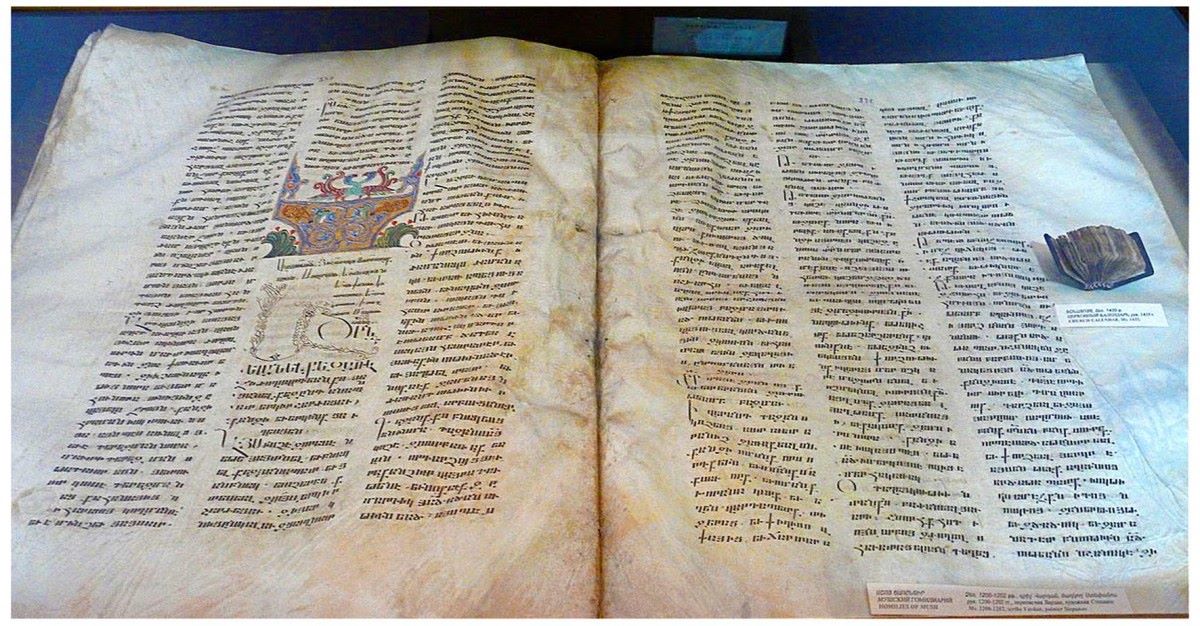
The Mush Homiliarius is the largest handwritten book in the Armenian language: one of its unbound manuscripts weighs nearly thirty kilograms! To create it at the turn of the XII-XIII centuries, it took the skins of six hundred calves. Today, the manuscript containing sermons and selected speeches on spiritual and historical topics, consisting of 604 sheets of parchment (and, accordingly, twice as many pages), is kept under number 7729 in Matenadaran - the Institute of Ancient Manuscripts named after St. Mesrop Mashtots in Yerevan. However, before arriving here, this majestic monument of the spiritual culture of the Armenian people has come a long way for seven centuries.
The Mush Homiliary The manuscript was written over three years, from 1200 to 1202, at the Avag monastery. It was commissioned to the monks by a pious Christian named Astavtsur, who wished to have a book that would combine the lives of the saints, grouped according to the church calendar, sermons, eulogies and descriptions of the most important historical events. Great work! Be that as it may, such a book was written by the monks and then handed over to the customer. It is doubtful, however, that Astavtsur had time to read it. During the Mongol invasion in 1203, he died, and the valuable manuscript was appropriated by the Turks, the judge of the city of Chlat - allegedly in payment for the debt of the deceased. The book was of no value, except for monetary value, for a Mohammedan judge - and he soon put it up for sale. Upon learning of this, the monks from the Surb Arkelots monastery collected a huge amount - 4,000 barats, which for that era was equivalent to the cost of 20 kilograms of silver of the highest standard - and after a grueling bidding they bought a manuscript book. The best scribes from among the monastic brethren carefully edited it and added to its text a story about how it was returned to the bosom of the Armenian Apostolic Church.
Miniature. Christ with Astavtsur There, in the monastery of Arkelots, standing on the slope of Tirnkatar, in the gorge of the Megraget River, surrounded on three sides by mountains, the book stayed for centuries. In the XIX century, the monastic brothers of the Catholic Order of the Mkhitarists from the island of Saint Lazarus (San Lazzaro degli Armeni in the Venetian lagoon) traveled to Arkelots on a pilgrimage - and as a precious relic they took seventeen sheets of the manuscript with them. In a monastery on this island, which, in fact, is the European center for the study of Armenian - and, more broadly, Eastern culture - these sheets are still found. As for the rest of the book, in 1915, when during the First World War the Turks staged a mass extermination of the Armenians, it was almost lost. Two simple women refugees from Mush, fleeing the massacre, find a precious manuscript in a monastery destroyed by the Turks. They split the massive manuscript in two and continue on their way to eastern Armenia. One of the women reaches Echmiadzin and transfers her part of the ancient manuscript to the holy monastery. And the second does not reach - but before death he manages to wrap his half of the book and bury it in the courtyard of the monastery in Erzurum. The manuscript does not stay in the ground for long: the Russian officer Nikolai de Goberti finds this half of the book and takes it to Tiflis, where he then donates it to the museum of the local charitable society of the local Armenian community. Fourteen years after the division, the two parts of the unique book were again united into one whole in the holy Mother See of Etchmiadzin. How many other unique manuscripts were destroyed during the massacres on the territory of western Armenia, it’s scary to even imagine. These are copies of the Bible and the Psalter dating from the first centuries of Christianity to modern times, the richest hagiographic literature, historical, philosophical treatises written by scientists from different times and peoples, masterpieces of Armenian miniatures that existed in a single copy - the loss of these books, both handwritten and printed, for more than a century, without exaggeration, gapes a gap in world culture.
The page with the text and miniature of the Entry of the Lord into Jerusalem by God's providence and thanks to the dedication of two Armenian refugees “Msho Charntir” or Mush homiliary was saved. Their names remained unknown. According to one of the versions, these women were sisters, according to the other - people who were unfamiliar until the time, then united first by a common misfortune, and then - by one great mission for two to save the book. The pages of the Mush homiliary, covered with the ancient Armenian script called Erkatagir, interspersed with unique miniatures and ornaments, are 70.5x55.5 centimeters in size - each of them required the skin of one calf. A monument called 'Life of Eternity' was erected in Yerevan for women who have preserved a masterpiece of Armenian Christian culture for future generations. The monument was made in Prague with the assistance of Moscow businessman Artur Janibekyan - and then transferred to the capital of Armenia by the famous French sculptor David Yerevantsi. The sculpture depicting a woman with a book reminds those contemplating her of the moments the highest flight of the human spirit, when, rising above the material, the soul saves what is important in eternity - and not only for itself, but also for millions of others who have not yet come into this world. V. Sergienko
'Msho Charntir' - Mush homiliary'Msho Charntir' - Mush homiliary The Mush Homiliarius is the largest handwritten book in the Armenian language: one of its unbound manuscripts weighs nearly thirty kilograms! To create it at the turn of the XII-XIII centuries, it took the skins of six hundred calves. Today, the manuscript containing sermons and selected speeches on spiritual and historical topics, consisting of 604 sheets of parchment (and, accordingly, twice as many pages), is kept under number 7729 in Matenadaran - the Institute of Ancient Manuscripts named after St. Mesrop Mashtots in Yerevan. However, before arriving here, this majestic monument of the spiritual culture of the Armenian people has come a long way for seven centuries. The Mush Homiliary The manuscript was written over three years, from 1200 to 1202, at the Avag monastery. It was commissioned to the monks by a pious Christian named Astavtsur, who wished to have a book that would combine the lives of the saints, grouped according to the church calendar, sermons, eulogies and descriptions of the most important historical events. Great work! Be that as it may, such a book was written by the monks and then handed over to the customer. It is doubtful, however, that Astavtsur had time to read it. During the Mongol invasion in 1203, he died, and the valuable manuscript was appropriated by the Turks, the judge of the city of Chlat - allegedly in payment for the debt of the deceased. The book was of no value, except for monetary value, for a Mohammedan judge - and he soon put it up for sale. Upon learning of this, the monks from the Surb Arkelots monastery collected a huge amount - 4,000 barats, which for that era was equivalent to the cost of 20 kilograms of silver of the highest standard - and after a grueling bidding they bought a manuscript book. The best scribes from among the monastic brethren carefully edited it and added to its text a story about how it was returned to the bosom of the Armenian Apostolic Church. Miniature. Christ with Astavtsur There, in the monastery of Arkelots, standing on the slope of Tirnkatar, in the gorge of the Megraget River, surrounded on three sides by mountains, the book stayed for centuries. In the XIX century, the monastic brothers of the Catholic Order of the Mkhitarists from the island of Saint Lazarus (San Lazzaro degli Armeni in the Venetian lagoon) traveled to Arkelots on a pilgrimage - and as a precious relic they took seventeen sheets of the manuscript with them. In a monastery on this island, which, in fact, is the European center for the study of Armenian - and, more broadly, Eastern culture - these sheets are still found. As for the rest of the book, in 1915, when during the First World War the Turks staged a mass extermination of the Armenians, it was almost lost. Two simple women refugees from Mush, fleeing the massacre, find a precious manuscript in a monastery destroyed by the Turks. They split the massive manuscript in two and continue on their way to eastern Armenia. One of the women reaches Echmiadzin and transfers her part of the ancient manuscript to the holy monastery. And the second does not reach - but before death he manages to wrap his half of the book and bury it in the courtyard of the monastery in Erzurum. The manuscript does not stay in the ground for long: the Russian officer Nikolai de Goberti finds this half of the book and takes it to Tiflis, where he then donates it to the museum of the local charitable society of the local Armenian community. Fourteen years after the division, the two parts of the unique book were again united into one whole in the holy Mother See of Etchmiadzin. How many other unique manuscripts were destroyed during the massacres on the territory of western Armenia, it’s scary to even imagine. These are copies of the Bible and the Psalter dating from the first centuries of Christianity to modern times, the richest hagiographic literature, historical, philosophical treatises written by scientists from different times and peoples, masterpieces of Armenian miniatures that existed in a single copy - the loss of these books, both handwritten and printed, for more than a century, without exaggeration, gapes a gap in world culture. The page with the text and miniature of the Entry of the Lord into Jerusalem by God's providence and thanks to the dedication of two Armenian refugees “Msho Charntir” or Mush homiliary was saved. Their names remained unknown. According to one of the versions, these women were sisters, according to the other - people who were unfamiliar until the time, then united first by a common misfortune, and then - by one great mission for two to save the book. The pages of the Mush homiliary, covered with the ancient Armenian script called Erkatagir, interspersed with unique miniatures and ornaments, are 70.5x55.5 centimeters in size - each of them required the skin of one calf. A monument called 'Life of Eternity' was erected in Yerevan for women who have preserved a masterpiece of Armenian Christian culture for future generations. The monument was made in Prague with the assistance of Moscow businessman Artur Janibekyan - and then transferred to the capital of Armenia by the famous French sculptor David Yerevantsi. The sculpture depicting a woman with a book reminds those contemplating her of the moments the highest flight of the human spirit, when, rising above the material, the soul saves what is important in eternity - and not only for itself, but also for millions of others who have not yet come into this world. V. SergienkoСвеча Иерусалима -en
The Mush Homiliarius is the largest handwritten book in the Armenian language: one of its unbound manuscripts weighs nearly thirty kilograms! To create it at the turn of the XII-XIII centuries, it took the skins of six hundred calves. Today, the manuscript containing sermons and selected speeches on spiritual and historical topics, consisting of 604 sheets of parchment (and, accordingly, twice as many pages), is kept under number 7729 in Matenadaran - the Institute of Ancient Manuscripts named after St. Mesrop Mashtots in Yerevan. However, before arriving here, this majestic monument of the spiritual culture of the Armenian people has come a long way for seven centuries. The Mush Homiliary The manuscript was written over three years, from 1200 to 1202, at the Avag monastery. It was commissioned to the monks by a pious Christian named Astavtsur, who wished to have a book that would combine the lives of the saints, grouped according to the church calendar, sermons, eulogies and descriptions of the most important historical events. Great work! Be that as it may, such a book was written by the monks and then handed over to the customer. It is doubtful, however, that Astavtsur had time to read it. During the Mongol invasion in 1203, he died, and the valuable manuscript was appropriated by the Turks, the judge of the city of Chlat - allegedly in payment for the debt of the deceased. The book was of no value, except for monetary value, for a Mohammedan judge - and he soon put it up for sale. Upon learning of this, the monks from the Surb Arkelots monastery collected a huge amount - 4,000 barats, which for that era was equivalent to the cost of 20 kilograms of silver of the highest standard - and after a grueling bidding they bought a manuscript book. The best scribes from among the monastic brethren carefully edited it and added to its text a story about how it was returned to the bosom of the Armenian Apostolic Church. Miniature. Christ with Astavtsur There, in the monastery of Arkelots, standing on the slope of Tirnkatar, in the gorge of the Megraget River, surrounded on three sides by mountains, the book stayed for centuries. In the XIX century, the monastic brothers of the Catholic Order of the Mkhitarists from the island of Saint Lazarus (San Lazzaro degli Armeni in the Venetian lagoon) traveled to Arkelots on a pilgrimage - and as a precious relic they took seventeen sheets of the manuscript with them. In a monastery on this island, which, in fact, is the European center for the study of Armenian - and, more broadly, Eastern culture - these sheets are still found. As for the rest of the book, in 1915, when during the First World War the Turks staged a mass extermination of the Armenians, it was almost lost. Two simple women refugees from Mush, fleeing the massacre, find a precious manuscript in a monastery destroyed by the Turks. They split the massive manuscript in two and continue on their way to eastern Armenia. One of the women reaches Echmiadzin and transfers her part of the ancient manuscript to the holy monastery. And the second does not reach - but before death he manages to wrap his half of the book and bury it in the courtyard of the monastery in Erzurum. The manuscript does not stay in the ground for long: the Russian officer Nikolai de Goberti finds this half of the book and takes it to Tiflis, where he then donates it to the museum of the local charitable society of the local Armenian community. Fourteen years after the division, the two parts of the unique book were again united into one whole in the holy Mother See of Etchmiadzin. How many other unique manuscripts were destroyed during the massacres on the territory of western Armenia, it’s scary to even imagine. These are copies of the Bible and the Psalter dating from the first centuries of Christianity to modern times, the richest hagiographic literature, historical, philosophical treatises written by scientists from different times and peoples, masterpieces of Armenian miniatures that existed in a single copy - the loss of these books, both handwritten and printed, for more than a century, without exaggeration, gapes a gap in world culture. The page with the text and miniature of the Entry of the Lord into Jerusalem by God's providence and thanks to the dedication of two Armenian refugees “Msho Charntir” or Mush homiliary was saved. Their names remained unknown. According to one of the versions, these women were sisters, according to the other - people who were unfamiliar until the time, then united first by a common misfortune, and then - by one great mission for two to save the book. The pages of the Mush homiliary, covered with the ancient Armenian script called Erkatagir, interspersed with unique miniatures and ornaments, are 70.5x55.5 centimeters in size - each of them required the skin of one calf. A monument called 'Life of Eternity' was erected in Yerevan for women who have preserved a masterpiece of Armenian Christian culture for future generations. The monument was made in Prague with the assistance of Moscow businessman Artur Janibekyan - and then transferred to the capital of Armenia by the famous French sculptor David Yerevantsi. The sculpture depicting a woman with a book reminds those contemplating her of the moments the highest flight of the human spirit, when, rising above the material, the soul saves what is important in eternity - and not only for itself, but also for millions of others who have not yet come into this world. V. Sergienko