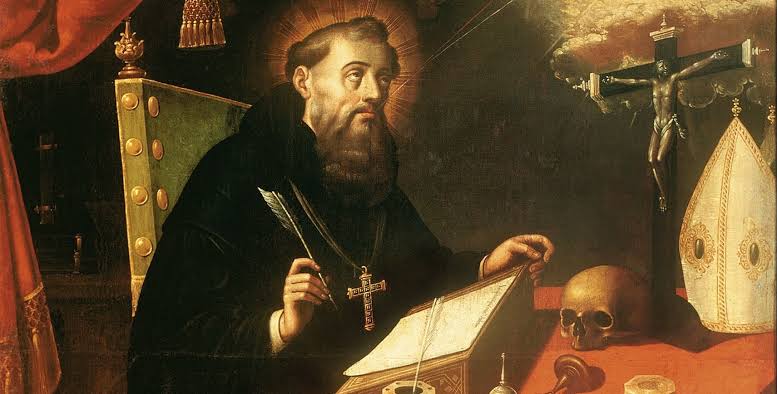
Saint Augustine of Hippo (354–430) is one of the most prominent thinkers and saints in the history of the Church. His works, especially Confessions and The City of God, had a tremendous impact on Western philosophy and Christian theology. Augustine was not only a great theologian but also a man who traveled a long path from skepticism and doubt to faith in Christ.
Early Years and Spiritual Search
Augustine was born in Thagaste, in present-day Algeria, to a Roman official and a deeply devout mother, Saint Monica. Although Monica raised her son in the Christian faith from an early age, young Augustine became fascinated by philosophy and the study of various teachings. Early in his journey, he became a follower of Manichaeism, a dualistic religion that taught that good and evil are in constant conflict.
Despite his successes in studying philosophy and rhetoric, Augustine found no satisfaction in them. His life was full of internal contradictions, and he continued to search for truth. In Confessions, he admits that in his youth, he was far from moral purity and was drawn to worldly pleasures. He describes this period of his life as a time of "wandering in darkness."
Conversion to Christianity
A turning point in Augustine's life occurred in 386 when he heard the voice of a child saying, "Take up and read." This prompted him to open the Bible, and the first thing he read was a passage from the Letter to the Romans: "Let us put aside the deeds of darkness and put on the armor of light" (Romans 13:12). This marked the beginning of his conversion to Christianity.
Augustine was baptized at Easter in 387, and this became the culmination of his spiritual search. He describes this moment in Confessions as liberation from spiritual chains and the attainment of true light.
Augustine’s Theology
Saint Augustine left a vast legacy in the field of theology. His works on sin, grace, predestination, and the nature of the Church became the foundation for many generations of theologians. Augustine taught that human nature is corrupted by original sin and that man cannot be saved by his own efforts. Salvation is possible only through the grace of God.
He also wrote extensively on the sacrament of Baptism, emphasizing its importance for cleansing from original sin and entering the Church. In his writings, Augustine defended the doctrine of predestination, affirming that God foreknows those who will be saved, but this does not negate human free will.
In his famous work The City of God, Augustine develops the concept of two cities: the City of God and the earthly city. The City of God is the spiritual community of believers striving for eternal life with God, while the earthly city focuses on worldly things and temporary pleasures. This work was Augustine's response to the fall of the Roman Empire and is one of the most important books on political theology.
Augustine's Legacy
Saint Augustine had a profound impact on all of Western Christian thought. His works are still studied and discussed today. He became one of the key figures in shaping the understanding of grace, free will, and the relationship between Church and state. His life is an example of how a person, through doubts and mistakes, can find faith and dedicate himself to serving God.
In 1298, Pope Boniface VIII declared Augustine a Doctor of the Church, recognizing his great contribution to the development of Christian thought. His works remain relevant for anyone seeking spiritual growth and understanding of God's will.
Saint Augustine of Hippo is a figure who, through the centuries, continues to inspire people with his deep theology and example of conversion. His Confessions and other works remain powerful testimonies of the soul's journey to God. In his writings, he reveals to us the truths about human nature, grace, and the Church, which are still important in our time.