Is it appropriate to apply iconographic images, Christian symbols and words from Holy Scripture to ordinary objects - souvenirs, dishes, key chains, jewelry? The question for modern Christians living in the era of mass production is highly topical! At the same time, this issue has been around for many centuries. And there is no definite answer to it to this day. Five years ago, the portal 'Orthodoxy and the World' posted a selection of opinions on the topic 'Icons on cups, plates, T-shirts: piety or blasphemy?' The points of view of the speakers, to whom the staff of the authoritative Christian website, addressed, were very different. At that time, priests, monks, Orthodox theologians, icon painters shared their opinion on the issue ... Unfortunately, among the respondents there were no those who constitute an absolute numerical majority in the current Church, namely, ordinary laity. Therefore, even with all the variety of points of view expressed, the results of the survey still looked incomplete - although they drew the most detailed retrospective of the history of the issue, from the time of iconoclasm to the present day. In no way intending to enter into a belated dispute with the popularly read pravmir.ru, we, the authors of The Candle of Jerusalem, will take the liberty of speculating on this acute topic from the point of view of ordinary parishioners of Orthodox churches and even not very churchly people who nevertheless consider themselves to be Christians.
Bracelet with icons Almost in any church shop today you can buy a bracelet, the links of which are nothing more than miniature icons: here are the Savior, and the Mother of God, and St. Nicholas, and a number of other venerated ascetics of the faith. Whether they are made by the official supplier of the church, Sofrino, or local craftsmen is not so important. Another thing is more important: these items are consecrated with a special rite and are offered through a network of specialized stores and church shops. Consequently, there is not only nothing reprehensible in wearing them, but, moreover, the church is thus directly recommended for this very wearing. Which is perfectly reasonable: it is much better if a person puts on a bracelet from a church shop than a handicraft on which the cross and the faces of the saints are likely to be depicted with distortions. Unfortunately, today you can find a lot of such products. As for the wearing of holy images on the hand, which may confuse someone, let us recall that it is the hands that are those parts of the body that we see most often during the day. How many times a day, having seen the icons on bracelet, will a person rush in his thoughts to heaven for even a split second? A lot. You can, perhaps, even say that such moments are a kind of silent prayer that helps the believer to stop internally, to be distracted from routine and to aspire to God at least for a moment.
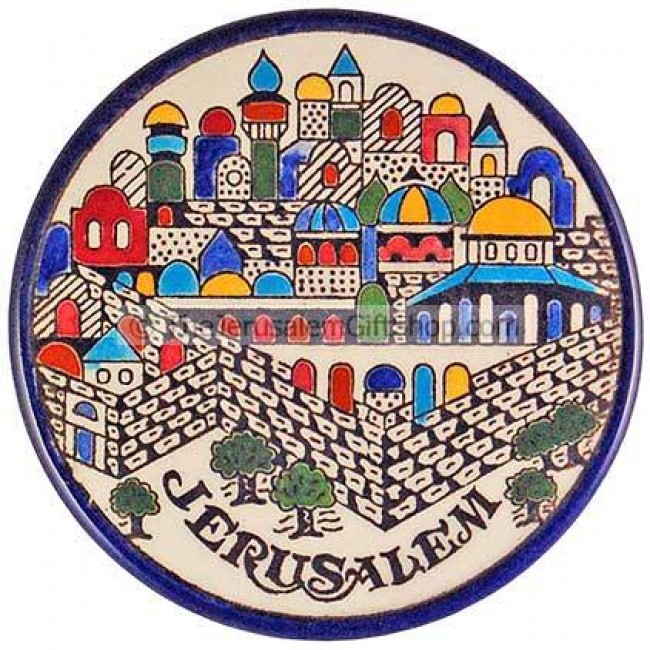
Armenian ceramics of the Jerusalem school Often we come across dishes with images of temples and holy places, and sometimes revered icons. So beautiful that you immediately want to buy it. There are teapots, cups, a variety of dishes with saucers, and flower vases that look so good in the middle of the festive table, and much more. It would seem: what could be more mundane than a plate for food, and is it worth, therefore, to put an image of a temple on it, for example? In fact, there is one very subtle point here, which at first glance is imperceptible. Why is the Lives of the Saints read at dinner in the refectory of a monastery or in a welfare canteen in a parish? Why do we start eating food with prayer and end with it? The fact is that during a meal a person's soul is somehow especially open; psychologists will say that what he heard and seen at this time falls directly into the subconscious - that is, to the very essence of the human soul. What is said at the festive table or at a family dinner is often remembered for years. For this very reason, I think it will be much better if our cutlery is decorated with images of holy places than meaningless, intrusive ornaments or, worse, vulgar pictures and inscriptions. The latter, unfortunately, has firmly entered into everyday life: cups and plates with bold caricatures and the same jokes are not only bought for themselves, but they are willingly given to each other, considering such a gift to be a manifestation of their own wit. What exactly, what thoughts will the soul of a person be open to while drinking tea with such a mug? The answer seems to be obvious. Better to have a cathedral or a rural landscape with a church on it! As for jewelry and bijouterie - medallions, pendants, as well as tokens, which men are happy to wear on a chain - sacred images on them are met, perhaps, by the greatest number of critics. After all, if a cross or incense, according to the Christian tradition, is worn secretly on the body, then these objects are not only visible to others, but often because of their beauty are the first thing that catches their eye. And then suddenly the Savior or the Theotokos of Jerusalem, put on display as it were ...
Necklace with a cross
Sailor's Badge with Image St. Nicholas the Wonderworker
But we never know for certain what exactly happens in the heart of the person who is looking at us. Perhaps right now he is entangled in a life situation, and in order to solve the oppressive problem, he needs to get out of the vicious circle of everyday thoughts, to see what is happening as if from the outside. And then the thought of God can become for his mind exactly the springboard that will help him rise above the situation, survey it from a height - and finally find a solution. And we ourselves, we admit, often begin to behave more meaningfully, restrainedly, when a hand suddenly, as if by chance, touches the medallion with the image of a guardian angel on our chest. By the way, these medallions (and in the male version - tokens) are a separate topic. There are many testimonies, modern and not so much, when it was a soldier's badge with a cross or an image of a saint that turned out to be the only object in front of which a soldier or officer in the middle of the hell of war could turn with fervent prayer to God for the preservation of life. our own or our comrades in arms ... We, of course, are not in a war. But situations are different, and in some of them such a medallion may suddenly turn out to be something much more for us than just a decoration. Don't forget about it.
Keychain with a cross And, finally, souvenirs. It is generally accepted to consider them almost trinkets, little things bought on the occasion - and often and only because each of your friends or work colleagues needs to bring something from the trip. Meanwhile, each such object invisibly carries in itself a particle of the place from which it was brought: if you take it in your hands, memories will flood. Probably everyone knows this feeling. That is why revered temples and monasteries often have shops and shops selling souvenirs depicting local shrines. Each of them, and many years later, can recall the long-standing pilgrimage that a person once made - and would willingly repeat that joyful path, but now, everything will not escape ... Such objects brought from the Holy Land have especially beneficial power. An icon written on a piece of olive tree that grew where the Savior's earthly life took place, a heart carved from Jerusalem stone, on which the face of the Blessed Virgin Mary is skillfully carved, a bottle of consecrated salt from the Church of the Holy Sepulcher ... By the way, in this very temple there is a special place - the only one in the world - where each believer can independently consecrate important for him things. This is the Stone of Confirmation , on which Joseph of Arimathea and Nicodemus prepared in the presence of the Mother of God and the wives of Jerusalem for burial the Body of our Lord taken from the cross ... I also have such an item - a simple icon of the Last Supper, made by a printing method, on the back of which there is a seal with a cross and a single word inscribed in Latin letters: Jerusalem. Almost thirty years ago this icon was presented to me by my father, the choir director, to whom one of the singers brought it from a pilgrimage trip. Since then, a lot of water has flowed under the bridge. My father is no longer alive, I myself have changed several cities and a dozen houses and apartments, children have grown up, my granddaughter is growing up - and that paper icon is still with me: it hasn’t been worn out or lost in the sea of everyday storms! I believe - no, now, perhaps, I even know for sure - that the things brought from the Holy Land or other places on the planet, shining with the glory of Christianity, whether it be a golden cross with precious stones or such a simple icon, has its own special purpose. They allow us to be mentally transported to where the soul of every believer seeks, in order to escape from everyday life at least for a while and remember where we all came from and to Whom we wish to return. V.Sergienko
Holy images and symbols on 'unholy' objectsHoly images and symbols on 'unholy' objects Is it appropriate to apply iconographic images, Christian symbols and words from Holy Scripture to ordinary objects - souvenirs, dishes, key chains, jewelry? The question for modern Christians living in the era of mass production is highly topical! At the same time, this issue has been around for many centuries. And there is no definite answer to it to this day. Five years ago, the portal 'Orthodoxy and the World' posted a selection of opinions on the topic 'Icons on cups, plates, T-shirts: piety or blasphemy?' The points of view of the speakers, to whom the staff of the authoritative Christian website, addressed, were very different. At that time, priests, monks, Orthodox theologians, icon painters shared their opinion on the issue ... Unfortunately, among the respondents there were no those who constitute an absolute numerical majority in the current Church, namely, ordinary laity. Therefore, even with all the variety of points of view expressed, the results of the survey still looked incomplete - although they drew the most detailed retrospective of the history of the issue, from the time of iconoclasm to the present day. In no way intending to enter into a belated dispute with the popularly read pravmir.ru, we, the authors of The Candle of Jerusalem, will take the liberty of speculating on this acute topic from the point of view of ordinary parishioners of Orthodox churches and even not very churchly people who nevertheless consider themselves to be Christians. Bracelet with icons Almost in any church shop today you can buy a bracelet, the links of which are nothing more than miniature icons: here are the Savior, and the Mother of God, and St. Nicholas, and a number of other venerated ascetics of the faith. Whether they are made by the official supplier of the church, Sofrino, or local craftsmen is not so important. Another thing is more important: these items are consecrated with a special rite and are offered through a network of specialized stores and church shops. Consequently, there is not only nothing reprehensible in wearing them, but, moreover, the church is thus directly recommended for this very wearing. Which is perfectly reasonable: it is much better if a person puts on a bracelet from a church shop than a handicraft on which the cross and the faces of the saints are likely to be depicted with distortions. Unfortunately, today you can find a lot of such products. As for the wearing of holy images on the hand, which may confuse someone, let us recall that it is the hands that are those parts of the body that we see most often during the day. How many times a day, having seen the icons on bracelet, will a person rush in his thoughts to heaven for even a split second? A lot. You can, perhaps, even say that such moments are a kind of silent prayer that helps the believer to stop internally, to be distracted from routine and to aspire to God at least for a moment. Armenian ceramics of the Jerusalem school Often we come across dishes with images of temples and holy places, and sometimes revered icons. So beautiful that you immediately want to buy it. There are teapots, cups, a variety of dishes with saucers, and flower vases that look so good in the middle of the festive table, and much more. It would seem: what could be more mundane than a plate for food, and is it worth, therefore, to put an image of a temple on it, for example? In fact, there is one very subtle point here, which at first glance is imperceptible. Why is the Lives of the Saints read at dinner in the refectory of a monastery or in a welfare canteen in a parish? Why do we start eating food with prayer and end with it? The fact is that during a meal a person's soul is somehow especially open; psychologists will say that what he heard and seen at this time falls directly into the subconscious - that is, to the very essence of the human soul. What is said at the festive table or at a family dinner is often remembered for years. For this very reason, I think it will be much better if our cutlery is decorated with images of holy places than meaningless, intrusive ornaments or, worse, vulgar pictures and inscriptions. The latter, unfortunately, has firmly entered into everyday life: cups and plates with bold caricatures and the same jokes are not only bought for themselves, but they are willingly given to each other, considering such a gift to be a manifestation of their own wit. What exactly, what thoughts will the soul of a person be open to while drinking tea with such a mug? The answer seems to be obvious. Better to have a cathedral or a rural landscape with a church on it! As for jewelry and bijouterie - medallions, pendants, as well as tokens, which men are happy to wear on a chain - sacred images on them are met, perhaps, by the greatest number of critics. After all, if a cross or incense, according to the Christian tradition, is worn secretly on the body, then these objects are not only visible to others, but often because of their beauty are the first thing that catches their eye. And then suddenly the Savior or the Theotokos of Jerusalem, put on display as it were ... Necklace with a cross Sailor's Badge with Image St. Nicholas the Wonderworker But we never know for certain what exactly happens in the heart of the person who is looking at us. Perhaps right now he is entangled in a life situation, and in order to solve the oppressive problem, he needs to get out of the vicious circle of everyday thoughts, to see what is happening as if from the outside. And then the thought of God can become for his mind exactly the springboard that will help him rise above the situation, survey it from a height - and finally find a solution. And we ourselves, we admit, often begin to behave more meaningfully, restrainedly, when a hand suddenly, as if by chance, touches the medallion with the image of a guardian angel on our chest. By the way, these medallions (and in the male version - tokens) are a separate topic. There are many testimonies, modern and not so much, when it was a soldier's badge with a cross or an image of a saint that turned out to be the only object in front of which a soldier or officer in the middle of the hell of war could turn with fervent prayer to God for the preservation of life. our own or our comrades in arms ... We, of course, are not in a war. But situations are different, and in some of them such a medallion may suddenly turn out to be something much more for us than just a decoration. Don't forget about it. Keychain with a cross And, finally, souvenirs. It is generally accepted to consider them almost trinkets, little things bought on the occasion - and often and only because each of your friends or work colleagues needs to bring something from the trip. Meanwhile, each such object invisibly carries in itself a particle of the place from which it was brought: if you take it in your hands, memories will flood. Probably everyone knows this feeling. That is why revered temples and monasteries often have shops and shops selling souvenirs depicting local shrines. Each of them, and many years later, can recall the long-standing pilgrimage that a person once made - and would willingly repeat that joyful path, but now, everything will not escape ... Such objects brought from the Holy Land have especially beneficial power. An icon written on a piece of olive tree that grew where the Savior's earthly life took place, a heart carved from Jerusalem stone, on which the face of the Blessed Virgin Mary is skillfully carved, a bottle of consecrated salt from the Church of the Holy Sepulcher ... By the way, in this very temple there is a special place - the only one in the world - where each believer can independently consecrate important for him things. This is the Stone of Confirmation , on which Joseph of Arimathea and Nicodemus prepared in the presence of the Mother of God and the wives of Jerusalem for burial the Body of our Lord taken from the cross ... I also have such an item - a simple icon of the Last Supper, made by a printing method, on the back of which there is a seal with a cross and a single word inscribed in Latin letters: Jerusalem. Almost thirty years ago this icon was presented to me by my father, the choir director, to whom one of the singers brought it from a pilgrimage trip. Since then, a lot of water has flowed under the bridge. My father is no longer alive, I myself have changed several cities and a dozen houses and apartments, children have grown up, my granddaughter is growing up - and that paper icon is still with me: it hasn’t been worn out or lost in the sea of everyday storms! I believe - no, now, perhaps, I even know for sure - that the things brought from the Holy Land or other places on the planet, shining with the glory of Christianity, whether it be a golden cross with precious stones or such a simple icon, has its own special purpose. They allow us to be mentally transported to where the soul of every believer seeks, in order to escape from everyday life at least for a while and remember where we all came from and to Whom we wish to return. V.SergienkoСвеча Иерусалима -en
Is it appropriate to apply iconographic images, Christian symbols and words from Holy Scripture to ordinary objects - souvenirs, dishes, key chains, jewelry? The question for modern Christians living in the era of mass production is highly topical! At the same time, this issue has been around for many centuries. And there is no definite answer to it to this day. Five years ago, the portal 'Orthodoxy and the World' posted a selection of opinions on the topic 'Icons on cups, plates, T-shirts: piety or blasphemy?' The points of view of the speakers, to whom the staff of the authoritative Christian website, addressed, were very different. At that time, priests, monks, Orthodox theologians, icon painters shared their opinion on the issue ... Unfortunately, among the respondents there were no those who constitute an absolute numerical majority in the current Church, namely, ordinary laity. Therefore, even with all the variety of points of view expressed, the results of the survey still looked incomplete - although they drew the most detailed retrospective of the history of the issue, from the time of iconoclasm to the present day. In no way intending to enter into a belated dispute with the popularly read pravmir.ru, we, the authors of The Candle of Jerusalem, will take the liberty of speculating on this acute topic from the point of view of ordinary parishioners of Orthodox churches and even not very churchly people who nevertheless consider themselves to be Christians. Bracelet with icons Almost in any church shop today you can buy a bracelet, the links of which are nothing more than miniature icons: here are the Savior, and the Mother of God, and St. Nicholas, and a number of other venerated ascetics of the faith. Whether they are made by the official supplier of the church, Sofrino, or local craftsmen is not so important. Another thing is more important: these items are consecrated with a special rite and are offered through a network of specialized stores and church shops. Consequently, there is not only nothing reprehensible in wearing them, but, moreover, the church is thus directly recommended for this very wearing. Which is perfectly reasonable: it is much better if a person puts on a bracelet from a church shop than a handicraft on which the cross and the faces of the saints are likely to be depicted with distortions. Unfortunately, today you can find a lot of such products. As for the wearing of holy images on the hand, which may confuse someone, let us recall that it is the hands that are those parts of the body that we see most often during the day. How many times a day, having seen the icons on bracelet, will a person rush in his thoughts to heaven for even a split second? A lot. You can, perhaps, even say that such moments are a kind of silent prayer that helps the believer to stop internally, to be distracted from routine and to aspire to God at least for a moment. Armenian ceramics of the Jerusalem school Often we come across dishes with images of temples and holy places, and sometimes revered icons. So beautiful that you immediately want to buy it. There are teapots, cups, a variety of dishes with saucers, and flower vases that look so good in the middle of the festive table, and much more. It would seem: what could be more mundane than a plate for food, and is it worth, therefore, to put an image of a temple on it, for example? In fact, there is one very subtle point here, which at first glance is imperceptible. Why is the Lives of the Saints read at dinner in the refectory of a monastery or in a welfare canteen in a parish? Why do we start eating food with prayer and end with it? The fact is that during a meal a person's soul is somehow especially open; psychologists will say that what he heard and seen at this time falls directly into the subconscious - that is, to the very essence of the human soul. What is said at the festive table or at a family dinner is often remembered for years. For this very reason, I think it will be much better if our cutlery is decorated with images of holy places than meaningless, intrusive ornaments or, worse, vulgar pictures and inscriptions. The latter, unfortunately, has firmly entered into everyday life: cups and plates with bold caricatures and the same jokes are not only bought for themselves, but they are willingly given to each other, considering such a gift to be a manifestation of their own wit. What exactly, what thoughts will the soul of a person be open to while drinking tea with such a mug? The answer seems to be obvious. Better to have a cathedral or a rural landscape with a church on it! As for jewelry and bijouterie - medallions, pendants, as well as tokens, which men are happy to wear on a chain - sacred images on them are met, perhaps, by the greatest number of critics. After all, if a cross or incense, according to the Christian tradition, is worn secretly on the body, then these objects are not only visible to others, but often because of their beauty are the first thing that catches their eye. And then suddenly the Savior or the Theotokos of Jerusalem, put on display as it were ... Necklace with a cross Sailor's Badge with Image St. Nicholas the Wonderworker But we never know for certain what exactly happens in the heart of the person who is looking at us. Perhaps right now he is entangled in a life situation, and in order to solve the oppressive problem, he needs to get out of the vicious circle of everyday thoughts, to see what is happening as if from the outside. And then the thought of God can become for his mind exactly the springboard that will help him rise above the situation, survey it from a height - and finally find a solution. And we ourselves, we admit, often begin to behave more meaningfully, restrainedly, when a hand suddenly, as if by chance, touches the medallion with the image of a guardian angel on our chest. By the way, these medallions (and in the male version - tokens) are a separate topic. There are many testimonies, modern and not so much, when it was a soldier's badge with a cross or an image of a saint that turned out to be the only object in front of which a soldier or officer in the middle of the hell of war could turn with fervent prayer to God for the preservation of life. our own or our comrades in arms ... We, of course, are not in a war. But situations are different, and in some of them such a medallion may suddenly turn out to be something much more for us than just a decoration. Don't forget about it. Keychain with a cross And, finally, souvenirs. It is generally accepted to consider them almost trinkets, little things bought on the occasion - and often and only because each of your friends or work colleagues needs to bring something from the trip. Meanwhile, each such object invisibly carries in itself a particle of the place from which it was brought: if you take it in your hands, memories will flood. Probably everyone knows this feeling. That is why revered temples and monasteries often have shops and shops selling souvenirs depicting local shrines. Each of them, and many years later, can recall the long-standing pilgrimage that a person once made - and would willingly repeat that joyful path, but now, everything will not escape ... Such objects brought from the Holy Land have especially beneficial power. An icon written on a piece of olive tree that grew where the Savior's earthly life took place, a heart carved from Jerusalem stone, on which the face of the Blessed Virgin Mary is skillfully carved, a bottle of consecrated salt from the Church of the Holy Sepulcher ... By the way, in this very temple there is a special place - the only one in the world - where each believer can independently consecrate important for him things. This is the Stone of Confirmation , on which Joseph of Arimathea and Nicodemus prepared in the presence of the Mother of God and the wives of Jerusalem for burial the Body of our Lord taken from the cross ... I also have such an item - a simple icon of the Last Supper, made by a printing method, on the back of which there is a seal with a cross and a single word inscribed in Latin letters: Jerusalem. Almost thirty years ago this icon was presented to me by my father, the choir director, to whom one of the singers brought it from a pilgrimage trip. Since then, a lot of water has flowed under the bridge. My father is no longer alive, I myself have changed several cities and a dozen houses and apartments, children have grown up, my granddaughter is growing up - and that paper icon is still with me: it hasn’t been worn out or lost in the sea of everyday storms! I believe - no, now, perhaps, I even know for sure - that the things brought from the Holy Land or other places on the planet, shining with the glory of Christianity, whether it be a golden cross with precious stones or such a simple icon, has its own special purpose. They allow us to be mentally transported to where the soul of every believer seeks, in order to escape from everyday life at least for a while and remember where we all came from and to Whom we wish to return. V.Sergienko