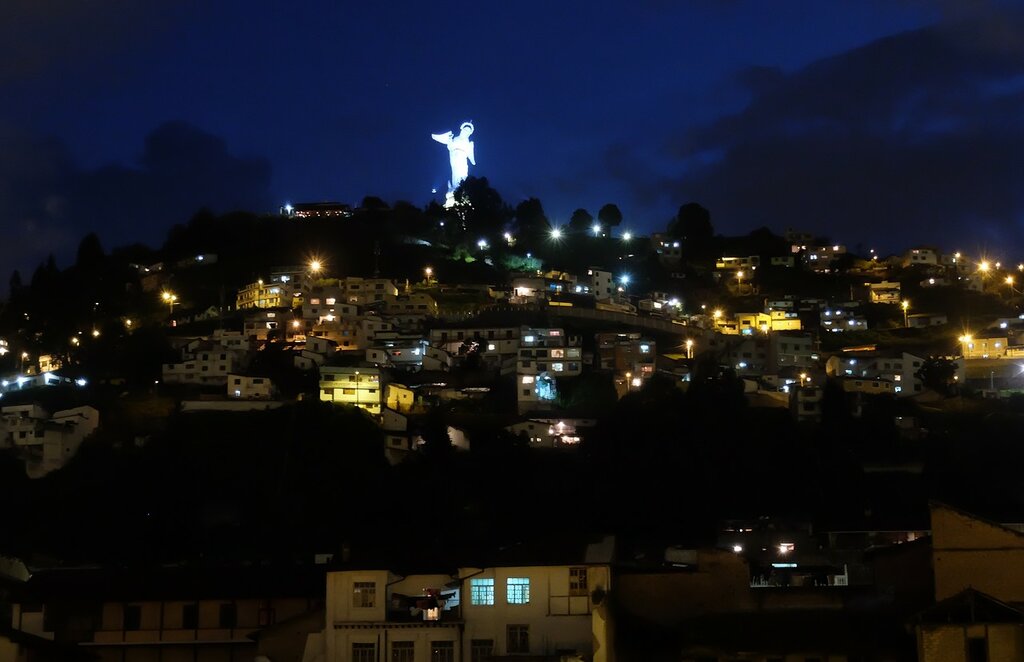
Statue of Our Lady of Quito (La Virgen de Quito)

Статуя Богоматери Кито ( La Virgen de Quito)
The sculptural image of the Lord Jesus Christ in Brazilian Rio de Janeiro is known to the whole world. However, in South America there are other equally impressive cultural monuments, albeit more modest in size. Just one of these is Our Lady of Quito in the capital of Ecuador. On the El Penesillo hill, where, perhaps, all tourists who come to the capital of the country, the city of Quito, climb, there is a sculpture of the Mother of God 41 meters high (if you count with the pedestal, it itself has a height of 30 meters). Locals claim that this statue of the Madonna is the only one in the world in which the Blessed Virgin is depicted with angelic wings behind her back. The symbolism of such a sculptural image is clear to any Christian - and the prototype for its creation was a thirty-centimeter wooden statuette of Our Lady of Quito covered with gold leaf by Bernardo de Legarda, created by the master in 1734. Its original is in the Basilica of St. Francis in Quito, and enlarged copies of Our Lady of Legarda (also known as 'The Dancing Madonna' or 'Virgin of the Apocalypse') are installed in many Catholic churches in the Andes region. The Spanish sculptor Agustin de La Erran Matorras also decided to create his own version of the revered sculpture. In short, he enlarged the original exactly one hundred times and placed it on a pedestal at the point from which the best view of the city opens. The statue on the El Penesillo hill is hollow inside, made of seven thousand aluminum fragments and, of course, supporting structures. The sculptor's idea was realized in just a year of work in 1976. The Virgin Mary stands on the ball, trampling the serpent with her feet. (The latter came out the way the artist saw him: tourists unfamiliar with the Latin American tradition often mistake a snake for a rhinoceros). The statue of Our Lady quickly became a recognizable symbol of Quito. Local urban belief says that those who live in front of the Madonna will be rich and happy, and those who have had a life behind Her back - on the contrary ... There is hardly anything in this statement other than the pride of the inhabitants of the historic center of the city. in relation to the inhabitants of new buildings - the territory behind the back of Our Lady of Quito was built up at a later time. The pedestal of Our Lady of Quito houses a museum, the exposition of which tells how a grandiose statue was erected in the capital of Ecuador. There is also a rather miniature Catholic chapel, in which there are usually few people - and you can always turn to the Mother of God with prayer. A staircase leads from the chapel to the Madonna's feet, which ends with an observation deck. A grandiose panorama opens from it cities with old colonial Quito right on course. In the north there are sleeping areas with offices and shopping centers, in the south there are workers' quarters, factories and factories, and, finally, in the center, there are colonial-style houses, churches of the 16th-18th centuries, museums and monuments. When the list of UNESCO World Heritage Sites just began to form, the historic center of Quito entered it at number 2. After all, it is here, like nowhere else in the New World, that the colonial quarter is perfectly preserved, and the most significant in its area. From the observation deck located at the feet of Our Lady of Quito, it opens up to the eyes in all its splendor. V. Sergienko
Share:
Statue of Our Lady of Quito (La Virgen de Quito) Statue of Our Lady of Quito (La Virgen de Quito) The sculptural image of the Lord Jesus Christ in Brazilian Rio de Janeiro is known to the whole world. However, in South America there are other equally impressive cultural monuments, albeit more modest in size. Just one of these is Our Lady of Quito in the capital of Ecuador. On the El Penesillo hill, where, perhaps, all tourists who come to the capital of the country, the city of Quito, climb, there is a sculpture of the Mother of God 41 meters high (if you count with the pedestal, it itself has a height of 30 meters). Locals claim that this statue of the Madonna is the only one in the world in which the Blessed Virgin is depicted with angelic wings behind her back. The symbolism of such a sculptural image is clear to any Christian - and the prototype for its creation was a thirty-centimeter wooden statuette of Our Lady of Quito covered with gold leaf by Bernardo de Legarda, created by the master in 1734. Its original is in the Basilica of St. Francis in Quito, and enlarged copies of Our Lady of Legarda (also known as 'The Dancing Madonna' or 'Virgin of the Apocalypse') are installed in many Catholic churches in the Andes region. The Spanish sculptor Agustin de La Erran Matorras also decided to create his own version of the revered sculpture. In short, he enlarged the original exactly one hundred times and placed it on a pedestal at the point from which the best view of the city opens. The statue on the El Penesillo hill is hollow inside, made of seven thousand aluminum fragments and, of course, supporting structures. The sculptor's idea was realized in just a year of work in 1976. The Virgin Mary stands on the ball, trampling the serpent with her feet. (The latter came out the way the artist saw him: tourists unfamiliar with the Latin American tradition often mistake a snake for a rhinoceros). The statue of Our Lady quickly became a recognizable symbol of Quito. Local urban belief says that those who live in front of the Madonna will be rich and happy, and those who have had a life behind Her back - on the contrary ... There is hardly anything in this statement other than the pride of the inhabitants of the historic center of the city. in relation to the inhabitants of new buildings - the territory behind the back of Our Lady of Quito was built up at a later time. The pedestal of Our Lady of Quito houses a museum, the exposition of which tells how a grandiose statue was erected in the capital of Ecuador. There is also a rather miniature Catholic chapel, in which there are usually few people - and you can always turn to the Mother of God with prayer. A staircase leads from the chapel to the Madonna's feet, which ends with an observation deck. A grandiose panorama opens from it cities with old colonial Quito right on course. In the north there are sleeping areas with offices and shopping centers, in the south there are workers' quarters, factories and factories, and, finally, in the center, there are colonial-style houses, churches of the 16th-18th centuries, museums and monuments. When the list of UNESCO World Heritage Sites just began to form, the historic center of Quito entered it at number 2. After all, it is here, like nowhere else in the New World, that the colonial quarter is perfectly preserved, and the most significant in its area. From the observation deck located at the feet of Our Lady of Quito, it opens up to the eyes in all its splendor. V. Sergienko
The sculptural image of the Lord Jesus Christ in Brazilian Rio de Janeiro is known to the whole world. However, in South America there are other equally impressive cultural monuments, albeit more modest in size. Just one of these is Our Lady of Quito in the capital of Ecuador. On the El Penesillo hill, where, perhaps, all tourists who come to the capital of the country, the city of Quito, climb, there is a sculpture of the Mother of God 41 meters high (if you count with the pedestal, it itself has a height of 30 meters). Locals claim that this statue of the Madonna is the only one in the world in which the Blessed Virgin is depicted with angelic wings behind her back. The symbolism of such a sculptural image is clear to any Christian - and the prototype for its creation was a thirty-centimeter wooden statuette of Our Lady of Quito covered with gold leaf by Bernardo de Legarda, created by the master in 1734. Its original is in the Basilica of St. Francis in Quito, and enlarged copies of Our Lady of Legarda (also known as 'The Dancing Madonna' or 'Virgin of the Apocalypse') are installed in many Catholic churches in the Andes region. The Spanish sculptor Agustin de La Erran Matorras also decided to create his own version of the revered sculpture. In short, he enlarged the original exactly one hundred times and placed it on a pedestal at the point from which the best view of the city opens. The statue on the El Penesillo hill is hollow inside, made of seven thousand aluminum fragments and, of course, supporting structures. The sculptor's idea was realized in just a year of work in 1976. The Virgin Mary stands on the ball, trampling the serpent with her feet. (The latter came out the way the artist saw him: tourists unfamiliar with the Latin American tradition often mistake a snake for a rhinoceros). The statue of Our Lady quickly became a recognizable symbol of Quito. Local urban belief says that those who live in front of the Madonna will be rich and happy, and those who have had a life behind Her back - on the contrary ... There is hardly anything in this statement other than the pride of the inhabitants of the historic center of the city. in relation to the inhabitants of new buildings - the territory behind the back of Our Lady of Quito was built up at a later time. The pedestal of Our Lady of Quito houses a museum, the exposition of which tells how a grandiose statue was erected in the capital of Ecuador. There is also a rather miniature Catholic chapel, in which there are usually few people - and you can always turn to the Mother of God with prayer. A staircase leads from the chapel to the Madonna's feet, which ends with an observation deck. A grandiose panorama opens from it cities with old colonial Quito right on course. In the north there are sleeping areas with offices and shopping centers, in the south there are workers' quarters, factories and factories, and, finally, in the center, there are colonial-style houses, churches of the 16th-18th centuries, museums and monuments. When the list of UNESCO World Heritage Sites just began to form, the historic center of Quito entered it at number 2. After all, it is here, like nowhere else in the New World, that the colonial quarter is perfectly preserved, and the most significant in its area. From the observation deck located at the feet of Our Lady of Quito, it opens up to the eyes in all its splendor. V. Sergienko