The Syrian Church of the Apostle Mark: Another Room of the Last Supper?
27 October 2018
In the very center of the Old City, on the border of the Armenian and Jewish quarters, at the intersection ofArraratandSyriacConventStreets, there is a rather miniature Church of St. Mark the Apostle, belonging to the ancient Church of the Antioch Patriarchate. This church is the most famous part of the monastery of the same name. Syrian Christians consider the Church of the Apostle Mark to be the oldest of the temples in Jerusalem - and, moreover, the true chamber of the Last Supper. Services in the church are performed in the everyday language of the times of the earthly life of Jesus Christ - Aramaic.
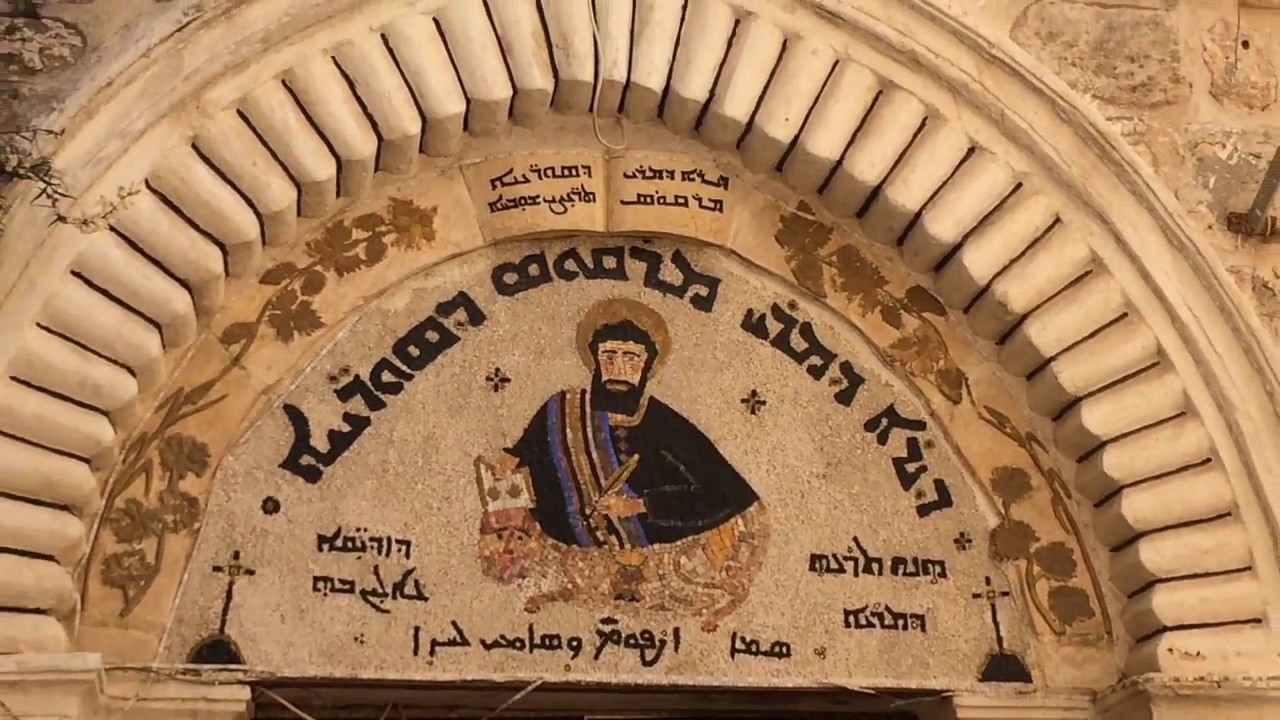
The Syrian community of Jerusalem considers the temple of the Apostle Mark in the monastery named after him to be the oldest Christian church in the Holy City. In confirmation of this, a sign is posted at the entrance to the church; on it is an inscription copied from an ancient column located inside the temple, in its northern part. The inscription is made in Aramaic and says that this church stands on the site of the house of Maryam - the mother of John (John was the name of the Apostle Mark before he became a disciple of St. Peter. Upon his return from Rome, the apostle Mark of seventy, who had already compiled his Gospel, zealously preached the Faith of Christ in his homeland.) Further, the inscription says that after the Ascension of the Lord, the apostles made the house of Mary, Mark's mother, a temple in the name of the Mother of God and that it was destroyed by the Romans and restored by the emperor Titus. The Syrian community determines the age of the inscription on the column at almost two thousand years, scientists - at one and a half thousand. With a high degree of probability, this church appeared here in the middle of the first millennium AD during the time of Bishop Jacob Baradei, who founded the brotherhood (which received his name after him) and made the Syrian (Aramaic) language the official language of his divine services. This version is supported by the fact that it was not Titus who restored Jerusalem, but another emperor of Rome, Hadrian, several decades later. If the tablet belonged to the 1st or even 2nd century AD, the name of the one who undertook such large-scale work would not be forgotten. One way or another, in the Byzantine era, the temple was already in operation, and after that it passed into the jurisdiction of the Jacobite brothers. After the capture of Jerusalem by the crusaders in 1099, the Syrian Christians left the Holy City and went to Egypt. And the building of the church became the property of the Frankish knight Goffier. Given the antiquity and historical significance of the building, it was radically rebuilt and richly decorated - so skillfully that it was then considered one of the most beautiful Christian churches in all of Palestine. As for the knight Goffier, later he was captured and for a long time was considered dead - and when he returned safe and sound, the question of the ownership of the building had to be decided by Queen Melisende. Without going into the twists and turns of this history more than a thousand years ago, we only note that the crowned daughter of Baldwin II ultimately left the right to the temple to the Syrian Christians.
However, this small church received worldwide fame not for the beauty of the ornaments of the era of the Kingdom of Jerusalem. Unlike other Christian denominations, the Syrians consider this building to be the true place of the Last Supper, and not the Upper Room of Zion. And, of course, they cite their own arguments in favor of this statement, relying primarily on the text of the Gospel of Mark. “One young man, wrapped in a veil over his naked body, followed Him; and the soldiers seized him. But he, leaving the veil, ran away from them naked. ' (Mark 14: 51.52). For the other three Evangelists, this episode, which took place immediately after the captivity of the Master, is absent. How would Mark know such details? There can be only one answer here: he himself, then still called John (Yochanan, to be exact), and was that young man! Syrian Christians claim (and the ancient inscription on the tablet mentioned above testifies to the same) that John Mark was at his mother's house on the evening of the Last Supper. From behind the wall, he could hear what was happening in the upper room - and when everyone left it, as if feeling the inevitable, hastily throw a veil directly over the naked body and follow the Lord Jesus Christ and the apostles ... The latter, the Syrians assure, after the captivity of the Teacher, returned to former place, which is also mentioned in the book of Acts. “Then Peter, coming to his senses, said: now I see truly that the Lord sent His Angel and delivered me from the hand of Herod and from all that the Jewish people were waiting for. And looking around, he came to the house of Mary, the mother of John, called Mark, where many gathered and prayed ” (Acts 12: 11-12).
After the crucifixion and Resurrection of the Lord, the Upper Room of the Last Supper became for His disciples a place of frequent meetings and joint prayers - and Syrian Christians believe that this happened exactly here, where the Church of the Apostle Mark now stands. And they will also show the allegedly true room of the Last Supper - however, it is not located in the building on the second (word Coenaculum means 'room on the second floor') , and, so to speak, on the minus second floor - underground ... How did it happen? In response to this question, the children of the Syrian Church reasonably note that over two thousand years the city has grown, the thickness of the cultural layer has greatly increased - and what was previously above the ground is now under it. There is undoubtedly a certain amount of common sense in this statement - but how, in that case, could both biblical scholars and believers of other churches, millions of whom visit the Upper Room on Mount Zion every year? .. Let's leave this question unanswered and remember that in the upper room The Last Supper later happened another event described in the New Testament - the Descent of the Holy Spirit on the apostles. Of course, according to the logic followed by the Syrians, it happened here as well. Now an altar has been erected on the site of events, which in the Eastern tradition are considered to be the birthday of the Christian church, and next to it there is a gilded patriarchal throne with carvings from the 15th century.
Let's try to go inside the church of the Apostle Mark. It is not easy to do this: the small Syrian community, whose members live nearby, do not really like outsiders. You can enter the temple during the services that the Syrian bishop performs here. These services are very long, so there are benches in the church for parishioners, which may seem very unusual to Orthodox Christians from Russia, Ukraine or Belarus. Nevertheless, it is convenient to sit on them and look around inside the ancient temple. Since it is difficult for all worshipers to fit in a small church, chairs are additionally placed in the courtyard. But what you should definitely not do in this church - neither during the service, nor after - is taking pictures or video filming: those who do this have every chance to hear many harsh words addressed to themselves: let them be pronounced in an incomprehensible language, make a mistake in their sense it is very difficult.
However, there is an opportunity to visit the temple of the Apostle Mark when there is no one here. A woman lives in the building adjacent to the courtyard of the temple, who, if you urgently ask her, will let you - not gratuitously, of course - inside the temple and even conduct a short tour with a demonstration of the main relics. These include, firstly, the already mentioned inscription in Aramaic, either the first or the fifth century AD, a copy of which is shown at the entrance to the temple. Here is its full text: “ This is the home of Mary, mother of John, called Mark. It was declared by the holy apostles by the church in honor of the Virgin Mary of the Theotokos after the ascension of the Lord Jesus Christ to heaven. Restored after the destruction of Jerusalem by Titus in 73. ' Here, in the courtyard of the temple, behind the iron gates is the grotto in which the Apostle Peter was hiding after the angel of God miraculously led him out of the prison to this very place. Note that both the grotto and the temple complex itself were thoroughly restored in 2014. Those who have been here before assure that the volume of the work done is quite impressive - while there is no remake around at all: everything here breathes two thousand years of antiquity ... well, perhaps one and a half thousand years! But it is inside. As for the outer walls of the temple - those that stand today - they were erected in the 19th century.
On the southern wall of the temple, carefully sheltered from casual eyes, there is an ancient Icon of the Mother of God with the Son in her arms, which is revered as miraculous. Written on parchment, this icon is said to have been created in the first century AD and belongs to the brush of the Apostle Luke himself. Icon very unusual: the face of the Mother of God on her looks tired, and the face of the Divine Infant - unusually adult, with an expression that is more typical of mature people. Syrian Christians explain this by the fact that the Apostle Luke saw the Savior of the world as an adult - and wrote His face on the icon just like that. If you think about it, this seems very likely. After all, Saint Luke, having come to Jerusalem from Antioch, unexpectedly for himself witnessed the preaching of the Savior, and then the Passion of Christ, the sufferings of the Mother of God, whom in those days, according to the prophecy, “the weapon passed through the soul” and, finally, the way of the cross going to Calvary of the Son of Man. All these events could have left an indelible imprint on the memory of the artist who painted the holy image ... By the way, in the church you can buy oil from the lamp burning at the holy icon, as well as reproductions of the image.
In the church of the Apostle Mark there is a stone font, in which, as the Syrian Christians believe, the Mother of God Herself was baptized. Although a number of Christian denominations question or directly deny the fact of the baptism of the Most Pure, the Eastern churches, relying on the testimony of the Holy Fathers, argue that it is undoubtedly It was. Saint Sophronius, Patriarch of Jerusalem, relying on local tradition, says that the Mother of God was baptized together by the Apostles Peter and John. In the hymns of such a pillar of Orthodoxy as the Monk Ephraim the Syrian, we also find references to this event with reference to an earlier text: 'Epiphanius of Cyprus narrates: like the Theologian baptized the Mother of God, Peter the same and the other apostles.' In the 'Hymns for the Nativity of Christ' the same Venerable Ephraim the Syrian says in the text of one of the hymns: 'How can I call You? ... Will I call You Bridegroom or Lord Who gave birth to His Mother by a new birth in the waters' - and further, but from the face of the Queen of Heaven: 'I am a Slave and a Daughter, because You bought Me and baptized me in the waters ... And as I gave birth to Him with a new birth in the flesh, so He also gave birth to Me with a second birth.' Thus, a Christian belonging to the Eastern tradition should not doubt the fact of the baptism of the Most Pure One - the only question is where it happened: in the house of the mother of the Apostle Mark-John or in some other place. And the last thing that should be said - because without mentioning this event, the story about the Syrian church of the Apostle Mark would be incomplete - refers to a fairly close time to us, namely, to the middle of the last century. It was then, in the midst of the War of Independence Israel, the abbot of the Syrian monastery of the Apostle Mark in Jerusalem, Metropolitan Athanasius Samuel, reasonably fearing for the safety of the relics of the ancient temple, transferred to New York three parchments of the first century BC, which, together with other similar manuscripts found later, will be called the Qumran scrolls or Dead Sea Scrolls. The artifacts taken by the Syrian metropolitan to the New World and sold there for a low price became the first Qumran scrolls to leave the Holy Land. In connection with the inexhaustible interest in the Qumran scrolls and the Essenes community behind them for the past half century, even skilful forgeries of ancient scrolls will appear in the United States - in 2018 independent experts will discover as many as five such replicas, previously considered originals. However, this story has nothing to do with the Syrian Church of the Apostle Mark located in Jerusalem. V. Sergienko
The Syrian Church of the Apostle Mark: Another Room of the Last Supper?The Syrian Church of the Apostle Mark: Another Room of the Last Supper? In the very center of the Old City, on the border of the Armenian and Jewish quarters, at the intersection of Arrarat and Syriac Convent Streets, there is a rather miniature Church of St. Mark the Apostle, belonging to the ancient Church of the Antioch Patriarchate. This church is the most famous part of the monastery of the same name. Syrian Christians consider the Church of the Apostle Mark to be the oldest of the temples in Jerusalem - and, moreover, the true chamber of the Last Supper. Services in the church are performed in the everyday language of the times of the earthly life of Jesus Christ - Aramaic. The Syrian community of Jerusalem considers the temple of the Apostle Mark in the monastery named after him to be the oldest Christian church in the Holy City. In confirmation of this, a sign is posted at the entrance to the church; on it is an inscription copied from an ancient column located inside the temple, in its northern part. The inscription is made in Aramaic and says that this church stands on the site of the house of Maryam - the mother of John (John was the name of the Apostle Mark before he became a disciple of St. Peter. Upon his return from Rome, the apostle Mark of seventy, who had already compiled his Gospel, zealously preached the Faith of Christ in his homeland.) Further, the inscription says that after the Ascension of the Lord, the apostles made the house of Mary, Mark's mother, a temple in the name of the Mother of God and that it was destroyed by the Romans and restored by the emperor Titus. The Syrian community determines the age of the inscription on the column at almost two thousand years, scientists - at one and a half thousand. With a high degree of probability, this church appeared here in the middle of the first millennium AD during the time of Bishop Jacob Baradei, who founded the brotherhood (which received his name after him) and made the Syrian (Aramaic) language the official language of his divine services. This version is supported by the fact that it was not Titus who restored Jerusalem, but another emperor of Rome, Hadrian, several decades later. If the tablet belonged to the 1st or even 2nd century AD, the name of the one who undertook such large-scale work would not be forgotten. One way or another, in the Byzantine era, the temple was already in operation, and after that it passed into the jurisdiction of the Jacobite brothers. After the capture of Jerusalem by the crusaders in 1099, the Syrian Christians left the Holy City and went to Egypt. And the building of the church became the property of the Frankish knight Goffier. Given the antiquity and historical significance of the building, it was radically rebuilt and richly decorated - so skillfully that it was then considered one of the most beautiful Christian churches in all of Palestine. As for the knight Goffier, later he was captured and for a long time was considered dead - and when he returned safe and sound, the question of the ownership of the building had to be decided by Queen Melisende. Without going into the twists and turns of this history more than a thousand years ago, we only note that the crowned daughter of Baldwin II ultimately left the right to the temple to the Syrian Christians. However, this small church received worldwide fame not for the beauty of the ornaments of the era of the Kingdom of Jerusalem. Unlike other Christian denominations, the Syrians consider this building to be the true place of the Last Supper, and not the Upper Room of Zion. And, of course, they cite their own arguments in favor of this statement, relying primarily on the text of the Gospel of Mark. “One young man, wrapped in a veil over his naked body, followed Him; and the soldiers seized him. But he, leaving the veil, ran away from them naked. ' (Mark 14: 51.52). For the other three Evangelists, this episode, which took place immediately after the captivity of the Master, is absent. How would Mark know such details? There can be only one answer here: he himself, then still called John (Yochanan, to be exact), and was that young man! Syrian Christians claim (and the ancient inscription on the tablet mentioned above testifies to the same) that John Mark was at his mother's house on the evening of the Last Supper. From behind the wall, he could hear what was happening in the upper room - and when everyone left it, as if feeling the inevitable, hastily throw a veil directly over the naked body and follow the Lord Jesus Christ and the apostles ... The latter, the Syrians assure, after the captivity of the Teacher, returned to former place, which is also mentioned in the book of Acts. “Then Peter, coming to his senses, said: now I see truly that the Lord sent His Angel and delivered me from the hand of Herod and from all that the Jewish people were waiting for. And looking around, he came to the house of Mary, the mother of John, called Mark, where many gathered and prayed ” (Acts 12: 11-12).After the crucifixion and Resurrection of the Lord, the Upper Room of the Last Supper became for His disciples a place of frequent meetings and joint prayers - and Syrian Christians believe that this happened exactly here, where the Church of the Apostle Mark now stands. And they will also show the allegedly true room of the Last Supper - however, it is not located in the building on the second (word Coenaculum means 'room on the second floor') , and, so to speak, on the minus second floor - underground ... How did it happen? In response to this question, the children of the Syrian Church reasonably note that over two thousand years the city has grown, the thickness of the cultural layer has greatly increased - and what was previously above the ground is now under it. There is undoubtedly a certain amount of common sense in this statement - but how, in that case, could both biblical scholars and believers of other churches, millions of whom visit the Upper Room on Mount Zion every year? .. Let's leave this question unanswered and remember that in the upper room The Last Supper later happened another event described in the New Testament - the Descent of the Holy Spirit on the apostles. Of course, according to the logic followed by the Syrians, it happened here as well. Now an altar has been erected on the site of events, which in the Eastern tradition are considered to be the birthday of the Christian church, and next to it there is a gilded patriarchal throne with carvings from the 15th century. Let's try to go inside the church of the Apostle Mark. It is not easy to do this: the small Syrian community, whose members live nearby, do not really like outsiders. You can enter the temple during the services that the Syrian bishop performs here. These services are very long, so there are benches in the church for parishioners, which may seem very unusual to Orthodox Christians from Russia, Ukraine or Belarus. Nevertheless, it is convenient to sit on them and look around inside the ancient temple. Since it is difficult for all worshipers to fit in a small church, chairs are additionally placed in the courtyard. But what you should definitely not do in this church - neither during the service, nor after - is taking pictures or video filming: those who do this have every chance to hear many harsh words addressed to themselves: let them be pronounced in an incomprehensible language, make a mistake in their sense it is very difficult. However, there is an opportunity to visit the temple of the Apostle Mark when there is no one here. A woman lives in the building adjacent to the courtyard of the temple, who, if you urgently ask her, will let you - not gratuitously, of course - inside the temple and even conduct a short tour with a demonstration of the main relics. These include, firstly, the already mentioned inscription in Aramaic, either the first or the fifth century AD, a copy of which is shown at the entrance to the temple. Here is its full text: “ This is the home of Mary, mother of John, called Mark. It was declared by the holy apostles by the church in honor of the Virgin Mary of the Theotokos after the ascension of the Lord Jesus Christ to heaven. Restored after the destruction of Jerusalem by Titus in 73. ' Here, in the courtyard of the temple, behind the iron gates is the grotto in which the Apostle Peter was hiding after the angel of God miraculously led him out of the prison to this very place. Note that both the grotto and the temple complex itself were thoroughly restored in 2014. Those who have been here before assure that the volume of the work done is quite impressive - while there is no remake around at all: everything here breathes two thousand years of antiquity ... well, perhaps one and a half thousand years! But it is inside. As for the outer walls of the temple - those that stand today - they were erected in the 19th century.On the southern wall of the temple, carefully sheltered from casual eyes, there is an ancient Icon of the Mother of God with the Son in her arms, which is revered as miraculous. Written on parchment, this icon is said to have been created in the first century AD and belongs to the brush of the Apostle Luke himself. Icon very unusual: the face of the Mother of God on her looks tired, and the face of the Divine Infant - unusually adult, with an expression that is more typical of mature people. Syrian Christians explain this by the fact that the Apostle Luke saw the Savior of the world as an adult - and wrote His face on the icon just like that. If you think about it, this seems very likely. After all, Saint Luke, having come to Jerusalem from Antioch, unexpectedly for himself witnessed the preaching of the Savior, and then the Passion of Christ, the sufferings of the Mother of God, whom in those days, according to the prophecy, “the weapon passed through the soul” and, finally, the way of the cross going to Calvary of the Son of Man. All these events could have left an indelible imprint on the memory of the artist who painted the holy image ... By the way, in the church you can buy oil from the lamp burning at the holy icon, as well as reproductions of the image. In the church of the Apostle Mark there is a stone font, in which, as the Syrian Christians believe, the Mother of God Herself was baptized. Although a number of Christian denominations question or directly deny the fact of the baptism of the Most Pure, the Eastern churches, relying on the testimony of the Holy Fathers, argue that it is undoubtedly It was. Saint Sophronius, Patriarch of Jerusalem, relying on local tradition, says that the Mother of God was baptized together by the Apostles Peter and John. In the hymns of such a pillar of Orthodoxy as the Monk Ephraim the Syrian, we also find references to this event with reference to an earlier text: 'Epiphanius of Cyprus narrates: like the Theologian baptized the Mother of God, Peter the same and the other apostles.' In the 'Hymns for the Nativity of Christ' the same Venerable Ephraim the Syrian says in the text of one of the hymns: 'How can I call You? ... Will I call You Bridegroom or Lord Who gave birth to His Mother by a new birth in the waters' - and further, but from the face of the Queen of Heaven: 'I am a Slave and a Daughter, because You bought Me and baptized me in the waters ... And as I gave birth to Him with a new birth in the flesh, so He also gave birth to Me with a second birth.' Thus, a Christian belonging to the Eastern tradition should not doubt the fact of the baptism of the Most Pure One - the only question is where it happened: in the house of the mother of the Apostle Mark-John or in some other place. And the last thing that should be said - because without mentioning this event, the story about the Syrian church of the Apostle Mark would be incomplete - refers to a fairly close time to us, namely, to the middle of the last century. It was then, in the midst of the War of Independence Israel, the abbot of the Syrian monastery of the Apostle Mark in Jerusalem, Metropolitan Athanasius Samuel, reasonably fearing for the safety of the relics of the ancient temple, transferred to New York three parchments of the first century BC, which, together with other similar manuscripts found later, will be called the Qumran scrolls or Dead Sea Scrolls. The artifacts taken by the Syrian metropolitan to the New World and sold there for a low price became the first Qumran scrolls to leave the Holy Land. In connection with the inexhaustible interest in the Qumran scrolls and the Essenes community behind them for the past half century, even skilful forgeries of ancient scrolls will appear in the United States - in 2018 independent experts will discover as many as five such replicas, previously considered originals. However, this story has nothing to do with the Syrian Church of the Apostle Mark located in Jerusalem. V. SergienkoСвеча Иерусалима -en
In the very center of the Old City, on the border of the Armenian and Jewish quarters, at the intersection of Arrarat and Syriac Convent Streets, there is a rather miniature Church of St. Mark the Apostle, belonging to the ancient Church of the Antioch Patriarchate. This church is the most famous part of the monastery of the same name. Syrian Christians consider the Church of the Apostle Mark to be the oldest of the temples in Jerusalem - and, moreover, the true chamber of the Last Supper. Services in the church are performed in the everyday language of the times of the earthly life of Jesus Christ - Aramaic. The Syrian community of Jerusalem considers the temple of the Apostle Mark in the monastery named after him to be the oldest Christian church in the Holy City. In confirmation of this, a sign is posted at the entrance to the church; on it is an inscription copied from an ancient column located inside the temple, in its northern part. The inscription is made in Aramaic and says that this church stands on the site of the house of Maryam - the mother of John (John was the name of the Apostle Mark before he became a disciple of St. Peter. Upon his return from Rome, the apostle Mark of seventy, who had already compiled his Gospel, zealously preached the Faith of Christ in his homeland.) Further, the inscription says that after the Ascension of the Lord, the apostles made the house of Mary, Mark's mother, a temple in the name of the Mother of God and that it was destroyed by the Romans and restored by the emperor Titus. The Syrian community determines the age of the inscription on the column at almost two thousand years, scientists - at one and a half thousand. With a high degree of probability, this church appeared here in the middle of the first millennium AD during the time of Bishop Jacob Baradei, who founded the brotherhood (which received his name after him) and made the Syrian (Aramaic) language the official language of his divine services. This version is supported by the fact that it was not Titus who restored Jerusalem, but another emperor of Rome, Hadrian, several decades later. If the tablet belonged to the 1st or even 2nd century AD, the name of the one who undertook such large-scale work would not be forgotten. One way or another, in the Byzantine era, the temple was already in operation, and after that it passed into the jurisdiction of the Jacobite brothers. After the capture of Jerusalem by the crusaders in 1099, the Syrian Christians left the Holy City and went to Egypt. And the building of the church became the property of the Frankish knight Goffier. Given the antiquity and historical significance of the building, it was radically rebuilt and richly decorated - so skillfully that it was then considered one of the most beautiful Christian churches in all of Palestine. As for the knight Goffier, later he was captured and for a long time was considered dead - and when he returned safe and sound, the question of the ownership of the building had to be decided by Queen Melisende. Without going into the twists and turns of this history more than a thousand years ago, we only note that the crowned daughter of Baldwin II ultimately left the right to the temple to the Syrian Christians. However, this small church received worldwide fame not for the beauty of the ornaments of the era of the Kingdom of Jerusalem. Unlike other Christian denominations, the Syrians consider this building to be the true place of the Last Supper, and not the Upper Room of Zion. And, of course, they cite their own arguments in favor of this statement, relying primarily on the text of the Gospel of Mark. “One young man, wrapped in a veil over his naked body, followed Him; and the soldiers seized him. But he, leaving the veil, ran away from them naked. ' (Mark 14: 51.52). For the other three Evangelists, this episode, which took place immediately after the captivity of the Master, is absent. How would Mark know such details? There can be only one answer here: he himself, then still called John (Yochanan, to be exact), and was that young man! Syrian Christians claim (and the ancient inscription on the tablet mentioned above testifies to the same) that John Mark was at his mother's house on the evening of the Last Supper. From behind the wall, he could hear what was happening in the upper room - and when everyone left it, as if feeling the inevitable, hastily throw a veil directly over the naked body and follow the Lord Jesus Christ and the apostles ... The latter, the Syrians assure, after the captivity of the Teacher, returned to former place, which is also mentioned in the book of Acts. “Then Peter, coming to his senses, said: now I see truly that the Lord sent His Angel and delivered me from the hand of Herod and from all that the Jewish people were waiting for. And looking around, he came to the house of Mary, the mother of John, called Mark, where many gathered and prayed ” (Acts 12: 11-12).After the crucifixion and Resurrection of the Lord, the Upper Room of the Last Supper became for His disciples a place of frequent meetings and joint prayers - and Syrian Christians believe that this happened exactly here, where the Church of the Apostle Mark now stands. And they will also show the allegedly true room of the Last Supper - however, it is not located in the building on the second (word Coenaculum means 'room on the second floor') , and, so to speak, on the minus second floor - underground ... How did it happen? In response to this question, the children of the Syrian Church reasonably note that over two thousand years the city has grown, the thickness of the cultural layer has greatly increased - and what was previously above the ground is now under it. There is undoubtedly a certain amount of common sense in this statement - but how, in that case, could both biblical scholars and believers of other churches, millions of whom visit the Upper Room on Mount Zion every year? .. Let's leave this question unanswered and remember that in the upper room The Last Supper later happened another event described in the New Testament - the Descent of the Holy Spirit on the apostles. Of course, according to the logic followed by the Syrians, it happened here as well. Now an altar has been erected on the site of events, which in the Eastern tradition are considered to be the birthday of the Christian church, and next to it there is a gilded patriarchal throne with carvings from the 15th century. Let's try to go inside the church of the Apostle Mark. It is not easy to do this: the small Syrian community, whose members live nearby, do not really like outsiders. You can enter the temple during the services that the Syrian bishop performs here. These services are very long, so there are benches in the church for parishioners, which may seem very unusual to Orthodox Christians from Russia, Ukraine or Belarus. Nevertheless, it is convenient to sit on them and look around inside the ancient temple. Since it is difficult for all worshipers to fit in a small church, chairs are additionally placed in the courtyard. But what you should definitely not do in this church - neither during the service, nor after - is taking pictures or video filming: those who do this have every chance to hear many harsh words addressed to themselves: let them be pronounced in an incomprehensible language, make a mistake in their sense it is very difficult. However, there is an opportunity to visit the temple of the Apostle Mark when there is no one here. A woman lives in the building adjacent to the courtyard of the temple, who, if you urgently ask her, will let you - not gratuitously, of course - inside the temple and even conduct a short tour with a demonstration of the main relics. These include, firstly, the already mentioned inscription in Aramaic, either the first or the fifth century AD, a copy of which is shown at the entrance to the temple. Here is its full text: “ This is the home of Mary, mother of John, called Mark. It was declared by the holy apostles by the church in honor of the Virgin Mary of the Theotokos after the ascension of the Lord Jesus Christ to heaven. Restored after the destruction of Jerusalem by Titus in 73. ' Here, in the courtyard of the temple, behind the iron gates is the grotto in which the Apostle Peter was hiding after the angel of God miraculously led him out of the prison to this very place. Note that both the grotto and the temple complex itself were thoroughly restored in 2014. Those who have been here before assure that the volume of the work done is quite impressive - while there is no remake around at all: everything here breathes two thousand years of antiquity ... well, perhaps one and a half thousand years! But it is inside. As for the outer walls of the temple - those that stand today - they were erected in the 19th century.On the southern wall of the temple, carefully sheltered from casual eyes, there is an ancient Icon of the Mother of God with the Son in her arms, which is revered as miraculous. Written on parchment, this icon is said to have been created in the first century AD and belongs to the brush of the Apostle Luke himself. Icon very unusual: the face of the Mother of God on her looks tired, and the face of the Divine Infant - unusually adult, with an expression that is more typical of mature people. Syrian Christians explain this by the fact that the Apostle Luke saw the Savior of the world as an adult - and wrote His face on the icon just like that. If you think about it, this seems very likely. After all, Saint Luke, having come to Jerusalem from Antioch, unexpectedly for himself witnessed the preaching of the Savior, and then the Passion of Christ, the sufferings of the Mother of God, whom in those days, according to the prophecy, “the weapon passed through the soul” and, finally, the way of the cross going to Calvary of the Son of Man. All these events could have left an indelible imprint on the memory of the artist who painted the holy image ... By the way, in the church you can buy oil from the lamp burning at the holy icon, as well as reproductions of the image. In the church of the Apostle Mark there is a stone font, in which, as the Syrian Christians believe, the Mother of God Herself was baptized. Although a number of Christian denominations question or directly deny the fact of the baptism of the Most Pure, the Eastern churches, relying on the testimony of the Holy Fathers, argue that it is undoubtedly It was. Saint Sophronius, Patriarch of Jerusalem, relying on local tradition, says that the Mother of God was baptized together by the Apostles Peter and John. In the hymns of such a pillar of Orthodoxy as the Monk Ephraim the Syrian, we also find references to this event with reference to an earlier text: 'Epiphanius of Cyprus narrates: like the Theologian baptized the Mother of God, Peter the same and the other apostles.' In the 'Hymns for the Nativity of Christ' the same Venerable Ephraim the Syrian says in the text of one of the hymns: 'How can I call You? ... Will I call You Bridegroom or Lord Who gave birth to His Mother by a new birth in the waters' - and further, but from the face of the Queen of Heaven: 'I am a Slave and a Daughter, because You bought Me and baptized me in the waters ... And as I gave birth to Him with a new birth in the flesh, so He also gave birth to Me with a second birth.' Thus, a Christian belonging to the Eastern tradition should not doubt the fact of the baptism of the Most Pure One - the only question is where it happened: in the house of the mother of the Apostle Mark-John or in some other place. And the last thing that should be said - because without mentioning this event, the story about the Syrian church of the Apostle Mark would be incomplete - refers to a fairly close time to us, namely, to the middle of the last century. It was then, in the midst of the War of Independence Israel, the abbot of the Syrian monastery of the Apostle Mark in Jerusalem, Metropolitan Athanasius Samuel, reasonably fearing for the safety of the relics of the ancient temple, transferred to New York three parchments of the first century BC, which, together with other similar manuscripts found later, will be called the Qumran scrolls or Dead Sea Scrolls. The artifacts taken by the Syrian metropolitan to the New World and sold there for a low price became the first Qumran scrolls to leave the Holy Land. In connection with the inexhaustible interest in the Qumran scrolls and the Essenes community behind them for the past half century, even skilful forgeries of ancient scrolls will appear in the United States - in 2018 independent experts will discover as many as five such replicas, previously considered originals. However, this story has nothing to do with the Syrian Church of the Apostle Mark located in Jerusalem. V. Sergienko