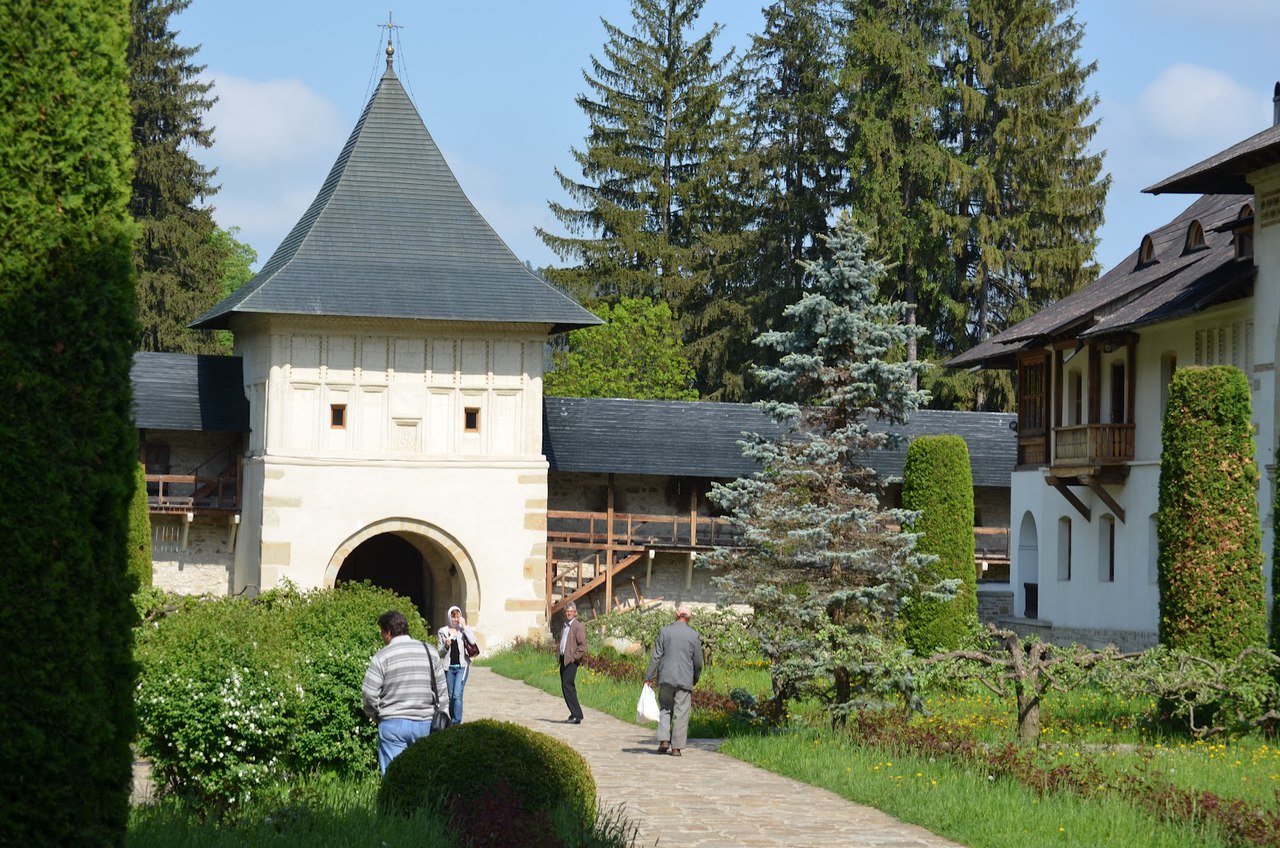
Putna: the holy abode called 'Romanian Jerusalem'

Путна: святая обитель, которую называют «румынским Иерусалимом»
The Putna Monastery (Mănăstirea Putna) is located near the Romanian-Ukrainian border. This is one of the spiritual centers of Eastern Europe, for its importance has received the unspoken name 'Romanian Jerusalem'. In addition, it is here that the ashes of the country's most famous ruler, ruler Stephen the Great (1457 - 1507), rest.   According to local legend, the ruler Stefan, wishing to build a monastery in this area, did so. Having climbed the Mount of the Cross (there really is a cross on it - it can be seen even today), the ruler pulled the string of his bow and fired an arrow - where it fell, and it was decided to build a holy monastery. It happened in 1466 from the birth of Christ. It took three years to build the monastery church - it was consecrated in 1470, and fifteen years - to build the entire monastery. It was fully completed by 1481; Considering medieval construction technologies, the term for the construction of a monastic citadel surrounded by walls and towers is more than short! It must be said that the fate of this monastery was not easy. It burned three times - in 1484, 1536 and 1691 (at least the last time the monastery was set on fire deliberately), it was plundered four times: by robbers from Bistritsa in 1622, by the Cossacks of Timofey Khmelnitsky in 1653 (then, according to the decree of ruler Vasily Lupu, the monastery was being reconstructed), by the Poles of King Jan Sobieski in 1691 and, finally, by Russian troops in 1739. The inhabitants were also disturbed by the natural elements. The most powerful earthquake occurred in these places in the same 1739 - then the tremors caused damage to the cathedral church, several towers and walls. The restoration of the monastery fell on the shoulders of the world politician Jacob Putnianu. In the work on the restoration and reconstruction of the monastery buildings and structures, he invested colossal money at that time, including ten thousand guilders of his own funds. The latter were spent mainly on arranging the interior of the cathedral church: a new iconostasis appeared in it, the floors were covered with tiles - and the Vladyka blessed to spend the rest of the amount on repairing the tower, walls, gates and cells for the brethren. However, Vladyka Jacob remained in the memory of descendants not only as a builder - it was he who, paying much attention to enlightenment and education, turned the monastery into one of the spiritual centers of the country. For his colossal contribution to the development of the holy monastery, Metropolitan Jacob is revered to this day as the second founder of the Putna monastery. And the ashes of the Vladyka rests together with the remains of the ruler Stephen the Great in the cathedral monastery church. Until Bukovina was annexed to Austria, Putna was very rich monastery. However, following the rules of Emperor Joseph II, 59 land plots were soon cut off from him. By the end of the century before last, only 28 monastic allotments were under the jurisdiction of the monastery fund - the rest were sold out, with the subsequent transfer of the proceeds to the fund's cashier. Be that as it may, even during the Austrian occupation, which lasted more than a century, Putna continued to serve as a stronghold of Orthodoxy and a hotbed of national consciousness of the people who professed it. In 1871, widespread national celebrations were held at the monastery, which played an important role in the national unity of the Romanians. Similar nationwide celebrations took place here in later times: in 1904 and 2004, nationwide celebrations were held here. Here is how the monastery chronicle says about them “These were high moments when the Romanians gathered here in Romanian Jerusalem proved that they are one people with one God, one faith and one baptism. These were outbursts of resurrection and a deep awakening of faith that real revival is impossible without unity in prayer, faith and hope in God's care. At these celebrations, the grave of Stephen, the great and saint, was named the altar of national identity. ' During the construction of communism, when three quarters of the temples and monasteries in the country were closed, and the clergy were persecuted, Putna was not closed - as, in fact, never in its entire history. Unbelievable, but true: during the years of the atheist regime, the monastery continued to operate. Attempts to stop the services were made, but the monks reminded the authorities that even the Magyar conquerors decided not to prohibit the liturgy at the grave of St. Stephen - and the supporters of socialist atheism were embarrassed. Portraits of the elders, who opposed the theomachy ideology with spiritual firmness and unceasing prayer, can be seen in the monastery today; they depict Archimandrites Pimen, Gerasim and Iacinth, Hieroschemamonk Caesarea, monks Mark and John and other monastics who managed to keep a lit candle of the living Christian faith and carefully pass it on to the new generation of Romanian Christians born after the 1989 revolution. Putna is the northernmost monastery in the country, and for many pilgrims and tourists, acquaintance with the Orthodox shrines of Romania begins from here. Monastic life here is very lively: about a hundred people, who have arrived in Putna from different parts of the country, work in the holy monastery. The brethren of the monastery kindly acquaints all the arrivals with the monastery shrines and historical buildings. Although several the hours that pilgrims usually take to visit the monastery - and even the entire daylight hours for these purposes are clearly not enough. The Cathedral of the Assumption Church - the heart of the holy monastery - was built in the shape of a trefoil. It became a kind of necropolis of the Romanian rulers: 28 rulers are buried here, most of whom belong to the Mushatin dynasty. Other people who played an important role in the history of Romania are also buried here. The first of all is the founder of the monastery, canonized Stephen the Great. Above his grave, there is a white tombstone made of Carrara marble, on which there is no date of death - the slab was made by order of the ruler during his lifetime. An unquenchable lamp is burning over the grave of St. Stephen. Here, in the cathedral church, the ashes of the last wife of the ruler, Mary of Mangup, as well as his two sons, Bogdan and Peter, rest. In the narthex of the church are the graves of Metropolitan Theognost, who placed the crown on the head of the ruler Stefan, and Metropolitan Jacob Putnianu, as well as the parents of the latter. On the outside of the cathedral church, to the right of the altar, lies the ashes of the Metropolitan of Transylvania Elijah (Iorest). During the time of persecution by the Hungarian Protestant Calvinists, Saint Elijah became a confessor. For his loyalty to Orthodoxy, expelled from the pulpit, and later subjected to imprisonment, he later returned to Putna, where he reposed in the Lord in 1678. And in the year 1955 the Romanian Orthodox Church canonized him. The monastic Treasury tower or storage tower, erected in 1481 in the western part of the monastery, has remained practically unchanged to this day. Fortified with four buttresses, the eighteen-meter structure with two-meter thick walls has a square parterre and three octagonal floors - you can get from one to the other via a spiral staircase. Earlier it was possible to get to the first floor only by a portable staircase, which was removed in the event of a siege - today the way here is open to everyone who arrives at the monastery. Also very interesting are the monastery bell tower built in 1886 and the tower of the entrance gate. The monastery museum houses the richest collection of Byzantine embroidery, which includes, among other things, the famous funeral veil of Mary of Mangup. Here you can see many exhibits discovered during the restoration of the monastery buildings and archaeological research carried out on its territory, as well as historical documents and manuscripts, for example, the Humor Four Gospels with a portrait of ruler Stefan. Separately, it should be said about the holy icons located in Putna. There is a miraculous the image of the Mother of God, in front of which pilgrims strive to light a candle and turn with prayer to the Queen of Heaven. There are eight amazing icons of the late fourteenth - early fifteenth centuries in the monastery, all of them are the work of a master who is allegorically called 'Ruble Putny'. In modern times, or to be precise - in 2001, a great contribution to the recreation of the unique frescoes of Putna covered with gilding and to the creation of new murals was made by the famous Romanian restorers brothers Mikhail and Gabriel Moroshany. There are many holy relics of the venerated saints of God in the monastery: three saints - Basil, Gregory and John, the monk hermit Daniel Sikhasrul, the great martyr and healer Panteleimon, the monk Nektarios of Eginsky, saint Gennady, the great martyr George the Victorious, the great martyr George the Victorious ... and present. Today, all the workshops that traditionally operated under it have been revived and are working in the holy monastery. The craftsmen who work in them are busy with icon painting, restoration of church utensils, jewelry, wood carving ... Items that come out of the monastery workshops are famous far beyond the borders of Romania. For example, the local technology of gold plating is in great demand. Putna Monastery has a large subsidiary farm, the inhabitants of nearby villages help the inhabitants to manage it. The monastic charter in the monastery is very strict. Lengthy church services are held daily, morning and evening, and all the brethren, free from obedience, pray for them. In addition, each of the monastics is supposed to make one and a half hundred bows and bows to the ground in private. Many pilgrims from all over Romania and other countries of Eastern Europe pray at almost every divine service in the monastery church. Therefore, from year to year the monastery increases the number of cells for receiving guests. It is interesting that during the divine services, almost all the worshipers sing - along with two choirs accompanying the succession of each service. There are also many interesting objects around the Putna Monastery. For example, the church in the cemetery next to the monastery dates back to the times of the governor Dragos and is considered the oldest wooden structure in Europe. It is older than the monastery itself: the church was built in 1346 and rebuilt in 1468. The monastery also has two sketes: Sihestria Putney and Hermit Daniel Sihasrul - we recently talked about the last of them in one of our materials. Romania is the only Orthodox country in the world (more than 90% of people profess Eastern Rite Christianity) that speaks Romance (based on colloquial Latin) language. And although the official capital of the country is Bucharest, the true sacred center of Romania is right here, in the Putna Monastery, which is precisely why it is called “Romanian Jerusalem”. V. Sergienko
Share:
Putna: the holy abode called 'Romanian Jerusalem' Putna: the holy abode called 'Romanian Jerusalem' The Putna Monastery (Mănăstirea Putna) is located near the Romanian-Ukrainian border. This is one of the spiritual centers of Eastern Europe, for its importance has received the unspoken name 'Romanian Jerusalem'. In addition, it is here that the ashes of the country's most famous ruler, ruler Stephen the Great (1457 - 1507), rest.   According to local legend, the ruler Stefan, wishing to build a monastery in this area, did so. Having climbed the Mount of the Cross (there really is a cross on it - it can be seen even today), the ruler pulled the string of his bow and fired an arrow - where it fell, and it was decided to build a holy monastery. It happened in 1466 from the birth of Christ. It took three years to build the monastery church - it was consecrated in 1470, and fifteen years - to build the entire monastery. It was fully completed by 1481; Considering medieval construction technologies, the term for the construction of a monastic citadel surrounded by walls and towers is more than short! It must be said that the fate of this monastery was not easy. It burned three times - in 1484, 1536 and 1691 (at least the last time the monastery was set on fire deliberately), it was plundered four times: by robbers from Bistritsa in 1622, by the Cossacks of Timofey Khmelnitsky in 1653 (then, according to the decree of ruler Vasily Lupu, the monastery was being reconstructed), by the Poles of King Jan Sobieski in 1691 and, finally, by Russian troops in 1739. The inhabitants were also disturbed by the natural elements. The most powerful earthquake occurred in these places in the same 1739 - then the tremors caused damage to the cathedral church, several towers and walls. The restoration of the monastery fell on the shoulders of the world politician Jacob Putnianu. In the work on the restoration and reconstruction of the monastery buildings and structures, he invested colossal money at that time, including ten thousand guilders of his own funds. The latter were spent mainly on arranging the interior of the cathedral church: a new iconostasis appeared in it, the floors were covered with tiles - and the Vladyka blessed to spend the rest of the amount on repairing the tower, walls, gates and cells for the brethren. However, Vladyka Jacob remained in the memory of descendants not only as a builder - it was he who, paying much attention to enlightenment and education, turned the monastery into one of the spiritual centers of the country. For his colossal contribution to the development of the holy monastery, Metropolitan Jacob is revered to this day as the second founder of the Putna monastery. And the ashes of the Vladyka rests together with the remains of the ruler Stephen the Great in the cathedral monastery church. Until Bukovina was annexed to Austria, Putna was very rich monastery. However, following the rules of Emperor Joseph II, 59 land plots were soon cut off from him. By the end of the century before last, only 28 monastic allotments were under the jurisdiction of the monastery fund - the rest were sold out, with the subsequent transfer of the proceeds to the fund's cashier. Be that as it may, even during the Austrian occupation, which lasted more than a century, Putna continued to serve as a stronghold of Orthodoxy and a hotbed of national consciousness of the people who professed it. In 1871, widespread national celebrations were held at the monastery, which played an important role in the national unity of the Romanians. Similar nationwide celebrations took place here in later times: in 1904 and 2004, nationwide celebrations were held here. Here is how the monastery chronicle says about them “These were high moments when the Romanians gathered here in Romanian Jerusalem proved that they are one people with one God, one faith and one baptism. These were outbursts of resurrection and a deep awakening of faith that real revival is impossible without unity in prayer, faith and hope in God's care. At these celebrations, the grave of Stephen, the great and saint, was named the altar of national identity. ' During the construction of communism, when three quarters of the temples and monasteries in the country were closed, and the clergy were persecuted, Putna was not closed - as, in fact, never in its entire history. Unbelievable, but true: during the years of the atheist regime, the monastery continued to operate. Attempts to stop the services were made, but the monks reminded the authorities that even the Magyar conquerors decided not to prohibit the liturgy at the grave of St. Stephen - and the supporters of socialist atheism were embarrassed. Portraits of the elders, who opposed the theomachy ideology with spiritual firmness and unceasing prayer, can be seen in the monastery today; they depict Archimandrites Pimen, Gerasim and Iacinth, Hieroschemamonk Caesarea, monks Mark and John and other monastics who managed to keep a lit candle of the living Christian faith and carefully pass it on to the new generation of Romanian Christians born after the 1989 revolution. Putna is the northernmost monastery in the country, and for many pilgrims and tourists, acquaintance with the Orthodox shrines of Romania begins from here. Monastic life here is very lively: about a hundred people, who have arrived in Putna from different parts of the country, work in the holy monastery. The brethren of the monastery kindly acquaints all the arrivals with the monastery shrines and historical buildings. Although several the hours that pilgrims usually take to visit the monastery - and even the entire daylight hours for these purposes are clearly not enough. The Cathedral of the Assumption Church - the heart of the holy monastery - was built in the shape of a trefoil. It became a kind of necropolis of the Romanian rulers: 28 rulers are buried here, most of whom belong to the Mushatin dynasty. Other people who played an important role in the history of Romania are also buried here. The first of all is the founder of the monastery, canonized Stephen the Great. Above his grave, there is a white tombstone made of Carrara marble, on which there is no date of death - the slab was made by order of the ruler during his lifetime. An unquenchable lamp is burning over the grave of St. Stephen. Here, in the cathedral church, the ashes of the last wife of the ruler, Mary of Mangup, as well as his two sons, Bogdan and Peter, rest. In the narthex of the church are the graves of Metropolitan Theognost, who placed the crown on the head of the ruler Stefan, and Metropolitan Jacob Putnianu, as well as the parents of the latter. On the outside of the cathedral church, to the right of the altar, lies the ashes of the Metropolitan of Transylvania Elijah (Iorest). During the time of persecution by the Hungarian Protestant Calvinists, Saint Elijah became a confessor. For his loyalty to Orthodoxy, expelled from the pulpit, and later subjected to imprisonment, he later returned to Putna, where he reposed in the Lord in 1678. And in the year 1955 the Romanian Orthodox Church canonized him. The monastic Treasury tower or storage tower, erected in 1481 in the western part of the monastery, has remained practically unchanged to this day. Fortified with four buttresses, the eighteen-meter structure with two-meter thick walls has a square parterre and three octagonal floors - you can get from one to the other via a spiral staircase. Earlier it was possible to get to the first floor only by a portable staircase, which was removed in the event of a siege - today the way here is open to everyone who arrives at the monastery. Also very interesting are the monastery bell tower built in 1886 and the tower of the entrance gate. The monastery museum houses the richest collection of Byzantine embroidery, which includes, among other things, the famous funeral veil of Mary of Mangup. Here you can see many exhibits discovered during the restoration of the monastery buildings and archaeological research carried out on its territory, as well as historical documents and manuscripts, for example, the Humor Four Gospels with a portrait of ruler Stefan. Separately, it should be said about the holy icons located in Putna. There is a miraculous the image of the Mother of God, in front of which pilgrims strive to light a candle and turn with prayer to the Queen of Heaven. There are eight amazing icons of the late fourteenth - early fifteenth centuries in the monastery, all of them are the work of a master who is allegorically called 'Ruble Putny'. In modern times, or to be precise - in 2001, a great contribution to the recreation of the unique frescoes of Putna covered with gilding and to the creation of new murals was made by the famous Romanian restorers brothers Mikhail and Gabriel Moroshany. There are many holy relics of the venerated saints of God in the monastery: three saints - Basil, Gregory and John, the monk hermit Daniel Sikhasrul, the great martyr and healer Panteleimon, the monk Nektarios of Eginsky, saint Gennady, the great martyr George the Victorious, the great martyr George the Victorious ... and present. Today, all the workshops that traditionally operated under it have been revived and are working in the holy monastery. The craftsmen who work in them are busy with icon painting, restoration of church utensils, jewelry, wood carving ... Items that come out of the monastery workshops are famous far beyond the borders of Romania. For example, the local technology of gold plating is in great demand. Putna Monastery has a large subsidiary farm, the inhabitants of nearby villages help the inhabitants to manage it. The monastic charter in the monastery is very strict. Lengthy church services are held daily, morning and evening, and all the brethren, free from obedience, pray for them. In addition, each of the monastics is supposed to make one and a half hundred bows and bows to the ground in private. Many pilgrims from all over Romania and other countries of Eastern Europe pray at almost every divine service in the monastery church. Therefore, from year to year the monastery increases the number of cells for receiving guests. It is interesting that during the divine services, almost all the worshipers sing - along with two choirs accompanying the succession of each service. There are also many interesting objects around the Putna Monastery. For example, the church in the cemetery next to the monastery dates back to the times of the governor Dragos and is considered the oldest wooden structure in Europe. It is older than the monastery itself: the church was built in 1346 and rebuilt in 1468. The monastery also has two sketes: Sihestria Putney and Hermit Daniel Sihasrul - we recently talked about the last of them in one of our materials. Romania is the only Orthodox country in the world (more than 90% of people profess Eastern Rite Christianity) that speaks Romance (based on colloquial Latin) language. And although the official capital of the country is Bucharest, the true sacred center of Romania is right here, in the Putna Monastery, which is precisely why it is called “Romanian Jerusalem”. V. Sergienko
The Putna Monastery (Mănăstirea Putna) is located near the Romanian-Ukrainian border. This is one of the spiritual centers of Eastern Europe, for its importance has received the unspoken name 'Romanian Jerusalem'. In addition, it is here that the ashes of the country's most famous ruler, ruler Stephen the Great (1457 - 1507), rest.   According to local legend, the ruler Stefan, wishing to build a monastery in this area, did so. Having climbed the Mount of the Cross (there really is a cross on it - it can be seen even today), the ruler pulled the string of his bow and fired an arrow - where it fell, and it was decided to build a holy monastery. It happened in 1466 from the birth of Christ. It took three years to build the monastery church - it was consecrated in 1470, and fifteen years - to build the entire monastery. It was fully completed by 1481; Considering medieval construction technologies, the term for the construction of a monastic citadel surrounded by walls and towers is more than short! It must be said that the fate of this monastery was not easy. It burned three times - in 1484, 1536 and 1691 (at least the last time the monastery was set on fire deliberately), it was plundered four times: by robbers from Bistritsa in 1622, by the Cossacks of Timofey Khmelnitsky in 1653 (then, according to the decree of ruler Vasily Lupu, the monastery was being reconstructed), by the Poles of King Jan Sobieski in 1691 and, finally, by Russian troops in 1739. The inhabitants were also disturbed by the natural elements. The most powerful earthquake occurred in these places in the same 1739 - then the tremors caused damage to the cathedral church, several towers and walls. The restoration of the monastery fell on the shoulders of the world politician Jacob Putnianu. In the work on the restoration and reconstruction of the monastery buildings and structures, he invested colossal money at that time, including ten thousand guilders of his own funds. The latter were spent mainly on arranging the interior of the cathedral church: a new iconostasis appeared in it, the floors were covered with tiles - and the Vladyka blessed to spend the rest of the amount on repairing the tower, walls, gates and cells for the brethren. However, Vladyka Jacob remained in the memory of descendants not only as a builder - it was he who, paying much attention to enlightenment and education, turned the monastery into one of the spiritual centers of the country. For his colossal contribution to the development of the holy monastery, Metropolitan Jacob is revered to this day as the second founder of the Putna monastery. And the ashes of the Vladyka rests together with the remains of the ruler Stephen the Great in the cathedral monastery church. Until Bukovina was annexed to Austria, Putna was very rich monastery. However, following the rules of Emperor Joseph II, 59 land plots were soon cut off from him. By the end of the century before last, only 28 monastic allotments were under the jurisdiction of the monastery fund - the rest were sold out, with the subsequent transfer of the proceeds to the fund's cashier. Be that as it may, even during the Austrian occupation, which lasted more than a century, Putna continued to serve as a stronghold of Orthodoxy and a hotbed of national consciousness of the people who professed it. In 1871, widespread national celebrations were held at the monastery, which played an important role in the national unity of the Romanians. Similar nationwide celebrations took place here in later times: in 1904 and 2004, nationwide celebrations were held here. Here is how the monastery chronicle says about them “These were high moments when the Romanians gathered here in Romanian Jerusalem proved that they are one people with one God, one faith and one baptism. These were outbursts of resurrection and a deep awakening of faith that real revival is impossible without unity in prayer, faith and hope in God's care. At these celebrations, the grave of Stephen, the great and saint, was named the altar of national identity. ' During the construction of communism, when three quarters of the temples and monasteries in the country were closed, and the clergy were persecuted, Putna was not closed - as, in fact, never in its entire history. Unbelievable, but true: during the years of the atheist regime, the monastery continued to operate. Attempts to stop the services were made, but the monks reminded the authorities that even the Magyar conquerors decided not to prohibit the liturgy at the grave of St. Stephen - and the supporters of socialist atheism were embarrassed. Portraits of the elders, who opposed the theomachy ideology with spiritual firmness and unceasing prayer, can be seen in the monastery today; they depict Archimandrites Pimen, Gerasim and Iacinth, Hieroschemamonk Caesarea, monks Mark and John and other monastics who managed to keep a lit candle of the living Christian faith and carefully pass it on to the new generation of Romanian Christians born after the 1989 revolution. Putna is the northernmost monastery in the country, and for many pilgrims and tourists, acquaintance with the Orthodox shrines of Romania begins from here. Monastic life here is very lively: about a hundred people, who have arrived in Putna from different parts of the country, work in the holy monastery. The brethren of the monastery kindly acquaints all the arrivals with the monastery shrines and historical buildings. Although several the hours that pilgrims usually take to visit the monastery - and even the entire daylight hours for these purposes are clearly not enough. The Cathedral of the Assumption Church - the heart of the holy monastery - was built in the shape of a trefoil. It became a kind of necropolis of the Romanian rulers: 28 rulers are buried here, most of whom belong to the Mushatin dynasty. Other people who played an important role in the history of Romania are also buried here. The first of all is the founder of the monastery, canonized Stephen the Great. Above his grave, there is a white tombstone made of Carrara marble, on which there is no date of death - the slab was made by order of the ruler during his lifetime. An unquenchable lamp is burning over the grave of St. Stephen. Here, in the cathedral church, the ashes of the last wife of the ruler, Mary of Mangup, as well as his two sons, Bogdan and Peter, rest. In the narthex of the church are the graves of Metropolitan Theognost, who placed the crown on the head of the ruler Stefan, and Metropolitan Jacob Putnianu, as well as the parents of the latter. On the outside of the cathedral church, to the right of the altar, lies the ashes of the Metropolitan of Transylvania Elijah (Iorest). During the time of persecution by the Hungarian Protestant Calvinists, Saint Elijah became a confessor. For his loyalty to Orthodoxy, expelled from the pulpit, and later subjected to imprisonment, he later returned to Putna, where he reposed in the Lord in 1678. And in the year 1955 the Romanian Orthodox Church canonized him. The monastic Treasury tower or storage tower, erected in 1481 in the western part of the monastery, has remained practically unchanged to this day. Fortified with four buttresses, the eighteen-meter structure with two-meter thick walls has a square parterre and three octagonal floors - you can get from one to the other via a spiral staircase. Earlier it was possible to get to the first floor only by a portable staircase, which was removed in the event of a siege - today the way here is open to everyone who arrives at the monastery. Also very interesting are the monastery bell tower built in 1886 and the tower of the entrance gate. The monastery museum houses the richest collection of Byzantine embroidery, which includes, among other things, the famous funeral veil of Mary of Mangup. Here you can see many exhibits discovered during the restoration of the monastery buildings and archaeological research carried out on its territory, as well as historical documents and manuscripts, for example, the Humor Four Gospels with a portrait of ruler Stefan. Separately, it should be said about the holy icons located in Putna. There is a miraculous the image of the Mother of God, in front of which pilgrims strive to light a candle and turn with prayer to the Queen of Heaven. There are eight amazing icons of the late fourteenth - early fifteenth centuries in the monastery, all of them are the work of a master who is allegorically called 'Ruble Putny'. In modern times, or to be precise - in 2001, a great contribution to the recreation of the unique frescoes of Putna covered with gilding and to the creation of new murals was made by the famous Romanian restorers brothers Mikhail and Gabriel Moroshany. There are many holy relics of the venerated saints of God in the monastery: three saints - Basil, Gregory and John, the monk hermit Daniel Sikhasrul, the great martyr and healer Panteleimon, the monk Nektarios of Eginsky, saint Gennady, the great martyr George the Victorious, the great martyr George the Victorious ... and present. Today, all the workshops that traditionally operated under it have been revived and are working in the holy monastery. The craftsmen who work in them are busy with icon painting, restoration of church utensils, jewelry, wood carving ... Items that come out of the monastery workshops are famous far beyond the borders of Romania. For example, the local technology of gold plating is in great demand. Putna Monastery has a large subsidiary farm, the inhabitants of nearby villages help the inhabitants to manage it. The monastic charter in the monastery is very strict. Lengthy church services are held daily, morning and evening, and all the brethren, free from obedience, pray for them. In addition, each of the monastics is supposed to make one and a half hundred bows and bows to the ground in private. Many pilgrims from all over Romania and other countries of Eastern Europe pray at almost every divine service in the monastery church. Therefore, from year to year the monastery increases the number of cells for receiving guests. It is interesting that during the divine services, almost all the worshipers sing - along with two choirs accompanying the succession of each service. There are also many interesting objects around the Putna Monastery. For example, the church in the cemetery next to the monastery dates back to the times of the governor Dragos and is considered the oldest wooden structure in Europe. It is older than the monastery itself: the church was built in 1346 and rebuilt in 1468. The monastery also has two sketes: Sihestria Putney and Hermit Daniel Sihasrul - we recently talked about the last of them in one of our materials. Romania is the only Orthodox country in the world (more than 90% of people profess Eastern Rite Christianity) that speaks Romance (based on colloquial Latin) language. And although the official capital of the country is Bucharest, the true sacred center of Romania is right here, in the Putna Monastery, which is precisely why it is called “Romanian Jerusalem”. V. Sergienko