This, of course, is not about the little Biblical prophet, whose prophetic vision was focused on the fate of Jerusalem, and not Rome, then unknown to anyone. The Catholic Saint Malachi, Archbishop of the Northern Ireland Armagh, who lived from 1094 to 1148, left behind a curious book that became widely known in Europe only five hundred years after his death. The composition of the Irish saint contains 112 short phrases - 'mottos' concerning the reign and life of the Popes (and several antipopes), starting with the modern Malachi CelestineIIand ending with the one hundred and twelfth head of the Western Church, which the author calls Peter the Roman (Petrus Romanus) ...
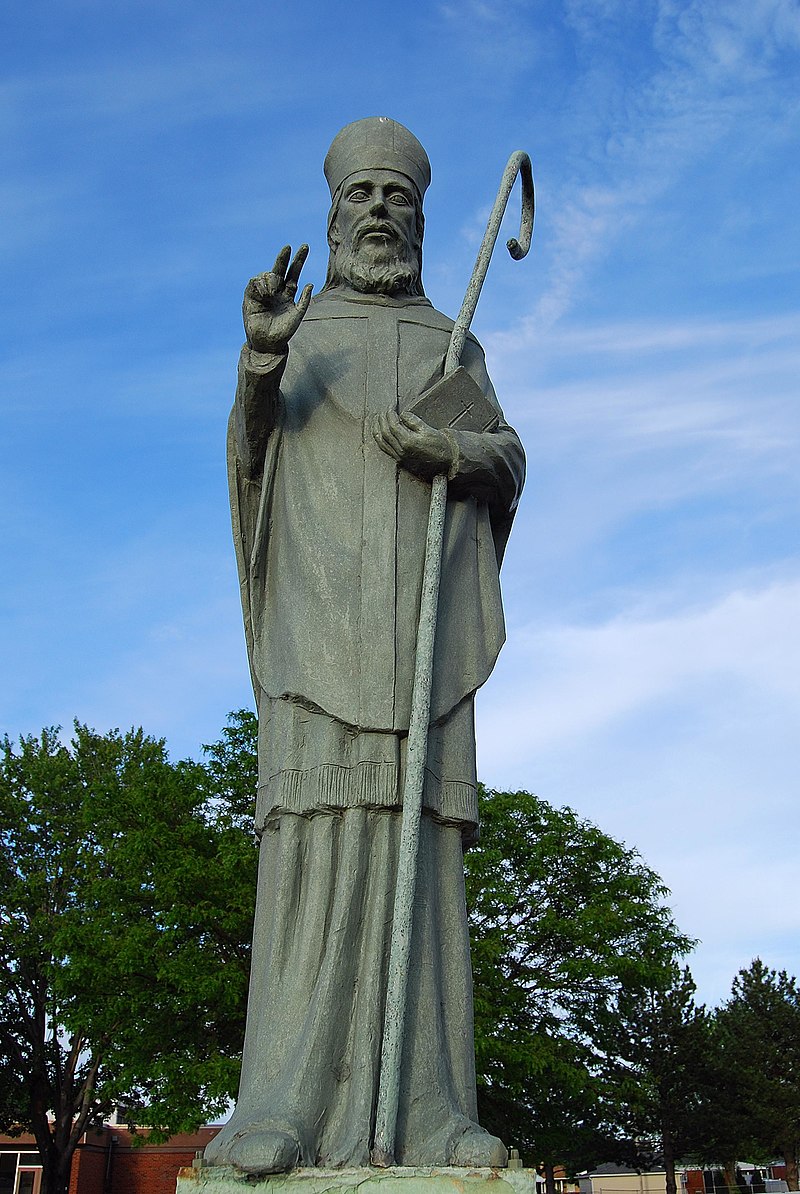
St. Malachy, Archbishop of Armagh, Northern Ireland The church story tells of a wonderful child from Ulster, born in 1094 and from early childhood in almost unceasing prayer. Because of his piety, he was ordained a deacon as a teenager - and later became a priest, choosing for himself the missionary service. People who fell in love with Father Malachi came to him for advice and blessing not only from all over the Island, but also from distant countries of Europe. Soon the fame of him reached the ears of the Roman Pope, who called a missionary from a distant country to his audience, thus doing him a great honor. According to Tradition, after a conversation with Malachi, the Pope called for the cardinals, removed the miter from his head and crowned a priest with it, saying: “Let everyone fall prostrate before him! This man was sent down to us by the Almighty! ' None of the cardinals could then comprehend the meaning of what the pontiff said. And the priest Malachi stayed in Rome for a while. He spent nights in the Vatican library, where he wrote some mysterious book ... After the departure of Malachi to the Lord and the establishment of his veneration soon after, the mysterious manuscript was passed on from one monastery to another for several centuries, and its contents remained hidden from most people. Only at the end of the sixteenth century was the manuscript found and published in 1595 in the book Lignum Vitae ('The Tree of Life'). Then the 'Prediction' was forgotten for almost a century (which is not surprising, given the circulation of books of those times) - and only in 1690 it was re-published. Only after that did the text of the book become widely known. In essence, the book of Malachi is a catalog. It lists under allegorical, aphoristic names 112 clergymen who occupied the Holy See during the life of the Irish bishop - as well as those who were still just had to climb it. 'The prophecy of the Popes', written, of course, in Latin, is sometimes also called the 'Prophecy of the Popes' (in English sources - Prophecy of the Popes). The list begins with a contemporary of Malachy Celestine II, who occupied the Roman See for only six months - and ends with the mysterious Peter the Roman (Petrus Romanus), one hundred and twelfth in a row. The end of the text, dedicated to the last chapter of the Western Church, does not look optimistic and reads: “At the end of time, the place of the Holy Roman Church will be taken by Peter the Roman, who will feed the sheep amid many torments. Upon completion of which the City of Seven Hills will be destroyed, and the Terrible Judge will judge the people. The end'.
We will return to this text later - but for now, we note that most church historians agree that many (if not almost all) 'mottos' assigned by Malachi to the popes really reflect the features of their origin, career, government history, or what happened at that time. historical events. Here are just a few examples. Pope Leo XIII is referred to as 'the light of heaven' - a comet is depicted on his coat of arms. About Urban VIII, who occupied the Holy See in the first half of the 17th century, Malachi says: 'Lily and a rose' - precisely for this the warming of relations between Protestant England and Catholic France, which occurred thanks to the marriage of Charles I Stuart and Henrietta-Marie de Bourbon, daughter of the French king Henry IV, dates back to time. Pope Pius VII, who ruled the Roman Church during the Napoleonic wars, the book calls the 'Stolen Eagle' - and indeed, Bonaparte, like an eagle, one might say tore this pontiff from the throne - and threw him into prison, from which he left and returned to his ministry only after the fall of the emperor. It would be unfair to keep silent about the voices of skeptics who spoke about the authenticity of the book of Malachi 'The Prediction of the Popes'. Church historians were more than once perplexed by the fact that neither the biographer of Malachi, Saint Bernard of Clairvaux (in whose hands the Irish saint died practically in his arms), nor other sources before 1595 mention the book at all. But even if we recognize the authorship of the 'Prediction' as controversial, the prophecies themselves remain in force, as the author of the book 'The Last Pope' John Hogue reasonably noted in this regard. At the end of the 19th century, the Catholic priest J.M. O'Brien published a monograph, where it was argued that the Prediction, written in not very good Latin, was compiled at the end of the 16th century by supporters of Cardinal Girolammo Simoncelli, who aimed at the Pope, in order to substantiate it claims to the Holy See ... However, if this is so, what about the predictions in the 17th-20th centuries, convincingly correlated with the events of modern and recent history?
Benedict XVI And there are many such in the book of Malachi. In addition to those already mentioned, let us pay attention to several others that are closer to us in time. For example, Pope Benedict XV, who led the Western Church from 1914 to 1922, is referred to in the book as 'the extermination of Christians.' The First World War, at that time unprecedented in the number of victims, the epidemic of the deadly flu - the Spanish flu, the revolution and the civil war in Russia - all these events together took more lives in Europe than in the previous centuries. John Paul II (pontificate 1978 - 2005, but Malachi does not indicate the year of his death) is named the author of the book Labores solis; translated from Latin, this expression indicates a solar eclipse. Pope Pole by birth, Karol Józef Wojtyła was born on the day of a partial eclipse of the sun, exuded the greatest Christian kindness like sunlight to the whole world - and after his death was buried on the day of a rare hybrid total solar eclipse. Benedict XVI, a prolific literary man and now a retired Pope, fits the definition of 'olive branch' in the book of Malachi. Researchers associate this motto with the fact that before his election this Pope bore the title of Cardinal Velletri Senyi - and the coat of arms of the city of Velletri depicts three olive trees. And also with the fact that Benedict XVI led the Congregation for the Doctrine of the Faith (until 1908 - the Holy Inquisition), which also has an olive branch on its coat of arms. The Pope is at rest, Benedict XVI is alive, and perhaps the years of the rest of his life measured by the Lord will add new meanings to the interpretations of the motto.
Finally, the one hundred and twelfth Pope, with whom the book of Malachi ends, is called Francis, not Peter - and by birth he is Argentine, and not at all an Italian from Rome. Why is the 112th of them named Petrus Romanus in the Prediction of the Popes? The book of Malachi is allegorical, it does not name specific names, but operates with comparisons and images. Pope Francis's pontificate continues, and perhaps the answer is simply not clear to us yet. The most famous explanation on this score (very, I must say, stretched) says that, occupying the Holy See, the current Pope chose a name in honor of one of the greatest saints of the Western Church - Francis of Assisi, who was called Giovanni Francesco di Pietro Bernardone during his lifetime. In this regard, it is impossible not to remember about the prevailing in countries the Catholic world has a legend that says that the last Pope will be none other than the holy Apostle Peter himself. Once the founder of the Roman Church, he allegedly will lead it in the last times, in order to thus complete a certain cycle ... This is just a legend, but it is related not only in the text of Malachi relating to the last, 'pre-apocalyptic' Pope (the corresponding words from the book were given above), but also with the Gospel of John, according to which the Lord Jesus Christ says to Peter: 'Feed my sheep' (John 21: 16-17).
But then it turns out that in the case of the 112th Pope, the book of Malachi does not mean Francis at all? There is no exact answer yet; this issue can be clarified only with time. Let us only recall the words of the already mentioned Pope Benedict XVI at rest, who, commenting on the Third Secret of Fatima( we wrote about this ) , noticed that the prophecies are not predetermined, but a warning for people, allowing them to avoid the worst development of events. Most likely, this is exactly how it is - after all, in the well-known 'Centuries' of Nostaradamus (by the way, with their text, the book of St. Malachi also has a number of intersection points), far from everything predicted was embodied in events of world history, although by the accompanying signs we can judge that the times that the French soothsayer spoke about in this or that case have already passed. Then it turns out that nothing is predetermined - only a dotted line is outlined or only individual points ... What then is the value of prophecies and predictions if the river of history passes by some of them, and others become understandable to us only when the events described have already taken place, and nothing can be changed? Probably, this value lies in the very opportunity to touch the future, which the Lord provides to a person, as to his beloved creation. What for? Well, at least so that he understands that events do not take place chaotically, but in accordance with a certain plan - which, if necessary, can be changed. V. Sergienko
'The Prediction of the Popes' by Saint Malachi'The Prediction of the Popes' by Saint Malachi This, of course, is not about the little Biblical prophet, whose prophetic vision was focused on the fate of Jerusalem, and not Rome, then unknown to anyone. The Catholic Saint Malachi, Archbishop of the Northern Ireland Armagh, who lived from 1094 to 1148, left behind a curious book that became widely known in Europe only five hundred years after his death. The composition of the Irish saint contains 112 short phrases - 'mottos' concerning the reign and life of the Popes (and several antipopes), starting with the modern Malachi Celestine II and ending with the one hundred and twelfth head of the Western Church, which the author calls Peter the Roman ( Petrus Romanus) ... St. Malachy, Archbishop of Armagh, Northern Ireland The church story tells of a wonderful child from Ulster, born in 1094 and from early childhood in almost unceasing prayer. Because of his piety, he was ordained a deacon as a teenager - and later became a priest, choosing for himself the missionary service. People who fell in love with Father Malachi came to him for advice and blessing not only from all over the Island, but also from distant countries of Europe. Soon the fame of him reached the ears of the Roman Pope, who called a missionary from a distant country to his audience, thus doing him a great honor. According to Tradition, after a conversation with Malachi, the Pope called for the cardinals, removed the miter from his head and crowned a priest with it, saying: “Let everyone fall prostrate before him! This man was sent down to us by the Almighty! ' None of the cardinals could then comprehend the meaning of what the pontiff said. And the priest Malachi stayed in Rome for a while. He spent nights in the Vatican library, where he wrote some mysterious book ... After the departure of Malachi to the Lord and the establishment of his veneration soon after, the mysterious manuscript was passed on from one monastery to another for several centuries, and its contents remained hidden from most people. Only at the end of the sixteenth century was the manuscript found and published in 1595 in the book Lignum Vitae ('The Tree of Life'). Then the 'Prediction' was forgotten for almost a century (which is not surprising, given the circulation of books of those times) - and only in 1690 it was re-published. Only after that did the text of the book become widely known. In essence, the book of Malachi is a catalog. It lists under allegorical, aphoristic names 112 clergymen who occupied the Holy See during the life of the Irish bishop - as well as those who were still just had to climb it. 'The prophecy of the Popes', written, of course, in Latin, is sometimes also called the 'Prophecy of the Popes' (in English sources - Prophecy of the Popes). The list begins with a contemporary of Malachy Celestine II, who occupied the Roman See for only six months - and ends with the mysterious Peter the Roman (Petrus Romanus), one hundred and twelfth in a row. The end of the text, dedicated to the last chapter of the Western Church, does not look optimistic and reads: “At the end of time, the place of the Holy Roman Church will be taken by Peter the Roman, who will feed the sheep amid many torments. Upon completion of which the City of Seven Hills will be destroyed, and the Terrible Judge will judge the people. The end'. We will return to this text later - but for now, we note that most church historians agree that many (if not almost all) 'mottos' assigned by Malachi to the popes really reflect the features of their origin, career, government history, or what happened at that time. historical events. Here are just a few examples. Pope Leo XIII is referred to as 'the light of heaven' - a comet is depicted on his coat of arms. About Urban VIII, who occupied the Holy See in the first half of the 17th century, Malachi says: 'Lily and a rose' - precisely for this the warming of relations between Protestant England and Catholic France, which occurred thanks to the marriage of Charles I Stuart and Henrietta-Marie de Bourbon, daughter of the French king Henry IV, dates back to time. Pope Pius VII, who ruled the Roman Church during the Napoleonic wars, the book calls the 'Stolen Eagle' - and indeed, Bonaparte, like an eagle, one might say tore this pontiff from the throne - and threw him into prison, from which he left and returned to his ministry only after the fall of the emperor. It would be unfair to keep silent about the voices of skeptics who spoke about the authenticity of the book of Malachi 'The Prediction of the Popes'. Church historians were more than once perplexed by the fact that neither the biographer of Malachi, Saint Bernard of Clairvaux (in whose hands the Irish saint died practically in his arms), nor other sources before 1595 mention the book at all. But even if we recognize the authorship of the 'Prediction' as controversial, the prophecies themselves remain in force, as the author of the book 'The Last Pope' John Hogue reasonably noted in this regard. At the end of the 19th century, the Catholic priest J.M. O'Brien published a monograph, where it was argued that the Prediction, written in not very good Latin, was compiled at the end of the 16th century by supporters of Cardinal Girolammo Simoncelli, who aimed at the Pope, in order to substantiate it claims to the Holy See ... However, if this is so, what about the predictions in the 17th-20th centuries, convincingly correlated with the events of modern and recent history? Benedict XVI And there are many such in the book of Malachi. In addition to those already mentioned, let us pay attention to several others that are closer to us in time. For example, Pope Benedict XV, who led the Western Church from 1914 to 1922, is referred to in the book as 'the extermination of Christians.' The First World War, at that time unprecedented in the number of victims, the epidemic of the deadly flu - the Spanish flu, the revolution and the civil war in Russia - all these events together took more lives in Europe than in the previous centuries. John Paul II (pontificate 1978 - 2005, but Malachi does not indicate the year of his death) is named the author of the book Labores solis; translated from Latin, this expression indicates a solar eclipse. Pope Pole by birth, Karol Józef Wojtyła was born on the day of a partial eclipse of the sun, exuded the greatest Christian kindness like sunlight to the whole world - and after his death was buried on the day of a rare hybrid total solar eclipse. Benedict XVI, a prolific literary man and now a retired Pope, fits the definition of 'olive branch' in the book of Malachi. Researchers associate this motto with the fact that before his election this Pope bore the title of Cardinal Velletri Senyi - and the coat of arms of the city of Velletri depicts three olive trees. And also with the fact that Benedict XVI led the Congregation for the Doctrine of the Faith (until 1908 - the Holy Inquisition), which also has an olive branch on its coat of arms. The Pope is at rest, Benedict XVI is alive, and perhaps the years of the rest of his life measured by the Lord will add new meanings to the interpretations of the motto. Finally, the one hundred and twelfth Pope, with whom the book of Malachi ends, is called Francis, not Peter - and by birth he is Argentine, and not at all an Italian from Rome. Why is the 112th of them named Petrus Romanus in the Prediction of the Popes? The book of Malachi is allegorical, it does not name specific names, but operates with comparisons and images. Pope Francis's pontificate continues, and perhaps the answer is simply not clear to us yet. The most famous explanation on this score (very, I must say, stretched) says that, occupying the Holy See, the current Pope chose a name in honor of one of the greatest saints of the Western Church - Francis of Assisi, who was called Giovanni Francesco di Pietro Bernardone during his lifetime. In this regard, it is impossible not to remember about the prevailing in countries the Catholic world has a legend that says that the last Pope will be none other than the holy Apostle Peter himself. Once the founder of the Roman Church, he allegedly will lead it in the last times, in order to thus complete a certain cycle ... This is just a legend, but it is related not only in the text of Malachi relating to the last, 'pre-apocalyptic' Pope (the corresponding words from the book were given above), but also with the Gospel of John, according to which the Lord Jesus Christ says to Peter: 'Feed my sheep' (John 21: 16-17). But then it turns out that in the case of the 112th Pope, the book of Malachi does not mean Francis at all? There is no exact answer yet; this issue can be clarified only with time. Let us only recall the words of the already mentioned Pope Benedict XVI at rest, who, commenting on the Third Secret of Fatima ( we wrote about this ) , noticed that the prophecies are not predetermined, but a warning for people, allowing them to avoid the worst development of events. Most likely, this is exactly how it is - after all, in the well-known 'Centuries' of Nostaradamus (by the way, with their text, the book of St. Malachi also has a number of intersection points), far from everything predicted was embodied in events of world history, although by the accompanying signs we can judge that the times that the French soothsayer spoke about in this or that case have already passed. Then it turns out that nothing is predetermined - only a dotted line is outlined or only individual points ... What then is the value of prophecies and predictions if the river of history passes by some of them, and others become understandable to us only when the events described have already taken place, and nothing can be changed? Probably, this value lies in the very opportunity to touch the future, which the Lord provides to a person, as to his beloved creation. What for? Well, at least so that he understands that events do not take place chaotically, but in accordance with a certain plan - which, if necessary, can be changed. V. SergienkoСвеча Иерусалима -en
This, of course, is not about the little Biblical prophet, whose prophetic vision was focused on the fate of Jerusalem, and not Rome, then unknown to anyone. The Catholic Saint Malachi, Archbishop of the Northern Ireland Armagh, who lived from 1094 to 1148, left behind a curious book that became widely known in Europe only five hundred years after his death. The composition of the Irish saint contains 112 short phrases - 'mottos' concerning the reign and life of the Popes (and several antipopes), starting with the modern Malachi Celestine II and ending with the one hundred and twelfth head of the Western Church, which the author calls Peter the Roman ( Petrus Romanus) ... St. Malachy, Archbishop of Armagh, Northern Ireland The church story tells of a wonderful child from Ulster, born in 1094 and from early childhood in almost unceasing prayer. Because of his piety, he was ordained a deacon as a teenager - and later became a priest, choosing for himself the missionary service. People who fell in love with Father Malachi came to him for advice and blessing not only from all over the Island, but also from distant countries of Europe. Soon the fame of him reached the ears of the Roman Pope, who called a missionary from a distant country to his audience, thus doing him a great honor. According to Tradition, after a conversation with Malachi, the Pope called for the cardinals, removed the miter from his head and crowned a priest with it, saying: “Let everyone fall prostrate before him! This man was sent down to us by the Almighty! ' None of the cardinals could then comprehend the meaning of what the pontiff said. And the priest Malachi stayed in Rome for a while. He spent nights in the Vatican library, where he wrote some mysterious book ... After the departure of Malachi to the Lord and the establishment of his veneration soon after, the mysterious manuscript was passed on from one monastery to another for several centuries, and its contents remained hidden from most people. Only at the end of the sixteenth century was the manuscript found and published in 1595 in the book Lignum Vitae ('The Tree of Life'). Then the 'Prediction' was forgotten for almost a century (which is not surprising, given the circulation of books of those times) - and only in 1690 it was re-published. Only after that did the text of the book become widely known. In essence, the book of Malachi is a catalog. It lists under allegorical, aphoristic names 112 clergymen who occupied the Holy See during the life of the Irish bishop - as well as those who were still just had to climb it. 'The prophecy of the Popes', written, of course, in Latin, is sometimes also called the 'Prophecy of the Popes' (in English sources - Prophecy of the Popes). The list begins with a contemporary of Malachy Celestine II, who occupied the Roman See for only six months - and ends with the mysterious Peter the Roman (Petrus Romanus), one hundred and twelfth in a row. The end of the text, dedicated to the last chapter of the Western Church, does not look optimistic and reads: “At the end of time, the place of the Holy Roman Church will be taken by Peter the Roman, who will feed the sheep amid many torments. Upon completion of which the City of Seven Hills will be destroyed, and the Terrible Judge will judge the people. The end'. We will return to this text later - but for now, we note that most church historians agree that many (if not almost all) 'mottos' assigned by Malachi to the popes really reflect the features of their origin, career, government history, or what happened at that time. historical events. Here are just a few examples. Pope Leo XIII is referred to as 'the light of heaven' - a comet is depicted on his coat of arms. About Urban VIII, who occupied the Holy See in the first half of the 17th century, Malachi says: 'Lily and a rose' - precisely for this the warming of relations between Protestant England and Catholic France, which occurred thanks to the marriage of Charles I Stuart and Henrietta-Marie de Bourbon, daughter of the French king Henry IV, dates back to time. Pope Pius VII, who ruled the Roman Church during the Napoleonic wars, the book calls the 'Stolen Eagle' - and indeed, Bonaparte, like an eagle, one might say tore this pontiff from the throne - and threw him into prison, from which he left and returned to his ministry only after the fall of the emperor. It would be unfair to keep silent about the voices of skeptics who spoke about the authenticity of the book of Malachi 'The Prediction of the Popes'. Church historians were more than once perplexed by the fact that neither the biographer of Malachi, Saint Bernard of Clairvaux (in whose hands the Irish saint died practically in his arms), nor other sources before 1595 mention the book at all. But even if we recognize the authorship of the 'Prediction' as controversial, the prophecies themselves remain in force, as the author of the book 'The Last Pope' John Hogue reasonably noted in this regard. At the end of the 19th century, the Catholic priest J.M. O'Brien published a monograph, where it was argued that the Prediction, written in not very good Latin, was compiled at the end of the 16th century by supporters of Cardinal Girolammo Simoncelli, who aimed at the Pope, in order to substantiate it claims to the Holy See ... However, if this is so, what about the predictions in the 17th-20th centuries, convincingly correlated with the events of modern and recent history? Benedict XVI And there are many such in the book of Malachi. In addition to those already mentioned, let us pay attention to several others that are closer to us in time. For example, Pope Benedict XV, who led the Western Church from 1914 to 1922, is referred to in the book as 'the extermination of Christians.' The First World War, at that time unprecedented in the number of victims, the epidemic of the deadly flu - the Spanish flu, the revolution and the civil war in Russia - all these events together took more lives in Europe than in the previous centuries. John Paul II (pontificate 1978 - 2005, but Malachi does not indicate the year of his death) is named the author of the book Labores solis; translated from Latin, this expression indicates a solar eclipse. Pope Pole by birth, Karol Józef Wojtyła was born on the day of a partial eclipse of the sun, exuded the greatest Christian kindness like sunlight to the whole world - and after his death was buried on the day of a rare hybrid total solar eclipse. Benedict XVI, a prolific literary man and now a retired Pope, fits the definition of 'olive branch' in the book of Malachi. Researchers associate this motto with the fact that before his election this Pope bore the title of Cardinal Velletri Senyi - and the coat of arms of the city of Velletri depicts three olive trees. And also with the fact that Benedict XVI led the Congregation for the Doctrine of the Faith (until 1908 - the Holy Inquisition), which also has an olive branch on its coat of arms. The Pope is at rest, Benedict XVI is alive, and perhaps the years of the rest of his life measured by the Lord will add new meanings to the interpretations of the motto. Finally, the one hundred and twelfth Pope, with whom the book of Malachi ends, is called Francis, not Peter - and by birth he is Argentine, and not at all an Italian from Rome. Why is the 112th of them named Petrus Romanus in the Prediction of the Popes? The book of Malachi is allegorical, it does not name specific names, but operates with comparisons and images. Pope Francis's pontificate continues, and perhaps the answer is simply not clear to us yet. The most famous explanation on this score (very, I must say, stretched) says that, occupying the Holy See, the current Pope chose a name in honor of one of the greatest saints of the Western Church - Francis of Assisi, who was called Giovanni Francesco di Pietro Bernardone during his lifetime. In this regard, it is impossible not to remember about the prevailing in countries the Catholic world has a legend that says that the last Pope will be none other than the holy Apostle Peter himself. Once the founder of the Roman Church, he allegedly will lead it in the last times, in order to thus complete a certain cycle ... This is just a legend, but it is related not only in the text of Malachi relating to the last, 'pre-apocalyptic' Pope (the corresponding words from the book were given above), but also with the Gospel of John, according to which the Lord Jesus Christ says to Peter: 'Feed my sheep' (John 21: 16-17). But then it turns out that in the case of the 112th Pope, the book of Malachi does not mean Francis at all? There is no exact answer yet; this issue can be clarified only with time. Let us only recall the words of the already mentioned Pope Benedict XVI at rest, who, commenting on the Third Secret of Fatima ( we wrote about this ) , noticed that the prophecies are not predetermined, but a warning for people, allowing them to avoid the worst development of events. Most likely, this is exactly how it is - after all, in the well-known 'Centuries' of Nostaradamus (by the way, with their text, the book of St. Malachi also has a number of intersection points), far from everything predicted was embodied in events of world history, although by the accompanying signs we can judge that the times that the French soothsayer spoke about in this or that case have already passed. Then it turns out that nothing is predetermined - only a dotted line is outlined or only individual points ... What then is the value of prophecies and predictions if the river of history passes by some of them, and others become understandable to us only when the events described have already taken place, and nothing can be changed? Probably, this value lies in the very opportunity to touch the future, which the Lord provides to a person, as to his beloved creation. What for? Well, at least so that he understands that events do not take place chaotically, but in accordance with a certain plan - which, if necessary, can be changed. V. Sergienko