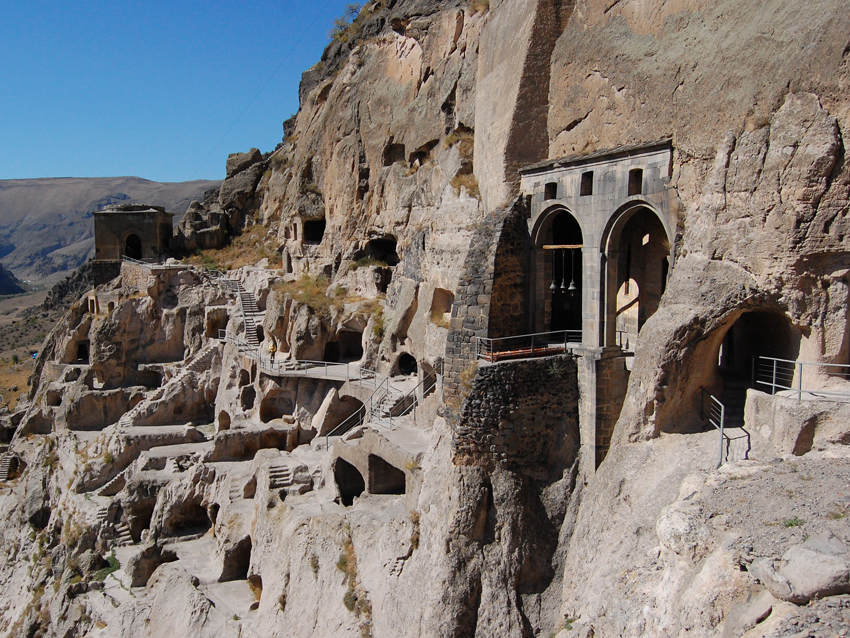
Cave city-monastery VardziaAmong the many Orthodox shrines of Georgia - temples, cathedrals, monasteries - the Vardzia cave complex occupies a special place. Carved into the thickness of the rock, it is not only one of the historical spiritual centers of the country, but also a kind of monument to human steadfastness in faith, fidelity to Christianity, which, despite tragic circumstances, preserved many generations of local inhabitants. The way to Vardzia from the capital of the country, Tbilisi, is not short: about three hundred kilometers. But at the end of the journey, anyone who embarks on it will be rewarded with a grandiose view of the city in the rock that opens up to him. It cannot be called a miracle of nature: Vardzia was created by human hands - but, undoubtedly, with God's blessing.
The holy monastery dates back to the golden age of Georgian history. It is interesting that Vardzia began not as a monastery, but primarily as a border fortress, capable, if necessary, of serving as a long-term refuge for many thousands of people living in relative proximity to it. In the almost vertical wall of the mountain, facing the Kura River, known as Erusheti, Tsar George III ordered to cut down the caves. And the work began to boil! All along the river bed in light and porous tuff, from which consisted of a mountain, more than six hundred of them were cut down. Going deep into the mountains, connected by a complex system of passages-galleries, these caves were a real labyrinth, which was very difficult for the uninitiated to pass into its secrets. Out of the intricacies of the underground fortress, only three moves led outward, it was simply impossible for a stranger to notice the places where they emerged to the surface, not knowing their exact location. And inside a nineteen-tiered labyrinth, going deep into the rock for fifty meters, everything was prepared for a long safe life: a supply of food and water, living rooms, libraries and, of course, churches ... The complex in the thickness of the rock could simultaneously give shelter to twenty thousand people! After the departure of Tsar George III to the Lord, his work on the improvement of the underground complex was continued by his daughter, Queen Tamara, whose name many people around the world associate with the word 'Georgia'. During her father's lifetime, honored to be his co-ruler, becoming a sovereign sovereign, she decided, as they would say today, to develop primarily the spiritual component of the underground complex. According to Tamara's plan, Vardzia was to become not just a fortress, but a majestic piedmont monastery, where hundreds of monks would devote themselves to spiritual work, praying to God for salvation and prosperity of Georgia and the entire Christian world.
Let's digress for a second and note that the very name Vardzia, according to legend, is associated with Queen Tamara, namely, with an incident that happened to her in childhood. Local legend tells that as a girl she and her uncle walked in caves - and out of mischief she hid from him. The relative of the princess was terribly frightened, he was looking for a child here and there and called Tamara by name. Finally, the girl replied: 'I am here, uncle!' (Ak var, dzia) The echo of these words, passing through the intricacies of caves and galleries, reached the ears of her father, the king - and he considered Vardzia an excellent name for a stronghold under the mountain. After becoming a Georgian queen, Tamara showed equal zeal both to defend the independence of Georgia and to establish the faith of Christ in the country. Like her great-grandfather, David IV the Builder, she erected churches and monastic monasteries, in her politics often relied on the clergy and supported them in every possible way. For this very reason, the Assumption Church became the heart of the Varadzia cave complex under her, from which, like arteries, galleries and passages leading into rooms that were very different in purpose ran deep into the rock. The temple itself is still hidden in the rock - only the arches of the vestibule are visible from the outside. The hall that the temple occupies is rounded with sides of the altar. Under the latter there is a hidden passage to the sacristy. Perhaps the most memorable thing about the Church of the Dormition of the Most Holy Theotokos is its unique painting. In the altar there are frescoes depicting the Most Pure Virgin, archangels and holy apostles, and in the church itself - images of scenes from the Great Feasts, as well as the resurrection of Lazarus. One of the walls of the temple is decorated with a fresco depicting the creators of this masterpiece of cave architecture: Tsar George III and his daughter, Queen Tamara.
As the chronicles testify, the consecration of the Dormition Church took place on August 15, 1185. It was here that the icon of the Mother of God of Vardzia, highly revered in Georgia, stayed. In front of this icon, Queen Tamara offered prayers on the eve of the Basian battle - and then, taking off her royal vestments, she went barefoot to the army, which was stationed in the Kura valley, and blessed him for the battle. The result of this historic battle for the country is known: Georgian soldiers defeated in it the 400,000-strong army of Seljuk Turks under the command of Sultan Rukn ad-Din. In addition to the central Assumption Church, the Varadzia monastery-fortress also included 14 churches, 120 monastic cells, 420 utility rooms for various purposes, 25 wine cellars, as well as bakeries, workshops, treasury storage and even baths! By the way, one simply cannot fail to mention the unique water supply system of the cave complex. Ceramic pipes of large diameter brought 170,000 liters of water here every day - not counting the one that came from the spring that gushed out of the rock next to the main temple. In addition to running water, the monastery also had a reservoir containing an emergency reserve of 700,000 liters.
Unfortunately, the Vardzia that has survived to this day is only a third of the colossal complex of the 12th century. Just before Easter in 1283, an earthquake, terrible in its destructive power, occurred in these places. A giant fragment of Mount Erusheti broke away from it and fell into the river. Together with him, the waters of the Kura took in virtually the entire front part of the unique rock complex. But the main thing is that the entire section of Vardzia now appeared to the gaze of every beholder: thus, the complex in the womb of the mountain lost its main protection - secrecy. Over the next twenty-five years, what was left of it, they tried to strengthen and give at least a somewhat complete look. In particular, the monastery bell tower and the arches of the vestibule leading to the Assumption Church were built. In the sixteenth century, a new disaster struck Georgia: the invasion of the Persians. King Luarsab the Great and his soldiers selflessly fought against the invaders, but it was difficult for them to resist the huge army of the enemy. In 1551 Vardzia was devastated by the hordes of Shah Mahasl. The Shah's chronicler called Vardzia 'an unprecedented miracle, as unapproachable as the wall of Alexander the Great.' That, however, did not stop the invaders from killing monks, breaking a huge bell, tearing down doors and church utensils made of precious metals, and razing the fortifications in front of the monastery city. The little that miraculously survived after the Persians was destroyed in 1578 by other destroyers of Georgia - the Turks. Deprived of defensive fortifications, they again robbed the monastery, set all the books in it on fire and burned the inhabitants themselves alive. This Vardzia could not bear: for more than two hundred years the monastic residence here was interrupted - and in the deserted caves only sometimes shepherds with their herds sheltered from the weather. At the end of the 18th century, the Georgian king George XII, fearing the enslavement of the country by the Persians (which was greatly favored by the endless feuds of the local aristocracy), asked Emperor Paul I to annex Georgia to Russia - which happened in 1800. Historic lands of Georgia in less than thirty years were liberated - in 1828 Russian troops expelled the Turks from Javakheti.
Monastics began to gradually return to Vardzia, which was no longer threatened by the invasion of foreigners. The Greek Khadzhi Georgy Popondopulo, who had fled from the Turks, received permission from the Exarch of Georgia to restore the holy monastery. The galleries and premises of the underground monastery were cleared of rubble; a new iconostasis was installed in the main church. In 1854, Exarch Isidore performed the rite of consecration of the renewed shrine. However, the new stage in the life of the holy monastery was, alas, short-lived. The Soviet government destroyed Orthodoxy in Georgia no less zealously than the Persians or Turks: churches and monasteries were closed, the clergy were sent to prison under far-fetched pretexts. For a long sixty years, starting in 1938, Vardzia turned into a museum: where fervent prayer was previously performed, a tourist site is now located. Divine services in the unique mountain monastery were resumed only in 1989, at the end of the godless era. A small handful of priests prayed to the Most Holy Theotokos at Her holy icon of Vardzia for the revival of the Georgian spiritual shrine on the banks of the Kura ... Of course, the revival of the holy monastery, which had been devastated many times - it's not about years, but at least decades. Today, many tourists and pilgrims come to Vardzia, a unique monastery-city in the mountain, but the monastics who work here can be counted on the fingers of one hand. May God grant that strength, means, and, most importantly, people are found who, over time, can return to the unique monastery of Georgia its greatness! V. Sergienko
Cave city-monastery VardziaCave city-monastery Vardzia Cave city-monastery Vardzia Among the many Orthodox shrines of Georgia - temples, cathedrals, monasteries - the Vardzia cave complex occupies a special place. Carved into the thickness of the rock, it is not only one of the historical spiritual centers of the country, but also a kind of monument to human steadfastness in faith, fidelity to Christianity, which, despite tragic circumstances, preserved many generations of local inhabitants. The way to Vardzia from the capital of the country, Tbilisi, is not short: about three hundred kilometers. But at the end of the journey, anyone who embarks on it will be rewarded with a grandiose view of the city in the rock that opens up to him. It cannot be called a miracle of nature: Vardzia was created by human hands - but, undoubtedly, with God's blessing. The holy monastery dates back to the golden age of Georgian history. It is interesting that Vardzia began not as a monastery, but primarily as a border fortress, capable, if necessary, of serving as a long-term refuge for many thousands of people living in relative proximity to it. In the almost vertical wall of the mountain, facing the Kura River, known as Erusheti, Tsar George III ordered to cut down the caves. And the work began to boil! All along the river bed in light and porous tuff, from which consisted of a mountain, more than six hundred of them were cut down. Going deep into the mountains, connected by a complex system of passages-galleries, these caves were a real labyrinth, which was very difficult for the uninitiated to pass into its secrets. Out of the intricacies of the underground fortress, only three moves led outward, it was simply impossible for a stranger to notice the places where they emerged to the surface, not knowing their exact location. And inside a nineteen-tiered labyrinth, going deep into the rock for fifty meters, everything was prepared for a long safe life: a supply of food and water, living rooms, libraries and, of course, churches ... The complex in the thickness of the rock could simultaneously give shelter to twenty thousand people! After the departure of Tsar George III to the Lord, his work on the improvement of the underground complex was continued by his daughter, Queen Tamara, whose name many people around the world associate with the word 'Georgia'. During her father's lifetime, honored to be his co-ruler, becoming a sovereign sovereign, she decided, as they would say today, to develop primarily the spiritual component of the underground complex. According to Tamara's plan, Vardzia was to become not just a fortress, but a majestic piedmont monastery, where hundreds of monks would devote themselves to spiritual work, praying to God for salvation and prosperity of Georgia and the entire Christian world. Let's digress for a second and note that the very name Vardzia, according to legend, is associated with Queen Tamara, namely, with an incident that happened to her in childhood. Local legend tells that as a girl she and her uncle walked in caves - and out of mischief she hid from him. The relative of the princess was terribly frightened, he was looking for a child here and there and called Tamara by name. Finally, the girl replied: 'I am here, uncle!' (Ak var, dzia) The echo of these words, passing through the intricacies of caves and galleries, reached the ears of her father, the king - and he considered Vardzia an excellent name for a stronghold under the mountain. After becoming a Georgian queen, Tamara showed equal zeal both to defend the independence of Georgia and to establish the faith of Christ in the country. Like her great-grandfather, David IV the Builder, she erected churches and monastic monasteries, in her politics often relied on the clergy and supported them in every possible way. For this very reason, the Assumption Church became the heart of the Varadzia cave complex under her, from which, like arteries, galleries and passages leading into rooms that were very different in purpose ran deep into the rock. The temple itself is still hidden in the rock - only the arches of the vestibule are visible from the outside. The hall that the temple occupies is rounded with sides of the altar. Under the latter there is a hidden passage to the sacristy. Perhaps the most memorable thing about the Church of the Dormition of the Most Holy Theotokos is its unique painting. In the altar there are frescoes depicting the Most Pure Virgin, archangels and holy apostles, and in the church itself - images of scenes from the Great Feasts, as well as the resurrection of Lazarus. One of the walls of the temple is decorated with a fresco depicting the creators of this masterpiece of cave architecture: Tsar George III and his daughter, Queen Tamara. As the chronicles testify, the consecration of the Dormition Church took place on August 15, 1185. It was here that the icon of the Mother of God of Vardzia, highly revered in Georgia, stayed. In front of this icon, Queen Tamara offered prayers on the eve of the Basian battle - and then, taking off her royal vestments, she went barefoot to the army, which was stationed in the Kura valley, and blessed him for the battle. The result of this historic battle for the country is known: Georgian soldiers defeated in it the 400,000-strong army of Seljuk Turks under the command of Sultan Rukn ad-Din. In addition to the central Assumption Church, the Varadzia monastery-fortress also included 14 churches, 120 monastic cells, 420 utility rooms for various purposes, 25 wine cellars, as well as bakeries, workshops, treasury storage and even baths! By the way, one simply cannot fail to mention the unique water supply system of the cave complex. Ceramic pipes of large diameter brought 170,000 liters of water here every day - not counting the one that came from the spring that gushed out of the rock next to the main temple. In addition to running water, the monastery also had a reservoir containing an emergency reserve of 700,000 liters. Unfortunately, the Vardzia that has survived to this day is only a third of the colossal complex of the 12th century. Just before Easter in 1283, an earthquake, terrible in its destructive power, occurred in these places. A giant fragment of Mount Erusheti broke away from it and fell into the river. Together with him, the waters of the Kura took in virtually the entire front part of the unique rock complex. But the main thing is that the entire section of Vardzia now appeared to the gaze of every beholder: thus, the complex in the womb of the mountain lost its main protection - secrecy. Over the next twenty-five years, what was left of it, they tried to strengthen and give at least a somewhat complete look. In particular, the monastery bell tower and the arches of the vestibule leading to the Assumption Church were built. In the sixteenth century, a new disaster struck Georgia: the invasion of the Persians. King Luarsab the Great and his soldiers selflessly fought against the invaders, but it was difficult for them to resist the huge army of the enemy. In 1551 Vardzia was devastated by the hordes of Shah Mahasl. The Shah's chronicler called Vardzia 'an unprecedented miracle, as unapproachable as the wall of Alexander the Great.' That, however, did not stop the invaders from killing monks, breaking a huge bell, tearing down doors and church utensils made of precious metals, and razing the fortifications in front of the monastery city. The little that miraculously survived after the Persians was destroyed in 1578 by other destroyers of Georgia - the Turks. Deprived of defensive fortifications, they again robbed the monastery, set all the books in it on fire and burned the inhabitants themselves alive. This Vardzia could not bear: for more than two hundred years the monastic residence here was interrupted - and in the deserted caves only sometimes shepherds with their herds sheltered from the weather. At the end of the 18th century, the Georgian king George XII, fearing the enslavement of the country by the Persians (which was greatly favored by the endless feuds of the local aristocracy), asked Emperor Paul I to annex Georgia to Russia - which happened in 1800. Historic lands of Georgia in less than thirty years were liberated - in 1828 Russian troops expelled the Turks from Javakheti. Monastics began to gradually return to Vardzia, which was no longer threatened by the invasion of foreigners. The Greek Khadzhi Georgy Popondopulo, who had fled from the Turks, received permission from the Exarch of Georgia to restore the holy monastery. The galleries and premises of the underground monastery were cleared of rubble; a new iconostasis was installed in the main church. In 1854, Exarch Isidore performed the rite of consecration of the renewed shrine. However, the new stage in the life of the holy monastery was, alas, short-lived. The Soviet government destroyed Orthodoxy in Georgia no less zealously than the Persians or Turks: churches and monasteries were closed, the clergy were sent to prison under far-fetched pretexts. For a long sixty years, starting in 1938, Vardzia turned into a museum: where fervent prayer was previously performed, a tourist site is now located. Divine services in the unique mountain monastery were resumed only in 1989, at the end of the godless era. A small handful of priests prayed to the Most Holy Theotokos at Her holy icon of Vardzia for the revival of the Georgian spiritual shrine on the banks of the Kura ... Of course, the revival of the holy monastery, which had been devastated many times - it's not about years, but at least decades. Today, many tourists and pilgrims come to Vardzia, a unique monastery-city in the mountain, but the monastics who work here can be counted on the fingers of one hand. May God grant that strength, means, and, most importantly, people are found who, over time, can return to the unique monastery of Georgia its greatness! V. SergienkoСвеча Иерусалима -en
Cave city-monastery Vardzia Among the many Orthodox shrines of Georgia - temples, cathedrals, monasteries - the Vardzia cave complex occupies a special place. Carved into the thickness of the rock, it is not only one of the historical spiritual centers of the country, but also a kind of monument to human steadfastness in faith, fidelity to Christianity, which, despite tragic circumstances, preserved many generations of local inhabitants. The way to Vardzia from the capital of the country, Tbilisi, is not short: about three hundred kilometers. But at the end of the journey, anyone who embarks on it will be rewarded with a grandiose view of the city in the rock that opens up to him. It cannot be called a miracle of nature: Vardzia was created by human hands - but, undoubtedly, with God's blessing. The holy monastery dates back to the golden age of Georgian history. It is interesting that Vardzia began not as a monastery, but primarily as a border fortress, capable, if necessary, of serving as a long-term refuge for many thousands of people living in relative proximity to it. In the almost vertical wall of the mountain, facing the Kura River, known as Erusheti, Tsar George III ordered to cut down the caves. And the work began to boil! All along the river bed in light and porous tuff, from which consisted of a mountain, more than six hundred of them were cut down. Going deep into the mountains, connected by a complex system of passages-galleries, these caves were a real labyrinth, which was very difficult for the uninitiated to pass into its secrets. Out of the intricacies of the underground fortress, only three moves led outward, it was simply impossible for a stranger to notice the places where they emerged to the surface, not knowing their exact location. And inside a nineteen-tiered labyrinth, going deep into the rock for fifty meters, everything was prepared for a long safe life: a supply of food and water, living rooms, libraries and, of course, churches ... The complex in the thickness of the rock could simultaneously give shelter to twenty thousand people! After the departure of Tsar George III to the Lord, his work on the improvement of the underground complex was continued by his daughter, Queen Tamara, whose name many people around the world associate with the word 'Georgia'. During her father's lifetime, honored to be his co-ruler, becoming a sovereign sovereign, she decided, as they would say today, to develop primarily the spiritual component of the underground complex. According to Tamara's plan, Vardzia was to become not just a fortress, but a majestic piedmont monastery, where hundreds of monks would devote themselves to spiritual work, praying to God for salvation and prosperity of Georgia and the entire Christian world. Let's digress for a second and note that the very name Vardzia, according to legend, is associated with Queen Tamara, namely, with an incident that happened to her in childhood. Local legend tells that as a girl she and her uncle walked in caves - and out of mischief she hid from him. The relative of the princess was terribly frightened, he was looking for a child here and there and called Tamara by name. Finally, the girl replied: 'I am here, uncle!' (Ak var, dzia) The echo of these words, passing through the intricacies of caves and galleries, reached the ears of her father, the king - and he considered Vardzia an excellent name for a stronghold under the mountain. After becoming a Georgian queen, Tamara showed equal zeal both to defend the independence of Georgia and to establish the faith of Christ in the country. Like her great-grandfather, David IV the Builder, she erected churches and monastic monasteries, in her politics often relied on the clergy and supported them in every possible way. For this very reason, the Assumption Church became the heart of the Varadzia cave complex under her, from which, like arteries, galleries and passages leading into rooms that were very different in purpose ran deep into the rock. The temple itself is still hidden in the rock - only the arches of the vestibule are visible from the outside. The hall that the temple occupies is rounded with sides of the altar. Under the latter there is a hidden passage to the sacristy. Perhaps the most memorable thing about the Church of the Dormition of the Most Holy Theotokos is its unique painting. In the altar there are frescoes depicting the Most Pure Virgin, archangels and holy apostles, and in the church itself - images of scenes from the Great Feasts, as well as the resurrection of Lazarus. One of the walls of the temple is decorated with a fresco depicting the creators of this masterpiece of cave architecture: Tsar George III and his daughter, Queen Tamara. As the chronicles testify, the consecration of the Dormition Church took place on August 15, 1185. It was here that the icon of the Mother of God of Vardzia, highly revered in Georgia, stayed. In front of this icon, Queen Tamara offered prayers on the eve of the Basian battle - and then, taking off her royal vestments, she went barefoot to the army, which was stationed in the Kura valley, and blessed him for the battle. The result of this historic battle for the country is known: Georgian soldiers defeated in it the 400,000-strong army of Seljuk Turks under the command of Sultan Rukn ad-Din. In addition to the central Assumption Church, the Varadzia monastery-fortress also included 14 churches, 120 monastic cells, 420 utility rooms for various purposes, 25 wine cellars, as well as bakeries, workshops, treasury storage and even baths! By the way, one simply cannot fail to mention the unique water supply system of the cave complex. Ceramic pipes of large diameter brought 170,000 liters of water here every day - not counting the one that came from the spring that gushed out of the rock next to the main temple. In addition to running water, the monastery also had a reservoir containing an emergency reserve of 700,000 liters. Unfortunately, the Vardzia that has survived to this day is only a third of the colossal complex of the 12th century. Just before Easter in 1283, an earthquake, terrible in its destructive power, occurred in these places. A giant fragment of Mount Erusheti broke away from it and fell into the river. Together with him, the waters of the Kura took in virtually the entire front part of the unique rock complex. But the main thing is that the entire section of Vardzia now appeared to the gaze of every beholder: thus, the complex in the womb of the mountain lost its main protection - secrecy. Over the next twenty-five years, what was left of it, they tried to strengthen and give at least a somewhat complete look. In particular, the monastery bell tower and the arches of the vestibule leading to the Assumption Church were built. In the sixteenth century, a new disaster struck Georgia: the invasion of the Persians. King Luarsab the Great and his soldiers selflessly fought against the invaders, but it was difficult for them to resist the huge army of the enemy. In 1551 Vardzia was devastated by the hordes of Shah Mahasl. The Shah's chronicler called Vardzia 'an unprecedented miracle, as unapproachable as the wall of Alexander the Great.' That, however, did not stop the invaders from killing monks, breaking a huge bell, tearing down doors and church utensils made of precious metals, and razing the fortifications in front of the monastery city. The little that miraculously survived after the Persians was destroyed in 1578 by other destroyers of Georgia - the Turks. Deprived of defensive fortifications, they again robbed the monastery, set all the books in it on fire and burned the inhabitants themselves alive. This Vardzia could not bear: for more than two hundred years the monastic residence here was interrupted - and in the deserted caves only sometimes shepherds with their herds sheltered from the weather. At the end of the 18th century, the Georgian king George XII, fearing the enslavement of the country by the Persians (which was greatly favored by the endless feuds of the local aristocracy), asked Emperor Paul I to annex Georgia to Russia - which happened in 1800. Historic lands of Georgia in less than thirty years were liberated - in 1828 Russian troops expelled the Turks from Javakheti. Monastics began to gradually return to Vardzia, which was no longer threatened by the invasion of foreigners. The Greek Khadzhi Georgy Popondopulo, who had fled from the Turks, received permission from the Exarch of Georgia to restore the holy monastery. The galleries and premises of the underground monastery were cleared of rubble; a new iconostasis was installed in the main church. In 1854, Exarch Isidore performed the rite of consecration of the renewed shrine. However, the new stage in the life of the holy monastery was, alas, short-lived. The Soviet government destroyed Orthodoxy in Georgia no less zealously than the Persians or Turks: churches and monasteries were closed, the clergy were sent to prison under far-fetched pretexts. For a long sixty years, starting in 1938, Vardzia turned into a museum: where fervent prayer was previously performed, a tourist site is now located. Divine services in the unique mountain monastery were resumed only in 1989, at the end of the godless era. A small handful of priests prayed to the Most Holy Theotokos at Her holy icon of Vardzia for the revival of the Georgian spiritual shrine on the banks of the Kura ... Of course, the revival of the holy monastery, which had been devastated many times - it's not about years, but at least decades. Today, many tourists and pilgrims come to Vardzia, a unique monastery-city in the mountain, but the monastics who work here can be counted on the fingers of one hand. May God grant that strength, means, and, most importantly, people are found who, over time, can return to the unique monastery of Georgia its greatness! V. Sergienko