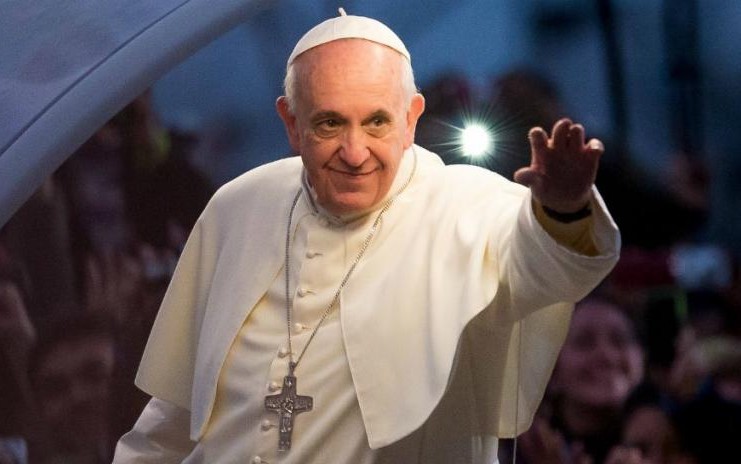
Pope Francis considers it necessary to correct the text of the main Christian prayer

Папа Франциск считает необходимым скорректировать текст главной христианской молитвы
Pope Francis, speaking on the evening of December 6 on the “Our Father” program on TV2000, spoke about the need to amend English, Italian and a number of other translations of the main prayer of Christians given by Jesus Christ Himself. The current translation contains distortions, which, according to the Pontiff, can lead to a false understanding of the meaning of prayer, as if 'God chooses whether to lead us into temptation or not.' Pope Francis recalled that four years ago in France they made a more correct translation of the original prayer, which reads “Don't let us fall into temptation” or “Don't let us succumb to temptation,” which is much more consistent with both the spirit and the letter of the Gospel original. It was this version of the translation of the prayer given in the Gospels of Matthew and Luke that was approved in 2013 by the Conference of Bishops of France, after which it was included in the Book of Hours and other liturgical books. Obviously, now the example of France will be followed by other Catholic countries - especially since there are references to the meaning of what the Savior said in the New Testament, among the apostolic epistles: “In temptation, no one say:“ God tempts me ”; because God is not tempted by evil and He Himself does not tempt anyone, but everyone is tempted, being carried away and deceived ... ”(James 1: 13-14).
Share:
Pope Francis considers it necessary to correct the text of the main Christian prayer Pope Francis considers it necessary to correct the text of the main Christian prayer Pope Francis, speaking on the evening of December 6 on the “Our Father” program on TV2000, spoke about the need to amend English, Italian and a number of other translations of the main prayer of Christians given by Jesus Christ Himself. The current translation contains distortions, which, according to the Pontiff, can lead to a false understanding of the meaning of prayer, as if 'God chooses whether to lead us into temptation or not.' Pope Francis recalled that four years ago in France they made a more correct translation of the original prayer, which reads “Don't let us fall into temptation” or “Don't let us succumb to temptation,” which is much more consistent with both the spirit and the letter of the Gospel original. It was this version of the translation of the prayer given in the Gospels of Matthew and Luke that was approved in 2013 by the Conference of Bishops of France, after which it was included in the Book of Hours and other liturgical books. Obviously, now the example of France will be followed by other Catholic countries - especially since there are references to the meaning of what the Savior said in the New Testament, among the apostolic epistles: “In temptation, no one say:“ God tempts me ”; because God is not tempted by evil and He Himself does not tempt anyone, but everyone is tempted, being carried away and deceived ... ”(James 1: 13-14).
Pope Francis, speaking on the evening of December 6 on the “Our Father” program on TV2000, spoke about the need to amend English, Italian and a number of other translations of the main prayer of Christians given by Jesus Christ Himself. The current translation contains distortions, which, according to the Pontiff, can lead to a false understanding of the meaning of prayer, as if 'God chooses whether to lead us into temptation or not.' Pope Francis recalled that four years ago in France they made a more correct translation of the original prayer, which reads “Don't let us fall into temptation” or “Don't let us succumb to temptation,” which is much more consistent with both the spirit and the letter of the Gospel original. It was this version of the translation of the prayer given in the Gospels of Matthew and Luke that was approved in 2013 by the Conference of Bishops of France, after which it was included in the Book of Hours and other liturgical books. Obviously, now the example of France will be followed by other Catholic countries - especially since there are references to the meaning of what the Savior said in the New Testament, among the apostolic epistles: “In temptation, no one say:“ God tempts me ”; because God is not tempted by evil and He Himself does not tempt anyone, but everyone is tempted, being carried away and deceived ... ”(James 1: 13-14).