Perhaps it is difficult to find a symbol that has the same power, variety and expressiveness as the cross, the image of which goes back to the very origins of the Christian religion. The cross is an instrument of the Savior's passions (suffering), an instrument of execution, but from the first centuries of Christianity it acquired the symbolic meaning of a sacred sign. The image of a cross of various configurations is the most common image in the paintings of the Roman catacombs, in which members of the early Christian community, fearing persecution, gathered to perform rituals. The cross in various designs is found here not only in the paintings of walls and vaults, but also on marble sarcophagi, lamps, lamps, cult vessels, gravestones, etc. In the II-III centuries. veneration of the cross spread so widely that Christians were called “cross worshipers” on the territory of the Roman Empire.
During the time of Emperor Constantine (IV century), along with the direct image of the cross, the so-called chrism, the monogram of Christ, appeared, in some cases replacing his figurative image.
The reason for the birth of this symbol was the legend associated with the battle of Constantine and Maxentius, which preceded the recognition of Christianity at the Mulvian bridge on October 27, 312 (Christianity received the status of the official state religion in the next year, 313). The monogram of Christ consisted of two Greek letters 'chi' and 'Ro' - the initial letters of his name. According to legend, this sign was shown to the emperor Constantine in a prophetic dream on the eve of the battle: he saw a banner on a staff in the form of a cross with the inscription 'Conquer by this'. Having made a semblance of this banner and placing the monogram of Christ on his helmet and shields of soldiers, Constantine was victorious and became the sole head of the empire. It was from that time that he believed in the power of Christ, and the monogram 'chi-ro' became the most widespread Christian symbol.
After the finding of the life-giving cross in the Holy Land by the mother of Tsar Constantine, Equal-to-the-Apostles Helen, the feast of the Exaltation of the Lord's Cross was established, and its direct image began to prevail over the monogram one. The image of the cross took pride of place on the royal crowns and on the domes of temples, in temple interiors and in liturgical practice. In the Middle Ages, the cross becomes a symbol of the power of the Church. It was used by knightly orders, it was included in the images of coats of arms and was placed on standards, its drawing was repeated in the general plans of churches: an equilateral Greek cross formed the basis of an Orthodox cross-domed church, and a Latin (with an elongated longitudinal bar) gave rise to the basilica.
Over the two millennia of its existence, Christian art has developed about a hundred different designs of the cross. Among them, the most famous are the already mentioned Greek (equal-end) and Latin crosses (it was on such a cross, according to Augustine, Christ was crucified), the oblique St. Andrew's cross (one of the disciples of the Savior, the Apostle Andrew the First-Called, died on a cross of this form), tau- a cross similar in shape to the Greek letter 'T' (aka Egyptian, or Antonievsky - according to legend, the Monk Anthony the Great, one of the founders of monasticism in Egypt, traveled with such a cross).
The addition of the 'title' (inscription) above the transverse crossbar of the Latin cross led to the appearance of a double cross (it is also called Lorraine , or Lorraine ), a cross with three crossbars is the exclusive property of the Pope, the inverted Latin cross symbolizes the Apostle Peter, who died through the crucifixion down head.
The oldest version of the cross is the anchor cross , often found in early Christian art (if the Christian Church is identified with the ship of salvation rushing along the stormy waves of the sea of life, then the anchor symbolizes the hope for eternal rest in the quiet harbor of the Kingdom of Heaven). In the Russian Orthodox Church, the most widespread is the eight-pointed cross ( Golgotha ) , which has two additional crossbeams: a short upper one and an oblique lower one. The upper one denotes 'title', or 'titlo' (a tablet on which Pontius Pilate ordered to inscribe the abbreviation 'INRI - Jesus of Nazareth the King of the Jews'); the lower one (the so-called 'righteous measure') with the right edge raised up and the left edge lowered down (relative to the figure of Christ) reminds of the two robbers crucified on the sides of the Savior and their posthumous fate, and, even more broadly, of the two paths that a person can follow (righteous, leading to heaven, and unrighteous, leading to hell).
The material from which the cross is made is important. The wooden cross is a symbol of victory over the devil, who led the ancestors to sin through the tree of the knowledge of good and evil. The famous Golden Legend - one of the favorite books of the Middle Ages - traces the history of the Cross of the Lord from the Garden of Eden to the 7th century, when Emperor Heraclius, having defeated the Persian king Khosrov, returned to Jerusalem the part of the greatest Christian shrine he had stolen from him and erected it on the hill of Calvary.
Death of Adam and Seth, receiving from the Archangel Michael the seeds from the tree of knowledge of good and evil. Fresco by Piero della Francesca. Italy, XV century. The Golden Legend tells that Adam, before his death, sent his son Seth to Eden for 'the oil of forgiveness' from the tree of the knowledge of good and evil. Blinded by the beauty of the Garden of Eden, Seth met the Archangel Michael, who told him that forgiveness would not be granted to the family of Adam very soon, namely in five and a half thousand years. With these words, the archangel handed three seeds to the son of Adam (according to another version - a branch from the tree of knowledge good and evil), which had to be put into the father's mouth before burying his body. Seth was promised that the tree of Atonement would grow on the grave of the first man. The order was fulfilled, and three trees grew out of Adam's body, which then grew together. This tree turned out to be associated with the most significant characters of the Old Testament: Moses, Abraham, David, Solomon, the Queen of Sheba. For example, it became the very pillar on which Moses lifted up the brazen serpent, which saved the Jews from deadly poisonous bites during their crossing through the desert. Later, Roman centurions used this tree to make a cross for the execution of Jesus. The cross was erected in Jerusalem at the place called 'the navel of the earth', where the tomb of Adam was. Drops of Christ's blood fell on the Adam's skull, and this sacred baptism was the salvation of the human race. Three centuries later, Queen Helen discovered the cross of Christ in the Holy Land and brought part of it to Constantinople. Another part of the cross in the 7th century. was kidnapped by the Persian king Khosrov II, who captured the Middle East. The Byzantine Emperor Heraclius returned to Jerusalem the Life-giving Cross, one of the main shrines of Christianity. According to legend, Heraclius, who was entering Jerusalem in triumph, was stopped by an angel who called him to humble his pride. The emperor tore off the royal clothes and on foot carried the cross to the city, after which it was solemnly hoisted on the hill of Calvary.
Celtic cross (St. Columba's cross). Ireland Among the numerous interpretations of the symbolism of the wooden cross, there is one that designates it as a path to faith, a vertical ascent that frees one from earthly gravity. The cross serves as a guarantee of resurrection, gives hope for overcoming death. It is not for nothing that after the spread of Christianity in territories with traditional Celtic culture with its ancient tree-worshiping Druid cults, the image of the cross became so widespread. Despite attempts the prohibition and persecution of cults associated with sacred images and forms, the church eventually adopted the 'pagan' symbol of the cross, enclosed in a circle (the symbol of the sun) and covered with a protective magic braid ( Celtic cross ). Meanwhile, as Abbot Luke explains, 'the diversity of the forms of the cross in the Christian tradition is the diversity of the glorification of the Cross, and not a change in its meaning.' According to St. John of Kronstadt, “the main thing that should remain in the Cross is Love: the Cross cannot be thought and imagined without love: where there is a cross, there is love; in the church you see crosses everywhere and on everything so that everything reminds you that you are in the temple of Love, crucified for us. '
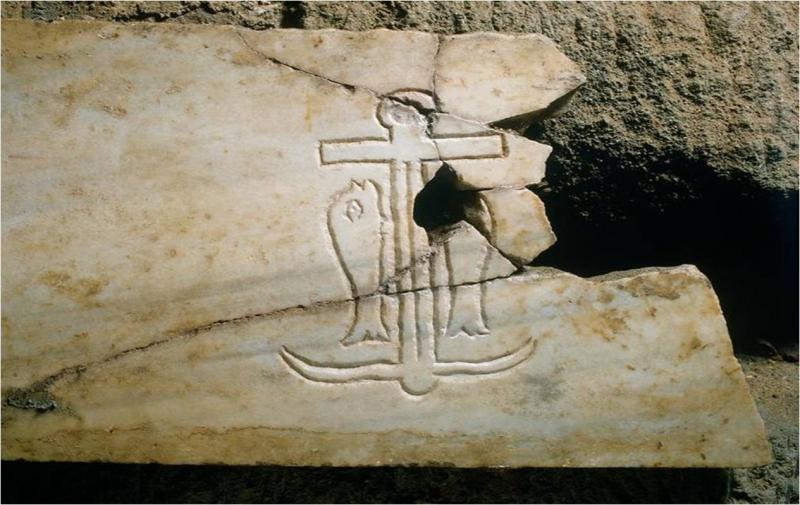
 Anchor cross on a marble slab in the Catacombs of Priscilla, Rome. II-III centuries |  Plate with images of crosses, Egypt. VI century. |
During the time of Emperor Constantine (IV century), along with the direct image of the cross, the so-called chrism, the monogram of Christ, appeared, in some cases replacing his figurative image.
 The depiction of a chrysma (monogram 'chi-ro') in early Christian relief |  The image of the chrysma (monogram 'chi-ro') in the Byzantine mosaic. |
The reason for the birth of this symbol was the legend associated with the battle of Constantine and Maxentius, which preceded the recognition of Christianity at the Mulvian bridge on October 27, 312 (Christianity received the status of the official state religion in the next year, 313). The monogram of Christ consisted of two Greek letters 'chi' and 'Ro' - the initial letters of his name. According to legend, this sign was shown to the emperor Constantine in a prophetic dream on the eve of the battle: he saw a banner on a staff in the form of a cross with the inscription 'Conquer by this'. Having made a semblance of this banner and placing the monogram of Christ on his helmet and shields of soldiers, Constantine was victorious and became the sole head of the empire. It was from that time that he believed in the power of Christ, and the monogram 'chi-ro' became the most widespread Christian symbol.
 Military standard (state banner) of imperial Rome with the monogram of Christ (cross of Constantine). IV century |  The Dream of Constantine and the Battle of the Mulvian Bridge. Book miniature IX century manuscript. |
After the finding of the life-giving cross in the Holy Land by the mother of Tsar Constantine, Equal-to-the-Apostles Helen, the feast of the Exaltation of the Lord's Cross was established, and its direct image began to prevail over the monogram one. The image of the cross took pride of place on the royal crowns and on the domes of temples, in temple interiors and in liturgical practice. In the Middle Ages, the cross becomes a symbol of the power of the Church. It was used by knightly orders, it was included in the images of coats of arms and was placed on standards, its drawing was repeated in the general plans of churches: an equilateral Greek cross formed the basis of an Orthodox cross-domed church, and a Latin (with an elongated longitudinal bar) gave rise to the basilica.
 Assumption Cathedral in Vladimir (cross-domed plan - in the form of a Greek cross). XII century. |  Cologne Cathedral (basilical plan - in the form of a Latin cross). XIII century |
Over the two millennia of its existence, Christian art has developed about a hundred different designs of the cross. Among them, the most famous are the already mentioned Greek (equal-end) and Latin crosses (it was on such a cross, according to Augustine, Christ was crucified), the oblique St. Andrew's cross (one of the disciples of the Savior, the Apostle Andrew the First-Called, died on a cross of this form), tau- a cross similar in shape to the Greek letter 'T' (aka Egyptian, or Antonievsky - according to legend, the Monk Anthony the Great, one of the founders of monasticism in Egypt, traveled with such a cross).
 B.E. Murillo. Martyrdom of St. Andrew. Spain. XVII century | Fragment of the altar door. Italy. XV century |
The addition of the 'title' (inscription) above the transverse crossbar of the Latin cross led to the appearance of a double cross (it is also called Lorraine , or Lorraine ), a cross with three crossbars is the exclusive property of the Pope, the inverted Latin cross symbolizes the Apostle Peter, who died through the crucifixion down head.
 Monument to Charles de Gaulle in Colombey (place of his death) in the form of Lorraine (Lorran) cross - chosen by him a symbol of the liberation of France from the Nazi occupiers. The same cross was worn by Joan of Arc, who was born near Lorran. |  |  |
The oldest version of the cross is the anchor cross , often found in early Christian art (if the Christian Church is identified with the ship of salvation rushing along the stormy waves of the sea of life, then the anchor symbolizes the hope for eternal rest in the quiet harbor of the Kingdom of Heaven). In the Russian Orthodox Church, the most widespread is the eight-pointed cross ( Golgotha ) , which has two additional crossbeams: a short upper one and an oblique lower one. The upper one denotes 'title', or 'titlo' (a tablet on which Pontius Pilate ordered to inscribe the abbreviation 'INRI - Jesus of Nazareth the King of the Jews'); the lower one (the so-called 'righteous measure') with the right edge raised up and the left edge lowered down (relative to the figure of Christ) reminds of the two robbers crucified on the sides of the Savior and their posthumous fate, and, even more broadly, of the two paths that a person can follow (righteous, leading to heaven, and unrighteous, leading to hell).
 Cross-anchor crowning the dome of the temple |  Orthodox (Golgotha) cross with the figure of the Savior and Adam's skull |
The material from which the cross is made is important. The wooden cross is a symbol of victory over the devil, who led the ancestors to sin through the tree of the knowledge of good and evil. The famous Golden Legend - one of the favorite books of the Middle Ages - traces the history of the Cross of the Lord from the Garden of Eden to the 7th century, when Emperor Heraclius, having defeated the Persian king Khosrov, returned to Jerusalem the part of the greatest Christian shrine he had stolen from him and erected it on the hill of Calvary.
 |
Death of Adam and Seth, receiving from the Archangel Michael the seeds from the tree of knowledge of good and evil. Fresco by Piero della Francesca. Italy, XV century. The Golden Legend tells that Adam, before his death, sent his son Seth to Eden for 'the oil of forgiveness' from the tree of the knowledge of good and evil. Blinded by the beauty of the Garden of Eden, Seth met the Archangel Michael, who told him that forgiveness would not be granted to the family of Adam very soon, namely in five and a half thousand years. With these words, the archangel handed three seeds to the son of Adam (according to another version - a branch from the tree of knowledge good and evil), which had to be put into the father's mouth before burying his body. Seth was promised that the tree of Atonement would grow on the grave of the first man. The order was fulfilled, and three trees grew out of Adam's body, which then grew together. This tree turned out to be associated with the most significant characters of the Old Testament: Moses, Abraham, David, Solomon, the Queen of Sheba. For example, it became the very pillar on which Moses lifted up the brazen serpent, which saved the Jews from deadly poisonous bites during their crossing through the desert. Later, Roman centurions used this tree to make a cross for the execution of Jesus. The cross was erected in Jerusalem at the place called 'the navel of the earth', where the tomb of Adam was. Drops of Christ's blood fell on the Adam's skull, and this sacred baptism was the salvation of the human race. Three centuries later, Queen Helen discovered the cross of Christ in the Holy Land and brought part of it to Constantinople. Another part of the cross in the 7th century. was kidnapped by the Persian king Khosrov II, who captured the Middle East. The Byzantine Emperor Heraclius returned to Jerusalem the Life-giving Cross, one of the main shrines of Christianity. According to legend, Heraclius, who was entering Jerusalem in triumph, was stopped by an angel who called him to humble his pride. The emperor tore off the royal clothes and on foot carried the cross to the city, after which it was solemnly hoisted on the hill of Calvary.
 The battle between the army of Heraclius and the Persians. Fresco by Piero della Francesca. Italy, XV century. |  Heraclius returns the Life-giving Cross to Jerusalem. Spain, XV century. |
 |
Celtic cross (St. Columba's cross). Ireland Among the numerous interpretations of the symbolism of the wooden cross, there is one that designates it as a path to faith, a vertical ascent that frees one from earthly gravity. The cross serves as a guarantee of resurrection, gives hope for overcoming death. It is not for nothing that after the spread of Christianity in territories with traditional Celtic culture with its ancient tree-worshiping Druid cults, the image of the cross became so widespread. Despite attempts the prohibition and persecution of cults associated with sacred images and forms, the church eventually adopted the 'pagan' symbol of the cross, enclosed in a circle (the symbol of the sun) and covered with a protective magic braid ( Celtic cross ). Meanwhile, as Abbot Luke explains, 'the diversity of the forms of the cross in the Christian tradition is the diversity of the glorification of the Cross, and not a change in its meaning.' According to St. John of Kronstadt, “the main thing that should remain in the Cross is Love: the Cross cannot be thought and imagined without love: where there is a cross, there is love; in the church you see crosses everywhere and on everything so that everything reminds you that you are in the temple of Love, crucified for us. '
Share: