Between the two testaments: the Essenes and the Qumran scrolls
23 August 2018
Near the Givat Ram hill in western Jerusalem is an unusual building known as the Temple of the Book. No, they do not pray for books in it - in the structure, two-thirds of which is underground, operates the Jerusalem department of the Israel Museum, where unique manuscripts are exhibited. And if some of them, for example, the 'Aleppo Code', are related exclusively to Judaism, then many others are in one way or another connected with Christianity. This connection is not obvious, but, as we will see below, it is very important - this statement fully applies to the Qumran manuscripts or the Dead Sea Scrolls, for the sake of which (together with the biblical manuscripts, of course) the Temple of the Book was built in 1965.
Temple of the Book
Exposition of the Qumran Scrolls
The snow-white temple-stupa, whose outlines are reflected in the surrounding pool of water and the wall of black basalt standing next to it - the Jerusalem Temple of the Book is instantly recognizable in any photograph. The symbolism of the building is also read even by an inexperienced visitor in philosophy: this is the confrontation between black and white, good and evil, truth and lies ... Perhaps this building in the Holy City would not have existed if it were not for one person - David Samuel Gottesman, emigrant from Hungary, millionaire and philanthropist. It was he who acquired the Dead Sea Scrolls at his own expense and donated them to the State of Israel. Anyone can see them in the Temple of the Book today - but not all at once: a group of scrolls is shown from several months to six months, and then goes to restoration, and others take their place. What are these unique manuscripts, the interest in which for more than half a century not only has not waned, but, on the contrary, is growing?
Dead Sea Scrolls
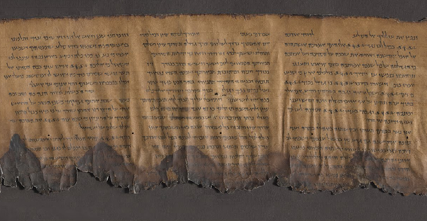
One of the Qumran manuscripts after restoration
The Qumran Manuscripts, also known as the Dead Sea Scrolls, are the collective name for a group of written artifacts found since 1947 in the Qumran caves, wadi Murrabat, Khirbet Mirda and several other places in the Judean Desert and Masada. The bearer of letters made in coal ink in Hebrew, Aramaic and Ancient Greek is parchment - the skin of sheep and goats, and less often - papyrus. The period when these artifacts were created, scientists date back to the time interval from 250 BC to 68 AD. These scrolls - the surviving parts of the library of the Qumran community of the Essenes - a special branch of Judaism, which we will discuss in detail below - contain the literature of the community itself, as well as Old Testament texts and apocrypha. The language of the scrolls, especially the most important of them - 'Rule', 'Blessings', 'Hymns', 'Commentary on Habakkuk', 'Scroll of War' and 'Temple Scroll' - gives a wonderful idea of the language (or rather, languages, including Aramaic and Greek), which was used in Palestine at the turn of the millennium. As far as Hebrew is concerned, members of the Qumran community, as evidenced by the scrolls, preferred biblical expressions of antiquity and, as far as possible, avoided the influence of their contemporary spoken language. Here it is necessary to make a reservation: the lists on display today in the Temple of the Book are only part of the once vast library of the Qumran community. Some of the manuscripts unknown to science are found from time to time. One of these scrolls was presented to the public in 2006 by Professor Hanan Eshel and contained parts of the Old Testament book of Leviticus. He was seized by the police from an Arab smuggler and, by the will of fate, fell into the hands of Professor Eshel, who was invited as an expert. What part of the Qumran community's manuscripts is in the hands of black archaeologists and illegal antiquities dealers and what conditions are stored these most valuable artifacts, one can only guess.
Qumran caves
Qumran settlement plan - modern view
Qumran today is a national park, which is located on a plateau one and a half kilometers from the northwestern coast of the Dead Sea, on the West Bank of the Jordan River, next to Kibbutz Kaliya. To the north of Qumran are the ruins of ancient settlements of the Hellenistic era. They flourished in the second century BC, in the First Jewish War they served as a base for the rebels of Bar Kokhba - and were destroyed by Roman legionaries in 68 AD, after which a Roman garrison stood in these places for about a quarter of a century. There are many caves scattered around; in eleven of them in 1947, the first Qumran scrolls were discovered. After that, up to 1956, excavations were carried out here - by their completion, the number of discovered manuscripts reached nine hundred. Their authors and custodians were members of the already mentioned community of the Essenes, who came to these empty places from Jerusalem. Excavations and the content of the scrolls made it possible to establish much of what concerns their life and everyday life. In the ruins of a settlement of the era At the second temple, scientists discovered dwellings, drainage tanks, furnaces for burning ceramics and others - for smelting metal, grain storage, workshops, laundry and much more. They found a meeting room or refectory, baths for ritual ablutions, a cemetery - and many small items of daily use. All this was created and used by Jews of a special kind - the Essenes, mentioned by the ancient historians Josephus Flavius and Pliny the Elder. The Essenes left the cities, rejecting their corrupted morals, in order to live in closed communities. Even when they came to the Jerusalem Temple, they pointedly avoided communicating with those who did not belong to them. The Essenes led a celibate and, if I may say so, a monastic way of life, accepting children for upbringing and raising them to continue their tradition. In principle, they did not deny marriage, but they revered residence in the community above it. Only men could join the community, and only after a three-year trial. The subsequent initiation procedure was the solemn adoption of lifelong vows. Here are the most important of them: to honor God and the scriptures, to keep the doctrine in secret, to expose lies and injustice and to adhere to truth and truth, not to hide anything from your own people and not to tell anything to strangers, to be obedient to the rulers. and loyal to the authorities, have no personal property and refrain from making a profit. According to Philo, the Essenes did not make bloody sacrifices and were diligently engaged in agriculture, beekeeping, cattle breeding and various crafts. However, they never made weapons, denied slavery and considered each other brothers.
Brotherhood of the Essenes, drawing Making everything for themselves for their own needs, the Essenes did not even enter into communication with merchants. Among them were the interpreters of the scriptures, who were freed from physical labor, spending every third night in prayer, meditation and the search for secret meanings. It was believed that some of these people are capable of foreseeing the future. Members of the community had a common meal, putting on snow-white clothes and treating eating food almost like a sacred rite. The rest of the time they wore an emphatically shabby dress and did not use any incense. The community's income was controlled by the clergy - and a significant part of it was used to help the poor, homeless and starving outside of Qumran. Communication even among the Essenes themselves was kept to a minimum. When they woke up, they did not have everyday conversations, but prayed, turning their faces to the sunrise (and not to Jerusalem, as is accepted in Judaism). They spent most of the day at work, followed by a ritual bath. In addition to the hierarchy, the Essenes' communities also had judges, and the most severe punishment among them was the expulsion from the community - however, they sincerely repented they accepted back. Together with the subjects, the members of the community were divided into five degrees - this division was so strict that the touch of a representative of a higher degree to a representative of a lower one in their midst was revered as desecration. If we talk about the beliefs of the Essenes, they were undoubtedly based on Judaism - however, it was supplemented by a large share of borrowings from other religions of the ancient world. Various researchers saw here the influence of the Chaldeans, which existed in the Jewish environment since the time of the Babylonian captivity, a strong raid of Zoroastrianism, Greek - or, to be more precise - Pythagorean ideas, as well as some kinship with Egyptian therapists, and the latter, according to many researchers, were an offshoot of the Essenes ...
Scroll from Qumran in excellent condition The chronology of the emergence of, let's say, Essenism allows to partially restore one of the Dead Sea scrolls - the so-called 'Damascus Document'. It says that 390 years after the destruction of Jerusalem by Nebuchadnezzar, that is, in 190 BC, a religious party of the 'pious' arose in Palestine, giving rise to the movements of the Pharisees and Essenes. Twenty years later, the manuscript says, God gave the Essenes a 'teacher of righteousness.' He considered the main goal of spreading the message about the imminent coming of the Messiah. During the Maccabean Wars, the teacher's followers took part in the national liberation movement - but exactly until the Temple was liberated. The teacher, whose name is unknown, had a chance to experience persecution, and prosecution, and a split among his associates and even an attempt on life - however, he outlived his ill-wishers and withdrew with his followers to Qumran, to the shores of the Dead Sea. It happened between 140 and 130 BC. In anticipation of the imminent arrival of the Messiah, in which the Essenes were convinced, they, as has already been said, strove to remain pure - of course, as they understood it. The crippled, crippled, blind could not join the community. Inappropriate laughter, spitting, and empty talk were punishable things for community members. Wine for the Essenes was replaced by grape juice - their daily common meal began with a prayer recited by the head of the community over a ritual goblet. It was precisely purity, asceticism and labor, the Essenes believed, were able to help them find the secret meanings and prophecies related to both their time and the future. Every year the entire community gathered for general repentance, which was accompanied by the reading of the provisions of the religious doctrine of the Essenes, included in the 'Rule' that has come down to us. It largely coincides with the thoughts contained in such Old Testament apocrypha as the books of Enoch, Jubilees, Sibyls. Perhaps the main thing in it is the presentiment of a new era that will come with the coming of the Messiah (or even two messiahs - from the priestly and from the royal family, and the first of these two was considered higher in its status). An important position of this doctrine is the conversion not only of the Jews, but of all peoples to the divine Truth. In each of the peoples, the Essenes believed, there are 'chosen ones' who are able to perceive its light and be saved. However, for the victory of the doctrine, they were sure, one should fight: ahead is a long war for the triumph of the 'sons of light' over the 'sons of darkness'. Not the preaching of the doctrine to all nations, as Christians believe to the faithful, but war is a fundamental moment.
The Essenes believed in the general resurrection at the end of days in the same way as the Pharisees: in one of the Qumran scrolls, the hope is expressed that their 'teacher of righteousness' will also arise at the end of days. It was after his death that the Qumran community split into several parts: some of them adhered to the previous strictness, others - returned to the world, got families and personal property. After the suppression of the uprising against Tsar Alexander Yannaya in the 80s of the 1st century BC. a considerable number of Pharisees joined the Qumran community, forced to seek refuge outside the cities. Some of the Essenes who practiced solitude moved to live in Egypt - later these people were known under the name of the 'therapists' about whom Philo speaks. Finally, in the 31st year of the 1st century AD, a powerful earthquake turned the Qumran fortress into ruins - and its last inhabitants scattered in all directions, continuing to adhere to the charter of the community and avoiding unnecessary contacts with people who did not belong to it. Later mentions of the Essenes of Qumran have not been found, but a number of researchers suggest that those of them who did not die during the bloody war of the Jews against the Romans joined the ranks of the early Christians. After all, much in the teaching of Christ was in tune with what they were faithful to for many years of their obedience in Qumran. Asceticism, wilderness, preaching repentance in anticipation of the imminent arrival of the Messiah, treating ablution as something more than just getting rid of ritual impurity ... More than once researchers have raised the question: was not John the Baptist a native of the Essenes, but a “desert”, where he spent his youth, - by the Qumran community, which he left after hearing the 'verb of God' to go to preach? Unfortunately, it is still impossible to give an unequivocal answer to it - just as it is impossible to give it to the question of the closeness to the Essenes of the Apostle John, who remained celibate and often used vocabulary close to the language of the Qumran scrolls in his letters. Either way, there is definitely a connection between Qumran and its legacy in the Dead Sea Scrolls and the Christians of the early centuries. The Qumran manuscripts demonstrate to us in all its fullness the hope for the coming of the One who will bring the world a new message, revealing the essence of the covenant between God and man in an unprecedented fullness. V. Sergienko
Between the two testaments: the Essenes and the Qumran scrollsBetween the two testaments: the Essenes and the Qumran scrolls Near the Givat Ram hill in western Jerusalem is an unusual building known as the Temple of the Book. No, they do not pray for books in it - in the structure, two-thirds of which is underground, operates the Jerusalem department of the Israel Museum, where unique manuscripts are exhibited. And if some of them, for example, the 'Aleppo Code', are related exclusively to Judaism, then many others are in one way or another connected with Christianity. This connection is not obvious, but, as we will see below, it is very important - this statement fully applies to the Qumran manuscripts or the Dead Sea Scrolls, for the sake of which (together with the biblical manuscripts, of course) the Temple of the Book was built in 1965. Temple of the Book Exposition of the Qumran Scrolls The snow-white temple-stupa, whose outlines are reflected in the surrounding pool of water and the wall of black basalt standing next to it - the Jerusalem Temple of the Book is instantly recognizable in any photograph. The symbolism of the building is also read even by an inexperienced visitor in philosophy: this is the confrontation between black and white, good and evil, truth and lies ... Perhaps this building in the Holy City would not have existed if it were not for one person - David Samuel Gottesman, emigrant from Hungary, millionaire and philanthropist. It was he who acquired the Dead Sea Scrolls at his own expense and donated them to the State of Israel. Anyone can see them in the Temple of the Book today - but not all at once: a group of scrolls is shown from several months to six months, and then goes to restoration, and others take their place. What are these unique manuscripts, the interest in which for more than half a century not only has not waned, but, on the contrary, is growing? Dead Sea Scrolls One of the Qumran manuscripts after restoration The Qumran Manuscripts, also known as the Dead Sea Scrolls, are the collective name for a group of written artifacts found since 1947 in the Qumran caves, wadi Murrabat, Khirbet Mirda and several other places in the Judean Desert and Masada. The bearer of letters made in coal ink in Hebrew, Aramaic and Ancient Greek is parchment - the skin of sheep and goats, and less often - papyrus. The period when these artifacts were created, scientists date back to the time interval from 250 BC to 68 AD. These scrolls - the surviving parts of the library of the Qumran community of the Essenes - a special branch of Judaism, which we will discuss in detail below - contain the literature of the community itself, as well as Old Testament texts and apocrypha. The language of the scrolls, especially the most important of them - 'Rule', 'Blessings', 'Hymns', 'Commentary on Habakkuk', 'Scroll of War' and 'Temple Scroll' - gives a wonderful idea of the language (or rather, languages, including Aramaic and Greek), which was used in Palestine at the turn of the millennium. As far as Hebrew is concerned, members of the Qumran community, as evidenced by the scrolls, preferred biblical expressions of antiquity and, as far as possible, avoided the influence of their contemporary spoken language. Here it is necessary to make a reservation: the lists on display today in the Temple of the Book are only part of the once vast library of the Qumran community. Some of the manuscripts unknown to science are found from time to time. One of these scrolls was presented to the public in 2006 by Professor Hanan Eshel and contained parts of the Old Testament book of Leviticus. He was seized by the police from an Arab smuggler and, by the will of fate, fell into the hands of Professor Eshel, who was invited as an expert. What part of the Qumran community's manuscripts is in the hands of black archaeologists and illegal antiquities dealers and what conditions are stored these most valuable artifacts, one can only guess. Qumran caves Qumran settlement plan - modern view Qumran today is a national park, which is located on a plateau one and a half kilometers from the northwestern coast of the Dead Sea, on the West Bank of the Jordan River, next to Kibbutz Kaliya. To the north of Qumran are the ruins of ancient settlements of the Hellenistic era. They flourished in the second century BC, in the First Jewish War they served as a base for the rebels of Bar Kokhba - and were destroyed by Roman legionaries in 68 AD, after which a Roman garrison stood in these places for about a quarter of a century. There are many caves scattered around; in eleven of them in 1947, the first Qumran scrolls were discovered. After that, up to 1956, excavations were carried out here - by their completion, the number of discovered manuscripts reached nine hundred. Their authors and custodians were members of the already mentioned community of the Essenes, who came to these empty places from Jerusalem. Excavations and the content of the scrolls made it possible to establish much of what concerns their life and everyday life. In the ruins of a settlement of the era At the second temple, scientists discovered dwellings, drainage tanks, furnaces for burning ceramics and others - for smelting metal, grain storage, workshops, laundry and much more. They found a meeting room or refectory, baths for ritual ablutions, a cemetery - and many small items of daily use. All this was created and used by Jews of a special kind - the Essenes, mentioned by the ancient historians Josephus Flavius and Pliny the Elder. The Essenes left the cities, rejecting their corrupted morals, in order to live in closed communities. Even when they came to the Jerusalem Temple, they pointedly avoided communicating with those who did not belong to them. The Essenes led a celibate and, if I may say so, a monastic way of life, accepting children for upbringing and raising them to continue their tradition. In principle, they did not deny marriage, but they revered residence in the community above it. Only men could join the community, and only after a three-year trial. The subsequent initiation procedure was the solemn adoption of lifelong vows. Here are the most important of them: to honor God and the scriptures, to keep the doctrine in secret, to expose lies and injustice and to adhere to truth and truth, not to hide anything from your own people and not to tell anything to strangers, to be obedient to the rulers. and loyal to the authorities, have no personal property and refrain from making a profit. According to Philo, the Essenes did not make bloody sacrifices and were diligently engaged in agriculture, beekeeping, cattle breeding and various crafts. However, they never made weapons, denied slavery and considered each other brothers. Brotherhood of the Essenes, drawing Making everything for themselves for their own needs, the Essenes did not even enter into communication with merchants. Among them were the interpreters of the scriptures, who were freed from physical labor, spending every third night in prayer, meditation and the search for secret meanings. It was believed that some of these people are capable of foreseeing the future. Members of the community had a common meal, putting on snow-white clothes and treating eating food almost like a sacred rite. The rest of the time they wore an emphatically shabby dress and did not use any incense. The community's income was controlled by the clergy - and a significant part of it was used to help the poor, homeless and starving outside of Qumran. Communication even among the Essenes themselves was kept to a minimum. When they woke up, they did not have everyday conversations, but prayed, turning their faces to the sunrise (and not to Jerusalem, as is accepted in Judaism). They spent most of the day at work, followed by a ritual bath. In addition to the hierarchy, the Essenes' communities also had judges, and the most severe punishment among them was the expulsion from the community - however, they sincerely repented they accepted back. Together with the subjects, the members of the community were divided into five degrees - this division was so strict that the touch of a representative of a higher degree to a representative of a lower one in their midst was revered as desecration. If we talk about the beliefs of the Essenes, they were undoubtedly based on Judaism - however, it was supplemented by a large share of borrowings from other religions of the ancient world. Various researchers saw here the influence of the Chaldeans, which existed in the Jewish environment since the time of the Babylonian captivity, a strong raid of Zoroastrianism, Greek - or, to be more precise - Pythagorean ideas, as well as some kinship with Egyptian therapists, and the latter, according to many researchers, were an offshoot of the Essenes ... Scroll from Qumran in excellent condition The chronology of the emergence of, let's say, Essenism allows to partially restore one of the Dead Sea scrolls - the so-called 'Damascus Document'. It says that 390 years after the destruction of Jerusalem by Nebuchadnezzar, that is, in 190 BC, a religious party of the 'pious' arose in Palestine, giving rise to the movements of the Pharisees and Essenes. Twenty years later, the manuscript says, God gave the Essenes a 'teacher of righteousness.' He considered the main goal of spreading the message about the imminent coming of the Messiah. During the Maccabean Wars, the teacher's followers took part in the national liberation movement - but exactly until the Temple was liberated. The teacher, whose name is unknown, had a chance to experience persecution, and prosecution, and a split among his associates and even an attempt on life - however, he outlived his ill-wishers and withdrew with his followers to Qumran, to the shores of the Dead Sea. It happened between 140 and 130 BC. In anticipation of the imminent arrival of the Messiah, in which the Essenes were convinced, they, as has already been said, strove to remain pure - of course, as they understood it. The crippled, crippled, blind could not join the community. Inappropriate laughter, spitting, and empty talk were punishable things for community members. Wine for the Essenes was replaced by grape juice - their daily common meal began with a prayer recited by the head of the community over a ritual goblet. It was precisely purity, asceticism and labor, the Essenes believed, were able to help them find the secret meanings and prophecies related to both their time and the future. Every year the entire community gathered for general repentance, which was accompanied by the reading of the provisions of the religious doctrine of the Essenes, included in the 'Rule' that has come down to us. It largely coincides with the thoughts contained in such Old Testament apocrypha as the books of Enoch, Jubilees, Sibyls. Perhaps the main thing in it is the presentiment of a new era that will come with the coming of the Messiah (or even two messiahs - from the priestly and from the royal family, and the first of these two was considered higher in its status). An important position of this doctrine is the conversion not only of the Jews, but of all peoples to the divine Truth. In each of the peoples, the Essenes believed, there are 'chosen ones' who are able to perceive its light and be saved. However, for the victory of the doctrine, they were sure, one should fight: ahead is a long war for the triumph of the 'sons of light' over the 'sons of darkness'. Not the preaching of the doctrine to all nations, as Christians believe to the faithful, but war is a fundamental moment. The Essenes believed in the general resurrection at the end of days in the same way as the Pharisees: in one of the Qumran scrolls, the hope is expressed that their 'teacher of righteousness' will also arise at the end of days. It was after his death that the Qumran community split into several parts: some of them adhered to the previous strictness, others - returned to the world, got families and personal property. After the suppression of the uprising against Tsar Alexander Yannaya in the 80s of the 1st century BC. a considerable number of Pharisees joined the Qumran community, forced to seek refuge outside the cities. Some of the Essenes who practiced solitude moved to live in Egypt - later these people were known under the name of the 'therapists' about whom Philo speaks. Finally, in the 31st year of the 1st century AD, a powerful earthquake turned the Qumran fortress into ruins - and its last inhabitants scattered in all directions, continuing to adhere to the charter of the community and avoiding unnecessary contacts with people who did not belong to it. Later mentions of the Essenes of Qumran have not been found, but a number of researchers suggest that those of them who did not die during the bloody war of the Jews against the Romans joined the ranks of the early Christians. After all, much in the teaching of Christ was in tune with what they were faithful to for many years of their obedience in Qumran. Asceticism, wilderness, preaching repentance in anticipation of the imminent arrival of the Messiah, treating ablution as something more than just getting rid of ritual impurity ... More than once researchers have raised the question: was not John the Baptist a native of the Essenes, but a “desert”, where he spent his youth, - by the Qumran community, which he left after hearing the 'verb of God' to go to preach? Unfortunately, it is still impossible to give an unequivocal answer to it - just as it is impossible to give it to the question of the closeness to the Essenes of the Apostle John, who remained celibate and often used vocabulary close to the language of the Qumran scrolls in his letters. Either way, there is definitely a connection between Qumran and its legacy in the Dead Sea Scrolls and the Christians of the early centuries. The Qumran manuscripts demonstrate to us in all its fullness the hope for the coming of the One who will bring the world a new message, revealing the essence of the covenant between God and man in an unprecedented fullness. V. SergienkoСвеча Иерусалима -en
Near the Givat Ram hill in western Jerusalem is an unusual building known as the Temple of the Book. No, they do not pray for books in it - in the structure, two-thirds of which is underground, operates the Jerusalem department of the Israel Museum, where unique manuscripts are exhibited. And if some of them, for example, the 'Aleppo Code', are related exclusively to Judaism, then many others are in one way or another connected with Christianity. This connection is not obvious, but, as we will see below, it is very important - this statement fully applies to the Qumran manuscripts or the Dead Sea Scrolls, for the sake of which (together with the biblical manuscripts, of course) the Temple of the Book was built in 1965. Temple of the Book Exposition of the Qumran Scrolls The snow-white temple-stupa, whose outlines are reflected in the surrounding pool of water and the wall of black basalt standing next to it - the Jerusalem Temple of the Book is instantly recognizable in any photograph. The symbolism of the building is also read even by an inexperienced visitor in philosophy: this is the confrontation between black and white, good and evil, truth and lies ... Perhaps this building in the Holy City would not have existed if it were not for one person - David Samuel Gottesman, emigrant from Hungary, millionaire and philanthropist. It was he who acquired the Dead Sea Scrolls at his own expense and donated them to the State of Israel. Anyone can see them in the Temple of the Book today - but not all at once: a group of scrolls is shown from several months to six months, and then goes to restoration, and others take their place. What are these unique manuscripts, the interest in which for more than half a century not only has not waned, but, on the contrary, is growing? Dead Sea Scrolls One of the Qumran manuscripts after restoration The Qumran Manuscripts, also known as the Dead Sea Scrolls, are the collective name for a group of written artifacts found since 1947 in the Qumran caves, wadi Murrabat, Khirbet Mirda and several other places in the Judean Desert and Masada. The bearer of letters made in coal ink in Hebrew, Aramaic and Ancient Greek is parchment - the skin of sheep and goats, and less often - papyrus. The period when these artifacts were created, scientists date back to the time interval from 250 BC to 68 AD. These scrolls - the surviving parts of the library of the Qumran community of the Essenes - a special branch of Judaism, which we will discuss in detail below - contain the literature of the community itself, as well as Old Testament texts and apocrypha. The language of the scrolls, especially the most important of them - 'Rule', 'Blessings', 'Hymns', 'Commentary on Habakkuk', 'Scroll of War' and 'Temple Scroll' - gives a wonderful idea of the language (or rather, languages, including Aramaic and Greek), which was used in Palestine at the turn of the millennium. As far as Hebrew is concerned, members of the Qumran community, as evidenced by the scrolls, preferred biblical expressions of antiquity and, as far as possible, avoided the influence of their contemporary spoken language. Here it is necessary to make a reservation: the lists on display today in the Temple of the Book are only part of the once vast library of the Qumran community. Some of the manuscripts unknown to science are found from time to time. One of these scrolls was presented to the public in 2006 by Professor Hanan Eshel and contained parts of the Old Testament book of Leviticus. He was seized by the police from an Arab smuggler and, by the will of fate, fell into the hands of Professor Eshel, who was invited as an expert. What part of the Qumran community's manuscripts is in the hands of black archaeologists and illegal antiquities dealers and what conditions are stored these most valuable artifacts, one can only guess. Qumran caves Qumran settlement plan - modern view Qumran today is a national park, which is located on a plateau one and a half kilometers from the northwestern coast of the Dead Sea, on the West Bank of the Jordan River, next to Kibbutz Kaliya. To the north of Qumran are the ruins of ancient settlements of the Hellenistic era. They flourished in the second century BC, in the First Jewish War they served as a base for the rebels of Bar Kokhba - and were destroyed by Roman legionaries in 68 AD, after which a Roman garrison stood in these places for about a quarter of a century. There are many caves scattered around; in eleven of them in 1947, the first Qumran scrolls were discovered. After that, up to 1956, excavations were carried out here - by their completion, the number of discovered manuscripts reached nine hundred. Their authors and custodians were members of the already mentioned community of the Essenes, who came to these empty places from Jerusalem. Excavations and the content of the scrolls made it possible to establish much of what concerns their life and everyday life. In the ruins of a settlement of the era At the second temple, scientists discovered dwellings, drainage tanks, furnaces for burning ceramics and others - for smelting metal, grain storage, workshops, laundry and much more. They found a meeting room or refectory, baths for ritual ablutions, a cemetery - and many small items of daily use. All this was created and used by Jews of a special kind - the Essenes, mentioned by the ancient historians Josephus Flavius and Pliny the Elder. The Essenes left the cities, rejecting their corrupted morals, in order to live in closed communities. Even when they came to the Jerusalem Temple, they pointedly avoided communicating with those who did not belong to them. The Essenes led a celibate and, if I may say so, a monastic way of life, accepting children for upbringing and raising them to continue their tradition. In principle, they did not deny marriage, but they revered residence in the community above it. Only men could join the community, and only after a three-year trial. The subsequent initiation procedure was the solemn adoption of lifelong vows. Here are the most important of them: to honor God and the scriptures, to keep the doctrine in secret, to expose lies and injustice and to adhere to truth and truth, not to hide anything from your own people and not to tell anything to strangers, to be obedient to the rulers. and loyal to the authorities, have no personal property and refrain from making a profit. According to Philo, the Essenes did not make bloody sacrifices and were diligently engaged in agriculture, beekeeping, cattle breeding and various crafts. However, they never made weapons, denied slavery and considered each other brothers. Brotherhood of the Essenes, drawing Making everything for themselves for their own needs, the Essenes did not even enter into communication with merchants. Among them were the interpreters of the scriptures, who were freed from physical labor, spending every third night in prayer, meditation and the search for secret meanings. It was believed that some of these people are capable of foreseeing the future. Members of the community had a common meal, putting on snow-white clothes and treating eating food almost like a sacred rite. The rest of the time they wore an emphatically shabby dress and did not use any incense. The community's income was controlled by the clergy - and a significant part of it was used to help the poor, homeless and starving outside of Qumran. Communication even among the Essenes themselves was kept to a minimum. When they woke up, they did not have everyday conversations, but prayed, turning their faces to the sunrise (and not to Jerusalem, as is accepted in Judaism). They spent most of the day at work, followed by a ritual bath. In addition to the hierarchy, the Essenes' communities also had judges, and the most severe punishment among them was the expulsion from the community - however, they sincerely repented they accepted back. Together with the subjects, the members of the community were divided into five degrees - this division was so strict that the touch of a representative of a higher degree to a representative of a lower one in their midst was revered as desecration. If we talk about the beliefs of the Essenes, they were undoubtedly based on Judaism - however, it was supplemented by a large share of borrowings from other religions of the ancient world. Various researchers saw here the influence of the Chaldeans, which existed in the Jewish environment since the time of the Babylonian captivity, a strong raid of Zoroastrianism, Greek - or, to be more precise - Pythagorean ideas, as well as some kinship with Egyptian therapists, and the latter, according to many researchers, were an offshoot of the Essenes ... Scroll from Qumran in excellent condition The chronology of the emergence of, let's say, Essenism allows to partially restore one of the Dead Sea scrolls - the so-called 'Damascus Document'. It says that 390 years after the destruction of Jerusalem by Nebuchadnezzar, that is, in 190 BC, a religious party of the 'pious' arose in Palestine, giving rise to the movements of the Pharisees and Essenes. Twenty years later, the manuscript says, God gave the Essenes a 'teacher of righteousness.' He considered the main goal of spreading the message about the imminent coming of the Messiah. During the Maccabean Wars, the teacher's followers took part in the national liberation movement - but exactly until the Temple was liberated. The teacher, whose name is unknown, had a chance to experience persecution, and prosecution, and a split among his associates and even an attempt on life - however, he outlived his ill-wishers and withdrew with his followers to Qumran, to the shores of the Dead Sea. It happened between 140 and 130 BC. In anticipation of the imminent arrival of the Messiah, in which the Essenes were convinced, they, as has already been said, strove to remain pure - of course, as they understood it. The crippled, crippled, blind could not join the community. Inappropriate laughter, spitting, and empty talk were punishable things for community members. Wine for the Essenes was replaced by grape juice - their daily common meal began with a prayer recited by the head of the community over a ritual goblet. It was precisely purity, asceticism and labor, the Essenes believed, were able to help them find the secret meanings and prophecies related to both their time and the future. Every year the entire community gathered for general repentance, which was accompanied by the reading of the provisions of the religious doctrine of the Essenes, included in the 'Rule' that has come down to us. It largely coincides with the thoughts contained in such Old Testament apocrypha as the books of Enoch, Jubilees, Sibyls. Perhaps the main thing in it is the presentiment of a new era that will come with the coming of the Messiah (or even two messiahs - from the priestly and from the royal family, and the first of these two was considered higher in its status). An important position of this doctrine is the conversion not only of the Jews, but of all peoples to the divine Truth. In each of the peoples, the Essenes believed, there are 'chosen ones' who are able to perceive its light and be saved. However, for the victory of the doctrine, they were sure, one should fight: ahead is a long war for the triumph of the 'sons of light' over the 'sons of darkness'. Not the preaching of the doctrine to all nations, as Christians believe to the faithful, but war is a fundamental moment. The Essenes believed in the general resurrection at the end of days in the same way as the Pharisees: in one of the Qumran scrolls, the hope is expressed that their 'teacher of righteousness' will also arise at the end of days. It was after his death that the Qumran community split into several parts: some of them adhered to the previous strictness, others - returned to the world, got families and personal property. After the suppression of the uprising against Tsar Alexander Yannaya in the 80s of the 1st century BC. a considerable number of Pharisees joined the Qumran community, forced to seek refuge outside the cities. Some of the Essenes who practiced solitude moved to live in Egypt - later these people were known under the name of the 'therapists' about whom Philo speaks. Finally, in the 31st year of the 1st century AD, a powerful earthquake turned the Qumran fortress into ruins - and its last inhabitants scattered in all directions, continuing to adhere to the charter of the community and avoiding unnecessary contacts with people who did not belong to it. Later mentions of the Essenes of Qumran have not been found, but a number of researchers suggest that those of them who did not die during the bloody war of the Jews against the Romans joined the ranks of the early Christians. After all, much in the teaching of Christ was in tune with what they were faithful to for many years of their obedience in Qumran. Asceticism, wilderness, preaching repentance in anticipation of the imminent arrival of the Messiah, treating ablution as something more than just getting rid of ritual impurity ... More than once researchers have raised the question: was not John the Baptist a native of the Essenes, but a “desert”, where he spent his youth, - by the Qumran community, which he left after hearing the 'verb of God' to go to preach? Unfortunately, it is still impossible to give an unequivocal answer to it - just as it is impossible to give it to the question of the closeness to the Essenes of the Apostle John, who remained celibate and often used vocabulary close to the language of the Qumran scrolls in his letters. Either way, there is definitely a connection between Qumran and its legacy in the Dead Sea Scrolls and the Christians of the early centuries. The Qumran manuscripts demonstrate to us in all its fullness the hope for the coming of the One who will bring the world a new message, revealing the essence of the covenant between God and man in an unprecedented fullness. V. Sergienko