Then Jesus comes from Galilee to the Jordan to John to be baptized by him. John restrained Him and said: I need to be baptized by You, and do You come to me? But Jesus answered him: Leave it now, for thus it is fitting for us to fulfill all righteousness. Then John allows Him. And, being baptized, Jesus immediately came out of the water - and behold, the heavens were opened to Him, and John saw the Spirit of God, who descended like a dove and descended on Him. And behold, a voice from heaven saying: This is My beloved Son, in whom I am well pleased <- this is how the Gospel of Matthew tells about the baptism of the Lord Jesus Christ (13, 13 -17).
Every year, on the eve of Epiphany, thousands of pilgrims and tourists from all over the world flock to Israel, to the territory of the Palestinian Authority, where on the border with Jordan there is a place where the above-described evangelical events took place more than two thousand years ago. However, pilgrims and tourists come here not only on the feast of Epiphany (Epiphany): it is somehow offensive to visit the Holy Land, visit the Church of the Holy Sepulcher in Jerusalem, and in Bethlehem - the Basilica of the Nativity of Christ and not plunge into the Jordanian waters at the site of the Baptism of the Savior of the world ...
The place of Qasr el-Yahud is located forty minutes from Jerusalem to the Dead Sea, almost at the entrance to it. Literally, its name is translated from Arabic as 'castle of a Jew' or 'fortress of a Jew'. And although no historical Jewish fortress is observed here in our time, this place in the Holy History is really special, known since the time of the Old Testament. It was here that the children of Israel, under the leadership of Joshua, crossed the Jordan to enter the land of Canaan - and what had happened before on the Red Sea was repeated. The priests with the Ark of the Covenant entered the water - and the river stopped upstream, giving people a way along the bottom. Considering that in Old Testament times the Jordan was much deeper than it is now, this was a truly wonderful event.
However, today in these places we remember first of all something else: the baptism of the Son of God and the appearance of the Triune God, the Father in the form of a Voice from heaven, the Son - Jesus Christ - and the Holy Spirit in the form of a dove, from where the feast of Baptism was named the Epiphany.
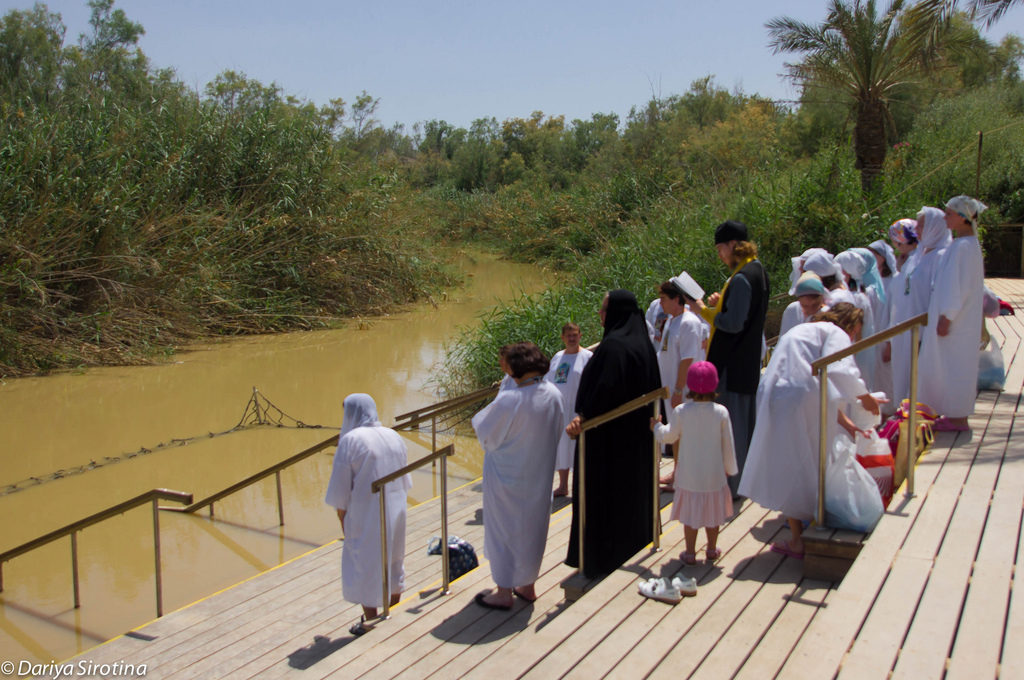
From the time of the Six Day War and until recently, Qasr el-Yahud was located in a closed military zone - free access here for pilgrims and tourists was opened only in 2011. At the entrance, the territory behind the barbed wire is clearly visible - these are minefields, the elimination of which today consistently carried out by the Israeli Ministry of Defense in conjunction with the staff of the Halo Trust. According to the country's military department, there are about three thousand different mines here - as soon as the entire space is cleared of them, they plan to transfer it to the believers. In the meantime, unless, of course, you deliberately climb behind the barbed wire, mines are not dangerous for visitors - and so that no one decides to risk their lives in this way, the servicemen are vigilantly watching. They are not always visible here, but they are in Qasr al-Yahud all the time: after all, on the other side of the river is already the territory of another state, Jordan. So that the visitors do not forget about it, the Jordan River in the middle is fenced off with a metal mesh, along which the border between the countries passes.

The Jordan today is a shallow river five meters wide; the water in it, due to the silty bottom, has a specific clay shade. It flows three hundred meters below sea level, and the difference in height between Jerusalem and Qasr el-Yahud is all 800 meters - you can feel this on the way here, when many people begin to slightly pinch their ears, and water bottles shrink.
Considering that this place has been open to pilgrims for only the last six years, the area here is still just a dedicated area. deserts with dressing rooms, parking, a gift shop and a wooden deck from which pilgrims descend the steps into the Jordan. You won't find people in swimming trunks and swimsuits here - both pilgrims and ordinary tourists go to the waters of the sacred river in special shirts that they bring with them or buy at a local store. However, if someone wants to dive in a regular T-shirt, no one will comment on him. You can change clothes before and after a dive in one of the changing rooms - by the way, in addition to a shirt, it is also a good idea to stock up on slates in advance.
Pilgrims arriving in an organized manner, as a rule, are accompanied by representatives of the clergy - and they dive into the river after the prayer of the priest. You can join one of these groups - fortunately, many of them come here, and especially - on the feast of Epiphany. At the same time, it is quite possible to pray before entering the water yourself: this place itself is very blessed, which is often noted even by not particularly religious visitors to Qasr el-Yahud.
 View of the temple of John the Baptist on the Jordanian side |  Ancient greek monastery of John the Baptist |
Opposite, on the Jordanian coast, there is also a launching platform. There, on the Jordanian side, stands the picturesque Russian Orthodox Church of St. John the Baptist - a modern building whose architecture is sustained in the Greek style. There is no temple on the Israeli side yet - however, at the entrance to Qasr el-Yahud there is a historic Greek monastery founded in the fourth century, which also bears the name of John the Baptist. For many centuries this monastery was destroyed and rebuilt more than once. Today the lamp of monastic prayer is again lit here: this year the monastery resumed its activities, divine services are held here and restoration work is being carried out under the leadership of the abbot, Archimandrite Bartholomew.
The monastery is located a kilometer from modern Beit Avar, which was considered the true place of Baptism since the 16th century until relatively recently, because of the similarity of its sound to the gospel Bethavara (where, according to the New Testament, John the Baptist was located when Jesus Christ came to him).

Another, more distant place was also called - Yardenit, also located on the Jordan, but, so to speak, from the other end - at the source of the river from Lake Galilee. Here, calm and calm water, many seagulls, ducks and herons - and under the surface, flocks of catfish are waiting to be fed. For visitors, a special complex with souvenir shops, cozy paths and slopes to the water is equipped - many people come here today ...
However, comparatively recent archaeological research on the east bank of the Jordan River - they began in 1996 - made it possible to find out that the Baptism of Jesus Christ most likely took place in a completely different place. Namely - not far from Wadi al-Harar, on the territory of modern Jordan. It was there that the ruins of three early Byzantine temples and a slab of the base of the column were found, mentioned in early church sources as a monument perpetuating the site of the Baptism of the Lord. It is this place that is now being improved by the authorities of Jordan and Israel on both sides of the river. Entering the water of the Jordan here, in Qasr el-Yahud, or from the opposite, Jordanian coast, pilgrims can be sure that they are doing it in about the same place where the Lord Jesus Christ was baptized more than two thousand years ago. Why approximately? Because over the past centuries, the riverbed of the Jordan has changed its location more than once, and the current Qasr el-Yahud simply is located as close as possible to the historical site of Epiphany.

And what about the picturesque Yardenit? The fact is that for many years it was the only place accessible for tourists on the Jordan, located in Israel itself - for the rest of its length, the river flows through the territory of the Palestinian Authority, and trips to it without special permission were not allowed for many years. And then there are archaeological discoveries that have contributed to the precise localization of the place of Epiphany. And although, to be honest, Qasr el-Yahud, unlike Yardenit, is not at all so picturesque, let's still hope that in a dozen or two years this territory will be as comfortable as possible for visitors - active work in this direction is already underway here Today.
As many travelers note, Qasr el-Yahud is already hot in April and the sun bakes mercilessly. Therefore, when going on a trip, it is not at all superfluous to stock up on a headdress (for women it will most likely be a kerchief). And there are also a lot of white pigeons: they are specially grown on the opposite, Jordanian bank of the river to be released on the feast of the Epiphany.
... And yet - why we, Christians, have been celebrating the Baptism of the Lord for many centuries how great holiday? Was it necessary in principle for the Savior to be baptized in water by the hand of John, who only preceded His sermon? After all, Jesus was born into a pious family that strictly observed the rules of Judaism, including the mikvah, a ritual cleansing from impurity by immersion in water, which must have happened many times? However, the followers of Judaism perform mikvah many times - and John the Baptist baptized those who followed his call to repentance only once. And in what he did, we can hear echoes of the teachings of the Essenes - a special offshoot of Judaism, who practiced immersion in water not as a ritual 'cleansing', but for the sake of forgiving sins. But about who the Essenes are, what is their place between the Old and New Testaments, as well as what spiritual message they left to humanity, we will definitely talk another time - in a special article dedicated to the Dead Sea Scrolls.
V. Sergienko