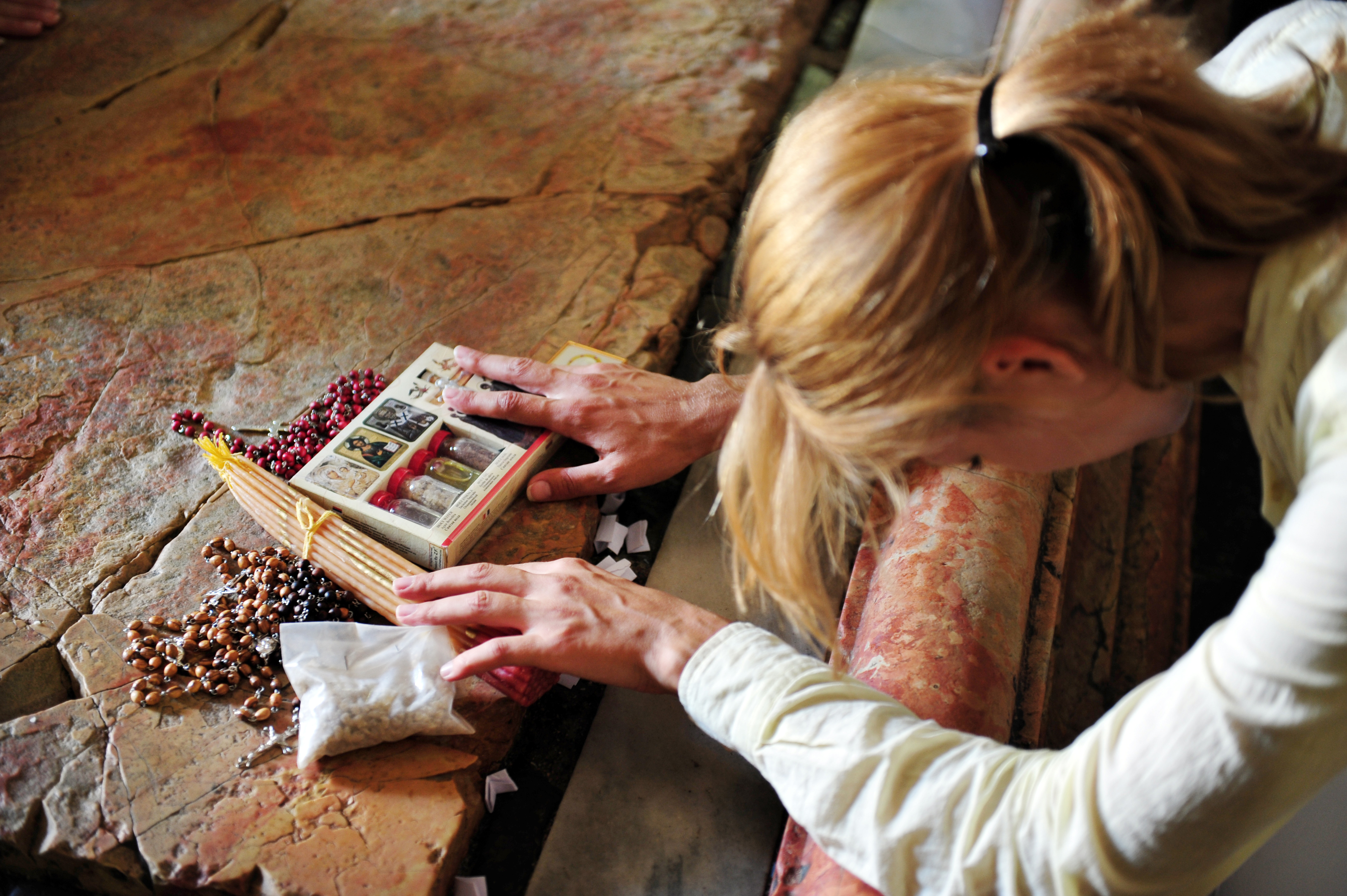
In the Jerusalem Church of the Holy Sepulcher, not far from the entrance, there is the only place in the world where every Christian can independently, without resorting to the services of a priest, consecrate a cross, icon or other religious or household item. The place is the Stone of Anointing, which is also called the Stone of Anointing, the Stone of Anointing, or even quite simply - the Board of the Lord. For pilgrims who arrived in Jerusalem to walk along the Via Dolorosa (Sorrowful Way), the Anointing Stone is one of the stops on this, perhaps the most important route for all Christian pilgrims. And yet it is best to come to the Stone separately - early in the morning, when there are almost no pilgrims in the temple - in order to preserve the feelings that this amazing place leaves in memory for a lifetime. Strictly speaking, the Anointing Stone itself is hidden under a marble slab placed on top for preservation purposes. But the grace inherent in him easily penetrates through the thickness of marble, invisibly spreading around. As well as myrrh, the microscopic drops of which miraculously cover the surface of the slab.
To better understand this place, let us first turn to the sacred history of the New Testament. According to the Gospel, one of Christ's secret disciples, a rich and well-born member Sanhedrin Joseph of Arimathea asked Pontius Pilate for permission to remove the Savior's body from the cross, prepare it in the right way for burial and then bury it. Pilate could not refuse one of the Jewish elders. Joseph, together with another follower of Christ, also secret, named Nicodemus, put the body of the Savior on a stone, anoint it with precious myrrh and aloe, and then wrap it in a shroud - in full accordance with the Jewish burial tradition. When the ritual is performed, the Most Holy Theotokos and the Galilean wives are nearby, who mourn Christ. Here is how the beloved disciple of the Lord, the Evangelist John, speaks of the anointing and the subsequent burial of the body of Jesus Christ: “After this, Joseph of Arimathea - a disciple of Jesus, but secret out of fear from the Jews, - asked Pilate to remove the body of Jesus; and Pilate allowed. He went and took off the body of Jesus. Nicodemus also came - who had come to Jesus at night before - and brought a composition of myrrh and aloe, about a hundred liters. So they took the body of Jesus and wrapped it in swaddling clothes with incense, as the Jews usually bury. In the place where He was crucified, there was a garden, and in the garden there is a new tomb, in which no one has yet been laid. They put Jesus there for the sake of Jewish Friday, because the tomb was near ”(John 19: 38–42). As you know, built several centuries later at the direction of the mother Emperor Constantine the Great, Queen Helena, the Jerusalem Church of the Holy Sepulcher united into a single architectural ensemble the places associated with the death of the cross, the burial and resurrection of the Savior. The Anointing Stone was also among these places.
In the Byzantine period, the Chapel of St. Mary, which was part of the temple complex, stood over the Anointing Stone. During the times of the Kingdom of Jerusalem, the crusaders radically reconstructed the buildings: instead of an architectural ensemble, which consisted of many separate objects, a monumental structure appeared here, uniting all the local shrines, including the Stone, under one roof. Until the beginning of the century before last, the Anointing Stone was owned by Catholic monks from the Franciscan order. Only in 1810, Catholics, Orthodox, as well as the ancient apostolic churches - Armenian and Coptic - came to an agreement on joint ownership of the Stone. A wall was built behind the shrine, which was then decorated with elaborate mosaics. It is a magnificent triptych by the master Vlasis Tsotsonis. His first scene depicts the removal from the cross, the second - the anointing with chrism, and the third - burial. Joseph of Arimathea appears in the mosaic as a gray-bearded old man in red robes. All past centuries, in which Jerusalem was accessible to Christian pilgrims, an endless stream of pilgrims flowed to the Church of the Holy Sepulcher. Each of them strove to touch the Stone - or even to chop off even the smallest part from it, in order to then reverently take it away with him. To protect against such destructive piety, the Stone was covered with black marble. Later this facing was removed - today the shrine is covered with a pale pink slab, also marble. The protective plate is 2.7 meters long, 1.3 meters wide, and 30 centimeters thick. Eight icon lamps hang on a special crossbar above the stone, the flame in which is supported by the ministers of six churches represented in the Church of the Holy Sepulcher: Greek Orthodox, Catholic, Armenian, Coptic, Ethiopian and Syrian-Maronite. To the left of the Anointing Stone, on the floor, is marked - also in marble - a circle. According to Tradition, it was at this place that the Most Holy Virgin Mary stood when the body of Her Son was prepared for burial.
As already mentioned, at the Stone, except perhaps in the very early hours of the morning, there are always many believers. A rock exudes microscopic particles of the world - and believers rush to touch the slab covered with it with their lips, forehead, hands, and even put handkerchiefs and the edges of their clothes on it. Crosses, body images, candles - so many things are blessed here. As Christians living in different parts of the earth believe, objects put on the Stone for a short time from this moment have a special, incomparable grace-filled power, sanctifying not only the objects themselves, but also the one who owns them. That is why an icon, a pectoral cross, a candle or a scarf consecrated on the Stone of Confirmation is always a long-awaited gift for believers belonging to successive Christian churches. There is no need to doubt the reality of the action of a special divine power here: everyone who at least once kneels at the Stone of Confirmation will confirm that everything is exactly like this. And at the end of our short story about the Stone of Confirmation, we will give a short review of one of the many, many thousands of pilgrims who have visited this place, published in LiveJournal by the user under the nickname chugoj - not even the whole review, but its most striking fragment. “Approaching the stone, I bent down, touched the surface with my forehead and clearly, almost sharply felt the smell exuded by the stone, in which the sounds of rose oil, something else spicy and coniferous. Applying and removing my hands, I felt that the smell was coming from them too - it was clearly, almost sharply felt that my burning forehead exudes it too.The feeling was almost shocking - by an unusual combination of simplicity and simplicity of a miracle and an insistent voice of everyday rationality, obligingly slipping in 'revelations' in the spirit of primitive atheistic agitation of Stalin's or Khrushchev's times ... If the servants of the Temple smear the slab with incense - then when? After all, the temple is locked at night and the keys of the hereditary Muslim keepers. If this is done in an open Temple, how is it possible? In disbelief, all the way back in the car, I kept bringing my hands to my face and caught an amazing sensation when the invisible fields of this smell coming from the hands and from the forehead seemed to combine, merge into a whole, my cheeks began to burn and washed back there, to the stone, to where once His body lay.
It seemed to me that life had sent me a seemingly simple, but almost insoluble problem, before which I was simply shy.Hochyu I woke up several times, brought a palm to his face and felt their heat and the smell - inseparable - roses, spicy pine needles, something else ...Consciousness and memory of a person as if 'cultural', and therefore - distinguishing 'Fahrenheit' from 'Kenzo', and 'Ted Lapidus' from 'Krasnaya Moskva' clearly, if not annoyingly demanded further identification of the smell, its components, and something else stopped, forcing to concentrate, to listen to the inner that was gradually formed both by the need to come to the temple, and by everything felt in it, and by this smell, as if carried away by me from the stone on my forehead and on my palms. ' Two thousand years ago, people who lived in the Holy Land achieved great success for their time in the creation of original incense and aromatic substances - this is evidenced by many historical sources. But, of course, none of the substances they have created, even the most persistent, can smell fragrant for almost two millennia in a row. This is possible only under the influence of the blessed power that invisibly spreads around the Stone, on which the body of the Savior of the world was prepared for burial. It is impossible to explain this rationally - but, perhaps, the words of a poet beloved by many can become a kind of key to understanding this phenomenon: 'God preserves everything ...'
Anointing stone: a place of life-giving powerAnointing stone: a place of life-giving power In the Jerusalem Church of the Holy Sepulcher, not far from the entrance, there is the only place in the world where every Christian can independently, without resorting to the services of a priest, consecrate a cross, icon or other religious or household item. The place is the Stone of Anointing, which is also called the Stone of Anointing, the Stone of Anointing, or even quite simply - the Board of the Lord. For pilgrims who arrived in Jerusalem to walk along the Via Dolorosa (Sorrowful Way), the Anointing Stone is one of the stops on this, perhaps the most important route for all Christian pilgrims. And yet it is best to come to the Stone separately - early in the morning, when there are almost no pilgrims in the temple - in order to preserve the feelings that this amazing place leaves in memory for a lifetime. Strictly speaking, the Anointing Stone itself is hidden under a marble slab placed on top for preservation purposes. But the grace inherent in him easily penetrates through the thickness of marble, invisibly spreading around. As well as myrrh, the microscopic drops of which miraculously cover the surface of the slab. To better understand this place, let us first turn to the sacred history of the New Testament. According to the Gospel, one of Christ's secret disciples, a rich and well-born member Sanhedrin Joseph of Arimathea asked Pontius Pilate for permission to remove the Savior's body from the cross, prepare it in the right way for burial and then bury it. Pilate could not refuse one of the Jewish elders. Joseph, together with another follower of Christ, also secret, named Nicodemus, put the body of the Savior on a stone, anoint it with precious myrrh and aloe, and then wrap it in a shroud - in full accordance with the Jewish burial tradition. When the ritual is performed, the Most Holy Theotokos and the Galilean wives are nearby, who mourn Christ. Here is how the beloved disciple of the Lord, the Evangelist John, speaks of the anointing and the subsequent burial of the body of Jesus Christ: “After this, Joseph of Arimathea - a disciple of Jesus, but secret out of fear from the Jews, - asked Pilate to remove the body of Jesus; and Pilate allowed. He went and took off the body of Jesus. Nicodemus also came - who had come to Jesus at night before - and brought a composition of myrrh and aloe, about a hundred liters. So they took the body of Jesus and wrapped it in swaddling clothes with incense, as the Jews usually bury. In the place where He was crucified, there was a garden, and in the garden there is a new tomb, in which no one has yet been laid. They put Jesus there for the sake of Jewish Friday, because the tomb was near ”(John 19: 38–42). As you know, built several centuries later at the direction of the mother Emperor Constantine the Great, Queen Helena, the Jerusalem Church of the Holy Sepulcher united into a single architectural ensemble the places associated with the death of the cross, the burial and resurrection of the Savior. The Anointing Stone was also among these places. In the Byzantine period, the Chapel of St. Mary, which was part of the temple complex, stood over the Anointing Stone. During the times of the Kingdom of Jerusalem, the crusaders radically reconstructed the buildings: instead of an architectural ensemble, which consisted of many separate objects, a monumental structure appeared here, uniting all the local shrines, including the Stone, under one roof. Until the beginning of the century before last, the Anointing Stone was owned by Catholic monks from the Franciscan order. Only in 1810, Catholics, Orthodox, as well as the ancient apostolic churches - Armenian and Coptic - came to an agreement on joint ownership of the Stone. A wall was built behind the shrine, which was then decorated with elaborate mosaics. It is a magnificent triptych by the master Vlasis Tsotsonis. His first scene depicts the removal from the cross, the second - the anointing with chrism, and the third - burial. Joseph of Arimathea appears in the mosaic as a gray-bearded old man in red robes. All past centuries, in which Jerusalem was accessible to Christian pilgrims, an endless stream of pilgrims flowed to the Church of the Holy Sepulcher. Each of them strove to touch the Stone - or even to chop off even the smallest part from it, in order to then reverently take it away with him. To protect against such destructive piety, the Stone was covered with black marble. Later this facing was removed - today the shrine is covered with a pale pink slab, also marble. The protective plate is 2.7 meters long, 1.3 meters wide, and 30 centimeters thick. Eight icon lamps hang on a special crossbar above the stone, the flame in which is supported by the ministers of six churches represented in the Church of the Holy Sepulcher: Greek Orthodox, Catholic, Armenian, Coptic, Ethiopian and Syrian-Maronite. To the left of the Anointing Stone, on the floor, is marked - also in marble - a circle. According to Tradition, it was at this place that the Most Holy Virgin Mary stood when the body of Her Son was prepared for burial. As already mentioned, at the Stone, except perhaps in the very early hours of the morning, there are always many believers. A rock exudes microscopic particles of the world - and believers rush to touch the slab covered with it with their lips, forehead, hands, and even put handkerchiefs and the edges of their clothes on it. Crosses, body images, candles - so many things are blessed here. As Christians living in different parts of the earth believe, objects put on the Stone for a short time from this moment have a special, incomparable grace-filled power, sanctifying not only the objects themselves, but also the one who owns them. That is why an icon, a pectoral cross, a candle or a scarf consecrated on the Stone of Confirmation is always a long-awaited gift for believers belonging to successive Christian churches. There is no need to doubt the reality of the action of a special divine power here: everyone who at least once kneels at the Stone of Confirmation will confirm that everything is exactly like this. And at the end of our short story about the Stone of Confirmation, we will give a short review of one of the many, many thousands of pilgrims who have visited this place, published in LiveJournal by the user under the nickname chugoj - not even the whole review, but its most striking fragment. “Approaching the stone, I bent down, touched the surface with my forehead and clearly, almost sharply felt the smell exuded by the stone, in which the sounds of rose oil, something else spicy and coniferous. Applying and removing my hands, I felt that the smell was coming from them too - it was clearly, almost sharply felt that my burning forehead exudes it too. The feeling was almost shocking - by an unusual combination of simplicity and simplicity of a miracle and an insistent voice of everyday rationality, obligingly slipping in 'revelations' in the spirit of primitive atheistic agitation of Stalin's or Khrushchev's times ... If the servants of the Temple smear the slab with incense - then when? After all, the temple is locked at night and the keys of the hereditary Muslim keepers. If this is done in an open Temple, how is it possible? In disbelief, all the way back in the car, I kept bringing my hands to my face and caught an amazing sensation when the invisible fields of this smell coming from the hands and from the forehead seemed to combine, merge into a whole, my cheeks began to burn and washed back there, to the stone, to where once His body lay. It seemed to me that life had sent me a seemingly simple, but almost insoluble problem, before which I was simply shy. H ochyu I woke up several times, brought a palm to his face and felt their heat and the smell - inseparable - roses, spicy pine needles, something else ... Consciousness and memory of a person as if 'cultural', and therefore - distinguishing 'Fahrenheit' from 'Kenzo', and 'Ted Lapidus' from 'Krasnaya Moskva' clearly, if not annoyingly demanded further identification of the smell, its components, and something else stopped, forcing to concentrate, to listen to the inner that was gradually formed both by the need to come to the temple, and by everything felt in it, and by this smell, as if carried away by me from the stone on my forehead and on my palms. ' Two thousand years ago, people who lived in the Holy Land achieved great success for their time in the creation of original incense and aromatic substances - this is evidenced by many historical sources. But, of course, none of the substances they have created, even the most persistent, can smell fragrant for almost two millennia in a row. This is possible only under the influence of the blessed power that invisibly spreads around the Stone, on which the body of the Savior of the world was prepared for burial. It is impossible to explain this rationally - but, perhaps, the words of a poet beloved by many can become a kind of key to understanding this phenomenon: 'God preserves everything ...'Свеча Иерусалима -en
In the Jerusalem Church of the Holy Sepulcher, not far from the entrance, there is the only place in the world where every Christian can independently, without resorting to the services of a priest, consecrate a cross, icon or other religious or household item. The place is the Stone of Anointing, which is also called the Stone of Anointing, the Stone of Anointing, or even quite simply - the Board of the Lord. For pilgrims who arrived in Jerusalem to walk along the Via Dolorosa (Sorrowful Way), the Anointing Stone is one of the stops on this, perhaps the most important route for all Christian pilgrims. And yet it is best to come to the Stone separately - early in the morning, when there are almost no pilgrims in the temple - in order to preserve the feelings that this amazing place leaves in memory for a lifetime. Strictly speaking, the Anointing Stone itself is hidden under a marble slab placed on top for preservation purposes. But the grace inherent in him easily penetrates through the thickness of marble, invisibly spreading around. As well as myrrh, the microscopic drops of which miraculously cover the surface of the slab. To better understand this place, let us first turn to the sacred history of the New Testament. According to the Gospel, one of Christ's secret disciples, a rich and well-born member Sanhedrin Joseph of Arimathea asked Pontius Pilate for permission to remove the Savior's body from the cross, prepare it in the right way for burial and then bury it. Pilate could not refuse one of the Jewish elders. Joseph, together with another follower of Christ, also secret, named Nicodemus, put the body of the Savior on a stone, anoint it with precious myrrh and aloe, and then wrap it in a shroud - in full accordance with the Jewish burial tradition. When the ritual is performed, the Most Holy Theotokos and the Galilean wives are nearby, who mourn Christ. Here is how the beloved disciple of the Lord, the Evangelist John, speaks of the anointing and the subsequent burial of the body of Jesus Christ: “After this, Joseph of Arimathea - a disciple of Jesus, but secret out of fear from the Jews, - asked Pilate to remove the body of Jesus; and Pilate allowed. He went and took off the body of Jesus. Nicodemus also came - who had come to Jesus at night before - and brought a composition of myrrh and aloe, about a hundred liters. So they took the body of Jesus and wrapped it in swaddling clothes with incense, as the Jews usually bury. In the place where He was crucified, there was a garden, and in the garden there is a new tomb, in which no one has yet been laid. They put Jesus there for the sake of Jewish Friday, because the tomb was near ”(John 19: 38–42). As you know, built several centuries later at the direction of the mother Emperor Constantine the Great, Queen Helena, the Jerusalem Church of the Holy Sepulcher united into a single architectural ensemble the places associated with the death of the cross, the burial and resurrection of the Savior. The Anointing Stone was also among these places. In the Byzantine period, the Chapel of St. Mary, which was part of the temple complex, stood over the Anointing Stone. During the times of the Kingdom of Jerusalem, the crusaders radically reconstructed the buildings: instead of an architectural ensemble, which consisted of many separate objects, a monumental structure appeared here, uniting all the local shrines, including the Stone, under one roof. Until the beginning of the century before last, the Anointing Stone was owned by Catholic monks from the Franciscan order. Only in 1810, Catholics, Orthodox, as well as the ancient apostolic churches - Armenian and Coptic - came to an agreement on joint ownership of the Stone. A wall was built behind the shrine, which was then decorated with elaborate mosaics. It is a magnificent triptych by the master Vlasis Tsotsonis. His first scene depicts the removal from the cross, the second - the anointing with chrism, and the third - burial. Joseph of Arimathea appears in the mosaic as a gray-bearded old man in red robes. All past centuries, in which Jerusalem was accessible to Christian pilgrims, an endless stream of pilgrims flowed to the Church of the Holy Sepulcher. Each of them strove to touch the Stone - or even to chop off even the smallest part from it, in order to then reverently take it away with him. To protect against such destructive piety, the Stone was covered with black marble. Later this facing was removed - today the shrine is covered with a pale pink slab, also marble. The protective plate is 2.7 meters long, 1.3 meters wide, and 30 centimeters thick. Eight icon lamps hang on a special crossbar above the stone, the flame in which is supported by the ministers of six churches represented in the Church of the Holy Sepulcher: Greek Orthodox, Catholic, Armenian, Coptic, Ethiopian and Syrian-Maronite. To the left of the Anointing Stone, on the floor, is marked - also in marble - a circle. According to Tradition, it was at this place that the Most Holy Virgin Mary stood when the body of Her Son was prepared for burial. As already mentioned, at the Stone, except perhaps in the very early hours of the morning, there are always many believers. A rock exudes microscopic particles of the world - and believers rush to touch the slab covered with it with their lips, forehead, hands, and even put handkerchiefs and the edges of their clothes on it. Crosses, body images, candles - so many things are blessed here. As Christians living in different parts of the earth believe, objects put on the Stone for a short time from this moment have a special, incomparable grace-filled power, sanctifying not only the objects themselves, but also the one who owns them. That is why an icon, a pectoral cross, a candle or a scarf consecrated on the Stone of Confirmation is always a long-awaited gift for believers belonging to successive Christian churches. There is no need to doubt the reality of the action of a special divine power here: everyone who at least once kneels at the Stone of Confirmation will confirm that everything is exactly like this. And at the end of our short story about the Stone of Confirmation, we will give a short review of one of the many, many thousands of pilgrims who have visited this place, published in LiveJournal by the user under the nickname chugoj - not even the whole review, but its most striking fragment. “Approaching the stone, I bent down, touched the surface with my forehead and clearly, almost sharply felt the smell exuded by the stone, in which the sounds of rose oil, something else spicy and coniferous. Applying and removing my hands, I felt that the smell was coming from them too - it was clearly, almost sharply felt that my burning forehead exudes it too. The feeling was almost shocking - by an unusual combination of simplicity and simplicity of a miracle and an insistent voice of everyday rationality, obligingly slipping in 'revelations' in the spirit of primitive atheistic agitation of Stalin's or Khrushchev's times ... If the servants of the Temple smear the slab with incense - then when? After all, the temple is locked at night and the keys of the hereditary Muslim keepers. If this is done in an open Temple, how is it possible? In disbelief, all the way back in the car, I kept bringing my hands to my face and caught an amazing sensation when the invisible fields of this smell coming from the hands and from the forehead seemed to combine, merge into a whole, my cheeks began to burn and washed back there, to the stone, to where once His body lay. It seemed to me that life had sent me a seemingly simple, but almost insoluble problem, before which I was simply shy. H ochyu I woke up several times, brought a palm to his face and felt their heat and the smell - inseparable - roses, spicy pine needles, something else ... Consciousness and memory of a person as if 'cultural', and therefore - distinguishing 'Fahrenheit' from 'Kenzo', and 'Ted Lapidus' from 'Krasnaya Moskva' clearly, if not annoyingly demanded further identification of the smell, its components, and something else stopped, forcing to concentrate, to listen to the inner that was gradually formed both by the need to come to the temple, and by everything felt in it, and by this smell, as if carried away by me from the stone on my forehead and on my palms. ' Two thousand years ago, people who lived in the Holy Land achieved great success for their time in the creation of original incense and aromatic substances - this is evidenced by many historical sources. But, of course, none of the substances they have created, even the most persistent, can smell fragrant for almost two millennia in a row. This is possible only under the influence of the blessed power that invisibly spreads around the Stone, on which the body of the Savior of the world was prepared for burial. It is impossible to explain this rationally - but, perhaps, the words of a poet beloved by many can become a kind of key to understanding this phenomenon: 'God preserves everything ...'