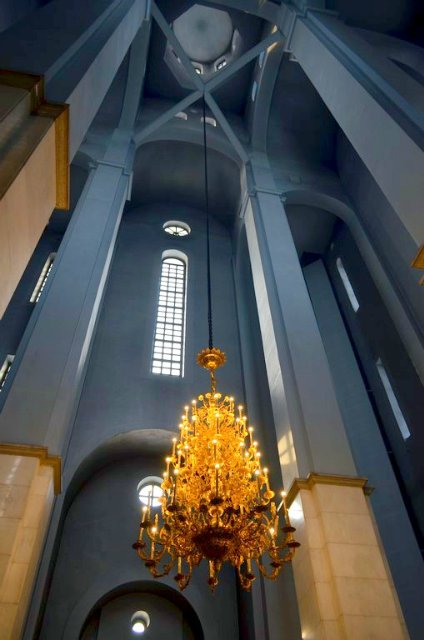
In addition to the rather unusual name, the Grado-Khabarovsk Cathedral of the Assumption of the Mother of God attracts the attention of anyone who comes to the capital of the region with its non-standard dimensions. The height of the temple - 50 meters - is significantly greater than its length and width, which makes the cathedral a kind of local architectural dominant: golden domes burn in the sun, as if welcoming those who enter the city with their radiance.
The cathedral, directed into the sky, is undoubtedly one of the most beautiful architectural structures in Khabarovsk. Despite the fact that the construction of the current church was completed at the beginning of the XXI century, the history of the cathedral is almost as old as the chronicle of the city itself.
The military post of Khabarovka, established in 1858, grew rapidly - including due to the influx of civilians from different classes - and soon demanded the construction of a spacious church. The philanthropist, who wished to remain anonymous, made a huge for those times contribution 'to the church' in the amount of 15,000 rubles in silver - but with the condition of collecting additional funds. The local merchants brought this amount to 40,000 rubles, after which the city authorities in 1880 decided to start construction - and a site was allocated on which the cathedral and related buildings were to be built: the priest's house, household and other buildings.
At the same time, it should be noted that the collection of money continued - the merchant of the First Guild Andrei Plyusnin, an honest man with an excellent business reputation, was appointed responsible for it. However, as soon as the foundations of the cathedral were laid, he suddenly died - and the construction was interrupted for four long years. In further fundraising for the construction of the temple, the deceased's brother, Vasily, was in charge.
The project of the cathedral in honor of the Dormition of the Mother of God was developed completely free of charge by the engineer S.O.Ber - he personally supervised the work in 1883-1889. Workers of the Khabarovsk Engineering Distance and Chinese masons were directly involved in the construction.
The Holy Synod allocated 16,000 rubles for the construction of the temple. At the same time, the collection of donations did not stop. The military governor of the Primorsky region Joseph Gavrilovich Baranov, the governor-general of Eastern Siberia Dmitry Gavrilovich Anuchin, merchants Plyusnins, Khlebnikovs, Bogdanovs, Pyankovs, Rafailov and others made their contribution to the construction of the main temple of Khabarovsk. The Russian Empress Maria Feodorovna donated a thousand rubles to the church, and the same amount was donated by the Irkutsk merchant Andrei Fedorovich Bryantsev. Many local residents took an active part in the construction - peasants, merchants, military men and representatives of the clergy. Finally in 1886 the bulk of the construction work was completed - and on Christmas Day the first Divine Liturgy was celebrated in the cathedral.
In 1890, the cathedral was consecrated with a great rite by the bishop of Kamchatka Guriy. And in the year 1991, a chapel was added to it in the name of St. Nicholas the Wonderworker - in memory of the visit to the city by the Tsarevich, the future Emperor-Passion-Bearer.
In 1994, a 180-pound bell intended for the belfry of the cathedral was delivered to Khabarovsk - funds for its casting and delivery were donated by the local merchant Kisilev. In 1895, a parish school was opened at the cathedral, supported by private donations and funds from the sale of candles.
At the very beginning of the twentieth century, a stone bell tower and two side chapels were added to the church - and the chapel of St. Nicholas was expanded with an extension of the 'semicircle'. Due to the fact that during the construction, changes and additions were made to the original project more than once, work inside and outside the cathedral continued until 1907. And in all its glory, the Assumption Cathedral appeared to the eyes of local residents and guests of Khabarovsk 27 years after the start of construction work.
The eyewitness accounts, captured by local newspapers of the time, are invariably enthusiastic - many noted that the new temple is superior in its splendor even the cathedral of Vladivostok. In 1905, when finishing work was still going on in the temple, the Assumption Cathedral of Khabarovsk was already recognized as the most magnificent work of church architecture in the Annunciation diocese and the entire Amur region. In the year when the Khabarovsk Cathedral was fully completed, a power plant was launched in the city, and the temple was illuminated with electric lights.
The Khabarovsk Cathedral survived the events of the civil war in the Far East and stood until 1930. It was then that the regional executive committee decided to demolish the temple 'as having no architectural and historical value', and de facto - for the sake of the building material required by the atheistic authorities - brick. And this was done: the grandiose cathedral was demolished, the hill on which it stood was dug down, and the place itself was covered with asphalt and named Komsomolskaya Square. It is, in fact, a common story for the times of building socialism - and a whole drama for the older generations of local residents who remembered the magnificent services in the main temple of the city.
The story of the Khabarovsk Cathedral was continued only 64 years later, when in 1994 it was decided to reconstruct Komsomolskaya Square. It was then that an initiative group of representatives of the clergy and laity, gathered at the local diocese, raised the issue of restoring in the same place the demolished at Soviet power cathedral. Of course, the forces of inertia in the early years of the new Russia were still very great. In response to the submitted request, the Commission for Religious Relations of the Khabarovsk Territory Administration replied that it '... does not recommend the reconstruction of the Assumption Cathedral in its historical place.'
Disputes about the restoration of the cathedral continued for about two more years. Finally, in 1996, the governor of the region, Viktor Ishaev, signed an appropriate document on the restoration of the main cathedral of the city, including the object in the plan for the revival of the historical part of Khabarovsk. In the same place - but, of course, not in its original form, because over the past decades, the appearance of the city has changed significantly and the new temple was supposed to harmoniously fit into the modern architectural ensemble of the center of Khabarovsk.
It is impossible not to mention the visit to the capital of the Khabarovsk Territory of the blessed memory of Alexy II, the most holy Patriarch of Moscow and All Russia. With a huge crowd of believers, he celebrated the Divine Liturgy on the site of the destroyed Assumption Cathedral, which served as a powerful incentive for its early restoration. Finally, on October 19, 2000, Bishop Mark of Khabarovsk and Amur consecrated the foundation stone placed in the foundation of the future memorial church.
It is interesting to note that the first draft of the cathedral was not approved - by reasons stated above. The preference was given to another project - being a collective development of the authors from the State Unitary Enterprise 'Khabarovskgrazhdanproekt', it assumed the reproduction of the general five-domed structure and historical elements of the external appearance of the cathedral (domes, arches, and so on), but at the same time took into account the specifics of the architectural space of the square ... October 29 In 2001, the construction of the temple-monument - the Grado-Khabarovsk Cathedral of the Assumption of the Mother of God was completed. Compared to its predecessor, it was built in record time - but at the same time it was in no way inferior to it in beauty.
The main icon of the Khabarovsk Cathedral is the image of the Assumption of the Mother of God - it can be seen in the lower row of the iconostasis. Other shrines transferred to the temple during the construction stage and a little earlier are the historical Albazin icon of the Most Pure (a list donated to the cathedral in 1897 by the merchant Vasily Plyusnin), the image of the Most Holy Theotokos of Tikhvin and the icon of the holy righteous warrior-naval commander Theodor Ushakov with a particle of his relics.
For the Orthodox believers of Khabarovsk, the grandiose Cathedral of the Dormition of the Mother of God has become one of the main (if not the most important) symbols of the city. The memorial temple is especially beautiful at night, when the illumination is turned on, emphasizing its sky-high silhouette.
What concerns the square on which the temple stands, it was, of course, renamed. Now it is called not Komsomolskaya, but Cathedral, and it is easy to guess which building on it has a plate with number 1 on its facade.
The cathedral, directed into the sky, is undoubtedly one of the most beautiful architectural structures in Khabarovsk. Despite the fact that the construction of the current church was completed at the beginning of the XXI century, the history of the cathedral is almost as old as the chronicle of the city itself.
The military post of Khabarovka, established in 1858, grew rapidly - including due to the influx of civilians from different classes - and soon demanded the construction of a spacious church. The philanthropist, who wished to remain anonymous, made a huge for those times contribution 'to the church' in the amount of 15,000 rubles in silver - but with the condition of collecting additional funds. The local merchants brought this amount to 40,000 rubles, after which the city authorities in 1880 decided to start construction - and a site was allocated on which the cathedral and related buildings were to be built: the priest's house, household and other buildings.
At the same time, it should be noted that the collection of money continued - the merchant of the First Guild Andrei Plyusnin, an honest man with an excellent business reputation, was appointed responsible for it. However, as soon as the foundations of the cathedral were laid, he suddenly died - and the construction was interrupted for four long years. In further fundraising for the construction of the temple, the deceased's brother, Vasily, was in charge.
The project of the cathedral in honor of the Dormition of the Mother of God was developed completely free of charge by the engineer S.O.Ber - he personally supervised the work in 1883-1889. Workers of the Khabarovsk Engineering Distance and Chinese masons were directly involved in the construction.
The Holy Synod allocated 16,000 rubles for the construction of the temple. At the same time, the collection of donations did not stop. The military governor of the Primorsky region Joseph Gavrilovich Baranov, the governor-general of Eastern Siberia Dmitry Gavrilovich Anuchin, merchants Plyusnins, Khlebnikovs, Bogdanovs, Pyankovs, Rafailov and others made their contribution to the construction of the main temple of Khabarovsk. The Russian Empress Maria Feodorovna donated a thousand rubles to the church, and the same amount was donated by the Irkutsk merchant Andrei Fedorovich Bryantsev. Many local residents took an active part in the construction - peasants, merchants, military men and representatives of the clergy. Finally in 1886 the bulk of the construction work was completed - and on Christmas Day the first Divine Liturgy was celebrated in the cathedral.
In 1890, the cathedral was consecrated with a great rite by the bishop of Kamchatka Guriy. And in the year 1991, a chapel was added to it in the name of St. Nicholas the Wonderworker - in memory of the visit to the city by the Tsarevich, the future Emperor-Passion-Bearer.
In 1994, a 180-pound bell intended for the belfry of the cathedral was delivered to Khabarovsk - funds for its casting and delivery were donated by the local merchant Kisilev. In 1895, a parish school was opened at the cathedral, supported by private donations and funds from the sale of candles.
At the very beginning of the twentieth century, a stone bell tower and two side chapels were added to the church - and the chapel of St. Nicholas was expanded with an extension of the 'semicircle'. Due to the fact that during the construction, changes and additions were made to the original project more than once, work inside and outside the cathedral continued until 1907. And in all its glory, the Assumption Cathedral appeared to the eyes of local residents and guests of Khabarovsk 27 years after the start of construction work.
The eyewitness accounts, captured by local newspapers of the time, are invariably enthusiastic - many noted that the new temple is superior in its splendor even the cathedral of Vladivostok. In 1905, when finishing work was still going on in the temple, the Assumption Cathedral of Khabarovsk was already recognized as the most magnificent work of church architecture in the Annunciation diocese and the entire Amur region. In the year when the Khabarovsk Cathedral was fully completed, a power plant was launched in the city, and the temple was illuminated with electric lights.
The Khabarovsk Cathedral survived the events of the civil war in the Far East and stood until 1930. It was then that the regional executive committee decided to demolish the temple 'as having no architectural and historical value', and de facto - for the sake of the building material required by the atheistic authorities - brick. And this was done: the grandiose cathedral was demolished, the hill on which it stood was dug down, and the place itself was covered with asphalt and named Komsomolskaya Square. It is, in fact, a common story for the times of building socialism - and a whole drama for the older generations of local residents who remembered the magnificent services in the main temple of the city.
The story of the Khabarovsk Cathedral was continued only 64 years later, when in 1994 it was decided to reconstruct Komsomolskaya Square. It was then that an initiative group of representatives of the clergy and laity, gathered at the local diocese, raised the issue of restoring in the same place the demolished at Soviet power cathedral. Of course, the forces of inertia in the early years of the new Russia were still very great. In response to the submitted request, the Commission for Religious Relations of the Khabarovsk Territory Administration replied that it '... does not recommend the reconstruction of the Assumption Cathedral in its historical place.'
Disputes about the restoration of the cathedral continued for about two more years. Finally, in 1996, the governor of the region, Viktor Ishaev, signed an appropriate document on the restoration of the main cathedral of the city, including the object in the plan for the revival of the historical part of Khabarovsk. In the same place - but, of course, not in its original form, because over the past decades, the appearance of the city has changed significantly and the new temple was supposed to harmoniously fit into the modern architectural ensemble of the center of Khabarovsk.
It is impossible not to mention the visit to the capital of the Khabarovsk Territory of the blessed memory of Alexy II, the most holy Patriarch of Moscow and All Russia. With a huge crowd of believers, he celebrated the Divine Liturgy on the site of the destroyed Assumption Cathedral, which served as a powerful incentive for its early restoration. Finally, on October 19, 2000, Bishop Mark of Khabarovsk and Amur consecrated the foundation stone placed in the foundation of the future memorial church.
It is interesting to note that the first draft of the cathedral was not approved - by reasons stated above. The preference was given to another project - being a collective development of the authors from the State Unitary Enterprise 'Khabarovskgrazhdanproekt', it assumed the reproduction of the general five-domed structure and historical elements of the external appearance of the cathedral (domes, arches, and so on), but at the same time took into account the specifics of the architectural space of the square ... October 29 In 2001, the construction of the temple-monument - the Grado-Khabarovsk Cathedral of the Assumption of the Mother of God was completed. Compared to its predecessor, it was built in record time - but at the same time it was in no way inferior to it in beauty.
The main icon of the Khabarovsk Cathedral is the image of the Assumption of the Mother of God - it can be seen in the lower row of the iconostasis. Other shrines transferred to the temple during the construction stage and a little earlier are the historical Albazin icon of the Most Pure (a list donated to the cathedral in 1897 by the merchant Vasily Plyusnin), the image of the Most Holy Theotokos of Tikhvin and the icon of the holy righteous warrior-naval commander Theodor Ushakov with a particle of his relics.
For the Orthodox believers of Khabarovsk, the grandiose Cathedral of the Dormition of the Mother of God has become one of the main (if not the most important) symbols of the city. The memorial temple is especially beautiful at night, when the illumination is turned on, emphasizing its sky-high silhouette.
What concerns the square on which the temple stands, it was, of course, renamed. Now it is called not Komsomolskaya, but Cathedral, and it is easy to guess which building on it has a plate with number 1 on its facade.
Share: