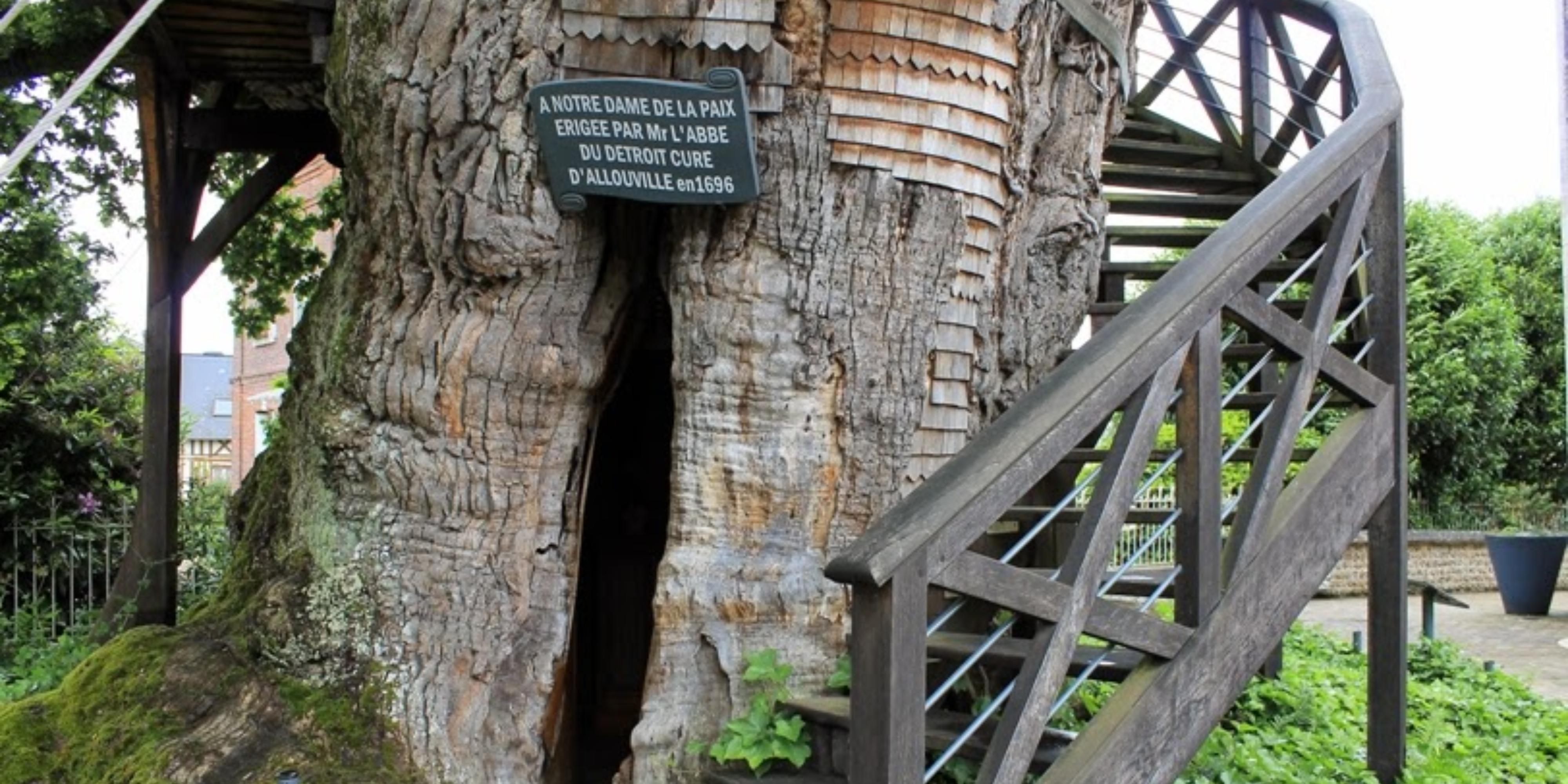
This small village in Normandy, in the Seine-Maritime department, has a population of just over a thousand - and has an attraction that is known far beyond the borders of France. It is a twin Catholic chapel inside an oak tree struck by lightning four centuries ago.
Nobody knows exactly how old an oak tree, turned by human hands into an unusual architectural structure, is. They say that it is about a thousand years old (sometimes the number 1200 is also called) and this tree is the oldest in France. But it is hardly possible to find out whether this is so. Be that as it may, supporters of different points of view on this issue agree that the oak is no less than eight hundred years old.
In the seventeenth century, a tree was struck by lightning. The monks, considering the oak dead, hollowed out its core and built a chapel inside. Incredibly, after that the tree came to life. Which of course was regarded as a good sign.
Strictly speaking, there are two chapels inside the oak: one is dedicated to the Mother of God: Notre Dame de la Paix (“Our Lady of Peace”), the second to the Savior's torment on the Cross, and is called the Hermit's Chapel: Chambre de l'Ermite (“Hermit's room”). The upper chapel got this name because of the cell that one of its founders, Father Serko, originally set up for himself here. (The second was the abbot of the local parish, the Abbot of Detroit).
Alluville oak (fr. Chêne d'Allouville) has a height of 18 meters and a trunk diameter at its widest point of 16 meters. At the end of the eighteenth century, during the years of the Great French Revolution, atheist citizens decided to burn the tree completely - however, the local authorities found a clever way out that allowed preserving the unique tree: they declared it ... 'the oak of reason and rationalism.' Of course, only for a while, until the revolutionary madness left the citizens.
In the 19th century, the first restoration took place in the two-tiered chapel. The work was carried out under the supervision of the director of the local seminary, Mr. d'Ivto. Working with the interior, the restorers tried to preserve and even emphasize the style of the 17th century, in which the chapel appeared. Much has been done here with the money of donors who came here from all over Normandy and from more distant places. For example, by their diligence, the spiral staircase of the chapel, which was so unsafe for visitors, finally received a railing.
A local legend has survived that after a lightning strike, the oak seemed to begin to glow - and that is why it was decided to build a chapel in the tree. And the tree bloomed supposedly later, when the chapel was already in operation. By the way, the aforementioned father Serko lived as a hermit in his cell inside an oak tree until his death - and after a while it became a chapel named after him.
During its existence, the chapel inside the oak has been restored several times. In 2007-2008, the last works to this day were carried out here. The stairs and some other wooden structures were once again replaced - and gravel was made around the ancient oak tree for reasons of beauty and convenience of pilgrims.
Nobody knows exactly how old an oak tree, turned by human hands into an unusual architectural structure, is. They say that it is about a thousand years old (sometimes the number 1200 is also called) and this tree is the oldest in France. But it is hardly possible to find out whether this is so. Be that as it may, supporters of different points of view on this issue agree that the oak is no less than eight hundred years old.
In the seventeenth century, a tree was struck by lightning. The monks, considering the oak dead, hollowed out its core and built a chapel inside. Incredibly, after that the tree came to life. Which of course was regarded as a good sign.
Strictly speaking, there are two chapels inside the oak: one is dedicated to the Mother of God: Notre Dame de la Paix (“Our Lady of Peace”), the second to the Savior's torment on the Cross, and is called the Hermit's Chapel: Chambre de l'Ermite (“Hermit's room”). The upper chapel got this name because of the cell that one of its founders, Father Serko, originally set up for himself here. (The second was the abbot of the local parish, the Abbot of Detroit).
Alluville oak (fr. Chêne d'Allouville) has a height of 18 meters and a trunk diameter at its widest point of 16 meters. At the end of the eighteenth century, during the years of the Great French Revolution, atheist citizens decided to burn the tree completely - however, the local authorities found a clever way out that allowed preserving the unique tree: they declared it ... 'the oak of reason and rationalism.' Of course, only for a while, until the revolutionary madness left the citizens.
In the 19th century, the first restoration took place in the two-tiered chapel. The work was carried out under the supervision of the director of the local seminary, Mr. d'Ivto. Working with the interior, the restorers tried to preserve and even emphasize the style of the 17th century, in which the chapel appeared. Much has been done here with the money of donors who came here from all over Normandy and from more distant places. For example, by their diligence, the spiral staircase of the chapel, which was so unsafe for visitors, finally received a railing.
A local legend has survived that after a lightning strike, the oak seemed to begin to glow - and that is why it was decided to build a chapel in the tree. And the tree bloomed supposedly later, when the chapel was already in operation. By the way, the aforementioned father Serko lived as a hermit in his cell inside an oak tree until his death - and after a while it became a chapel named after him.
During its existence, the chapel inside the oak has been restored several times. In 2007-2008, the last works to this day were carried out here. The stairs and some other wooden structures were once again replaced - and gravel was made around the ancient oak tree for reasons of beauty and convenience of pilgrims.
Share: