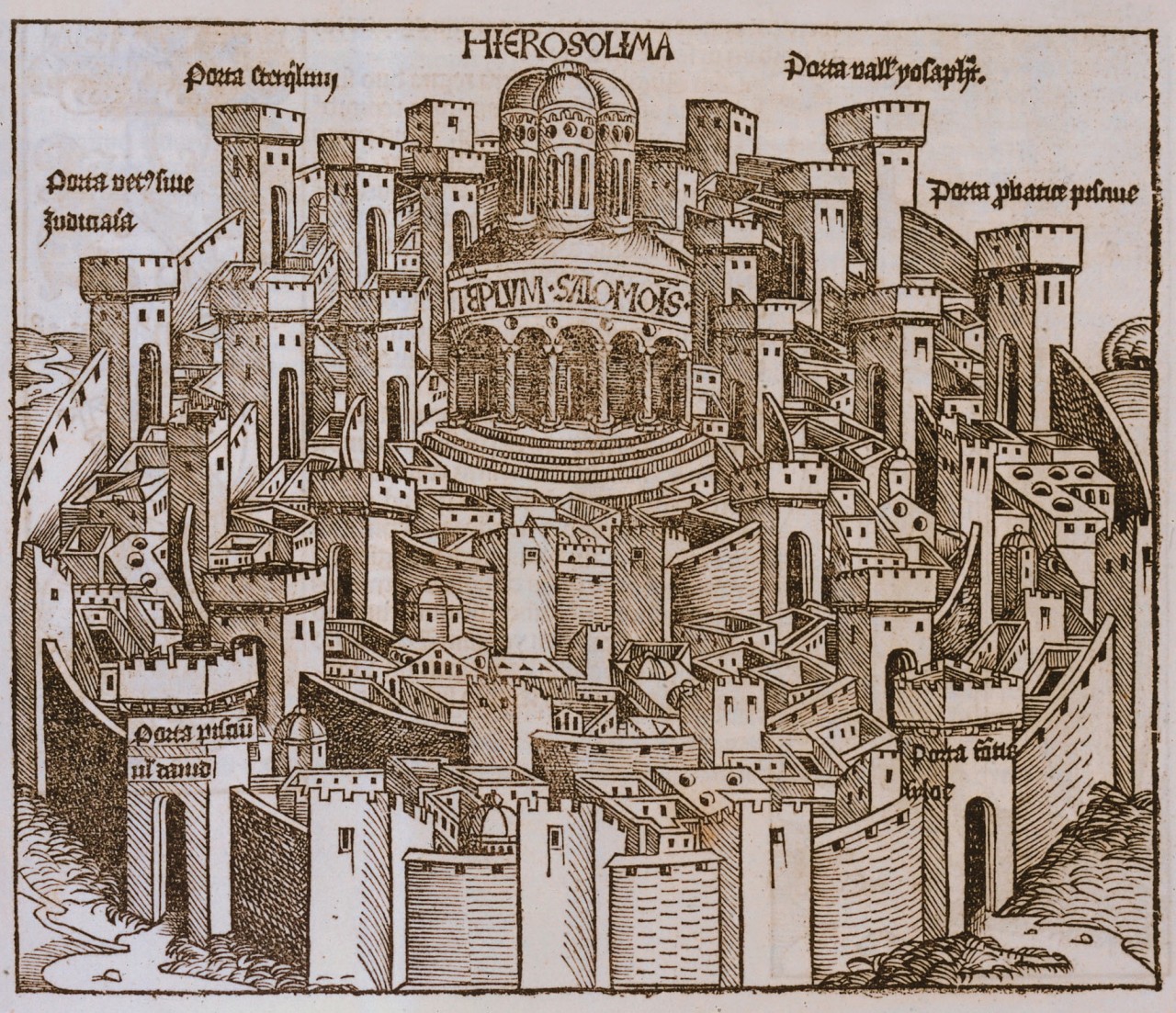
One of the most common forms of medieval man's lifestyle was pilgrimage - a special kind of religious journey to the countries of the Middle East: Sinai, Egypt, Palestine, Asia Minor. For Europeans, these travels were of great importance, since they allowed them to see with their own eyes the places where the events described in the Old and New Testaments took place, and with their own hands touch the shrines about which medieval preachers were constantly broadcasting from their pulpits.
European Christians began to travel to the East very early, already from the 4th century. One of the most famous pilgrims was Queen Helena, who went to Jerusalem at the request of her son, the Roman emperor Constantine. Her active work in the search for Christian shrines was crowned with the acquisition of the Life-giving Cross, on which the Savior was crucified, as well as the founding of many churches in holy places, including the Church of the Holy Sepulcher. Later this tradition was continued, and for many centuries the pilgrimage was an important part of the life of a medieval man.
Pilgrimage is always a voluntary act. The Christian pilgrim voluntarily leaves his native place, renounces habits and attachments in order to worship shrines at least once in his life, which the bountiful land of the East provides him in abundance.
The journey that the believer embarked on in those days was not an easy one. The pilgrim had to not only evaluate his own willpower, but also take into account all kinds of dangers, forced sleepless nights, inevitable fatigue, bad weather, bad roads, poor food, illness ... How great and tempting were the benefits of achieving the final goal in order to overshadow all the dangers this enterprise!
In the name of God, the pilgrim discovered in himself the natural principle of the nomad and thus actually literally followed the words once said by Christ: 'I am the way.' By imitating the models of Christianity, overcoming all the hardships of the path, the person who made the pilgrimage ultimately acquired a truly unique experience.
The main source, telling medieval pilgrims about the East, was the Bible. However, they did not follow the chosen path by themselves: they were led by 'pious guides' who showed the Europeans certain wonderful places: in the vicinity of Mount Sinai, they could see a huge stone, about which Moses broke the tablets in anger, and a place where from heaven the manna has fallen; the stream that Moses brought out of the rock to water his companions, and the remnants of the camp of the twelve tribes of Israel. In Palestine, they were shown the field where Christ fed with two loaves and five fishes, five thousand people. The pilgrim Peter the Deacon (XII century), who left the memory of his journey, described the stone on which the Lord put bread: '... now it has been converted into an altar, from which stone those who come for their health raise pieces of bread, and everyone benefits.'
Of course, the ultimate destination of the journey was Jerusalem, which was the image of the Heavenly Jerusalem. A feeling of deepest reverence gripped the pilgrim, who achieved his goal. For example, the nun Egeria, who visited the Holy Land at the end of the 4th century, wrote: 'Bowing down, we kissed the earth and entered the Holy City, in which we bowed to the Holy Sepulcher.' The happiness of touching the shrine made one forget all the difficulties and hardships of the path traveled.
In medieval sources, Jerusalem is described as a city located on a mountain, surrounded by walls with 84 towers and two triple gates. Its main shrine, which attracted pilgrims like a magnet, was the Church of the Holy Sepulcher. This is how the Irishman Arkulf described it, who made a trip to Jerusalem at the end of the 7th century: 'The Temple of the Resurrection is a very extensive church, all stone, surprisingly round.' The Holy Sepulcher itself is as follows: “In the middle space of the church there is a round building, a tent carved from a whole stone, in which they can praying standing three times three people ... The entrance of this tent is facing east, and the entire entrance from the outside is decorated with the best marble. Outside, its high top, decorated with gold, bears a considerable gold cross. '
Among other temples in Jerusalem, the church on Mount Zion, dedicated to the Last Supper and the Descent of the Holy Spirit on the Apostles, aroused great interest. In this church there was a rich sacristy, where many shrines were kept: the stones with which they killed the holy first martyr Stephen, who was highly revered throughout the Christian world, the crown of thorns of the Savior, the pillar at which Christ was scourged. In one of the sources of the VI century. there is a description of the latter: 'A miracle appeared there, how the Lord embraced the pillar with his hands, and as if imprinted them on wax.' Other writings from the same time tell about the custom associated with this pillar: the sick hugged him and, putting their hands in the traces of Christ's hands, were healed.
In medieval Jerusalem, there were many shrines and a wide variety of objects that could not fail to arouse the surprise and curiosity of Europeans. Thus, in the Basilica of Constantine, the attention of the pilgrims was invariably attracted by the twelve marble columns located in the apse, on which twelve silver vessels were fixed, “in which Solomon sealed the demons,” and in the Church of Calvary, “the very ring” was kept whom Solomon did it. In the church of Calvary, pilgrims went to look at 'the dish on which the head of St. John the Baptist was worn' and at 'the horn from which David and Solomon were anointed for the kingdom.' The Basilica of Constantine kept the cup of the Last Supper, 'which the Lord blessed and gave to His disciples.'
All of Palestine was like a series of illustrations for the New Testament. In Nazareth, pilgrims sought to see the church on the site of the house where the archangel Gabriel brought the news of the future birth of the Savior to the Virgin Mary. From Nazareth, one should go to Mount Tabor, where the miracle of the Transfiguration took place. Coming to Bethlehem, the pilgrims visited the cave where Christ was born and saw 'a manger decorated with silver and gold.' And not far from this city, as Peter the Deacon said in his essay 'On the Holy Places', there is 'a very bright cave with an altar in the place where the shepherds, when they were guarding the sheep, an angel appeared and announced the Nativity of Christ.'
Certain topics aroused a particularly keen interest of Western travelers, for example, the fate of Sodom and Gomorrah, the Dead Sea, in which one cannot drown. They noted not only religious, but also purely everyday moments: for example, the extraordinary emotionality of the sellers of oriental bazaars and the unusual conditions of purchase and sale: “... that if you are going to buy, do not touch it before you pay; for if you touch and do not buy, then indignation will immediately begin ”; admiration was caused by the extraordinary splendor of orchards in such a hot country, as well as the beauty of its inhabitants, especially the inhabitants of Bethlehem: “In this city, Jewish women are so attractive that there are no more beautiful among the Jews in this land, and they say that this gift of beauty to them was served by the Blessed Virgin Mary, ”says the Italian pilgrim Antoninus from Piacenza (6th century).
For pilgrims who traveled to the East, the places mentioned in the biblical story became a reality. The amazement they experienced at the Eastern miracles was so great and precious that it could not be kept only for oneself. Therefore, medieval travelers generously shared what they saw and experienced in the East in the texts they wrote, many of which have survived to this day.
However, not every person at that time had the opportunity to travel to the legendary eastern countries. Lack of funds or health was a serious obstacle to this. In addition, after the conquest of the Seljuk Turks and subsequent crusades, it became too dangerous to visit the Holy Land.
And then the Europeans came up with an original sacred ritual that served a kind of substitute for pilgrimage: during the construction of grandiose Gothic temples at the intersection of the nave with the transept (middle cross of the cathedral), an image of a labyrinth was applied to the floor. At that time, Christians believed that if you crawl on your knees to the center of the labyrinth, you can find the same grace and absolution as on a real pilgrimage to Jerusalem.
Such labyrinths have survived in many European cathedrals (in Chartres, Reims, Poitiers, Amiens, etc.). For example, in Chartres Cathedral, a symbolic round labyrinth with a diameter of about 13 meters was laid out on the floor, embodying the path of the believer to God. In the center was a rose, symbolizing the Most Holy Theotokos.
The labyrinth denoted both the way of the cross of Christ himself and the journey of a person through life. The pilgrims with prayer crawled on their knees for more than two hundred meters, which took almost an hour.
Such medieval labyrinths are characterized by the absence of dead ends and dubious forks: once starting the path, a person could be sure that he would inevitably come to the goal. The exit of the labyrinth to the temple corresponded to the Christian understanding of death not as the end, but as the beginning of a new, eternal life.
Entering the cathedral - the House of God, the medieval man saw the world symbolically represented and built around a single center, passed initiation into the highest secret of being, into immortality, into absolute reality. In other words, going through the labyrinth meant embarking on the path of confrontation with death, the path of rebirth that leads to salvation.
Today the Holy Land attracts no less number of believers than it did in the Middle Ages. The East has become much closer and more accessible. And our site provides a unique opportunity to make a virtual pilgrimage to Jerusalem right now to see the sacred places for any Christian associated with the events of the New Testament.
European Christians began to travel to the East very early, already from the 4th century. One of the most famous pilgrims was Queen Helena, who went to Jerusalem at the request of her son, the Roman emperor Constantine. Her active work in the search for Christian shrines was crowned with the acquisition of the Life-giving Cross, on which the Savior was crucified, as well as the founding of many churches in holy places, including the Church of the Holy Sepulcher. Later this tradition was continued, and for many centuries the pilgrimage was an important part of the life of a medieval man.
Pilgrimage is always a voluntary act. The Christian pilgrim voluntarily leaves his native place, renounces habits and attachments in order to worship shrines at least once in his life, which the bountiful land of the East provides him in abundance.
The journey that the believer embarked on in those days was not an easy one. The pilgrim had to not only evaluate his own willpower, but also take into account all kinds of dangers, forced sleepless nights, inevitable fatigue, bad weather, bad roads, poor food, illness ... How great and tempting were the benefits of achieving the final goal in order to overshadow all the dangers this enterprise!
In the name of God, the pilgrim discovered in himself the natural principle of the nomad and thus actually literally followed the words once said by Christ: 'I am the way.' By imitating the models of Christianity, overcoming all the hardships of the path, the person who made the pilgrimage ultimately acquired a truly unique experience.
The main source, telling medieval pilgrims about the East, was the Bible. However, they did not follow the chosen path by themselves: they were led by 'pious guides' who showed the Europeans certain wonderful places: in the vicinity of Mount Sinai, they could see a huge stone, about which Moses broke the tablets in anger, and a place where from heaven the manna has fallen; the stream that Moses brought out of the rock to water his companions, and the remnants of the camp of the twelve tribes of Israel. In Palestine, they were shown the field where Christ fed with two loaves and five fishes, five thousand people. The pilgrim Peter the Deacon (XII century), who left the memory of his journey, described the stone on which the Lord put bread: '... now it has been converted into an altar, from which stone those who come for their health raise pieces of bread, and everyone benefits.'
Of course, the ultimate destination of the journey was Jerusalem, which was the image of the Heavenly Jerusalem. A feeling of deepest reverence gripped the pilgrim, who achieved his goal. For example, the nun Egeria, who visited the Holy Land at the end of the 4th century, wrote: 'Bowing down, we kissed the earth and entered the Holy City, in which we bowed to the Holy Sepulcher.' The happiness of touching the shrine made one forget all the difficulties and hardships of the path traveled.
In medieval sources, Jerusalem is described as a city located on a mountain, surrounded by walls with 84 towers and two triple gates. Its main shrine, which attracted pilgrims like a magnet, was the Church of the Holy Sepulcher. This is how the Irishman Arkulf described it, who made a trip to Jerusalem at the end of the 7th century: 'The Temple of the Resurrection is a very extensive church, all stone, surprisingly round.' The Holy Sepulcher itself is as follows: “In the middle space of the church there is a round building, a tent carved from a whole stone, in which they can praying standing three times three people ... The entrance of this tent is facing east, and the entire entrance from the outside is decorated with the best marble. Outside, its high top, decorated with gold, bears a considerable gold cross. '
Among other temples in Jerusalem, the church on Mount Zion, dedicated to the Last Supper and the Descent of the Holy Spirit on the Apostles, aroused great interest. In this church there was a rich sacristy, where many shrines were kept: the stones with which they killed the holy first martyr Stephen, who was highly revered throughout the Christian world, the crown of thorns of the Savior, the pillar at which Christ was scourged. In one of the sources of the VI century. there is a description of the latter: 'A miracle appeared there, how the Lord embraced the pillar with his hands, and as if imprinted them on wax.' Other writings from the same time tell about the custom associated with this pillar: the sick hugged him and, putting their hands in the traces of Christ's hands, were healed.
In medieval Jerusalem, there were many shrines and a wide variety of objects that could not fail to arouse the surprise and curiosity of Europeans. Thus, in the Basilica of Constantine, the attention of the pilgrims was invariably attracted by the twelve marble columns located in the apse, on which twelve silver vessels were fixed, “in which Solomon sealed the demons,” and in the Church of Calvary, “the very ring” was kept whom Solomon did it. In the church of Calvary, pilgrims went to look at 'the dish on which the head of St. John the Baptist was worn' and at 'the horn from which David and Solomon were anointed for the kingdom.' The Basilica of Constantine kept the cup of the Last Supper, 'which the Lord blessed and gave to His disciples.'
All of Palestine was like a series of illustrations for the New Testament. In Nazareth, pilgrims sought to see the church on the site of the house where the archangel Gabriel brought the news of the future birth of the Savior to the Virgin Mary. From Nazareth, one should go to Mount Tabor, where the miracle of the Transfiguration took place. Coming to Bethlehem, the pilgrims visited the cave where Christ was born and saw 'a manger decorated with silver and gold.' And not far from this city, as Peter the Deacon said in his essay 'On the Holy Places', there is 'a very bright cave with an altar in the place where the shepherds, when they were guarding the sheep, an angel appeared and announced the Nativity of Christ.'
Certain topics aroused a particularly keen interest of Western travelers, for example, the fate of Sodom and Gomorrah, the Dead Sea, in which one cannot drown. They noted not only religious, but also purely everyday moments: for example, the extraordinary emotionality of the sellers of oriental bazaars and the unusual conditions of purchase and sale: “... that if you are going to buy, do not touch it before you pay; for if you touch and do not buy, then indignation will immediately begin ”; admiration was caused by the extraordinary splendor of orchards in such a hot country, as well as the beauty of its inhabitants, especially the inhabitants of Bethlehem: “In this city, Jewish women are so attractive that there are no more beautiful among the Jews in this land, and they say that this gift of beauty to them was served by the Blessed Virgin Mary, ”says the Italian pilgrim Antoninus from Piacenza (6th century).
For pilgrims who traveled to the East, the places mentioned in the biblical story became a reality. The amazement they experienced at the Eastern miracles was so great and precious that it could not be kept only for oneself. Therefore, medieval travelers generously shared what they saw and experienced in the East in the texts they wrote, many of which have survived to this day.
However, not every person at that time had the opportunity to travel to the legendary eastern countries. Lack of funds or health was a serious obstacle to this. In addition, after the conquest of the Seljuk Turks and subsequent crusades, it became too dangerous to visit the Holy Land.
And then the Europeans came up with an original sacred ritual that served a kind of substitute for pilgrimage: during the construction of grandiose Gothic temples at the intersection of the nave with the transept (middle cross of the cathedral), an image of a labyrinth was applied to the floor. At that time, Christians believed that if you crawl on your knees to the center of the labyrinth, you can find the same grace and absolution as on a real pilgrimage to Jerusalem.
Such labyrinths have survived in many European cathedrals (in Chartres, Reims, Poitiers, Amiens, etc.). For example, in Chartres Cathedral, a symbolic round labyrinth with a diameter of about 13 meters was laid out on the floor, embodying the path of the believer to God. In the center was a rose, symbolizing the Most Holy Theotokos.
The labyrinth denoted both the way of the cross of Christ himself and the journey of a person through life. The pilgrims with prayer crawled on their knees for more than two hundred meters, which took almost an hour.
Such medieval labyrinths are characterized by the absence of dead ends and dubious forks: once starting the path, a person could be sure that he would inevitably come to the goal. The exit of the labyrinth to the temple corresponded to the Christian understanding of death not as the end, but as the beginning of a new, eternal life.
Entering the cathedral - the House of God, the medieval man saw the world symbolically represented and built around a single center, passed initiation into the highest secret of being, into immortality, into absolute reality. In other words, going through the labyrinth meant embarking on the path of confrontation with death, the path of rebirth that leads to salvation.
Today the Holy Land attracts no less number of believers than it did in the Middle Ages. The East has become much closer and more accessible. And our site provides a unique opportunity to make a virtual pilgrimage to Jerusalem right now to see the sacred places for any Christian associated with the events of the New Testament.
Share: