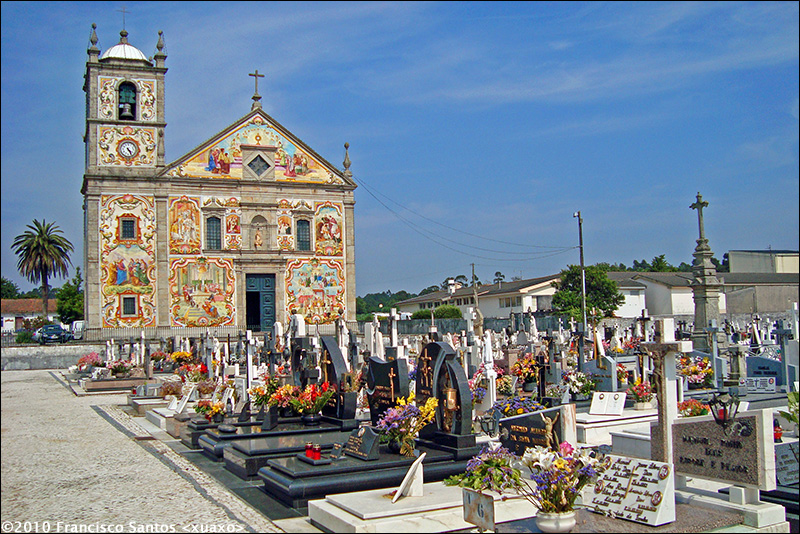
It seems incredible, but this church, one of the ten most beautiful temples in its country, has not yet been awarded the status of a national monument. The first church on this site, located on the territory of the Valega parish of the Aveiro district, was built in the 12th century - it was part of the monastery of San Pedro de Ferreira. Some time later it was transferred under the control of the bishop of Porto. In the form in which the church has survived to this day, it was completed in the 18th century. Moreover, the construction process itself took a whole century. During this time, the Baroque style, which was popular when the temple was laid, ceased to attract architects and construction customers - for this reason, the completed building was very different from the original project. The main attractions of the Igreja de Nossa Senhora do Amparo church are the coffered ceiling made of precious exotic woods, the altar that creates a stunning acoustic resonance, and most importantly, the façade of incredible beauty, tiled with azulejos tiles. This colored tile was made at the Lusitania factory in the capital of the country, and sketches for it were created by the unsurpassed Jorge Collas. The works of the outstanding Portuguese painter and designer also adorn the Busacu and Casa do Alentejo palaces. 'Our Lady of Perpetual Help' is a type of icons in Catholic iconography, which has a number of others, somewhat less common titles: 'Virgin of Sorrow', 'Golden Maiden', 'Mary Missionary', 'Our Lady of the Redemptorists', 'Mother of Catholic Families'. In addition to the Blessed Virgin with the Divine Infant in her arms, who clasped the Mother's hand with His palms, the icon also depicts angels holding the weapons of the Passion of Christ. The Orthodox analogue of this image is the Passionate Icon of the Virgin. In the Western Church, the Redemptorist Congregation is distinguished by a special veneration of this icon - it also contributed to the widespread dissemination of the holy image throughout the world. The iconography of Our Lady of Perpetual Help was developed by Italian and Greek masters as early as the fifteenth century. The most revered and oldest image of this type is found in the shrine of Saint Alphonse Liguori in Rome. It came to the Eternal City in 1480, when it was brought from the island of Crete. For about three centuries, the icon resided in the church of St. Matthew, and then, from the beginning of the nineteenth century, in the church of Santa Maria in Posterula. In 1865, Pope Pius IX handed over the 'Our Lady of Perpetual Help' to the Redemptorists with a mandate to make this holy image known throughout the planet. What later happened: the icon became widespread in the Catholic world. Today in different countries there are several women's monastic congregations and hundreds of churches dedicated to this icon, including two Russian ones, in Petrozavodstvo and Orsk. As for the most revered image that is in Rome, its last major restoration was undertaken in the nineties of the last century. The celebration of the icon 'Our Lady of Perpetual Help' is celebrated by the Catholic Church on June 27. V. Sergienko
Share: