Feastday: July 26
By tradition Joachim and Anne are considered to be the names of the parents of Mary, the Mother of God. We have no historical evidence, however, of any elements of their lives, including their names. Any stories about Mary's father and mother come to us through legend and tradition.
We get the oldest story from a document called the Gospel of James, though in no way should this document be trusted to be factual, historical, or the Word of God. The legend told in this document says that after years of childlessness, an angel appeared to tell Anne and Joachim that they would have a child. Anne promised to dedicate this child to God (much the way that Samuel was dedicated by his mother Hannah -- Anne -- in 1 Kings).
For those who wonder what we can learn from people we know nothing about and how we can honor them, we must focus on why they are honored by the church. Whatever their names or the facts of their lives, the truth is that it was the parents of Mary who nurtured Mary, taught her, brought her up to be a worthy Mother of God. It was their teaching that led her to respond to God's request with faith, "Let it be done to me as you will." It was their example of parenting that Mary must have followed as she brought up her own son, Jesus. It was their faith that laid the foundation of courage and strength that allowed her to stand by the cross as her son was crucified and still believe.
Such parents can be examples and models for all parents.
Anne (or Ann) is the patron saint of Christian mothers and of women in labor.
Prayer:Parents of Mary, pray for all parents that they may provide the loving home and faithful teaching that you provided your daughter. Amen
For other uses, see Joachim (disambiguation). Biblical figureJoachim (/ˈdʒoʊəkɪm/; Hebrew: יְהוֹיָקִים Yəhōyāqīm, "he whom Yahweh has set up"; Greek Ἰωακείμ Iōākeím) was, according to Christian tradition, the husband of Saint Anne and the father of Mary, the mother of Jesus. The story of Joachim and Anne first appears in the apocryphal Gospel of James. His feast day is 26 July, a date shared with Saint Anne.
In Christian tradition
The story of Joachim, his wife Anne (or Anna), and the miraculous birth of their child Mary, the mother of Jesus, is told for the first time in the 2nd century apocryphal infancy-gospel the Gospel of James (also called Protoevangelium of James). Joachim is a rich and pious man, who regularly gave to the poor. However, at the temple, Joachim's sacrifice was rejected, as the couple's childlessness was interpreted as a sign of divine displeasure. Joachim consequently withdrew to the desert, where he fasted and did penance for 40 days. Angels then appeared to both Joachim and Anne to promise them a child.
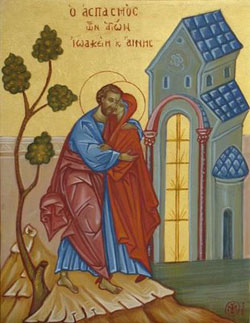
Joachim later returned to Jerusalem and embraced Anne at the city gate, located in the Walls of Jerusalem. An ancient belief held that a child born of an elderly mother who had given up hope of having offspring was destined for great things. Parallels occur in the Old Testament in the case of Hannah, mother of Samuel, and in the New Testament in the case of the parents of St John the Baptist.
The cycle of legends concerning Joachim and Anne was included in the Golden Legend (around 1260) by Jacobus da Varagine. This cycle remained popular in Christian art until the Council of Trent (1545–1563) restricted the depiction of apocryphal events.
No liturgical celebration of Saint Joachim was included in the Tridentine Calendar. It was added to the General Roman Calendar in 1584, for celebration on 20 March, the day after the feast day of Saint Joseph. In 1738, it was transferred to the Sunday after the Octave of the Assumption of Mary. As part of his effort to allow the liturgy of Sundays to be celebrated, Pope Pius X (term 1903–1914) transferred it to 16 August, the day after the Assumption, so Joachim may be remembered in the celebration of Mary's triumph. It was then celebrated as a Double of the Second Class, a rank that was changed in 1960 to that of Second Class Feast. In the 1969 revision of the General Roman Calendar, it was joined to that of Anne, for celebration on 26 July.
 12-century German Nativity of Mary with Joachim wearing a Jewish hat.
The Eastern Orthodox Churches and Greek Catholics commemorate Joachim on 9 September, the Synaxis of Joachim and Anne, the day after the Nativity of the Theotokos.
Joachim is remembered (with Anne) in the Church of England with a Lesser Festival on 26 July.
Patronage
Joachim is named as the patron saint of fathers, grandfathers, grandparents, married couples, cabinet makers, and linen traders.
Iconography
 Saint Joachim
In medieval art he often wears a conical Jewish hat. He is often treated as a saint, with a halo, but in the Western church there was some awareness that he had quite likely died too soon to strictly be counted as a Christian.
Joachim and Anne Meeting at the Golden Gate was a popular subject in artistic renditions of the life of the Virgin.
Symbols associated with Saint Joachim include a book or scroll representing linen makers, a shepherd's staff for the Christian Word, and a basket of doves representing peace. He is almost always clothed in green, the color of hope.
The name of the San Joaquin River dates to 1805–1808, when Spanish explorer Gabriel Moraga was surveying east from Mission San José in order to find possible sites for a mission. The name was in common use by 1810.