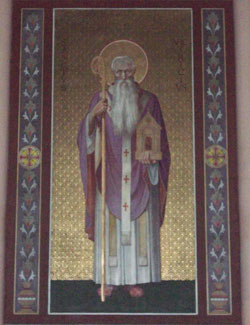
Feastday: August 7
Birth: 330
Death: 407
Bishop and missionary. The son of a Roman legionnaire, he set out on a military career. After becoming a Christian, he refused to remain in the legions. Flogged and sentenced to death for remaining adamant in his refusal to return to the army, he somehow avoided execution and received a discharge. Victricius became a missionary among the tribes of Flanders, Hainault, and Brabant, Belgium, and later the bishop of Rouen, France (about 386). Owing to his reputation for goodness and being a capable prelate, he journeyed to England in 396 to assist in the settlement of some dispute among the bishops there, although in his later years he was accused of heretical leanings. Not only was he exonerated by Pope St. Innocent I (r. 401-417), but he received from the pope the important decretal of the Liber Regularum. He was also the author of the work The Praise of Saints.
Saint Victricius (French: Victrice; Italian: Vittricio) also known as Victricius of Rouen (c. 330 – c. 407 AD) was a bishop of Rouen (393–407), missionary, and author. His feast day is August 7.
Life
Victricius was Gallic by birth, the son of a Roman legionnaire. He also became a soldier and was posted to various locations around Gaul. However, when he became a Christian, he refused to remain in the army. He was flogged and sentenced to death, but managed to avoid execution. He proselytized amongst the tribes of Flanders, Hainault, and Brabant. He became bishop of Rouen around 386 or 393.
He was accused of heresy but was defended by Pope Innocent I and received from Innocent the important decretal of the Liber Regularum.
De Laude Sanctorum
In 396, Ambrose of Milan sent Victricius (as well as Paulinus of Nola and others) some relics of Vitalis and Agricola. Victricius wrote a sermon, De Laude Sanctorum (On the Praise of the Saints), celebrating the arrival of the relics from Italy. He mentions that he had been away from Rouen (396), as he had been requested to travel to Britain to help resolve some doctrinal issues. Victricius describes Britain as a wild and hostile place dealing with paganism and heresy in contrast with Italy with its abundance of holy sites and relics of martyrs.