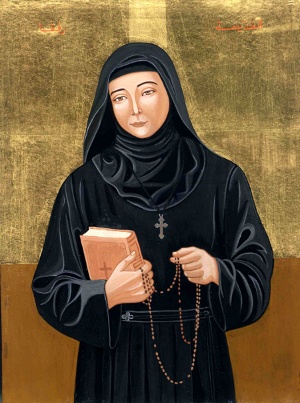
Feastday: March 23
Birth: 1832
Death: 1914
Beatified: November 16, 1985 by Pope John Paul II
Canonized: June 10, 2001, Saint Peter's Basilica in Rome, Italy by Pope John Paul II
Saint Rafqa, also know as Saint Rebecca, was born in Hemlaya, Lebanon on June 29, 1832. She was the only child of her parents, Saber El-Choboq El-Rayess and Rafqa Gemayel. She was baptized on July 7, 1832 and named Boutroussieh.
Her parents were devout Christians and taught her daily prayers. By all accounts, her childhood was happy and simple, until she was just 7 years old and her mother, Rafqa (for whom she was named) died.
The death of her mother started a period of tribulation for Rafqa and her father, who soon experienced financial difficulties. Rafqa was sent to work as a domestic servant for four years to help support the family. During that period, she worked in Damascus, away from her father.
In 1847, she returned to find that her father had remarried and his new wife desired that Rafqa marry her brother. At the same time, an aunt wanted to arrange a marriage between Rafqa and her cousin.
Rafqa was left to decide what to do with herself, split between two potential suitors and under pressure from family to make two different choices. She turned to prayer and asked God to guide her. Her answer surprised everyone. Rafqa would marry neither man, but instead would devote her life to Jesus and become a nun.
Rafqa traveled to the convent of Our Lady of Deliverance in Bikfaya. She joined the Mariamettes, founded by Fr. Jospeh Gemayel.
According to legend, when she entered the convent and gazed upon the icon of Our Lady of Deliverance, she heard the voice of God tell her "You will become a nun."
The Mother Superior of the convent accepted her immediately, without question. Shortly thereafter, her father and his new wife arrived to try to dissuade Rafqa from her God-chosen path. She refused to leave and remained devoted to her vocation.
She was sent to Deir El Qamar to teach catechism. The town became the site of civil unrest and on one occasions he reportedly saved a child from murder by hiding him under her robes.
She served in Deir El Qamar for a year.
In 1861, she returned to her congregation and become a novice. On March 19, 1862, she took her temporary vows and was assigned to kitchen service in a seminary.
Rafqa spent her free time learning Arabic, writing, and arithmetic. She also helped convince other girls to join the congregation. In 1863, she continued working as a teacher, first at a school belonging to her congregation in Byblos, then Maad village where she and a fellow sister established a new school for girls.
Following this early period, Rafqa repeatedly heard messages from heaven. When her order faced a crisis, god told her "You will remain a nun." And she heard the voices of saints directing her to enter the Lebanese Maronite Order. She obeyed.
Sister Rafqa took her solemn vows in the new order on Augist 25, 1872.
During her time, she was known to be quiet and contemplative. She was devoted to prayer and spoke little. She commonly made sacrifices and lived in great austerity.
In October 1885, Sister Rafqa made an unusual request of Jesus, asking to share in his suffering. She immediately began to experience pain in her head, which moved to her eyes. Her superior was concerned about Rafqa's pain and ordered that she be examined by doctors and sent to Beirut for treatment.
As she passed through the nearby church in Byblos, the congregation made note that an American doctor was in the area. The located the doctor who recommended immediate surgery for Sister Rafqa.
During the surgery, she refused anesthesia, and the doctor made a mistake which caused her eye to emerge from its socket and fall to the floor. Sister Rafqa, instead of panicking, blessed the doctor, saying "For Christ's passion, god bless your hands and may God repay you."
The surgery did not succeed. Shortly thereafter, pain entered her left eye.
For the next 12 years, she experienced pain in her remaining eye and headaches. At no point did she reverse her wish to share in Christ's suffering. Instead, she remained joyful in prayer and patient in her suffering. She remained quiet for long periods, speaking infrequently, but always joyously.
In 1887, Sister Rafqa was sent with five other sisters to found a new monastery in Jrabta, Batroun in Lebanon. She did as she was asked, working patiently and diligently as she was able despite her suffering. In 1899, she became blind and paralysis set in.
Eventually she was confined to bed, mostly paralyzed and only able to lie on her right side. Her body withered, but her hands remained capable, and she used them to knit socks. A wound developed in left shoulder, which she referred to as "the wound in the shoulder of Jesus." This continued for seven years.
On March 23, 1914, she received her last communion and called upon Jesus and the Holy Family, then went to her reward in Heaven.
After she was buried in the monastery cemetery, a light appeared on her grave for three consecutive light and was witnessed by many.
In 1925, a case for her beatification was opened in the Vatican and the investigation into her life began in the year following.
In 1927, her grave was exhumed and she was reburied in the monastery church.
Pope John Paul declared her venerable on Feb. 11, 1982, and she was beatified on Nov. 17, 1985. She was finally recognized as a saint on July 10, 2001.
19th-century Lebanese Mennonite nun and saint | This article needs additional citations for verification. (April 2013) |
| Part of a series on |
| Maronite Church |
|---|
 Coat of arms of the Syriac Maronite Church, Coat of arms of the Syriac Maronite Church,an Eastern Catholic sui iuris particular church |
| Patriarchate |
|
| Religious orders and societies |
|
| Communities |
|
| Languages |
|
| History |
|
| Related politics |
|
|
 Christianity portal Christianity portal |
|
 Catholicism portal
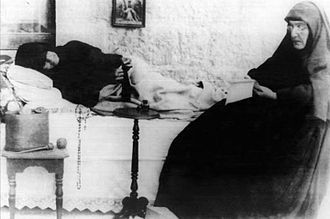 St Rafka ill in bed in her latter days
Rafqa Pietra Chobok, O.L.M. (Arabic: رفقا بطرسيّة شبق , June 29, 1832 – March 23, 1914), also known as Saint Rafka and Saint Rebecca, was a Lebanese Maronite nun who was canonized by Pope John Paul II on June 10, 2001.
Birth and Youth
Rafka was born in Himlaya, in Matn District, on 29 June 1832, the Feast of St. Peter and St. Paul, the only child of Saber Mourad El Rayess and Rafqa Gemayel, and was baptised Boutrossieh (pronounced in Arabic as the feminine of Peter). Her mother died when she was seven years of age. In 1843, her father experienced financial difficulties and sent her to work as a servant for four years in Damascus at the home of Assaad Al-Badawi. She returned home in 1847 to find that her father had remarried.
When Boutrossieh was 14 years old, her stepmother wanted her to marry her stepbrother, and her maternal aunt wanted her to marry her son. Boutrossieh did not want to marry either of the men and this caused a great deal of discord in her family. One day, while she was coming back from the fountain, holding her jar, she overheard them arguing. She asked God to help her deal with the problem. She then decided to become a nun and went straight to the Convent of Our Lady of Liberation at Bikfaya. Boutrossieh's father and stepmother tried to take her back home but she did not want to go. "I asked the Mistress of novices to excuse me from seeing them and she agreed." They returned home, saddened, and from then on they never saw her again.
Boutrossieh's kinsman, Father Joseph Gemayel and his family founded a new religious institute for women that provided them with full-time education as well as religious instruction. Boutrossieh's name, Pierine (in French), was listed last among the first four candidates of the Daughters of Mary of the Immaculate Conception (“Mariamettes”, in French) in Gemayel's notebook dated January 1, 1853. She was 21.
Mariamette Sisters
On February 9, 1855, the Feast of St. Maron, Boutrossieh commenced her novitiate at the convent in Ghazir and chose the name Rafqa (Like her mother's name). She took her first temporary religious vows on 19 March 1862 at the age of thirty. Sister Rafqa's first assignment in the congregation was charge of the kitchen service in the Jesuit school in Ghazir, where she spent seven years. She was placed in charge of the workers and had the task of giving them religious instruction in a spinning mill in Scerdanieh, where she remained for two months.
In 1860, while still stationed in Ghazir, Rafqa's superiors sent her on a temporary posting to Deir-el-Qamar, in Mount Lebanon - Shouf, where she helped the Jesuit mission. In less than two months the Druze killed 7,771 people and destroyed 360 villages, 560 churches, 28 schools, and 42 convents. Sister Rafqa saved one child's life by hiding him in the skirts of her habit as he was being chased by some soldiers. Rafqa was deeply affected by the massacres.
Two years later, Sister Rafqa was transferred to Byblos, where she remained for one year before going to Ma'ad to establish a school there at the request of Antoun (Anthony) Issa, a prominent citizen.
In 1871, the “Mariamettes” religious institute merged with another to form the Order of the Sacred Hearts of Jesus and Mary. The Religious Sisters were given the option to join the new congregation, or a different one, or to resume lay status. Rafqa decided to become a cloistered nun rather than a teaching Sister, and, after praying in the Church of St. George, made the decision to join the Baladita Order, the monastic order now named the Lebanese Maronite Order of St. Anthony, founded in 1695, and told Antoun Issa of her decision. He offered to pay the requisite dowry.
That same night, Rafqa dreamed of three men. One with a white beard, one dressed like a soldier and the third was an old man. She recounted "One of the men said to me, 'Become a nun in the Baladita Order'. I woke up very happy … and went to Antoun Issa, bursting with joy … and I told him about my dream.” Antoun identified the men as St. Anthony of Qozhaia (St. Anthony the Abbot) from whom the order was inspired, the soldier was St. George, to whom the church in Ma'ad was dedicated, and the third could only be a Baladita monk. Rafqa decided to leave immediately for the Monastery of St. Simon in Al-Qarn. Antoun gave her the money as promised as well as a letter of recommendation to the archbishop.
A nun of the Lebanese Maronite Order
Monastery of St. Simon
On July 12, 1871, at the age of thirty-nine, Rafqa began her novitiate into the new monastery and then on August 25, 1873, she “professed her perpetual vows of poverty, chastity and obedience in the spirit of the strict Rule of the Baladita Order.” Her new name was that of her mother's, Rafqa, (Rebecca), the name of Abraham's great granddaughter and wife of his son Isaac. St. Simon Monastery was situated on a high altitude, where the winters were very harsh. The nuns followed a very rigid daily schedule throughout the year. Prayer and manual labour became the rule of their daily lives. The nuns planted and harvested vegetables and grain in the surrounding fields. They also cultivated silkworms and sewed vestments for churches. Rafqa remained in this monastery until 1897.
Life with pain
In 1885 Rafqa decided not to join the nuns for a walk around the monastery. In her autobiographical account she wrote, “It was the first Sunday of the Rosary. I did not accompany them. Before leaving each of the nuns came and said to me, ‘Pray for me sister.’ There were some who asked me to say seven decades of the Rosary ... I went to the Church and started to pray. Seeing that I was in good health and that I had never been sick in my life, I prayed to God in this way, ‘Why, O my God, have you distance yourself from me and have abandoned me. You have never visited me with sickness! Have you perhaps abandoned me?’”
Rafqa continued in her account to her superior, the next night after the prayer “At the moment of sleeping I felt a most violent pain spreading above my eyes to the point that I reached the state you see me in, blind and paralyzed, and as I myself had asked for sickness I could not allow myself to complain or murmur.”
“The symbolic daughter of a country which for over a decade has been in the world headlines because of its suffering,” Rafqa suffered many years because of her desire to share in the passion of Jesus Christ.
The Mother Superior sent Rafqa to Tripoli, where she submitted to a painful medical examination. For two years, she suffered. She went to several doctors who all agreed that there was nothing they could do. Upon the persuasion of Father Estefan, Rafqa consulted a visiting American doctor who strongly suggested that the eye be removed. Estefan later recounted,
Before the operation I asked the doctor to anesthetize the eye so that Rafqa would not feel any pain but she refused. The doctor made her sit down and pushed a long scalpel … into her eye … the eye popped out and fell on the ground, palpitating slightly … Rafqa didn’t complain … but only said, ‘in communion with Christ’s Passion.’
The pain was then all concentrated in her left eye and nothing could be done.
Gradually Rafqa's left eye shrunk and sunk into the socket and she became blind. For about thirty years both sockets hemorrhaged two to three times a week. She also suffered from frequent nosebleeds. “Her head, her brow, her eyes, her nose were as if they were being pierced by a red hot needle. Rafqa did not let this pain isolate her from the community. She continued to spin wool and cotton and knitted stockings for the other sisters; she participated in choral prayer.
Due to the harsh winters at the Monastery of St. Simon, Rafqa was allowed to spend the coldest months on the Lebanese coast as a guest of the Daughters of Charity and then of the residence of the Maronite Order. Unable to observe the Rule at these locales, Rafqa asked to be taken to the Monastery of St. Elias at El Rass, which belonged to her order.
Monastery of St. Joseph
In 1897, Rafqa was one of six nuns sent to found the order's new Monastery of St. Joseph of Gerbata in Ma’ad, along with Mother Ursula Doumit, the superior, where Rafqa remained for the last 17 years of her life. It was here that her suffering increased.
In 1907 Rafqa confided to Mother Ursula that she felt a pain in her legs, “as if someone were sticking lances in them and pain in my toes as if they were being pulled off.” This began the long list of sufferings and pains Rafqa endured for the last seven years of her life.
Based on direct evidence and on the autopsy of Rafqa's remains in 1927, she had become paralyzed due to complete disarticulation in her wrist and finger joints, while the pain continued in her head, her devastated eye sockets and her nosebleeds ... completely immobile, her lower jaw touched her benumbed knee.
Even in this state, Rafqa was able to crawl to the chapel on the feast of Corpus Christi to the amazement of all the sisters. When asked about this, Rafqa replied, “I don’t know. I asked God to help me and suddenly I felt myself slipping from the bed with my legs hanging down; I fell on the floor and crawled to the chapel.”
On a separate occasion, when asked by her superior if she would like to see, Rafqa responded, “I would like to see for at least an hour, to be able to look at you.” In an instant the superior could see Rafqa smile and suddenly said, “Look, I can see now.” Not believing her, Sister Ursula put her to the test asking her to identify several objects. Shortly thereafter, Rafqa fell into a deep sleep for about two hours. Sister Ursula became worried and tried repeatedly to awaken her. Upon waking, Rafqa explained that she had entered a large, beautifully decorated building with baths full of water and people crowding to enter them; she went with them. Sister Ursula asked her why she came back; why she didn't continue to walk. Blessed Rafqa explained, “You called me, and I came.”
Rafqa's obedience and love for her superior is quite evident in this account. For a nun, the superior, “as the Rule puts it, represents Christ and is owed respect, obedience and love. Despite her condition, Rafqa did nothing without the Superior’s permission.”
Before dying, Rafqa told of her life to Mother Ursula Doumit, superior of the monastery in which she died, “There is nothing important in my life that is worthy of being recorded … my mother died when I was seven years old. After her death my father married for a second time.”
Three days before her death, Rafqa said, “I am not afraid of death which I have waited for a long time. God will let me live through my death.” Then on March 23, 1914, four minutes after receiving final absolution and the plenary indulgence, she died.
Beatification and canonization
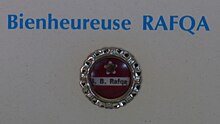 A relic of St. Rafqa at St. Raymond Maronite Cathedral (St. Louis, Missouri)
On June 9, 1984, the eve of Pentecost, in the presence of the Pope John Paul II, the decree approving the miracle of Elizabeth Ennakl, who was said to have been completely cured of uterine cancer in 1938 at the tomb of Rafka, was promulgated.
On November 16, 1985, Pope John Paul II declared Rafqa Al Rayess a Blessed, and on June 10, 2001, he proclaimed her to be a saint at a solemn ceremony in the Vatican.