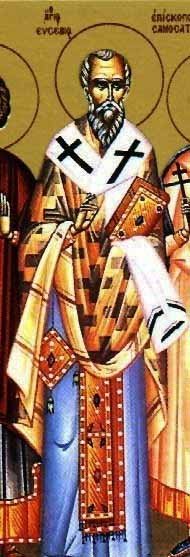
Feastday: June 21
Death: 380
Bishop in Syria and a friend of Sts. Basil and Gregory Nazianzus. Made bishop of Samosata in 361, Eusebius was a ferocious foe of the Arian heretics. This stand brought him into conflict with Emperor Constantius II , who threatened to dismember him. He helped elect St. Basil the bishop of Caesarea, in Cappadocia in 372. In 374, Eusebius was exiled to Thrace by Emperor Valens but returned four years later to Samosata. While visiting a nearby area, Eusebius was slain by an Arian woman who threw a roof tile at his head.
4th century Christian martyrSaint Eusebius, Bishop of Samosata (died c. 379, Dolikha) was a Christian martyr and opponent of Arianism.
His feast day is June 22.
Life
All that is definitely known of Eusebius is gathered from the letters of Basil the Great and of Gregory Nazianzen, and from some incidents in the "Ecclesiastical History" of Theodoret.
In 361 he became bishop of the ancient Syrian city of Samosata. Eusebius had been entrusted with the official record of the election (360) of Bishop St. Meletius of Antioch, who was supported by the Arian bishops, who were under the mistaken notion that he would prove sympathetic to their cause. When Meletius expounded his orthodoxy, the bishops persuaded the Roman emperor Constantius II, a staunch Arian, to extort the record from Eusebius and destroy it. Constantius threatened Eusebius with the loss of his right hand because he refused to surrender the record, but the threat was withdrawn when Eusebius offered both hands.
It was chiefly due to the concerted efforts of Eusebius and St. Gregory Nazianzen that, in 370, St. Basil was elected Archbishop of Cæsarea in Cappadocia.
During the persecution of orthodox Christians under Julian the Apostate, Eusebius travelled incognito through Syria, Palestine and Phoenicia disguised as a military officer, ordaining presbyters and deacons.
Orthodox Christians experienced a short respite during the brief reign of Jovian, but in 374 the emperor Valens, an Arian, banished Eusebius to Thrace, in the Balkan Peninsula. Bishop Eusebius asked the messenger to keep the imperial order confidential saying: “If the people should be apprized, such is their zeal for the faith, that they would rise in arms against you, and your death might be laid to my charge.” Although advanced in years, Eusebius left that evening.
After the Emperor's death in 378, Eusebius was restored to his see of Samosata. While in Dolikha to consecrate a bishop, he was killed after being struck on the head with a roof tile thrown by an Arian woman.