Feastday: September 18
Patron: of Aviators, Flying, Studying, and those suffering mental handicaps
Birth: 1603
Death: 1663
Beatified: by Pope Benedict XIV in 1753
Canonized: by Pope Clement XIII in 1767
St. Joseph was born in 1603 at Cupertino, in the diocese of Nardo in the Kingdom of Naples. After spending his childhood and adolescence in simplicity and innocence, he finally joined the Franciscan Friars Minor Conventual. After his ordination to the holy priesthood, he gave himself up entirely to a life of devotion to the Lord and his church. His deep devotional life led him to the kind of holiness which is forged through humility, voluntary mortification, and obedience. He was consecrated to the Blessed Virgin Mary and promoted devotion to her among all classes of people as wonderful path to a deeper Christian life and love for Jesus Christ.
It is said that his mother often considered him a nuisance and treated him harshly. Joseph was purported to be slow to learn and absent-minded. He was said to frequently wander aimlessly, with his mouth gaping open. And, he had a bad temper, so, he was not at all popular. He tried to learn the trade of shoemaking, but failed. He asked to become a Franciscan, but they initially would not accept him. Finally he did join the Capuchins. However, for a very short period of time. Eight months later, they sent him away. Sources say it was because he could not seem to do anything right.
He dropped piles of dishes and kept forgetting to do what he was told. His mother was not at all pleased to have the eighteen-year-old Joseph back home again, so she finally got him accepted as a servant at the Franciscan monastery. He was given the friars habit and put to hard work taking care of the horses.
About this time, Joseph began to change. He grew in humility and gentleness, fruits of the Holy Spirit at work in a person. He became more careful and successful at his work. He also began to pray more do more voluntary acts of penance. Finally, he was able to enter the Franciscan order and, eventually, study for the priesthood. Although he was a good and holy friar, he had a very hard time with studies. During his seminary exams, the examiner happened to ask him to explain the only thing he knew well, and so he was ordained a deacon, and later a priest.
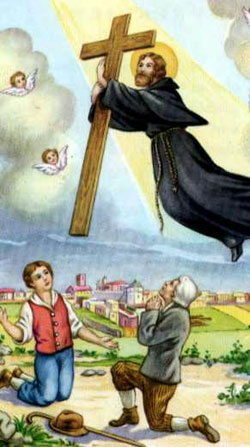
After this, the Holy Spirit began to work many amazing miracles through St. Joseph. Over seventy times, people say they saw him rise from the ground while offering mass or praying. Often he went into ecstasy and would be caught up in talking with God. He fell so deeply in love with God that everything he saw only drew him into a deeper union. He said that all the troubles of this world were nothing but the "play" battles children have with popguns. St. Joseph became so famous for the miracles that he was finally kept hidden from the public, but he was happy for the chance to be alone with his beloved Lord. On His part, Jesus never left him alone and one day came to bring him to Heaven. Pope Clement XIII canonized him in 1767. He is the patron saint of air travelers, pilots and learning disabled.
The life of this saint was marked by ecstasies and levitations. The mere mention of God or a spiritual matter was enough to take him out of his senses; at Mass he is said to have frequently floated in the air in rapture. Once as Christmas carols were being sung, he soared to the high altar and knelt in the air, in ecstatic prayer. The people flocked to him in droves seeking help and advice in the confessional, and he assisted many in living a truly devout Christian life. However, this humble man had to endure many severe trials and terrible temptations throughout his life. He died on September 18, 1663.
Prayer of St. Joseph Cupertino
O Great St. Joseph of Cupertino who while on earth did obtain from God the grace to be asked at your examination only the questions you knew, obtain for me a like favour in the examinations for which I am now preparing.
In return I promise to make you known and cause you to be invoked. I will also imitate your life of prayer and devotion
Through Jesus Christ our Lord.
St. Joseph of Cupertino, Pray for us.
Amen.
To all our readers, Please don't scroll past this.
Today, we humbly ask you to defend Catholic Online's independence. 98% of our readers don't give; they simply look the other way. If you donate just $5.00, or whatever you can, Catholic Online could keep thriving for years. Most people donate because Catholic Online is useful. If Catholic Online has given you $5.00 worth of knowledge this year, take a minute to donate. Show the volunteers who bring you reliable, Catholic information that their work matters. If you are one of our rare donors, you have our gratitude and we warmly thank you. Help Now > Christian saint
Joseph of Copertino (Italian: Giuseppe da Copertino; 17 June 1603 – 18 September 1663) was an Italian Conventual Franciscan friar who is honored as a Christian mystic and saint. He was said to have been remarkably unclever, but prone to miraculous levitation and intense ecstatic visions that left him gaping. Joseph began to experience ecstatic visions as a child, which were to continue throughout his life, and made him the object of scorn. He applied to the Conventual Franciscan friars, but was rejected due to his lack of education. He then pleaded with them to serve in their stables. After several years of working there, he had so impressed the friars with the devotion and simplicity of his life that he was admitted to their Order, destined to become a Catholic priest, in 1625.
Life
He was born the son of Felice Desa and Frencesca Panara in the village of Cupertino, in the Region of Apulia, then in the Kingdom of Naples, now in the Italian Province of Lecce. His father having died before his birth, however, the family home was seized to settle the large debts he had left, and his mother was forced to give birth to him in a stable.
Joseph began to experience ecstatic visions as a child, which were to continue throughout his life, and made him the object of scorn. His life was not helped by his frequent outbursts of anger. He was soon apprenticed by his uncle to a shoemaker. Feeling drawn to religious life, in 1620 he applied to the Conventual Franciscan friars, but was rejected due to his lack of education. He then applied to the Capuchin friars in Martino, near Taranto, by whom he was accepted in 1620 as a lay brother, but he was dismissed as his continued ecstasies made him unfit for the duties required of him.
After Joseph returned to the scorn of his family, he pleaded with the Conventual friars near Cupertino to be allowed to serve in their stables. After several years of working there, he had so impressed the friars with the devotion and simplicity of his life that he was admitted to their Order, destined to become a Catholic priest, in 1625. He was ordained a priest on 28 March 1628. He was then sent to the Madonna delle Grazie, Gravina in Puglia, where he spent the next 15 years.
After this point, the occasions of ecstasy in Joseph's life began to multiply. It was claimed that he began to levitate while participating at the Mass or joining the community for the Divine Office, thereby gaining a widespread reputation of holiness among the people of the region and beyond. He was deemed disruptive by his religious superiors and church authorities, however, and eventually was confined to a small cell, forbidden from joining in any public gathering of the community.
As the phenomenon of flying or levitation was widely believed to be connected with witchcraft, Joseph was denounced to the Inquisition. At their command, he was transferred from one Franciscan friary in the region to another for observation, first to Assisi (1639–1653), then briefly to Pietrarubbia and finally Fossombrone, where he lived with and under the supervision of the Capuchin friars (1653–1657). He practiced a severe asceticism throughout his life, usually eating solid food only twice a week, and adding bitter powders to his meals. He passed 35 years of his life following this regimen.
Finally, on 9 July 1657, Joseph was allowed to return to a Conventual community, being sent to the one in Osimo, where he soon died.
Joseph was beatified in 1753 and canonized in 1767.
Skeptical reception
Skeptics are not convinced that Joseph possessed magical or paranormal powers. They have suggested that alleged eyewitness reports of his levitations are unreliable as they are subject to gross exaggeration, or written two years after his death.
Robert D. Smith in his book Comparative Miracles (1965) suggested that Joseph performed feats similar to a gymnast. Smith noted that some of his alleged levitations "originate from a leap, and not from a prone or simple standing or kneeling position, the witnesses mistook a leap of a very agile man for levitation."
Skeptical investigator Joe Nickell concluded that:
Joseph’s most dramatic aerial traverses were launched by a leap—not by a simple slow rising while merely standing or kneeling—but, moreover, I find that they appear to have continued as just the sudden arcing trajectories that would be expected from bounding. They were never circuitous or spiraling flights like a bird’s. Invariably, Joseph’s propulsions began with a shout or scream, suggesting that he was not caused to leap by some force but chose to.
Human poisoning due to the consumption of rye bread made from ergot-infected grain was common in Europe in the Middle Ages. It was known to cause convulsion symptoms and hallucinations. British academic John Cornwell has suggested that Joseph had consumed rye bread (see ergot poisoning). According to Cornwell "Here, perhaps, lay the key to his levitations. After sampling his own loaves he evidently believed he was taking off."