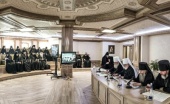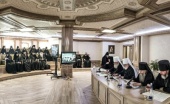
On July 3, 2024, in Sretensky Stavropigial Monastery Moscow, a regional round table «Replenishing the brotherhood of the monastery was held. A regional round table «Replenishment of the monastery brotherhood. What does it depend on? », which was attended by vicars, hegumens and abbesses of stavropegic monasteries and cloisters of the Moscow Metropolis.
Moscow Metropolitan Church.
The meeting was preceded by the Divine Liturgy in the church in honor of the Purification of the Vladimir Icon of the Mother of God, which was led by the chairman of the Synodal Department for Monasteries and Monasticism (SOMM), vicar of the Don Stavropegial Monastery of Moscow. Moscow Metropolitan Theognost of Kashir.
The presidium of the forum included: Metropolitan Feognost of Kashira; Patriarchal Vicar of the Moscow Metropolis Metropolitan Pavel of Krutitsy and Kolomna; Deputy Chairman of the SOMM, Mother Superior of the Zachatievsky Stavropegial Nunnery Higumenia Juliana (Kaleda); Vicar of the Danilov Stavropigial Monastery Moscow Danilov Stavropigial Monastery . Moscow Bishop Alexis of Solnechnogorsk; Chairman of the Synodal Missionary Department; Vicar of the Vysoko-Petrovsky Stavropegial Monastery of Moscow Bishop Evfimy of Lukhovitsky.
Moscow. Moscow Bishop Evfimy of Lukhovitsky.
Opening the work of the round table, Metropolitan Feognost of Kashir gave the participants the blessing of His Holiness Patriarch Kirill of Moscow and All Russia for the upcoming work.
Metropolitan Feognost of Kashir conveyed the blessing of His Holiness Patriarch Kirill of Moscow and All Russia to the participants.
Metropolitan Pavel, Metropolitan of Krutitsy and Kolomna, in his opening address to the leaders of monastic communities, noted the importance of the theme of the forum and reminded that the main condition for the replenishment of monasteries is love. Christian attitude of the brethren to each other and to all those who come to the monastery attract people. If Christian love lives and works in the monastery, the monastery is replenished. About such a monastery the people quickly learn. Pious life — the best preaching of Christianity and monasticism», — noted the Patriarchal Vicar. Among the significant conditions for a prosperous spiritual life of a monastery, Vladyka Paul also noted the personal example and prayer of the abbot or abbess, the cheerful mood of the members of the monastic community and the spiritual (elderly) nurturing of the brethren or sisterhood.
The floor for the first report was given to Bishop Alexis of Solnechnogorsk. He entitled his speech with a quotation from the Paschal Canon «Another life of eternal life is the beginning of eternal life…», placing the main emphasis on the spiritual life in the monastery as the beginning of eternal life. According to His Eminence, those who seek eternal life in God already here on earth and are looking for spiritual fulfillment should come to the monastery. It is known that in reality this ideal is not always achievable; sometimes the Lord comes to a person in sin and in fallenness, literally plucking him out of the abyss of sin. Sometimes a spiritual spark is ignited because a person just feels good and gracious in the temple, when visiting holy places. In any case, the hegumen or abbess must treat the need to be with God that has arisen in the newcomer to the monastery very carefully, not only supporting this burning, but also protecting him from the danger of seduction. The meeting of a novice with monasticism, in addition to the inspiring external aspect, should immediately give a sense of inner, spiritual fulfillment. And here we must not neglect small things, explaining the necessity of obedience, acceptance of the will of God, non-judgment, cutting off evil thoughts, doing good deeds, etc. The hegumen and the senior brothers need to pay special attention to the probationary, The novice period, supporting the newcomers, talking, clarifying perplexities, and most importantly, treating them with love. If love reigns in the monastery, everything else will be added, if there is no love, then no rules will help, — Vladyka Alexis noted, — And to gain love, you need to do a lot of work». At the conclusion of the report, the bishop reminded of one advantage of monastic life: in a monastery with the right spiritual structure literally everything «brings us back to the truth about ourselves, and then —to the true concepts of God, the world, people» thus helping us, by the grace of God, to become partakers of another eternal life».
Bishop Joseph of Mozhaisk, Vicar of the Vedensky Stavropegial Monastery Optina Desert, discussing in his speech the reasons for the decrease in the number of those wishing to enter monasteries, named external and internal circumstances under the influence of which modern man is under. Among the external reasons — unfavorable demographic situation in the regions where Russian Orthodox people live. His Holiness Patriarch Kirill has repeatedly spoken of the need to take measures at the state level to address the demographic situation problems, the Vladyka recalled. Then he described the influence of mass culture, which over the past 30 years has contributed to the formation of a consumer society. Educating young people to be selfish, to desire a comfortable existence, to impose an idle lifestyle through virtual reality — all of this is fundamentally contrary to the Christian worldview. And perhaps that is why today, according to VTsIOM estimates, 66% of the population in Russia consider themselves Orthodox, and not 80%, as it was 14 years ago. In the opinion of the vicar of the Optina Hermitage, those who imposed the values of the consumer society are in fact enemies of the Church.
Talking about the internal reasons for the reduction of novices, Bishop Joseph paid special attention to the importance of clergy in the monastery, and spoke about how important it is to take care of the lay people who come to monasteries. Vladyka also expressed his opinion about the large number of people who filled the monasteries in the 90s of the twentieth century, calling that situation rather atypical for church life. At the end of the twentieth — the beginning of the twenty-first century, many people were baptized, realizing that the period of persecution of the Church was over. People went to monasteries, hungry for church life, without realizing what monasticism is. The current state of affairs, from Bishop Joseph's point of view, can be summarized as follows to call normal. Judging by the statistics that His Holiness Patriarch Kirill of Moscow and All Russia presented at the Meeting of Hegumens and Hegumesses, in particular, the need to replenish monastic communities is not an acute issue in stauropegial monasteries. Summarizing what was said and based on the saying of St. Ignatius (Bryanchaninov), Vladyka Joseph noted: «All members of the Church, and especially monastics should prove by their example the truth of Christianity and the immutability of traditional values.... In order for the world to change, monasticism must change.
Hegumen Sergius (Kuxov), vicar of the Ascension David's Hermitage, in his presentation examined the reasons that motivate a person to seek a monastery and the possibilities of helping those who would like to stay in the monastery. During his 12 years as abbot, Father Sergius shared, more than 600 people visited the monastery as laborers, but the motivations of all were different. Those who sincerely desired the monastic life wanted to convey the beauty of monasticism in its entirety, and to do this, according to the hegumen, was possible by immersing people in the life of the monastic community. However, the monastery, located within the city, was at that time oriented towards external activities, and the lack of the abbot's experience prevented him from seeing the life of the monastic community. the need to be primarily engaged in building the spiritual life of the monastic community. Without diminishing the importance of missionary and educational work, the Vicar of the Davidic Desert noted that those who aspire to monasticism are still attracted to monasteries by the opportunity to work spiritually. When this understanding came, and external service ceased to occupy the main place in the life of the monastery, workers and students of the Sunday school at the monastery began to express a desire to become monks, to enter the seminary, which is, as Father Sergius believes, a sign that the Lord does not abandon the David's Desert. Based on the experience of the head of the monastic community, Father Sergius warned the hegumens and abbesses against giving the residents excessive physical exertion as obedience. Being overworked physically, a modern person often loses the ability to lead a spiritual life, falls into despondency and may completely lose the desire to live in a monastery. Hegumen Sergius called the attention of the hegumen, the love and support of the brethren, the connection of the members of the monastic community with each other through the prayer rule and participation in the sacraments the main conditions for a prosperous spiritual life of the monastery. was held June 1-6 this year as part of a pilgrimage to the Christian shrines of Egypt.
Igumnya Tamara (Goncharenko), Mother Superior of the Alexander Nevsky Nunnery of Sergiev-Posad Diocese, presented a report «“This generation of those seeking the Lord…ˮ Spiritual component as one of the factors of replenishing the brotherhood of the monastery». In her opinion, for a person to firmly embark on the monastic path, in addition to a divine calling, his own aspiration for God-seeking and God-knowledge, and the ability for a feat of self-denial, he must be met in the monastery with a full spiritual life and conditions for inner work. Matushka Tamara recalled several periods of the heyday of monasticism, when brotherhoods and sisterhoods were actively replenished: the 4th century in the Byzantine Empire, the beginning of Russian monasticism in Kiev, the era of St. Sergius of Radonezh, the time of the Optina elders. And always in such periods the greatest importance was the personal example of asceticism. Among the ascetics of the spirit, who attracted many to the monastic path, the abbess of the monastery near Moscow named the Monkess of the Monastery of the Confessor, Szygumnya Famar (Marjanova), founder of the Serafimo-Znamensky Skete. Matushka Tamara mentioned that the image of Ssihyigumenia Famari and In her youth she herself was deeply impressed by the first thoughts of monasticism, which she later strengthened by communicating with Sycharchimandrite Seraphim (Mirchuk) and his keleinitsa, Matushka Maria, who exemplified a high spiritual life. Abbess Tamara also spoke about the beneficial influence of spiritual and labor education that people received in the past (the Soviet era, having discarded the spiritual component, at least tried to leave the moral and labor component). Nowadays it is incredibly difficult for a young person who is used to continuous entertainment of attention in the flow of heterogeneous information, who does not know self-control and, most importantly, who often grows up without love in the family, without warmth in relationships, to learn the virtues of patience, obedience, care for neighbor.
«The world is changing irresistibly, and it will never be the same as before, — summarized these reflections Hegumen Tamara. — The replenishment of the brotherhood of the monastery depends both on the spiritual state of the monastery itself, and the state of the society in which the person who comes to the monastery lives». To fulfill the Lord's commandment of love, to be an example in this, despite all the opposing circumstances, in our time, perhaps, the most important thing that monasteries can give to the world, what they can attract and teach the new generation monks.
Another essential aspect of monasticism was revealed in her report «Monasticism: seeking the nectar of Divine beauty» Igumenia Alexia (Petrova), Abbess of the Serpukhov Vvedensky Vladychny Nunnery of the Podolsk diocese. What pilgrims see in the monastery will determine whether they want to stay there or not, Mother Alexia said. In her opinion, it is possible to show the unearthly beauty of monasticism through the strict statutory service, the gracious atmosphere in the monastery, through the right attitude to monasticism of brothers and sisters. But the first impressions of a pilgrim from the monastery — this is not the whole monastic life, emphasized the abbess. A lot of labors and temptations lie ahead, that is why the art of the newcomers should not be brief. An important moment in the replenishment of the brotherhood is the prayer of the hegumen and all the residents. From the first years of the revival in Vladychny Monastery after midnight prayers are recited that the Lord would send «faithful sisters», shared her experience, Matushka Alexia, noting in conclusion that, on the one hand, it is necessary to live in such a way that the nuns want to go to the monastery, but one should not be discouraged if There are not enough newcomers: «After all, our will and labor are from us, and the result is from God.
The necessity of such a prayerful appeal to God for the replenishment of the brotherhood, as well as attention to the conduct of personal pious life was emphasized by Metropolitan Pavel of Krutitsy and Kolomna in his closing remarks, summarizing the round table. On behalf of all the participants, the Patriarchal Vicar expressed his gratitude to His Holiness Patriarch Kirill for his blessing for such meetings to discuss the pressing problems of monasticism. Vladyka Pavel also thanked Metropolitan Feognost of Kashira and the Synodal Department for Monasteries and Monasticism headed by him for organizing the event, Vicar of the Sretensky Monastery Humen John (Ludischev) — for hospitality, and all those present — for their participation.
Synodal Department for Monasteries and Monasticism/Patriarchy.ru