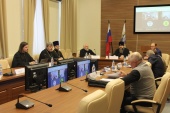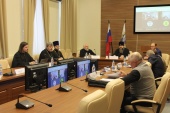
On November 26-27, 2024, Smolensk State University hosted an all-Russian church-scientific conference on «Issues of church-state relations in the USSR in the 1950s — 1960s ». The conference was timed to coincide with the sixtieth anniversary of the end of the era of Khrushchev's persecutions.
The event was organized jointly with the Russian Academy of Education and the Study Committee of the Russian Orthodox Church. Among the participants of the conference — leading Russian specialists in the field of church history, teachers and students of the Smolensk Theological Seminary, Smolensk State University and other Russian universities.
Before the opening of the conference the participants sang the prayer «Heavenly King».
The rector of the Smolensk Theological Seminary Metropolitan Isidore of Smolensk and Dorogobuzh welcomed the forum participants. «Almost a year ago we held an all-Russian conference here, and we have gathered again to devote our efforts to reflecting on church-state relations during the Khrushchev period, including focusing on those events that took place in our region» — the bishop said.
At the conference, the bishop said.
Head of Smolensk Metropolitan Church also expressed gratitude to the Rector of Smolensk State University M.N. Artyomenkov for providing the venue for the conference and for the active participation of the university in joint events: «Smolensk State University is always a research locomotive in many issues, including those related to the activities of the Church; during the academic year we hold many conferences together and get incredible benefit from it»
.
M.N. Artyomenkov then addressed the audience of the conference. He noted that such conferences demonstrate the fusion of the secular and spiritual, helping to explore the difficult history of the state: «Without a deep study of these pages it is impossible to understand how our society developed, how the modern state was formed. Today's theme of the conference is devoted to a very difficult period — Khrushchev years, which are called the time of "thaw". However, it was then that there was another round of persecution of the Russian Orthodox Church. This contradiction requires reflection: how such a thing could coexist, how it affected society.
M.N. Artyomenkov wished fruitful work and successful results to the participants of the conference, expressing the hope for continued cooperation next year.
Doctor of Historical Sciences, Doctor of Church History, Professor, Head of the Department of Doctoral Studies of the Oschechurch Postgraduate and Doctoral School named after Saints Cyril and Methodius Archpriest Alexis Marchenko welcomed the organizers and participants of the scientific conference on behalf of the Chairman of the Study Committee of the Russian Orthodox Church, Rector of OCAD Protopriest Maxim Kozlov and noted: «I would like to say that the All-Church Postgraduate School and Doctoral School is one of the flagships of church education, where personnel of the highest scientific qualifications are trained. There are three dissertation councils, which award academic degrees: doctor of theology, theology and church history. We are very pleased that Metropolitan Isidore is a doctoral student of the Church Postgraduate School.
Metropolitan Isidore emphasized: «Next year is in many ways a landmark year, a jubilee year for the Russian Orthodox Church. We use this conference as an opportunity to coordinate future events related to the exploits of such figures as Vladyka Michael (Chub), who served during the years of persecution and is associated with the cities of Smolensk and Tambov.
The participants of the forum were welcomed by S. A. Chebotarev, Advisor to the Head of the Tambov Region, Candidate of Historical Sciences, Professor of the G.R. Derzhavin Tambov State University.
The basis of the program of the first day of the conference was the work of the section № 1 «Church-state relations and persecution of the Church in the USSR in the second half of the 1950s — the first half of the 1960s: general trends and regional specifics». The moderator of the section was Deacon Sergiy Kulpinov, Doctor of Church History, Professor of the Department of Church History and Philology of the Ekaterinburg Theological Seminary.
In the course of the section the following reports were presented:
- T.A. Chumachenko, Doctor of Historical Sciences, corresponding member of RAO, head of the South Ural Scientific Center of RAS on the basis of the South Ural State Humanitarian-Pedagogical University, — «The policy of the Soviet authorities in relation to the Church, religion, believers. 1958-1964, » (remotely);
- Propriest Alexis Marchenko, Doctor of Church History, Doctor of Historical Sciences, Professor, Head of the Department of Doctoral Studies of UCAD, — ««Forms of Church resistance during the period of Khrushchev persecution 1958-1964 »;
- Metropolitan Isidor of Smolensk — «Smolensk diocese at the peak of the Khrushchev persecutions in 1961-1964»;
- S.A. Chebotarev, Ph. Professor of Tambov State University named after G.R. Derzhavin, Advisor to the Head of the Tambov region, — «Onslaught and confrontation. The role of the personalities of the Tambov commissioners of the Council for the Russian Orthodox Church and bishops in the era of Khrushchev's offensive on the Church»;
- A.F. Gavrilenkov, Doctor of Historical Sciences, Candidate of Philosophy, Professor, Vice-Rector for Scientific Work of Smolensk Theological Seminary, — ««To the question of typification of religious associations in the USSR at the turn of the 1950s and 1960s»;
- Yu.A. Biryukova, Candidate of Historical Sciences, Associate Professor, Don State Technical University, — «Khrushchev's anti-religious campaign in the South of Russia: Church and power in Don, Stavropol and Kuban in 1958-1964 »;
- Hieromonk Alexander (Serpeninov), resident of Svyato-Trinity Sergius Lavra, employee of the protocol service of the Administrative Secretariat of the Moscow Patriarchate, — «Archbishop Palladius: life and ministry under persecution» .
Afterwards, the participants of the church-scientific conference discussed the reports they had listened to.
On the second day of the conference, November 27, the participants of the scientific forum continued their work in the framework of the section № 2 «Life of the Church in the era of "Khrushchev's" persecution: the fate of the
Moderated by Archpriest Alexis Marchenko.
The work of the section was moderated by Archpriest Alexis Marchenko. In his greeting to the participants of the section, he noted that «the decision to gather this conference was made in connection with the round date of the end of the Khrushchev persecution and the resignation of Nikita Khrushchev from all his posts». «This date, Archpriest Alexy noted, — — at first glance may not seem so significant in the scale of Russian history, but for the Church October 14, 1964 is a very memorable day». Father Alexy emphasized that Khrushchev's resignation took place on the feast of the Protection of the Blessed Virgin Mary, and also «became a peculiar point in a dramatic and tragic period of history, which many witnesses of that epoch remember with bitterness»
.
The following reports were presented within the framework of the section:
- Priest Dimitri Safonov, candidate of theology and historical sciences, associate professor of the Department of Theology of the Moscow State Linguistic University and consultant to the Department for External Church Relations of the Moscow Patriarchate, — «Fates of clergy-refugees during the years of Khrushchev's persecution»;
- I.V. Petrov, Candidate of Historical Sciences, Associate Professor St. Petersburg Branch of the Russian Customs Academy named after V.B. Bobkov. V.B. Bobkov; — «The uncomfortable past of an Orthodox priest in the 1920s-1940s as a factor in Khrushchev's persecution of the Church»;
- Priest Iliya Solovyov, Candidate of Theology and Historical Sciences, Associate Professor of OCAD, Chairman of the Society of Amateurs of Church History; — «Reflection of Khrushchev's persecution in the Russian foreign press»;
- M.V. Kail, Candidate of Historical Sciences, Associate Professor, Head of the Department of Russian History, Smolensk State University; — «Against the Current? New faces in shaping the course of church diplomacy in 1959-1964»;
- Deacon Sergius Kulpinov, Doctor of Church History, Associate Professor of Tomsk Theological Seminary, Professor of Yekaterinburg Theological Seminary; — «Foreign Church Delegations in the USSR in the Era of Khrushchev's Persecution»;
- S.L. Firsov, Doctor of Historical Sciences and Professor at the Herzen State Pedagogical University of Russia, Professor at the St. Petersburg Theological Academy, — « "They left us, but they were not ours": the perception of contemporaries of the former theologian's abdication» .
At the conclusion of the conference, Metropolitan Isidore thanked the participants of the forum for their successful work, and also expressed thanks to the rector of Smolensk State University M.N. Artyomenkov for many years of cooperation. «We, the representatives of the Smolensk Metropolis, sincerely hope for further development of our relations» — added the bishop.
The bishop said that on the eve of the preliminary discussion of possible prospects for the next meeting of the archdiocese.
The Archbishop said that the day before the possible prospects of holding the next professorial conference in Smolensk State University were discussed beforehand.
The Archbishop said.
Protopriest Alexis Marchenko, summarizing the last conference, noted that next year two more important dates are expected: the anniversary date associated with the victory in the Great Patriotic War, and the centenary of the repose of Holy Patriarch Tikhon.
Holy Patriarch Tikhon.
M.N. Artyomenkov thanked the speakers and all the participants of the forum.
Smolensk Eparchy/Patriarchy.ru