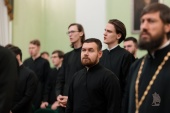
The St. Petersburg Theological Academy hosted the presentation of the collection "Consciousness and Matter. Mind, Brain and Cosmos in the Dialogue between Science and Theology"

В Санкт-Петербургской духовной академии прошла презентация сборника «Сознание и материя. Разум, мозг и космос в диалоге между наукой и теологией»

On November 27, 2024 in the auditorium of the St. Petersburg Theological Academy the presentation of the collection «Consciousness and Matter. Mind, Brain, and Cosmos in the Dialogue between Science and Theology» («Consciousness and Matter. Mind, Brain, and Cosmos in the Dialogue between Science and Theology»), published by Pickwick Publications in March of this year.

The book contains the publications of a research group of prominent domestic and foreign scientists, formed in the process of work within the international research project «Science and Orthodoxy in the world» supported by the Templeton Foundation — the largest and most authoritative foundation funding research in the frontier area of contact between science and religion.

The book contains the publications of the research group of prominent domestic and foreign scientists, formed in the process of work within the international research project «Science and Orthodoxy in the world» supported by the Templeton Foundation — the largest and most authoritative foundation funding research in the frontier area of contact between science and religion.

This interdisciplinary study sought to make sense of current research on the interface between science and theology in the context of the age-old psychophysical problem of «Consciousness — body». Particular attention was paid to the contribution of Eastern Orthodox theology to the dialog between religion and science, as well as to the identification of ways to develop theological thought taking into account recent advances in quantum physics, physiology, and medical sciences.

.

At the beginning of the presentation with a welcoming speech to the audience Archpriest Konstantin Kostromin, Vice-Rector for Theological and Scientific Work of the St. Petersburg State Theological Academy, addressed us: «Dear colleagues, dear friends! I am very glad that conferences of the Theology Department on complex topics, topics of interaction between natural and cognitive sciences and theology, have become a tradition in our theological school. They raise acute questions that are not only the subject of theological discourse, but also of philosophical discourse, where the ethics of artificial intelligence and practical issues of modern technology are discussed. This junction is always painful and forms a gulf between natural and humanities knowledge, which has long been overlapped by artificial constructs. Now the semantic links between different fields of knowledge have become more stable, more serious, for which there is a cognitive science. However, now theology, together with the luminaries of our department, is trying to keep up with the modern scientific agenda.

Professor D.V. Shmonin, Director of the Institute of Theology of St. Petersburg State University, continued the welcoming speech by telling about philosophical and scholastic prerequisites of the dialog between religion and science.

The first presentation, devoted to the process of work on the collection, was made by one of his

Assistant Professor Archpriest Kirill Kopeikin, candidate of physical and mathematical sciences and candidate of theology, was the author and organizer of the meeting.

The presentation was continued by the head of the Laboratory of Neurophysiology and Neurocomputer Interfaces of the Faculty of Biology of the Lomonosov Moscow State University, Doctor of Biological Sciences, Professor A.Y. Kaplan, who presented a dynamic mental model of the physical world, spoke about the latest neurophysiological studies of the religious experience of Buddhist monks, acquired during meditation, and also touched upon the problem of thinking and speech. In his presentation, he noted the existence of a vast underlying potential in the human brain, the existence of which cannot be explained by biological causes alone.

He emphasized the existence of a vast underlying potential in the human brain.

Further, in a remote format, the director of the Institute of Cognitive Studies of St. Petersburg State University, academician of the Russian Academy of Sciences, Doctor of Biological Sciences, Doctor of Philological Sciences, Professor T.V. Chernigovskaya, who continued to discuss the problem of speech and thinking, noted the special necessity of metaphysical knowledge for cognitive science, and also touched upon the socio-cultural problems brought by the rapid development of artificial intelligence and digitalization.

Afterwards, the Director of the International Center for Professor A.V. Kavokin, Doctor of Physical and Mathematical Sciences, Head of the A.A. Abrikosov Theoretical Physics Group of the Moscow Institute of Physics and Technology, Head of the Quantum Polaritonics Group of the Russian Quantum Center, Director of the I.N. Uraltsev Spin Optics Laboratory of St. Petersburg State University. The largest Russian specialist in the field of polaritonics and quantum optics told the audience about the phenomenon of «liquid light» as a special intermediate state between light and matter. From his point of view, strongly coupled states of light and matter, such as exciton-polaritons, can be considered as a conditional model of the interaction between consciousness and matter.

Furthermore, the linguist Trimble Walker, a graduate of Oxford University and a lecturer at the Department of Translation at the Herzen State Pedagogical University of Russia, PhD, presented his concept of the relationship between the brain and the higher moral humanity.

Trimble Walker presented his concept of the relationship between the brain and the higher moral humanity.

The first part of the presentation was completed by the Director of the Kola Scientific Center of the Russian Academy of Sciences, Academician of the Russian Academy of Sciences, Professor of the Department of Theology of SPbDA PhD Geological and Mineralogical Sciences Professor Priest Sergiy Krivovichev, who touched upon the scientific legacy of Professor M.V. Lomonosov Moscow State University PhD N.I. Kobozev. The latter back in

After the break, the presentation continued with the head of the theology department at Tobolsk Theological Seminary, Ph.

After a break, the presentation was continued by the head of the theology department of Tobolsk Theological Seminary, candidate of philosophical sciences, associate professor Archpriest Demetrius Kiryanov, who presented various natural-scientific and theological points of view on the problem of the correlation between the brain and the soul.

The next speaker was Dr. A.V. Nesteruk, Doctor of Philosophy, Candidate of Physical and Mathematical Sciences, Professor of the University of Portsmouth (UK), who considered the psychophysical problem in the cosmological discourse. He showed that, in a sense, the difficult problem of consciousness becomes another form of explication of what is radically unknowable: the creation of man by God out of nothing, creatio ex nihilo.

The presentation of the collection «Consciousness and Matter» was concluded by the report of Archpriest Kirill Kopeikin, Candidate of Physical and Mathematical Sciences, Candidate of Theology, Associate Professor, who demonstrated that a careful analysis of the procedure of quantum-mechanical measurement shows that in quantum theory there is no ontological difference between «subjective» reality of the observer and «objective» reality of the world This, in turn, means that all reality is, in a certain sense, «mental». Such a seemingly paradoxical result seems, however, to be quite natural when considered within the discourse of natural theology.

After each presentation, the audience had the opportunity to ask questions of the speakers.

Press Service of SPbDA/Patriarchy.ru
Share:
The St. Petersburg Theological Academy hosted the presentation of the collection "Consciousness and Matter. Mind, Brain and Cosmos in the Dialogue between Science and Theology" The St. Petersburg Theological Academy hosted the presentation of the collection "Consciousness and Matter. Mind, Brain and Cosmos in the Dialogue between Science and Theology" On November 27, 2024 in the auditorium of the St. Petersburg Theological Academy the presentation of the collection «Consciousness and Matter. Mind, Brain, and Cosmos in the Dialogue between Science and Theology» («Consciousness and Matter. Mind, Brain, and Cosmos in the Dialogue between Science and Theology»), published by Pickwick Publications in March of this year. The book contains the publications of a research group of prominent domestic and foreign scientists, formed in the process of work within the international research project «Science and Orthodoxy in the world» supported by the Templeton Foundation — the largest and most authoritative foundation funding research in the frontier area of contact between science and religion. The book contains the publications of the research group of prominent domestic and foreign scientists, formed in the process of work within the international research project «Science and Orthodoxy in the world» supported by the Templeton Foundation — the largest and most authoritative foundation funding research in the frontier area of contact between science and religion. This interdisciplinary study sought to make sense of current research on the interface between science and theology in the context of the age-old psychophysical problem of «Consciousness — body». Particular attention was paid to the contribution of Eastern Orthodox theology to the dialog between religion and science, as well as to the identification of ways to develop theological thought taking into account recent advances in quantum physics, physiology, and medical sciences. . At the beginning of the presentation with a welcoming speech to the audience Archpriest Konstantin Kostromin, Vice-Rector for Theological and Scientific Work of the St. Petersburg State Theological Academy, addressed us: «Dear colleagues, dear friends! I am very glad that conferences of the Theology Department on complex topics, topics of interaction between natural and cognitive sciences and theology, have become a tradition in our theological school. They raise acute questions that are not only the subject of theological discourse, but also of philosophical discourse, where the ethics of artificial intelligence and practical issues of modern technology are discussed. This junction is always painful and forms a gulf between natural and humanities knowledge, which has long been overlapped by artificial constructs. Now the semantic links between different fields of knowledge have become more stable, more serious, for which there is a cognitive science. However, now theology, together with the luminaries of our department, is trying to keep up with the modern scientific agenda. Professor D.V. Shmonin, Director of the Institute of Theology of St. Petersburg State University, continued the welcoming speech by telling about philosophical and scholastic prerequisites of the dialog between religion and science. The first presentation, devoted to the process of work on the collection, was made by one of his Assistant Professor Archpriest Kirill Kopeikin, candidate of physical and mathematical sciences and candidate of theology, was the author and organizer of the meeting. The presentation was continued by the head of the Laboratory of Neurophysiology and Neurocomputer Interfaces of the Faculty of Biology of the Lomonosov Moscow State University, Doctor of Biological Sciences, Professor A.Y. Kaplan, who presented a dynamic mental model of the physical world, spoke about the latest neurophysiological studies of the religious experience of Buddhist monks, acquired during meditation, and also touched upon the problem of thinking and speech. In his presentation, he noted the existence of a vast underlying potential in the human brain, the existence of which cannot be explained by biological causes alone. He emphasized the existence of a vast underlying potential in the human brain. Further, in a remote format, the director of the Institute of Cognitive Studies of St. Petersburg State University, academician of the Russian Academy of Sciences, Doctor of Biological Sciences, Doctor of Philological Sciences, Professor T.V. Chernigovskaya, who continued to discuss the problem of speech and thinking, noted the special necessity of metaphysical knowledge for cognitive science, and also touched upon the socio-cultural problems brought by the rapid development of artificial intelligence and digitalization. Afterwards, the Director of the International Center for Professor A.V. Kavokin, Doctor of Physical and Mathematical Sciences, Head of the A.A. Abrikosov Theoretical Physics Group of the Moscow Institute of Physics and Technology, Head of the Quantum Polaritonics Group of the Russian Quantum Center, Director of the I.N. Uraltsev Spin Optics Laboratory of St. Petersburg State University. The largest Russian specialist in the field of polaritonics and quantum optics told the audience about the phenomenon of «liquid light» as a special intermediate state between light and matter. From his point of view, strongly coupled states of light and matter, such as exciton-polaritons, can be considered as a conditional model of the interaction between consciousness and matter. Furthermore, the linguist Trimble Walker, a graduate of Oxford University and a lecturer at the Department of Translation at the Herzen State Pedagogical University of Russia, PhD, presented his concept of the relationship between the brain and the higher moral humanity. Trimble Walker presented his concept of the relationship between the brain and the higher moral humanity. The first part of the presentation was completed by the Director of the Kola Scientific Center of the Russian Academy of Sciences, Academician of the Russian Academy of Sciences, Professor of the Department of Theology of SPbDA PhD Geological and Mineralogical Sciences Professor Priest Sergiy Krivovichev, who touched upon the scientific legacy of Professor M.V. Lomonosov Moscow State University PhD N.I. Kobozev. The latter back in After the break, the presentation continued with the head of the theology department at Tobolsk Theological Seminary, Ph. After a break, the presentation was continued by the head of the theology department of Tobolsk Theological Seminary, candidate of philosophical sciences, associate professor Archpriest Demetrius Kiryanov, who presented various natural-scientific and theological points of view on the problem of the correlation between the brain and the soul. The next speaker was Dr. A.V. Nesteruk, Doctor of Philosophy, Candidate of Physical and Mathematical Sciences, Professor of the University of Portsmouth (UK), who considered the psychophysical problem in the cosmological discourse. He showed that, in a sense, the difficult problem of consciousness becomes another form of explication of what is radically unknowable: the creation of man by God out of nothing, creatio ex nihilo. The presentation of the collection «Consciousness and Matter» was concluded by the report of Archpriest Kirill Kopeikin, Candidate of Physical and Mathematical Sciences, Candidate of Theology, Associate Professor, who demonstrated that a careful analysis of the procedure of quantum-mechanical measurement shows that in quantum theory there is no ontological difference between «subjective» reality of the observer and «objective» reality of the world This, in turn, means that all reality is, in a certain sense, «mental». Such a seemingly paradoxical result seems, however, to be quite natural when considered within the discourse of natural theology. After each presentation, the audience had the opportunity to ask questions of the speakers. Press Service of SPbDA/Patriarchy.ru
On November 27, 2024 in the auditorium of the St. Petersburg Theological Academy the presentation of the collection «Consciousness and Matter. Mind, Brain, and Cosmos in the Dialogue between Science and Theology» («Consciousness and Matter. Mind, Brain, and Cosmos in the Dialogue between Science and Theology»), published by Pickwick Publications in March of this year. The book contains the publications of a research group of prominent domestic and foreign scientists, formed in the process of work within the international research project «Science and Orthodoxy in the world» supported by the Templeton Foundation — the largest and most authoritative foundation funding research in the frontier area of contact between science and religion. The book contains the publications of the research group of prominent domestic and foreign scientists, formed in the process of work within the international research project «Science and Orthodoxy in the world» supported by the Templeton Foundation — the largest and most authoritative foundation funding research in the frontier area of contact between science and religion. This interdisciplinary study sought to make sense of current research on the interface between science and theology in the context of the age-old psychophysical problem of «Consciousness — body». Particular attention was paid to the contribution of Eastern Orthodox theology to the dialog between religion and science, as well as to the identification of ways to develop theological thought taking into account recent advances in quantum physics, physiology, and medical sciences. . At the beginning of the presentation with a welcoming speech to the audience Archpriest Konstantin Kostromin, Vice-Rector for Theological and Scientific Work of the St. Petersburg State Theological Academy, addressed us: «Dear colleagues, dear friends! I am very glad that conferences of the Theology Department on complex topics, topics of interaction between natural and cognitive sciences and theology, have become a tradition in our theological school. They raise acute questions that are not only the subject of theological discourse, but also of philosophical discourse, where the ethics of artificial intelligence and practical issues of modern technology are discussed. This junction is always painful and forms a gulf between natural and humanities knowledge, which has long been overlapped by artificial constructs. Now the semantic links between different fields of knowledge have become more stable, more serious, for which there is a cognitive science. However, now theology, together with the luminaries of our department, is trying to keep up with the modern scientific agenda. Professor D.V. Shmonin, Director of the Institute of Theology of St. Petersburg State University, continued the welcoming speech by telling about philosophical and scholastic prerequisites of the dialog between religion and science. The first presentation, devoted to the process of work on the collection, was made by one of his Assistant Professor Archpriest Kirill Kopeikin, candidate of physical and mathematical sciences and candidate of theology, was the author and organizer of the meeting. The presentation was continued by the head of the Laboratory of Neurophysiology and Neurocomputer Interfaces of the Faculty of Biology of the Lomonosov Moscow State University, Doctor of Biological Sciences, Professor A.Y. Kaplan, who presented a dynamic mental model of the physical world, spoke about the latest neurophysiological studies of the religious experience of Buddhist monks, acquired during meditation, and also touched upon the problem of thinking and speech. In his presentation, he noted the existence of a vast underlying potential in the human brain, the existence of which cannot be explained by biological causes alone. He emphasized the existence of a vast underlying potential in the human brain. Further, in a remote format, the director of the Institute of Cognitive Studies of St. Petersburg State University, academician of the Russian Academy of Sciences, Doctor of Biological Sciences, Doctor of Philological Sciences, Professor T.V. Chernigovskaya, who continued to discuss the problem of speech and thinking, noted the special necessity of metaphysical knowledge for cognitive science, and also touched upon the socio-cultural problems brought by the rapid development of artificial intelligence and digitalization. Afterwards, the Director of the International Center for Professor A.V. Kavokin, Doctor of Physical and Mathematical Sciences, Head of the A.A. Abrikosov Theoretical Physics Group of the Moscow Institute of Physics and Technology, Head of the Quantum Polaritonics Group of the Russian Quantum Center, Director of the I.N. Uraltsev Spin Optics Laboratory of St. Petersburg State University. The largest Russian specialist in the field of polaritonics and quantum optics told the audience about the phenomenon of «liquid light» as a special intermediate state between light and matter. From his point of view, strongly coupled states of light and matter, such as exciton-polaritons, can be considered as a conditional model of the interaction between consciousness and matter. Furthermore, the linguist Trimble Walker, a graduate of Oxford University and a lecturer at the Department of Translation at the Herzen State Pedagogical University of Russia, PhD, presented his concept of the relationship between the brain and the higher moral humanity. Trimble Walker presented his concept of the relationship between the brain and the higher moral humanity. The first part of the presentation was completed by the Director of the Kola Scientific Center of the Russian Academy of Sciences, Academician of the Russian Academy of Sciences, Professor of the Department of Theology of SPbDA PhD Geological and Mineralogical Sciences Professor Priest Sergiy Krivovichev, who touched upon the scientific legacy of Professor M.V. Lomonosov Moscow State University PhD N.I. Kobozev. The latter back in After the break, the presentation continued with the head of the theology department at Tobolsk Theological Seminary, Ph. After a break, the presentation was continued by the head of the theology department of Tobolsk Theological Seminary, candidate of philosophical sciences, associate professor Archpriest Demetrius Kiryanov, who presented various natural-scientific and theological points of view on the problem of the correlation between the brain and the soul. The next speaker was Dr. A.V. Nesteruk, Doctor of Philosophy, Candidate of Physical and Mathematical Sciences, Professor of the University of Portsmouth (UK), who considered the psychophysical problem in the cosmological discourse. He showed that, in a sense, the difficult problem of consciousness becomes another form of explication of what is radically unknowable: the creation of man by God out of nothing, creatio ex nihilo. The presentation of the collection «Consciousness and Matter» was concluded by the report of Archpriest Kirill Kopeikin, Candidate of Physical and Mathematical Sciences, Candidate of Theology, Associate Professor, who demonstrated that a careful analysis of the procedure of quantum-mechanical measurement shows that in quantum theory there is no ontological difference between «subjective» reality of the observer and «objective» reality of the world This, in turn, means that all reality is, in a certain sense, «mental». Such a seemingly paradoxical result seems, however, to be quite natural when considered within the discourse of natural theology. After each presentation, the audience had the opportunity to ask questions of the speakers. Press Service of SPbDA/Patriarchy.ru