Penza Seminary hosted the conference "The Role of the Russian Orthodox Church, Society and State in Preserving the Historical Memory of New Martyrs, Confessors and Victims of Repressions"

В Пензенской семинарии прошла конференция «Роль Русской Православной Церкви, общества и государства в сохранении исторической памяти о новомучениках, исповедниках и жертвах репрессий»
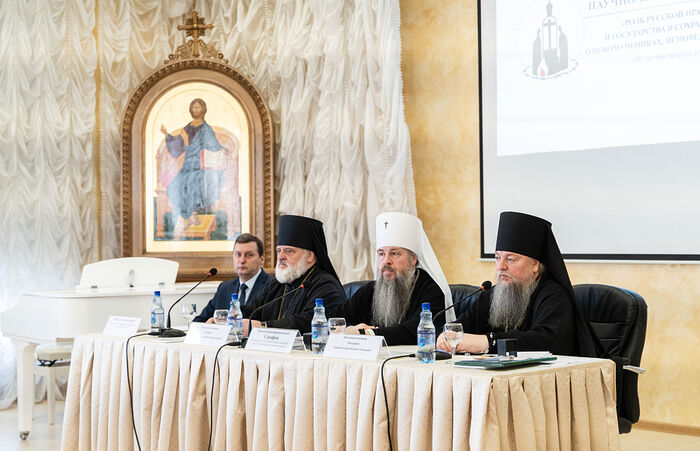
On April 2, 2024, the Penza Theological Seminary hosted the XI International Scientific and Practical Conference "The Role of the Russian Orthodox Church, society and the state in preserving the historical memory of the new martyrs, confessors and victims of repression", reports Patriarchy.ru. Metropolitan Seraphim of Penza and Nizhnelomovsk, Bishop Nazarius of Kuznetsk and Nikolsk, Bishop Mitrofan of Serdobsk and Spassky, clergy, invited guests of honor, teachers and students of Penza universities took part in the conference, timed to coincide with the 80th anniversary of the revival of the Penza diocese. The conference began with the grand opening of the photo exhibition "Persecuted but not forsaken: the ministry of confessors of faith in the Russian Orthodox Church in the 1940-50s". The exhibition was organized by the Penza Diocese and the St. Philaret Institute (Moscow). The exposition is dedicated to the ascetics and confessors of the Orthodox faith who revived church life in the 1940-50s in the Tashkent and Central Asian diocese. The history of the diocese at this time is closely connected with the personality of Archbishop Kirill (Pospelov), who was consecrated in 1944 as Bishop of Penza and Saransk, but in the same year was transferred to the Tashkent and Central Asian cathedra after eight years of its actual abolition. In 1947 he again became head of the The restoration of the Tashkent diocese was continued by Vladyks Guriy (Egorov) and Ermogen (Golubev). Thanks to the ministry of the ascetics of faith, church life flourished in the diocese and a wonderful spiritual atmosphere developed. Vladyka Seraphim expressed his gratitude to the St. Philaret Institute for joint activities in organizing the exhibition, which helps to understand the role of the clergy in the formation of Orthodoxy in 1944-1960 in Central Asia. "It is important to take into account that when Vladyka Kirill was transferred to the Tashkent and Central Asian cathedra, it was significantly different from the present one," Metropolitan Seraphim emphasized. - Back then, the diocese united the three modern Central Asian republics, which now position themselves as Muslim states. But at that time, this vast territory was home to many Russians of the Orthodox faith, because it was a place of exile for hundreds of thousands of people. This land became a new spiritual homeland for many martyrs and confessors. And it so happened that the land of Penza is akin to this land". The exhibition in the foyer of the Penza Theological Seminary (4 Perekop St.) will last until May 30 and will be available for everyone to visit daily from 8.00 to 18.00. After the opening of the exhibition plenary session The conference began with a cathedral prayer "Heavenly King". A cooperation agreement was signed between the Penza Theological Seminary and the State Archive of the Penza Region. The agreement was signed by Metropolitan Seraphim of Penza and Nizhnelomovsk, Rector of the Theological School, and A.G. Vazerova, Director of the Archive. The greeting of the Director of the State Archive of the Russian Federation L.A. Rogova was read out by the moderator of the conference K.G. Aristova, Candidate of Historical Sciences, Associate Professor of the Penza Theological Seminary. The State Archive is one of the largest repositories of the Russian Federation, which contains a significant number of documents on the history of Orthodoxy of the pre-revolutionary, Soviet and post-Soviet periods. Of greatest importance are the sources on the history of relations between the Church and the state after the revolution of 1917, which can form the basis of comprehensive works on the history of the Russian Orthodox Church in the twentieth century. The total volume of all materials in this area is more than 20 thousand units of storage, most of which are waiting for close study. The Director of the State Archive of the Russian Federation invited the conference participants to work with the funds. Unique documents on the election of Archpriest Alexander Belyaev as bishop were donated to the Penza Theological Seminary Penza Local Council of Churches, which was held in the Vvedensky Church (but was not realized due to the developing Renewal movement in Penza). The Head of the Penza Metropolis thanked those present for their participation in the conference and gave the floor to O.V. Yagov, First Deputy Chairman of the Government of the Penza Region, who noted the relevance and importance of the conference. He emphasized that it is necessary to remember the lessons of history in order not to repeat the mistakes made in the future. O.V. Yagov congratulated all those present on the 80th anniversary of the revival of the Penza diocese and wished fruitful work, pleasant communication and achievement of all the goals and objectives. After that the plenary reports were presented to the conference participants. T.A. Chumachenko, corresponding member of the Russian Academy of Education, Doctor of Historical Sciences, head of the South Ural Scientific Center of the Russian Academy of Education on the basis of the South Ural State Humanitarian and Pedagogical University, told about the evolution of the church policy of the authorities in the 1940s - the first half of the 1960s. O.A. Sukhova, Doctor of Historical Sciences, Dean of the Faculty of History and Philology of Penza State University, made a presentation "The Russian Orthodox Church in the system of socio-political interaction in the years of the Great Patriotic War (on materials of the Penza region)". Archpriest Alexei Marchenko, Doctor of Historical Sciences, Doctor of Church History, Associate Professor, Head of the Department of Doctoral Studies of the All-Church Postgraduate School and Doctoral School named after Saints Cyril and Methodius, told about the church service and confessional exploits of Archbishop Alexander (Tolstopiatov) of Molotov and Solikamsk. The report of O.V. Borisova, an employee of the publishing house of St. Philaret Institute, was devoted to the activities of Bishop Kirill (Pospelov) to restore church life in the Tashkent and Central Asian diocese in 1944-46. The report "On the Reasons for the Transfer of Bishop Kirill (Pospelov) from the Tashkent and Central Asian Diocese to the Ivanovo Diocese" was presented by D.V. Pavlov, Master of Theology, Junior Research Associate of the Research Department of the Modern History of the Russian Orthodox Church of the Orthodox Svyato-Tikhonovsky Humanitarian University (Moscow). The plenary session ended with the Sobor prayer "Worthy is".
Share:
Penza Seminary hosted the conference "The Role of the Russian Orthodox Church, Society and State in Preserving the Historical Memory of New Martyrs, Confessors and Victims of Repressions" Penza Seminary hosted the conference "The Role of the Russian Orthodox Church, Society and State in Preserving the Historical Memory of New Martyrs, Confessors and Victims of Repressions" On April 2, 2024, the Penza Theological Seminary hosted the XI International Scientific and Practical Conference "The Role of the Russian Orthodox Church, society and the state in preserving the historical memory of the new martyrs, confessors and victims of repression", reports Patriarchy.ru. Metropolitan Seraphim of Penza and Nizhnelomovsk, Bishop Nazarius of Kuznetsk and Nikolsk, Bishop Mitrofan of Serdobsk and Spassky, clergy, invited guests of honor, teachers and students of Penza universities took part in the conference, timed to coincide with the 80th anniversary of the revival of the Penza diocese. The conference began with the grand opening of the photo exhibition "Persecuted but not forsaken: the ministry of confessors of faith in the Russian Orthodox Church in the 1940-50s". The exhibition was organized by the Penza Diocese and the St. Philaret Institute (Moscow). The exposition is dedicated to the ascetics and confessors of the Orthodox faith who revived church life in the 1940-50s in the Tashkent and Central Asian diocese. The history of the diocese at this time is closely connected with the personality of Archbishop Kirill (Pospelov), who was consecrated in 1944 as Bishop of Penza and Saransk, but in the same year was transferred to the Tashkent and Central Asian cathedra after eight years of its actual abolition. In 1947 he again became head of the The restoration of the Tashkent diocese was continued by Vladyks Guriy (Egorov) and Ermogen (Golubev). Thanks to the ministry of the ascetics of faith, church life flourished in the diocese and a wonderful spiritual atmosphere developed. Vladyka Seraphim expressed his gratitude to the St. Philaret Institute for joint activities in organizing the exhibition, which helps to understand the role of the clergy in the formation of Orthodoxy in 1944-1960 in Central Asia. "It is important to take into account that when Vladyka Kirill was transferred to the Tashkent and Central Asian cathedra, it was significantly different from the present one," Metropolitan Seraphim emphasized. - Back then, the diocese united the three modern Central Asian republics, which now position themselves as Muslim states. But at that time, this vast territory was home to many Russians of the Orthodox faith, because it was a place of exile for hundreds of thousands of people. This land became a new spiritual homeland for many martyrs and confessors. And it so happened that the land of Penza is akin to this land". The exhibition in the foyer of the Penza Theological Seminary (4 Perekop St.) will last until May 30 and will be available for everyone to visit daily from 8.00 to 18.00. After the opening of the exhibition plenary session The conference began with a cathedral prayer "Heavenly King". A cooperation agreement was signed between the Penza Theological Seminary and the State Archive of the Penza Region. The agreement was signed by Metropolitan Seraphim of Penza and Nizhnelomovsk, Rector of the Theological School, and A.G. Vazerova, Director of the Archive. The greeting of the Director of the State Archive of the Russian Federation L.A. Rogova was read out by the moderator of the conference K.G. Aristova, Candidate of Historical Sciences, Associate Professor of the Penza Theological Seminary. The State Archive is one of the largest repositories of the Russian Federation, which contains a significant number of documents on the history of Orthodoxy of the pre-revolutionary, Soviet and post-Soviet periods. Of greatest importance are the sources on the history of relations between the Church and the state after the revolution of 1917, which can form the basis of comprehensive works on the history of the Russian Orthodox Church in the twentieth century. The total volume of all materials in this area is more than 20 thousand units of storage, most of which are waiting for close study. The Director of the State Archive of the Russian Federation invited the conference participants to work with the funds. Unique documents on the election of Archpriest Alexander Belyaev as bishop were donated to the Penza Theological Seminary Penza Local Council of Churches, which was held in the Vvedensky Church (but was not realized due to the developing Renewal movement in Penza). The Head of the Penza Metropolis thanked those present for their participation in the conference and gave the floor to O.V. Yagov, First Deputy Chairman of the Government of the Penza Region, who noted the relevance and importance of the conference. He emphasized that it is necessary to remember the lessons of history in order not to repeat the mistakes made in the future. O.V. Yagov congratulated all those present on the 80th anniversary of the revival of the Penza diocese and wished fruitful work, pleasant communication and achievement of all the goals and objectives. After that the plenary reports were presented to the conference participants. T.A. Chumachenko, corresponding member of the Russian Academy of Education, Doctor of Historical Sciences, head of the South Ural Scientific Center of the Russian Academy of Education on the basis of the South Ural State Humanitarian and Pedagogical University, told about the evolution of the church policy of the authorities in the 1940s - the first half of the 1960s. O.A. Sukhova, Doctor of Historical Sciences, Dean of the Faculty of History and Philology of Penza State University, made a presentation "The Russian Orthodox Church in the system of socio-political interaction in the years of the Great Patriotic War (on materials of the Penza region)". Archpriest Alexei Marchenko, Doctor of Historical Sciences, Doctor of Church History, Associate Professor, Head of the Department of Doctoral Studies of the All-Church Postgraduate School and Doctoral School named after Saints Cyril and Methodius, told about the church service and confessional exploits of Archbishop Alexander (Tolstopiatov) of Molotov and Solikamsk. The report of O.V. Borisova, an employee of the publishing house of St. Philaret Institute, was devoted to the activities of Bishop Kirill (Pospelov) to restore church life in the Tashkent and Central Asian diocese in 1944-46. The report "On the Reasons for the Transfer of Bishop Kirill (Pospelov) from the Tashkent and Central Asian Diocese to the Ivanovo Diocese" was presented by D.V. Pavlov, Master of Theology, Junior Research Associate of the Research Department of the Modern History of the Russian Orthodox Church of the Orthodox Svyato-Tikhonovsky Humanitarian University (Moscow). The plenary session ended with the Sobor prayer "Worthy is".
On April 2, 2024, the Penza Theological Seminary hosted the XI International Scientific and Practical Conference "The Role of the Russian Orthodox Church, society and the state in preserving the historical memory of the new martyrs, confessors and victims of repression", reports Patriarchy.ru. Metropolitan Seraphim of Penza and Nizhnelomovsk, Bishop Nazarius of Kuznetsk and Nikolsk, Bishop Mitrofan of Serdobsk and Spassky, clergy, invited guests of honor, teachers and students of Penza universities took part in the conference, timed to coincide with the 80th anniversary of the revival of the Penza diocese. The conference began with the grand opening of the photo exhibition "Persecuted but not forsaken: the ministry of confessors of faith in the Russian Orthodox Church in the 1940-50s". The exhibition was organized by the Penza Diocese and the St. Philaret Institute (Moscow). The exposition is dedicated to the ascetics and confessors of the Orthodox faith who revived church life in the 1940-50s in the Tashkent and Central Asian diocese. The history of the diocese at this time is closely connected with the personality of Archbishop Kirill (Pospelov), who was consecrated in 1944 as Bishop of Penza and Saransk, but in the same year was transferred to the Tashkent and Central Asian cathedra after eight years of its actual abolition. In 1947 he again became head of the The restoration of the Tashkent diocese was continued by Vladyks Guriy (Egorov) and Ermogen (Golubev). Thanks to the ministry of the ascetics of faith, church life flourished in the diocese and a wonderful spiritual atmosphere developed. Vladyka Seraphim expressed his gratitude to the St. Philaret Institute for joint activities in organizing the exhibition, which helps to understand the role of the clergy in the formation of Orthodoxy in 1944-1960 in Central Asia. "It is important to take into account that when Vladyka Kirill was transferred to the Tashkent and Central Asian cathedra, it was significantly different from the present one," Metropolitan Seraphim emphasized. - Back then, the diocese united the three modern Central Asian republics, which now position themselves as Muslim states. But at that time, this vast territory was home to many Russians of the Orthodox faith, because it was a place of exile for hundreds of thousands of people. This land became a new spiritual homeland for many martyrs and confessors. And it so happened that the land of Penza is akin to this land". The exhibition in the foyer of the Penza Theological Seminary (4 Perekop St.) will last until May 30 and will be available for everyone to visit daily from 8.00 to 18.00. After the opening of the exhibition plenary session The conference began with a cathedral prayer "Heavenly King". A cooperation agreement was signed between the Penza Theological Seminary and the State Archive of the Penza Region. The agreement was signed by Metropolitan Seraphim of Penza and Nizhnelomovsk, Rector of the Theological School, and A.G. Vazerova, Director of the Archive. The greeting of the Director of the State Archive of the Russian Federation L.A. Rogova was read out by the moderator of the conference K.G. Aristova, Candidate of Historical Sciences, Associate Professor of the Penza Theological Seminary. The State Archive is one of the largest repositories of the Russian Federation, which contains a significant number of documents on the history of Orthodoxy of the pre-revolutionary, Soviet and post-Soviet periods. Of greatest importance are the sources on the history of relations between the Church and the state after the revolution of 1917, which can form the basis of comprehensive works on the history of the Russian Orthodox Church in the twentieth century. The total volume of all materials in this area is more than 20 thousand units of storage, most of which are waiting for close study. The Director of the State Archive of the Russian Federation invited the conference participants to work with the funds. Unique documents on the election of Archpriest Alexander Belyaev as bishop were donated to the Penza Theological Seminary Penza Local Council of Churches, which was held in the Vvedensky Church (but was not realized due to the developing Renewal movement in Penza). The Head of the Penza Metropolis thanked those present for their participation in the conference and gave the floor to O.V. Yagov, First Deputy Chairman of the Government of the Penza Region, who noted the relevance and importance of the conference. He emphasized that it is necessary to remember the lessons of history in order not to repeat the mistakes made in the future. O.V. Yagov congratulated all those present on the 80th anniversary of the revival of the Penza diocese and wished fruitful work, pleasant communication and achievement of all the goals and objectives. After that the plenary reports were presented to the conference participants. T.A. Chumachenko, corresponding member of the Russian Academy of Education, Doctor of Historical Sciences, head of the South Ural Scientific Center of the Russian Academy of Education on the basis of the South Ural State Humanitarian and Pedagogical University, told about the evolution of the church policy of the authorities in the 1940s - the first half of the 1960s. O.A. Sukhova, Doctor of Historical Sciences, Dean of the Faculty of History and Philology of Penza State University, made a presentation "The Russian Orthodox Church in the system of socio-political interaction in the years of the Great Patriotic War (on materials of the Penza region)". Archpriest Alexei Marchenko, Doctor of Historical Sciences, Doctor of Church History, Associate Professor, Head of the Department of Doctoral Studies of the All-Church Postgraduate School and Doctoral School named after Saints Cyril and Methodius, told about the church service and confessional exploits of Archbishop Alexander (Tolstopiatov) of Molotov and Solikamsk. The report of O.V. Borisova, an employee of the publishing house of St. Philaret Institute, was devoted to the activities of Bishop Kirill (Pospelov) to restore church life in the Tashkent and Central Asian diocese in 1944-46. The report "On the Reasons for the Transfer of Bishop Kirill (Pospelov) from the Tashkent and Central Asian Diocese to the Ivanovo Diocese" was presented by D.V. Pavlov, Master of Theology, Junior Research Associate of the Research Department of the Modern History of the Russian Orthodox Church of the Orthodox Svyato-Tikhonovsky Humanitarian University (Moscow). The plenary session ended with the Sobor prayer "Worthy is".