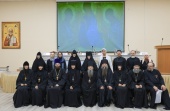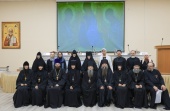
On November 22, 2024, the All-Russian scientific conference «Monasteries and monasticism in the history of the Russian Church» was held at the Nikolo-Ugresh Theological Seminary. The annual event this time was dedicated to stavropegial monasteries.
In the presidium were present: Bishop Methodius of Egorievsk, Vicar of Nikolo-Ugresh Stavropegial Monastery, Rector of PSTSU; Bishop Alexis of Solnechnogorsk, Vicar of the Danil's Stavropegial Monastery in Moscow; Higumenia Juliana (Kaleda), Deputy Chairman of Synodal Department for Monasteries and Monasticism, abbess of the Zachatievsky Stavropegial Nunnery in Moscow; Hymenia Victorina (Perminova), abbess of The Nativity of the Virgin Mary Stavropigial Nunnery of Moscow; Priest Vladimir Aleshkov, acting vice-rector for research at the Nikolo-Ugreshskaya Theological Seminary; Protodeacon Vladimir Vasilik, Ph.
Bishop Methodius reminded the participants that monasticism invariably influences not only the spiritual life of believers, but also the spiritual life of believers.
Welcoming the participants of the conference, Bishop Methodius reminded the audience that monasticism invariably has an impact not only on the spiritual life of believers, but also on all spheres of society. The topic of stavropigial monasteries, according to the Bishop, is worthy of close study, since the monasteries that were directly subordinate to the Patriarch had the opportunity to be more creative in solving the problems of monastic life and set the tone for monasticism in the entire Russian Orthodox Church. In conclusion, Vladyka Methodius wished God's help in their labors to all the participants.
Hegumeness Juliana (Caleda) read a greeting from the Chairman of the Synodal Department for Monasteries and Monasticism Metropolitan Feognost of Kashir.
Metropolitan Feognost of Kashir.
Afterwards, Bishop Alexei Solnechnogorsky of Solnechnogorsk made a report «Revival of spiritual life in the Danilov Stavropegial Monastery of Moscow in 1983-1986 and its first abbot Archimandrite (Metropolitan of Vladimir and Suzdal) Evlogii (Smirnov; † 2020)». The bishop reminded the listeners that the oldest Moscow Danilov monastery was returned to the Church 41 years ago, the first of fifteen monasteries in the capital that had been closed and destroyed under Soviet rule. Its revival marked a new epoch in the life of the Russian Orthodox Church and in the life of the country. The vicar of the monastery described the difficult conditions in which the restoration took place, sharing his personal memories: at the initial stage of the work he was sent to Danilov from Svyato-Troitskaya Sergiev Lavra. While the leaders of the state were still making speeches about the harm of religion, dozens and hundreds of volunteers went to work at the monastery every day; specialists of all fields sought to help professionally — builders, archaeologists, restorers, historians, archivists… Not only faith turned out to be alive in the people, but also the monastic tradition, which seemed to have been interrupted for more than half a century, continued on a spiritual level. Speaking about the activities of the first vicar of Danilov, archimandrite Evlogii, Bishop Alexis emphasized that his spiritual formation took place in the Lavra of St. Sergius, among people who represented the golden fund of monasticism, who had carried the faith and the holy theological precepts through the camps and exile. Therefore, the future Metropolitan Evlogii was well aware that the restoration of the walls and temples, no matter how much effort it required, was incomparable to the work of reviving the monastic brotherhood. Although the spiritual attitude of the first inhabitants of the monastery was characterized by readiness for ascetic trials, craving for the word of God, thirst for prayer, and in this sense the first years were the best for the monastery. «It took a lot of time for the Danilov brotherhood to fully enter into the rhythm and spirit of monastic life» — noted Bishop Alexis. A significant role was played here by giving special importance to confession as the core of spiritual life, as well as the establishment of a statutory liturgical life — following the example of Russian monasteries in the past. Concluding his speech, the Vladyka noted that during the three years that Archimandrite Evlogii was at the head of the brotherhood, he managed to do a lot. The restoration of the Danilov Monastery shook up the religious life of people, it became an example for many other monasteries rising from oblivion and destruction. All this could only be realized with God's help, with the prayerful intercession of St. Prince Daniel — are convinced of the current inhabitants of the glorious monastery.
Igumnya Juliana (Kaleda), having made a report « "To Christ the Bridegroom Unveiled. On the ascetics of piety — She familiarized the audience with the main milestones in the history of the monastery she headed. Focusing on the events of the twentieth century, Matushka Iuliania reminded that the Zachatiev Monastery celebrates a special date: 25 years since the return of the miracle-working monastery image of the Blessed Virgin Mary «Graceful», its transfer from the Church of the Prophet Elijah in Obydensky Lane, Moscow, where it was kept throughout the godless hardship. The revival of the ancient monastery — not only the walls and buildings, but also its spiritual heritage — became possible largely due to the confessional feat of the previous generations of monks and clergymen. Hegumeness Juliana (Kaleda) told about the nuns of the monastery, who by their faith, firm will and strength of spirit preserved the thread of succession of the monastic tradition, with vivid details, as if they were close people. Although afterwards, answering a question from the audience, she clarified that she had only childhood memories of the last Conception sisters. The first heroine of the story was nun Antonina (Yakovleva) — she entered the monastery in the century before last, lived for 100 years and until her death in 1969 was the center and support of the community of surviving sisters, fed in the Obydensky church. Spiritual mother of the nun Antonina was in the postwar years both for many people seeking faith and for priests who returned from camps and exile. Mother Antonina's successor was the schema-monk Nina (Korneeva; † 1984) — «the last inhabitant of the Zachatiev Monastery, who survived the closure of the monastery, the difficult years of a poor life filled with suffering and oppression, and who preserved, as a precious treasure, a deep faith and devotion to the beloved Lord Jesus Christ, to Whom she devoted herself from her youth, » — this is what Hegumeness Juliana (Kaleda) said about the ascetic. Mentioning the difficulties that had to endure in the early years of the revival of the monastery, the abbess summarized her story with a testimony of prayerful support — she has felt it many times, turning to the nuns predecessors, not leaving their care of the native monastery and the new generation of the Conception sisters.
.
Report of Hegumen Victoria (Perminova) «Igumenia Juvenalia (Lovenetskaya) — spiritual mother of the Monk Confessor Famari (Marjanova) and abbess of the Monastery of the Nativity of the Virgin in 1902-1921» continued the theme of ascetic monastic service. The name of Abbess Juvenalia is associated with two famous monasteries. One monastery, in honor of St. Equal-to-the-Apostles Nina in Bodbi (Georgia), she restored from the As Mother Victorina said, she not only invested labor, but also breathed new life into the other one, the Nativity of the Theotokos, «inspired many of the nuns to the upcoming feats of new martyrdom and confession, strengthened them to keep their vows and carry the banner of monasticism in their hearts in the new, sometimes very harsh reality». The deserted Bodbia monastery, thanks to Hegumeness Juvenalia, had by the beginning of the twentieth century become one of the most well-appointed nunneries of the first class. It was at the first acquaintance with this monastery and Mother Juvenalia that the spiritual rebirth of young Tamara Marjanova, the future shegumeness Famari, took place and she embarked on the long path of confession. Becoming abbess of the Monastery of the Nativity of the Theotokos, Abbess Juvenalia invested a lot of energy in its beautification, at the same time not leaving the work of spiritual education of the sisters entrusted to her. Some of them were granted a crown of martyrdom during the years of persecution, such as the Monk Martyr Tatiana (Besfamilnaya), who was shot at the Butovo polygon. Matushka Victorina concluded her report with words about the spiritual «message» of Abbess Juvenalia to her descendants, which, in fact, was her whole life — in prayer and soberness, in the fulfillment of the Divine will with with the deepest humility and responsibility for their own and other people's souls.
Protodeacon Vladimir Vasilik in his report «Origin of stavropigia» recalled that stavropigial were temples, monasteries, spiritual institutions, and in the XVI century and brotherhoods, removed from the canonical jurisdiction of the local diocesan bishop and subordinate directly to the Primate of the Local Church. The Greek word «stavropigia» means the placing of the cross. It was used when laying the foundation stone for the construction of a church or opening a new monastic monastery. According to the canons of the Church, the establishment of a monastery or the construction of a temple is under the authority of the local bishop. There is no word «stavropigia» in the basic code of laws of the Church. The canons, apostolic rules and resolutions of Church Councils repeatedly stipulate the inviolability of the powers of local bishops and the inadmissibility of intrusion into his jurisdiction by fellow bishops. The institution of Patriarchate as the highest ecclesiastical authority, standing above the metropolitans, is formalized in the V century, but according to the decree of the Council of Carthage in 256, the Patriarch «should not make himself bishop over the bishops». The spreading practice of inviting the Patriarch to the ceremony of laying the stone was due to the fact that the nobles were not educated, did not know the church canons and could ignore the bishops. Disrespect for the ruling bishops was characteristic of the Patriarchate of Constantinople, and this unwritten custom became the basis for the possibility of the Patriarch of Constantinople to establish stavropigia in other Local Churches. Although the right to establish stavropigia in the territory of other Local Churches has no canonical basis. However, Constantinople is now demanding the right of stavropigia throughout the universe. Illustrating modern manifestations of Eastern papism, Protodeacon Vladimir Vasilik recalled that relatively recently Constantinople attempted to establish the stauropy in the Orthodox Church of the Czech Lands and Slovakia. Contradicting the Patriarchate of Constantinople on the procedure for the formation of stavropigia in the Russian Orthodox Church, the speaker drew the attention of the conference participants to the circumstance fixed in the Statute of 2000, which states that in the Moscow (city) diocese the formation of stavropigia is carried out by decrees of the Patriarch of Moscow and All Russia as the ruling bishop of the diocese. In other dioceses — with the consent of the ruling bishop, by decision of the Patriarch and the Holy Synod. In other words, in the Russian Church there is an agreement between by the Primate of the Church and the diocesan bishop. It is impossible to form a stauropigion without the consent of the ruling bishop, because the Russian Church follows the spirit and meaning of the ancient apostolic holy-theological tradition. At present, stavropigial monasteries are major centers of education, pilgrimage and spiritual life, concluded Protodeacon Vladimir Vasilik.
Nun Ekaterina (Zakharova), a nun of Anosina Borisoglebsky Stavropigial Nunnery, head of the office of the Department for External Church Relations of the Moscow Patriarchate, presented a report «The role of Moscow archpastors in the fate of the Anosina Borisoglebsky Monastery». The seed of the Anosyn monastery was laid under Metropolitan Seraphim (Glagolevsky) of Moscow and Kolomna. Princess Evdokia Nikolaevna Meshcherskaya — the future Abbess Eugenia, the founder of the monastery — in her monastic life and abbatial activity was guided by the advice of St. Philaret (Drozdov), with whom she was in correspondence. Matushka Eugenia worked hard to realize the saint's idea of reviving in female monasticism the spirit of the ancient monastic life. Subsequently Metropolitan Philaret took under his authority Eudokia (in monasticism also Eugenia) Ozerova, the granddaughter of Abbess Eugenia, under whose abbacy the monastery became exemplary. Nun Ekaterina (Zakharova) gave evidence of the attention to the monastery on the part of St. Innocent, Metropolitan of Moscow, Bishops Manuel (Lemeshevsky), Arseny (Zhadanovsky) and Seraphim (Zvezdinsky). The first years of life of the revived monastery were under the special patronage of Patriarch Alexy II. He also appointed in 2005 as abbess monkess Maria (Solodovnikova), raised to the abbess rank in 2013 by Patriarch Kirill, under whose omophorion the construction of monastic life continues today.
After a break, the work of the conference was continued by Priest Vladimir Aleshkov. In co-authorship with the candidate of historical sciences, researcher of the Solovetsky State Historical-Architectural and Natural Museum-Reserve A.V. Aleshkova father Vladimir prepared a speech on the topic «Activity of Solovetsky archimandrite Dosifey (Nemchinov; 1826-1836) on the revival of Golgotha-Raspyatsky Anzer skete». Having told the story of the construction of the hermitage by the Monk Job of Anzero at the command of the elder who appeared to him in a vision. Priest Vladimir Aleshkov emphasized that when the hermitage was founded at the beginning of the 18th century, it was characterized by the strictness of monastic life. After the death of the Monk there was a long period of desolation. Radical changes occurred in 1826, when Archimandrite Dosifey (Nemchinov) became the abbot of the Solovets Monastery. By his care the skete was renewed and began to be rebuilt in stone (it is interesting that Archimandrite Dosifey preserved the wooden church from which the skete began, — «descending» it from the top of the mountain to the foot and making it a cemetery). The speaker paid attention to the description of architectural features of the new buildings of the hermitage — Golgotha-Raspyatskaya church and other buildings, kept in the same classical style, noting that the ensemble of the hermitage became an ornament of the entire Solovetsky archipelago. Being attentive to the spiritual life of the brethren, Father Dosifey also revived a particularly strict ascetic statute of the skete; with fragments of this statute, Priest Vladimir Aleshkov introduced the audience of the conference.
Priest Vyacheslav Masin, a lecturer at the Department of Church History at Moscow Theological Academy, in a report (in remote format) «The early twentieth-century discussion of monastic charity and its prerequisites in the monastic policy of Emperor Peter I» examined the reforms of Emperor Peter the Great in that part of them, which was devoted to the reform of monasticism in the Russian Empire. The document that defined the status of monasticism in society and the state, and in fact imposed significant restrictions on monasteries, was published in 1722. According to Fr. Vyacheslav, its authors stated that they sought to correct the monastic rank in accordance with the holy theological rules. However, Peter's regulations did not always have a canonical character. The abbots, according to the authors of the reforms, actually became state officials, and monasteries were assigned the role of social institutions. The bureaucratic mechanism also provided for control over the implementation of legislation. Subsequent documents further consolidated the utilitarian attitude to monasticism. According to the speaker, the ideal of monasticism of the Peter the Great era was not an ideal of asceticism, but an ideal of service to the world. Monasteries were offered to assume civil responsibility in the field of solving social problems of the state. Later, however, under the influence of the Optina elders and other representatives of the ascetic tradition, such an attitude towards monasticism did not become determinative. However, even nowadays there are still different views on what is in to what extent monks should devote themselves to serving their neighbors. Commenting on the remark from the audience that the monastic traditions of charity and mercy were adopted in Russia from Byzantium and in the IX-X centuries monasteries cared for the sick and indigent at the expense of the benefactors of princely families, the speaker noted that the problem arises when social work is imputed as a duty to monks, regardless of the ability of monasteries to perform it. In the case when the monastery has the strength and means to engage in works of mercy and educational activities, service to the neighbor can coexist on a par with the ascetic feat of monasticism.
The scientific consultant of the pilgrimage service Vysoko-Petrovsky Stavropigial Monastery of Moscow E.G. Balashova had a double task at the conference: in addition to her topic, she presented to the audience the text of the report of the dean of the Vysoko-Petrovsky monastery Hieromonk Matthew (Munteanu) — «Bogolyubsky Cathedral of the Vysoko-Petrovsky Monastery of Moscow: a few touches of 340-years-old. Moscow: a few touches of 340-year history». Father Matthew's report highlighted little-known moments of the history of the cathedral, built in 1684-1688, such as: the device «secret room» for the hidden presence of the young Peter the Great at the cathedral. services; some mysteries of the burials of the Naryshkin boyars; the lost fresco on the facade after the addition of the narthex in the middle of the XIX century; three venerated lists of the Kazan icon of the Blessed Virgin Mary in the history of the cathedral; Archimandrite Gregory (Voinov), abbot of the monastery from 1873 to 1882, about the renovation and consecration of Bogolyubsky Cathedral in 1877; icons from Bogolyubsky Cathedral, kept in the State Historical Museum, and some other issues.
E.G. Balashova continued her speech, offering the audience her report «Archbishop Bartholomew (Remov). Documentary evidence 1932-1934» devoted to the rector of the Vysoko-Petrovsky Monastery, shot in 1935. In various documents, testimonies, memoirs, and articles by contemporary authors, diametrically opposed arguments about this bishop are given. Some testify about him as a martyr for the Orthodox faith, others call him a secret Catholic. Some write about a broken and lost man, others — about a courageous Christian, ascetic, attentive clergyman. The report gave examples of documents revealing the personality of the lord and convincingly showing that Archbishop Bartholomew consciously took up the cross of protecting the Russian Church from proselytizing and new schisms that could be caused by the Unia (about The leaders of the Catholic Commission «Pro Russia»). The preserved documents make it possible to analyze what this man was like, what were his words, deeds and even thoughts reflected in letters and sermons carefully preserved by members of the secret monastic community of the Vysoko-Petrovsky monastery.
In the remote format was listened to the report of Priest Dimitri Levchuk, Master of Law, postgraduate student of the Department of Civil Law of the Yanka Kupala State University of Grodno (Belarus), rector of the Church of the Great Martyr George the Victorious, Novorossiysk, «Stavropigial monasteries as monuments of historical and cultural heritage». In accordance with the specificity of his scientific interests, the author of the report focused mainly on the legal aspects of the chosen topic.
The representative of the Donskiy Stavropigial Monastery in Moscow M.V. Artyushenko, historian, member of the Union of Local Lore Historians of Russia, laureate of the Makariev Prize, told about the monastic statutes and liturgical traditions of the Donskiy monastery from the XVII to the beginning of the XXI century. The report considered the changes in the status of the monastery in the XVII-XVIII centuries (the establishment of the archimandry, the introduction of the stavropigia, the granting of the hierarchical degree to the Iversky Valdai Monastery).
Special attention was paid to such documents as the «instruction to the superior officer» (XVIII century), «rank of service of archimandrites». The presence of an extensive necropolis had a significant influence on the monastery liturgical system. The monastery celebrated requiem liturgies, and numerous funeral services were served daily. The abbots gave instructions to the brethren regarding the performance of clergy obedience, observance of monastic discipline. Particularly reverent were the divine service on the feast of the Donskoi Icon of the Mother of God on August 19/September 1. In the post-revolutionary years in the liturgical structure of the monastery, in particular, the number of Liturgies decreased, and Matins began to be celebrated in the evening. Now in the monastery, as before, three Divine Liturgies are celebrated daily. Prayer services with akathist to the Donskoi Icon of the Mother of God and to Saint Tikhon, Patriarch of All Russia are served. On Wednesdays, the liturgical chants of the early Liturgy are sung by a large banner choir.
At the conclusion of the conference, Priest Vladimir Aleshkov thanked the speakers and listeners, among whom were predominantly seminary students, for their participation in the event and expressed the hope that the traditional scientific meetings will continue next year.
Synodal Department for Monasteries and Monasticism/Patriarchy.ru