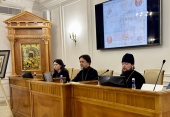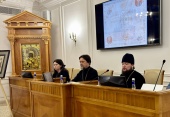
The conference "Antiminses and Liturgical Fabrics: History and Image" was held in Moscow

В Москве состоялась конференция «Антиминсы и литургические ткани: история и образ»

On November 11-12, 2024, the conference «Antimins and liturgical fabrics: history and image» was held, organized by the All-Church Postgraduate and Doctoral School named after Equal Apostles Cyril and Methodius and the Andrei Rublev Central Museum of Old Russian Culture and Art in Moscow.

At the beginning of the conference there were welcoming speeches of the Rector of the All-Church Postgraduate and Doctoral School, Chairman of the Study Committee of the Russian Orthodox Church Protopriest Maxim (Kozlov), Chairman of Synodal Department for Youth Affairs, Professor of the Department of Church-Practical Disciplines at UCAD, Doctor of Theology Bishop Seraphim of Istra, at whose suggestion the conference was held, and Scientific Secretary of the Andrei Rublev Central Museum of Old Russian Culture and Art M.I. Yakovleva.

Mr.

In the course of the forum, Bishop Seraphim presented a historical and archaeological description of the printed antimins of 1623 of Metropolitan Job (Boretsky) in the context of the restoration of the Orthodox hierarchy in the Western Russian Metropolis in 1620.

Bishop Seraphim presented a historical and archaeological description of the printed antimins of 1623 of Metropolitan Job (Boretsky).

Specifics of the consecration of the throne and its coverings in the Armenian Apostolic Church was reflected in the remote presentation of G.S. Ghazaryan (National University of Athens).

M.V. Vilkova, research associate of the fabrics sector of the Moscow Kremlin Museums, presented a brief overview of the collection of antimins in the collection of the Moscow Kremlin Museums.

Candidate of Historical Sciences, Doctor of Philological Sciences, Professor A.Yu. Vinogradov devoted his speech to the story of the oldest Russian antimins of Novgorod Archbishop Nifont and its riddles.

Candidate of Historical Sciences, Doctor of Philological Sciences, Professor A. Yu.

The specifics of the rite of consecration of the antimins in historical perspective was described in the speech of the secretary of the commission Mezhsobornogo Presence on Divine Service and Church Art, Priest Michael Zheltov.

Hierarch Michael Zheltov.

Candidate of Philological Sciences M.M. Bernatsky spoke about the peculiarities of the evolution of the liturgical use of antimins in the XVI-XVII centuries, reflected in the polemics of Kasyan Sakovich and Metropolitan Peter (Mogila).

A review of the rite of consecration of the temple in the Latin liturgical tradition of the XIII century, set forth in the Rationale Divinorum Officiorum by Guillaume Durand, was presented by Protodeacon Konstantin Markovich.

Unknown antimins by brothers Ivan and Alexei Zubov were described by Y.M. Khodko (Russian State Museum).

O.A. Bachurina spoke on the following topics with a presentation on the engravings with the composition of the Entombment of the Lord Jesus Christ from the collection of the State Historical Museum from the end of the 18th — first third of the 19th century.

Information about antimins in the collection of the Research Department of Rare Books (Museum of the Book) of the Russian State Library was presented in her speech by Y.E. Shustova.

The events of the second day of the conference were held at the Andrei Rublev Central Museum of Old Russian Culture and Art. At the beginning of the forum, Bishop Seraphim and the director of the museum M.B. Mindlin made welcoming speeches.

On the peculiarities of the restoration of antimins from the collection of the Museum of Christian Art Moscow Theological Academy told O.S. Voskresenskaya.

O.R. Khromov presented a description of the antimins of the church of St. Philip, Metropolitan of Moscow and All Russia, from the collection of the Museum of Christian Art «Church Archaeological Cabinet» MDA.

The peculiarities of handwritten antimins in the collection of the Church History Cabinet of the Kolomna Theological Seminary were reflected in the speech of Hieromonk George (Tavitsky).

Description of an unknown antimins in the collection of the Yaroslavl State Historical-Architectural and Art Seminary The report of Hieromonk Vladimir (Muravyov) was presented in the Museum-Reserve.

N.V. Lopato told about antimins in the collection of the Sverdlovsk Regional Museum of Local Lore.

A.L. Krasnova made a report on the study of rare iconography of the Greek antimins from the Pushkin State Museum of Fine Arts and the symbols of the Evangelists on the antimins.

A.L. Krasnova spoke on the study of the rare iconography of the Greek antimins from the Pushkin State Museum of Fine Arts and the symbols of the Evangelists on the antimins.

The question of the symbolic connection between the antimins and the burial cloths of the Savior touched in his speech Archpriest Igor Rogatenyuk (Tavricheskaya Theological Seminary).

Priest Kirill Bykov on the example of antimins of the sacristy of Pskovo-Pechersk Monastery considered the antimins as a source of historical data.

Priest Kirill Bykov examined the antimins as a source of historical data.

The peculiarities of the liturgical aspect of the iconography of «Se Lamb» in the Russian face sewing of the XVI century were reflected in the speech of E.I. Gritsai.

The report of O.V. Grishanina considered antimins of the XIX-XXI centuries from the collection of the Museum of History of Saratov Metropolis.

Propriest Timothy Morev and Deacon Andrei Shiltsin spoke about historical antimins in the collections of the Novosibirsk Metropolis.

The issues of historical and archaeological description of antimins were touched upon during the conference, The research was also presented on the specifics of the consecration of the temple building, altar part, altars, altars and church utensils in the Armenian and Latin liturgical traditions and the rite of consecration of antimins. Also presented were studies of the specifics of the consecration of the temple building, altar part, altars and church utensils in the Armenian and Latin liturgical traditions and the rite of consecration of antimins in the liturgical tradition of the Russian Orthodox Church.

At the end of the forum, the participants, among whom were representatives of spiritual and secular universities, expressed their wishes to organize similar events in the future.

The exhibition «Russian antimins», which presents all iconographic versions of engraved antimins from the beginning of their appearance in Russia in 1655 to the middle of the XIX century, continues to work in the Central Museum of Old Russian Culture and Art named after Andrei Rublev. Among the exhibited works are rare monuments of icon painting, engravings and lithographs with views of monasteries and portraits of church hierarchs from the collection of the Museum of Old Russian Culture and Art and the Museum of Christian Art &Laquo;Church and Archaeological Cabinet» MDA.

OCAD Press Service/Patriarchy.ru
Share:
The conference "Antiminses and Liturgical Fabrics: History and Image" was held in Moscow The conference "Antiminses and Liturgical Fabrics: History and Image" was held in Moscow On November 11-12, 2024, the conference «Antimins and liturgical fabrics: history and image» was held, organized by the All-Church Postgraduate and Doctoral School named after Equal Apostles Cyril and Methodius and the Andrei Rublev Central Museum of Old Russian Culture and Art in Moscow. At the beginning of the conference there were welcoming speeches of the Rector of the All-Church Postgraduate and Doctoral School, Chairman of the Study Committee of the Russian Orthodox Church Protopriest Maxim (Kozlov), Chairman of Synodal Department for Youth Affairs, Professor of the Department of Church-Practical Disciplines at UCAD, Doctor of Theology Bishop Seraphim of Istra, at whose suggestion the conference was held, and Scientific Secretary of the Andrei Rublev Central Museum of Old Russian Culture and Art M.I. Yakovleva. Mr. In the course of the forum, Bishop Seraphim presented a historical and archaeological description of the printed antimins of 1623 of Metropolitan Job (Boretsky) in the context of the restoration of the Orthodox hierarchy in the Western Russian Metropolis in 1620. Bishop Seraphim presented a historical and archaeological description of the printed antimins of 1623 of Metropolitan Job (Boretsky). Specifics of the consecration of the throne and its coverings in the Armenian Apostolic Church was reflected in the remote presentation of G.S. Ghazaryan (National University of Athens). M.V. Vilkova, research associate of the fabrics sector of the Moscow Kremlin Museums, presented a brief overview of the collection of antimins in the collection of the Moscow Kremlin Museums. Candidate of Historical Sciences, Doctor of Philological Sciences, Professor A.Yu. Vinogradov devoted his speech to the story of the oldest Russian antimins of Novgorod Archbishop Nifont and its riddles. Candidate of Historical Sciences, Doctor of Philological Sciences, Professor A. Yu. The specifics of the rite of consecration of the antimins in historical perspective was described in the speech of the secretary of the commission Mezhsobornogo Presence on Divine Service and Church Art, Priest Michael Zheltov. Hierarch Michael Zheltov. Candidate of Philological Sciences M.M. Bernatsky spoke about the peculiarities of the evolution of the liturgical use of antimins in the XVI-XVII centuries, reflected in the polemics of Kasyan Sakovich and Metropolitan Peter (Mogila). A review of the rite of consecration of the temple in the Latin liturgical tradition of the XIII century, set forth in the Rationale Divinorum Officiorum by Guillaume Durand, was presented by Protodeacon Konstantin Markovich. Unknown antimins by brothers Ivan and Alexei Zubov were described by Y.M. Khodko (Russian State Museum). O.A. Bachurina spoke on the following topics with a presentation on the engravings with the composition of the Entombment of the Lord Jesus Christ from the collection of the State Historical Museum from the end of the 18th — first third of the 19th century. Information about antimins in the collection of the Research Department of Rare Books (Museum of the Book) of the Russian State Library was presented in her speech by Y.E. Shustova. The events of the second day of the conference were held at the Andrei Rublev Central Museum of Old Russian Culture and Art. At the beginning of the forum, Bishop Seraphim and the director of the museum M.B. Mindlin made welcoming speeches. On the peculiarities of the restoration of antimins from the collection of the Museum of Christian Art Moscow Theological Academy told O.S. Voskresenskaya. O.R. Khromov presented a description of the antimins of the church of St. Philip, Metropolitan of Moscow and All Russia, from the collection of the Museum of Christian Art «Church Archaeological Cabinet» MDA. The peculiarities of handwritten antimins in the collection of the Church History Cabinet of the Kolomna Theological Seminary were reflected in the speech of Hieromonk George (Tavitsky). Description of an unknown antimins in the collection of the Yaroslavl State Historical-Architectural and Art Seminary The report of Hieromonk Vladimir (Muravyov) was presented in the Museum-Reserve. N.V. Lopato told about antimins in the collection of the Sverdlovsk Regional Museum of Local Lore. A.L. Krasnova made a report on the study of rare iconography of the Greek antimins from the Pushkin State Museum of Fine Arts and the symbols of the Evangelists on the antimins. A.L. Krasnova spoke on the study of the rare iconography of the Greek antimins from the Pushkin State Museum of Fine Arts and the symbols of the Evangelists on the antimins. The question of the symbolic connection between the antimins and the burial cloths of the Savior touched in his speech Archpriest Igor Rogatenyuk (Tavricheskaya Theological Seminary). Priest Kirill Bykov on the example of antimins of the sacristy of Pskovo-Pechersk Monastery considered the antimins as a source of historical data. Priest Kirill Bykov examined the antimins as a source of historical data. The peculiarities of the liturgical aspect of the iconography of «Se Lamb» in the Russian face sewing of the XVI century were reflected in the speech of E.I. Gritsai. The report of O.V. Grishanina considered antimins of the XIX-XXI centuries from the collection of the Museum of History of Saratov Metropolis. Propriest Timothy Morev and Deacon Andrei Shiltsin spoke about historical antimins in the collections of the Novosibirsk Metropolis. The issues of historical and archaeological description of antimins were touched upon during the conference, The research was also presented on the specifics of the consecration of the temple building, altar part, altars, altars and church utensils in the Armenian and Latin liturgical traditions and the rite of consecration of antimins. Also presented were studies of the specifics of the consecration of the temple building, altar part, altars and church utensils in the Armenian and Latin liturgical traditions and the rite of consecration of antimins in the liturgical tradition of the Russian Orthodox Church. At the end of the forum, the participants, among whom were representatives of spiritual and secular universities, expressed their wishes to organize similar events in the future. The exhibition «Russian antimins», which presents all iconographic versions of engraved antimins from the beginning of their appearance in Russia in 1655 to the middle of the XIX century, continues to work in the Central Museum of Old Russian Culture and Art named after Andrei Rublev. Among the exhibited works are rare monuments of icon painting, engravings and lithographs with views of monasteries and portraits of church hierarchs from the collection of the Museum of Old Russian Culture and Art and the Museum of Christian Art &Laquo;Church and Archaeological Cabinet» MDA. OCAD Press Service/Patriarchy.ru
On November 11-12, 2024, the conference «Antimins and liturgical fabrics: history and image» was held, organized by the All-Church Postgraduate and Doctoral School named after Equal Apostles Cyril and Methodius and the Andrei Rublev Central Museum of Old Russian Culture and Art in Moscow. At the beginning of the conference there were welcoming speeches of the Rector of the All-Church Postgraduate and Doctoral School, Chairman of the Study Committee of the Russian Orthodox Church Protopriest Maxim (Kozlov), Chairman of Synodal Department for Youth Affairs, Professor of the Department of Church-Practical Disciplines at UCAD, Doctor of Theology Bishop Seraphim of Istra, at whose suggestion the conference was held, and Scientific Secretary of the Andrei Rublev Central Museum of Old Russian Culture and Art M.I. Yakovleva. Mr. In the course of the forum, Bishop Seraphim presented a historical and archaeological description of the printed antimins of 1623 of Metropolitan Job (Boretsky) in the context of the restoration of the Orthodox hierarchy in the Western Russian Metropolis in 1620. Bishop Seraphim presented a historical and archaeological description of the printed antimins of 1623 of Metropolitan Job (Boretsky). Specifics of the consecration of the throne and its coverings in the Armenian Apostolic Church was reflected in the remote presentation of G.S. Ghazaryan (National University of Athens). M.V. Vilkova, research associate of the fabrics sector of the Moscow Kremlin Museums, presented a brief overview of the collection of antimins in the collection of the Moscow Kremlin Museums. Candidate of Historical Sciences, Doctor of Philological Sciences, Professor A.Yu. Vinogradov devoted his speech to the story of the oldest Russian antimins of Novgorod Archbishop Nifont and its riddles. Candidate of Historical Sciences, Doctor of Philological Sciences, Professor A. Yu. The specifics of the rite of consecration of the antimins in historical perspective was described in the speech of the secretary of the commission Mezhsobornogo Presence on Divine Service and Church Art, Priest Michael Zheltov. Hierarch Michael Zheltov. Candidate of Philological Sciences M.M. Bernatsky spoke about the peculiarities of the evolution of the liturgical use of antimins in the XVI-XVII centuries, reflected in the polemics of Kasyan Sakovich and Metropolitan Peter (Mogila). A review of the rite of consecration of the temple in the Latin liturgical tradition of the XIII century, set forth in the Rationale Divinorum Officiorum by Guillaume Durand, was presented by Protodeacon Konstantin Markovich. Unknown antimins by brothers Ivan and Alexei Zubov were described by Y.M. Khodko (Russian State Museum). O.A. Bachurina spoke on the following topics with a presentation on the engravings with the composition of the Entombment of the Lord Jesus Christ from the collection of the State Historical Museum from the end of the 18th — first third of the 19th century. Information about antimins in the collection of the Research Department of Rare Books (Museum of the Book) of the Russian State Library was presented in her speech by Y.E. Shustova. The events of the second day of the conference were held at the Andrei Rublev Central Museum of Old Russian Culture and Art. At the beginning of the forum, Bishop Seraphim and the director of the museum M.B. Mindlin made welcoming speeches. On the peculiarities of the restoration of antimins from the collection of the Museum of Christian Art Moscow Theological Academy told O.S. Voskresenskaya. O.R. Khromov presented a description of the antimins of the church of St. Philip, Metropolitan of Moscow and All Russia, from the collection of the Museum of Christian Art «Church Archaeological Cabinet» MDA. The peculiarities of handwritten antimins in the collection of the Church History Cabinet of the Kolomna Theological Seminary were reflected in the speech of Hieromonk George (Tavitsky). Description of an unknown antimins in the collection of the Yaroslavl State Historical-Architectural and Art Seminary The report of Hieromonk Vladimir (Muravyov) was presented in the Museum-Reserve. N.V. Lopato told about antimins in the collection of the Sverdlovsk Regional Museum of Local Lore. A.L. Krasnova made a report on the study of rare iconography of the Greek antimins from the Pushkin State Museum of Fine Arts and the symbols of the Evangelists on the antimins. A.L. Krasnova spoke on the study of the rare iconography of the Greek antimins from the Pushkin State Museum of Fine Arts and the symbols of the Evangelists on the antimins. The question of the symbolic connection between the antimins and the burial cloths of the Savior touched in his speech Archpriest Igor Rogatenyuk (Tavricheskaya Theological Seminary). Priest Kirill Bykov on the example of antimins of the sacristy of Pskovo-Pechersk Monastery considered the antimins as a source of historical data. Priest Kirill Bykov examined the antimins as a source of historical data. The peculiarities of the liturgical aspect of the iconography of «Se Lamb» in the Russian face sewing of the XVI century were reflected in the speech of E.I. Gritsai. The report of O.V. Grishanina considered antimins of the XIX-XXI centuries from the collection of the Museum of History of Saratov Metropolis. Propriest Timothy Morev and Deacon Andrei Shiltsin spoke about historical antimins in the collections of the Novosibirsk Metropolis. The issues of historical and archaeological description of antimins were touched upon during the conference, The research was also presented on the specifics of the consecration of the temple building, altar part, altars, altars and church utensils in the Armenian and Latin liturgical traditions and the rite of consecration of antimins. Also presented were studies of the specifics of the consecration of the temple building, altar part, altars and church utensils in the Armenian and Latin liturgical traditions and the rite of consecration of antimins in the liturgical tradition of the Russian Orthodox Church. At the end of the forum, the participants, among whom were representatives of spiritual and secular universities, expressed their wishes to organize similar events in the future. The exhibition «Russian antimins», which presents all iconographic versions of engraved antimins from the beginning of their appearance in Russia in 1655 to the middle of the XIX century, continues to work in the Central Museum of Old Russian Culture and Art named after Andrei Rublev. Among the exhibited works are rare monuments of icon painting, engravings and lithographs with views of monasteries and portraits of church hierarchs from the collection of the Museum of Old Russian Culture and Art and the Museum of Christian Art &Laquo;Church and Archaeological Cabinet» MDA. OCAD Press Service/Patriarchy.ru