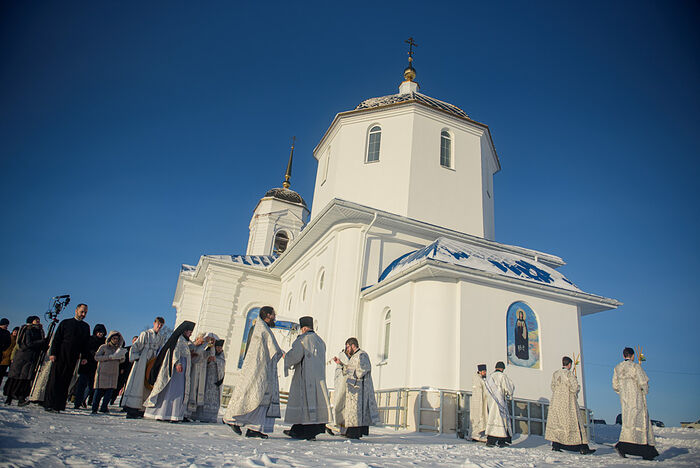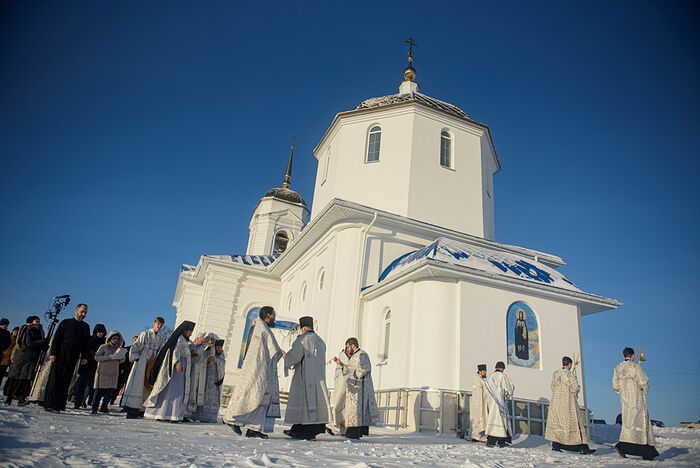
On January 14, 2024, in the Week of the 32nd Pentecost, before Epiphany, the Feast of the Circumcision of the Lord and the Feast of St. Basil the Great, Metropolitan Zinovy of Saransk and Mordovia consecrated a church in honor of the icon of the Mother of God "Znamenie" in the village of Yakovshchina, Ruzaevsky District, Mordovia, and led the Divine Liturgy in the newly consecrated church, Patriarchy.ru reports.
Before the service, Metropolitan Zinovy solemnly brought into the church a gift from Metropolitan Zinovy to the new parish - the Kursk-Root Icon of the Mother of God "The Sign", an exact copy of the venerated list located in the Cathedral of the Righteous Warrior Theodore Ushakov in Saransk.
His Eminence was served by the clergyman of the Saransk diocese, the vicar of St. John the Theologian Makarov Monastery, hegumen Meletii (Kisnyashkin), archpriest Victor Khokhlov, the clergyman of the Theodore Cathedral, archpriest Grigory Cherepanov, dean of churches of the Second Ruzaevsky District, Hieromonk Daniel (Pyanzin), rector of the church in honor of the icon of the Mother of God "Neupitaya Chasha" in Saransk, Priest Panteleimon Droga.
At the end of the service there was a glorification of St. Basil the Great.
After the service, the head of the Mordovian Metropolis addressed the residents and guests of the city Ruzayevsky district, who arrived at the divine service in Yakovshchina. The Archpastor also honored the initiators and participants of the restoration of the church in honor of the icon of the Mother of God "The Sign" with diocesan awards.
The Church of the Sign was built on the site of Pugachev's massacre of many innocent people. Thanks to the painstaking work of Alexander Sergeevich Pushkin, all the names of the victims were restored. In 2021 Metropolitan Zinovy performed a memorial service for them. At that time the church building was almost a ruin. The remains removed during the restoration work in the church were buried near its walls. People who prayed at that service saw folded skulls, among which there were children's skulls. The rioters massacred all members of the landowning family, hanging even little girls.
The brother of the executed owner and his young daughter, who escaped death, did not take revenge on their peasants who took part in the massacre. At the end of the XVIII century a stone Znamenskaya church was built over the grave. 90 years after the Pugachevshchina Yulia Fyodorovna Kozhina decided "in memory of the unfortunate incident and for the eternal remembrance of relatives to arrange at this church Ascension female community". According to the noblewoman's thoughts, the convent would be of great importance both in prayer, spiritual and social-educational aspects. Sisters were to be engaged in works of mercy and public education. The landowner made great efforts to establish the monastery. In August 1870, the opening of the community was approved by the personal permission of Emperor Alexander II. After Kozhina's death, the care of the community was entrusted to the cassock nun Anna Semyonovna Osipova, in monasticism Paraskeva. The monastery began to flourish: temples were built, a school was opened with many students, nuns were trained as sisters of mercy, and the household was rapidly developing.
In 1917 the monastery was looted and then destroyed. On this place stood churches, workshops, schoolrooms for children, a nursing home. There was nothing left except the Znamensky church, and this church building was vandalized and restored by the efforts of good true Christians only now.
Share: