Exclusive interview with Metropolitan Anthony of Volokolamsk, Chairman of the Department for External Church Relations of the Moscow Patriarchate, for the TV channel Temple of the Serbian Orthodox Church
The Church of the Holy Trinity of the Russian Orthodox Church in Belgrade was built in 1924, according to the plans of architect Valeri Stashevsky, for Russians who fled from the Communists after the October Revolution. They were mostly educated people, representatives of the upper strata of society, and believers. One hundred years later, the first century of this Belgrade, Russian and All-Orthodox shrine was solemnly and prayerfully celebrated.
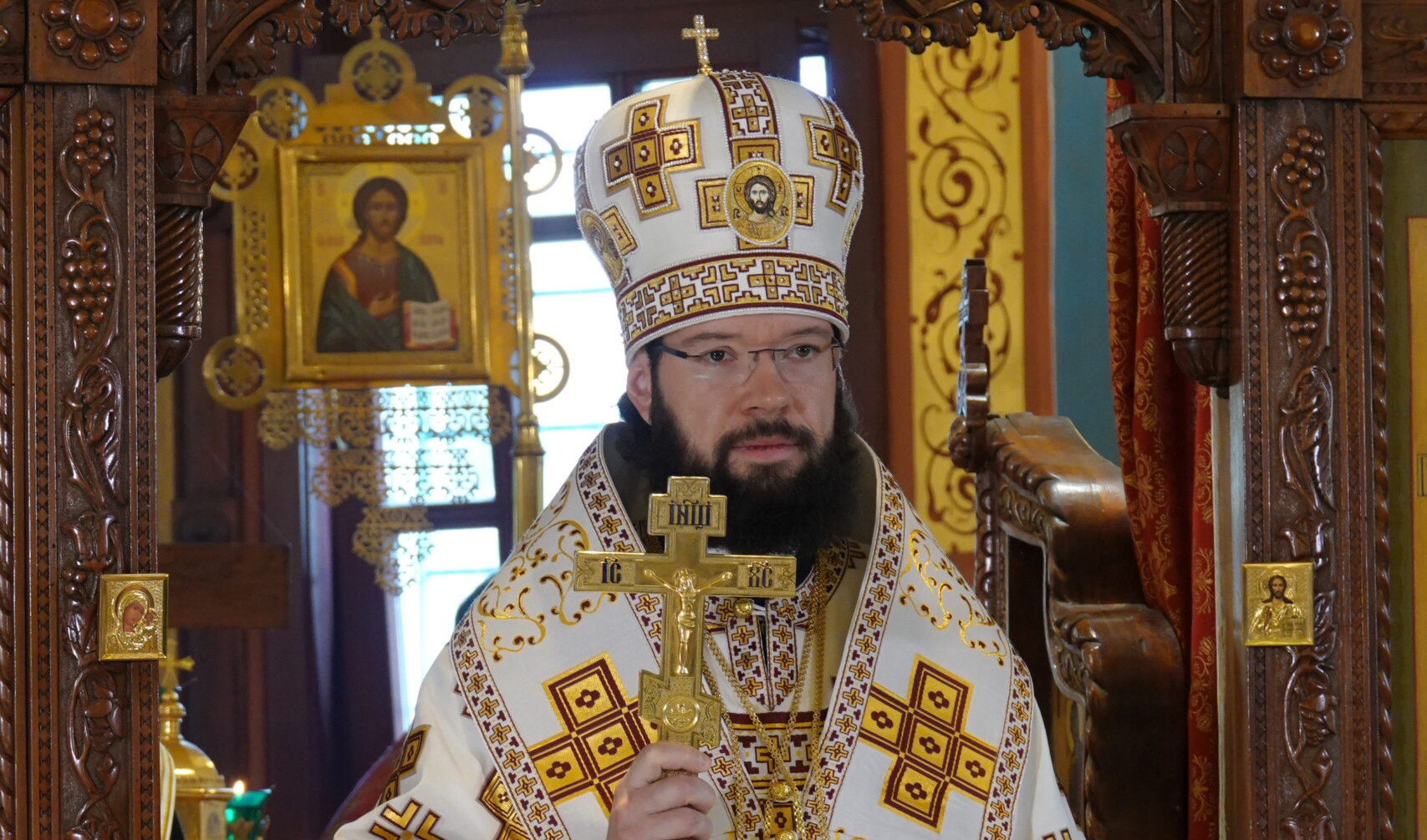
The conference entitled "100 years of the Holy Trinity Church of the Russian Orthodox Church's sub-church in Belgrade and the connection with the Serbian Orthodox Church ' was held on November 15. 2024. at the Palace of Serbia. In addition to the Minister responsible for the social situation of the Church in the country and abroad, Dr. Nenad Popovic, Vicar of the Patriarch of Serbia and Bishop-elect of British-Irish Mr. Nektarius, the Elder of the Russian Church sub-church Archpriest Vitaly Tarashev, a special address was delivered at this gathering by His Eminence Metropolitan Mr. Anthony of Volokolamsk. It was on the occasion of the great anniversary of the Church of the Holy Trinity that He came to Serbia. The visit attracted a great deal of media attention, Serbian, Russian and regional, as he is a metropolitan and chairman of the Department for External Church Relations of the Moscow Patriarchate, i.e. the head of Russian church diplomacy.
After the conference, the visit to Novi Sad and the City Glory Day service with His Holiness Patriarch Mr. Porfiry of Serbia and His Eminence Metropolitan Mr. Irinej of Bacsk, followed by the Holy Liturgy and the anniversary celebrations in the Russian Church, Metropolitan Anthony in an exclusive interview with the Temple TV channel talks about the impressions he will bring from Serbia, but also about all the current issues of Orthodoxy in the world.
In an exclusive interview with the Serbian TV channel, Metropolitan Anthony talks about the impressions he will bring from Serbia, but also about all the current issues of Orthodoxy in the world.
- Blessings, Eminence. How do you evaluate your visit to Serbia, what impressions will you get from here?
- This is not the first time I come to Serbia, I have been several times in your beautiful, hospitable country. And this time the reason for my visit is special, because we are celebrating a beautiful date, one hundred years since the consecration of the Russian Church of the Holy Trinity in Belgrade. And answering the question about my impressions from visiting your country and from my previous visits to Serbia, I would like to say that I feel the same as the Russian exiles who by God's will found themselves in your country a hundred years ago, who found themselves far from their homeland, who found themselves far from their homeland, who found themselves far from their homeland. lost everything, they were here without work, without means of livelihood, but they found in Serbia hospitality, warm brotherly love, and felt here not as in exile, but as at home. Because of my obligations as chairman of the Department for External Church Relations, I travel a lot, but here in Serbia I never feel abroad, but I feel at home, among family, close and dear people, which is very dear and very important to me. I am very happy that these days I have the opportunity to speak with both His Holiness Patriarch Porphyrios of Serbia and the bishops of the Serbian Orthodox Church. We have already had the opportunity to visit Novi Sad and meet with Metropolitan Irinej of Bacsk, an outstanding Orthodox theologian, a person of great authority in the Russian Orthodox Church. We also met with our other brothers, and this is very important and valuable for us, because, unfortunately, it is no secret that the Orthodox world is currently going through a difficult chapter in its history. Today there is a division between the Orthodox Churches. Frankly speaking, there are tense relations between the individual Local Churches, but speaking about the relations between the Russian Orthodox Church and the Serbian Orthodox Church, we can say that they are characterized by an absolute unanimity, full mutual understanding on all issues that are on the agenda of inter-Orthodox relations. And for us this is very important and very, very valuable.
Metropolitan Anthony Sevryuk, head of the Department for External Church Relations of the Moscow Patriarchate, was born in 1984 in Tver. He graduated from the famous Tver Lyceum with a gold medal, and while still a student, he obeyed the altar server and subdeacon in the Cathedral of the Resurrection in Tver. 2002. entered the St. Petersburg Theological Academy by decision of the Pedagogical Council without passing the entrance exams. He successfully defended his thesis 'eschatology in world religions' and received the Metropolitan Nicodemus Prize (Rotov). He was then an intern in the information department of the Moscow Patriarchate's Department for External Church Relations, an assistant to Metropolitan Kirill of Smolensk and Kaliningrad (now Patriarch of Moscow and All Russia) and a teacher at Smolensk Seminary. From February 2009. he was personal secretary to the Patriarch of Moscow, and in the same year Patriarch Kirill inducted him into monasticism, giving him the name Anthony. 2015. he was elected vicar bishop of Bogorodsk, charged with the care of parishes in Italy, and was appointed head of the Moscow Patriarchate's directorate for institutions abroad. 2017. he was appointed Administrator of the Diocese of Vienna-Austria and Budapest-Hungary and in 2019. he was elevated to Metropolitan by Patriarch Kirill. 2022. he was appointed head of the Department for External Church Relations and a permanent member of the Holy Synod of the Russian Orthodox Church with the title "Volokolamskiy".
- Because of your experience and knowledge, Eminence, the question arises, how do you approach the analysis of the state of the Orthodox world today? Let us name only two problems: Kosovo and Ukraine.
- You asked a difficult question, but this is also what unites our peoples, what unites our Churches. I am deeply convinced that a person who has never experienced suffering cannot sympathize with another person, just as someone who does not know what real joy is cannot be happy for another. In the history of our peoples, there is a common sorrow, a common suffering. For the Serbian people, this is Kosovo. And we very much understand your pain. Recently, we were deeply angered by the fact that His Holiness Patriarch Porfiry was banned from entering Kosovo. So our Patriarch was very upset that he wrote a letter to His Holiness Patriarch Porfiry expressing our support at this difficult time. We very much appreciate the support that we are receiving from the Serbian Church in the context of what is happening in Ukraine today, because, like Kosovo, which is the source of Serbian Orthodoxy, Kiev is for us the baptistery of Holy Russia. From there we received our faith. And the fact that today in Ukraine the largest Christian denomination in that country, the Ukrainian Orthodox Church, is subjected to the most incredible public persecution, and all this is hidden by the almost absolute silence of the world community. This is a deep tragedy and a deep pain for us. Our Church, as you know, went through very difficult trials in its 20s. century. We lived in a situation when the powerful leader of the Soviet Union promised to depict the last living priest on television. But today, it seems that all that must be a thing of the past. And we see how in a 21. century country that claims to be committed to the principles of democracy and freedom, today persecutes priests, bishops, and believers of the Ukrainian Orthodox Church. Today we live in a situation where bishops of the Ukrainian Church are imprisoned, are under house arrest, are subjected to cruel treatment, and churches are forcibly taken away from the faithful. Of course, all we can do today is to appeal to the world community and encourage them to pay attention to what is happening in Ukraine. We do this, but frankly, we don't always get support, understanding, or even any responses.
And from the side of The Serbian Church, its Primate, His Holiness Patriarch Porfiry, its Synod, its bishops, who are not afraid to boldly raise their voices in this situation and support our persecuted brothers and sisters, we are receiving support, for which, believe me, the Russian people are very grateful. We will never forget this. We will always remember it with great gratitude and great love. You are wondering how to get out of this situation. I think that for us, Christians, the answer is obvious: we must all work according to our conscience, and in everything we do, we must be guided by the Holy Gospel. If we talk about the situation in Ukraine, it is quite clear that today there is a Church schism there, in which the state is clearly interfering, and which is happening contrary to the canons, contrary to the Orthodox understanding of what the Church is. Today we are forced to believe that the Ecumenical Patriarch, sitting in his chancery in Istanbul, can make a layman a "bishop" with one signature, accept as a bishop a man who has never had any canonical ordination, neither deacon, priest nor bishop. We will never accept this because everyone, even me, when we were ordained to the priesthood, took an oath and promised to live by the canons. In conscience, of course, we must also act in matters of rights, rights of people to be able to know their origins, to be able to freely visit those places that relate to their history and the origin of their existence. And today, unfortunately, this is probably the most difficult thing for me personally. I have not been in the position I am in today for a long time, but I am talking to people who themselves understand everything perfectly well, realize what is happening in the world today, and at the same time, because of the need to observe some political correctness, to hide specific violations of human rights and violations of the principles of world order. They are just blatantly trampling on the foundations of international law. All of this seems to be done so that people live in an atmosphere of deceit and lies. But for us, for Christians, this is impossible. No matter what, we must never give up hope. We know that the Lord and His Church will never be humiliated, and the truth of God will surely triumph. Believe me, speaking about the current situation in Kosovo and Metohija, we, the Russian people, are completely with you. We sincerely pray for you, we support you as much as we can. I know that the Russian State is making great efforts to support Serbia in the international arena. Perhaps, humanly speaking, we do not always see concrete ways to solve the problem, but we know that God works miracles, and we certainly believe and hope that it will allow justice to be served and that Kosovo, which is an integral part of Serbia and the heart of the Serbian people, must take its place in this context of justice.
The Russian Orthodox Church or Moscow Patriarchate is a local and autocephalous church with the dignity of a patriarchate, occupying the fifth place in the diptych. It has 290 bishops, 224 dioceses, 788 monasteries and more than 110 million believers.
- The Russian Church has clearly made great efforts in recent years in its media, as well as on digital platforms and social media. Why do you think this type of communication is important?"
- Let me answer this question as one of the youngest bishops in the Russian Church. I communicate a lot with my peers and I understand very well that everyone has their own way to the temple. Someone was baptized from childhood and lives and grows up in a believing family, so for him being in church is something natural and logical. Some come to church at a later age, in high school or college, take their first step into the temple and stay in the temple. But at the same time, in every society, and I believe that Serbia is no exception, there is always a thirst to hear the word of God. But not everyone can take the first step to enter the temple by themselves. I know from the experience of my country and from the experience of my peers with whom I am in contact that many people are not so simply, passing by the church, enter the temple and stay there. Therefore, the Church must always look for opportunities to reach out to people, to find the way to their heart. In fact, this is what the apostles did. And the Apostle Paul and his famous words about becoming all things to all people in order to keep at least the elect, means that the Church must always, in a rapidly changing world, find an opportunity to reach out to all people with the Gospel. Today we live in the age of communications, the age of social media. This is something that no one realized twenty years ago, and no one thought that life would develop in this way. And it seems to me that the opportunity to reach people through the media is, first of all, an opportunity to pass on the word of God to younger generations of Christians, future Christians. And I really see many people today, looking at the interviews of good priests, reading priests who are bloggers, who pass on the word of Christ through their social networks, reading good telegrams, many people through this begin to think about what Christianity is, begin to think about what the Church is, and thus find the way to Christ. Once again I emphasize that everyone's path is different, but the Church, it seems to me, should open all doors, all possible doors, to give people the opportunity to come to Christ. Next everything is in God's hands. God leads everyone in his own way. For someone this door may be suitable, for someone else it may be different. Our Patriarch Kirill, His Holiness Patriarch of Moscow and All Russia, who was the Rector of the Theological Academy for a long time and communicated with young people, was one of the first to address people through the media, through television. For many years he hosted a wonderful program calledSword of the Shepherd, which was broadcast on Saturdays on Channel One television. As a very young schoolboy, I watched this program and was amazed at how, while still a Metropolitan at the time, His Holiness Kirill found a way to bring complex issues of Christian theology to young people like me in the simplest and most understandable m forms. I know that for many it became a kind of window that brought them into the Church. That was then, twenty years ago, when there was still only television. Today there are many more such tools. And our Patriarch, having become the Primate of the Russian Church, calls on all priests to actively go to the people, in a way and means that they understand, in which they are able to find the right opportunities, to go with this and address the people and create the opportunity for everyone to open the church, to open Christ. That's why we have now Orthodox TV channels, not just one. Moreover, they are included in the Russian state package of broadcasting programs, that is. all people who have satellite television can watch Orthodox channels. Among other things, there are wonderful priests who, as I said, have their own blogs, their own Telegram channels. I know that for many, especially modern people, for those who spend most of their time on social networks, such priests, such Telegrams and other means of communication were their first step towards the Church. So it seems very important to me, as a still young person. And it is wonderful that the Serbian Church is doing a lot today to get closer to people through the media and to bring the Gospel message to them.
After Belgrade and Novi Sad, Metropolitan Anthony, head of the Department for External Church Affairs of the Moscow Patriarchate, traveled to Banja Luka. In spite of all the challenges of Orthodoxy in the modern world, a strong good impression remains on us after his statement that "the Russian Church in Belgrade is a bridge between two sister churches, which are connected by the warmest relations". For many years to come!
Interviewed by: Sanja Lubardic, editor-in-chief of Temple TV and Radio Slovo lubva
translated from Russian: Deacon Nikolai Sapsay
The Church of the Holy Trinity of the Russian Orthodox Church in Belgrade was built in 1924, according to the plans of architect Valeri Stashevsky, for Russians who fled from the Communists after the October Revolution. They were mostly educated people, representatives of the upper strata of society, and believers. One hundred years later, the first century of this Belgrade, Russian and All-Orthodox shrine was solemnly and prayerfully celebrated.
The conference entitled "100 years of the Holy Trinity Church of the Russian Orthodox Church's sub-church in Belgrade and the connection with the Serbian Orthodox Church ' was held on November 15. 2024. at the Palace of Serbia. In addition to the Minister responsible for the social situation of the Church in the country and abroad, Dr. Nenad Popovic, Vicar of the Patriarch of Serbia and Bishop-elect of British-Irish Mr. Nektarius, the Elder of the Russian Church sub-church Archpriest Vitaly Tarashev, a special address was delivered at this gathering by His Eminence Metropolitan Mr. Anthony of Volokolamsk. It was on the occasion of the great anniversary of the Church of the Holy Trinity that He came to Serbia. The visit attracted a great deal of media attention, Serbian, Russian and regional, as he is a metropolitan and chairman of the Department for External Church Relations of the Moscow Patriarchate, i.e. the head of Russian church diplomacy.
After the conference, the visit to Novi Sad and the City Glory Day service with His Holiness Patriarch Mr. Porfiry of Serbia and His Eminence Metropolitan Mr. Irinej of Bacsk, followed by the Holy Liturgy and the anniversary celebrations in the Russian Church, Metropolitan Anthony in an exclusive interview with the Temple TV channel talks about the impressions he will bring from Serbia, but also about all the current issues of Orthodoxy in the world.
In an exclusive interview with the Serbian TV channel, Metropolitan Anthony talks about the impressions he will bring from Serbia, but also about all the current issues of Orthodoxy in the world.
- Blessings, Eminence. How do you evaluate your visit to Serbia, what impressions will you get from here?
- This is not the first time I come to Serbia, I have been several times in your beautiful, hospitable country. And this time the reason for my visit is special, because we are celebrating a beautiful date, one hundred years since the consecration of the Russian Church of the Holy Trinity in Belgrade. And answering the question about my impressions from visiting your country and from my previous visits to Serbia, I would like to say that I feel the same as the Russian exiles who by God's will found themselves in your country a hundred years ago, who found themselves far from their homeland, who found themselves far from their homeland, who found themselves far from their homeland. lost everything, they were here without work, without means of livelihood, but they found in Serbia hospitality, warm brotherly love, and felt here not as in exile, but as at home. Because of my obligations as chairman of the Department for External Church Relations, I travel a lot, but here in Serbia I never feel abroad, but I feel at home, among family, close and dear people, which is very dear and very important to me. I am very happy that these days I have the opportunity to speak with both His Holiness Patriarch Porphyrios of Serbia and the bishops of the Serbian Orthodox Church. We have already had the opportunity to visit Novi Sad and meet with Metropolitan Irinej of Bacsk, an outstanding Orthodox theologian, a person of great authority in the Russian Orthodox Church. We also met with our other brothers, and this is very important and valuable for us, because, unfortunately, it is no secret that the Orthodox world is currently going through a difficult chapter in its history. Today there is a division between the Orthodox Churches. Frankly speaking, there are tense relations between the individual Local Churches, but speaking about the relations between the Russian Orthodox Church and the Serbian Orthodox Church, we can say that they are characterized by an absolute unanimity, full mutual understanding on all issues that are on the agenda of inter-Orthodox relations. And for us this is very important and very, very valuable.
Metropolitan Anthony Sevryuk, head of the Department for External Church Relations of the Moscow Patriarchate, was born in 1984 in Tver. He graduated from the famous Tver Lyceum with a gold medal, and while still a student, he obeyed the altar server and subdeacon in the Cathedral of the Resurrection in Tver. 2002. entered the St. Petersburg Theological Academy by decision of the Pedagogical Council without passing the entrance exams. He successfully defended his thesis 'eschatology in world religions' and received the Metropolitan Nicodemus Prize (Rotov). He was then an intern in the information department of the Moscow Patriarchate's Department for External Church Relations, an assistant to Metropolitan Kirill of Smolensk and Kaliningrad (now Patriarch of Moscow and All Russia) and a teacher at Smolensk Seminary. From February 2009. he was personal secretary to the Patriarch of Moscow, and in the same year Patriarch Kirill inducted him into monasticism, giving him the name Anthony. 2015. he was elected vicar bishop of Bogorodsk, charged with the care of parishes in Italy, and was appointed head of the Moscow Patriarchate's directorate for institutions abroad. 2017. he was appointed Administrator of the Diocese of Vienna-Austria and Budapest-Hungary and in 2019. he was elevated to Metropolitan by Patriarch Kirill. 2022. he was appointed head of the Department for External Church Relations and a permanent member of the Holy Synod of the Russian Orthodox Church with the title "Volokolamskiy".
- Because of your experience and knowledge, Eminence, the question arises, how do you approach the analysis of the state of the Orthodox world today? Let us name only two problems: Kosovo and Ukraine.
- You asked a difficult question, but this is also what unites our peoples, what unites our Churches. I am deeply convinced that a person who has never experienced suffering cannot sympathize with another person, just as someone who does not know what real joy is cannot be happy for another. In the history of our peoples, there is a common sorrow, a common suffering. For the Serbian people, this is Kosovo. And we very much understand your pain. Recently, we were deeply angered by the fact that His Holiness Patriarch Porfiry was banned from entering Kosovo. So our Patriarch was very upset that he wrote a letter to His Holiness Patriarch Porfiry expressing our support at this difficult time. We very much appreciate the support that we are receiving from the Serbian Church in the context of what is happening in Ukraine today, because, like Kosovo, which is the source of Serbian Orthodoxy, Kiev is for us the baptistery of Holy Russia. From there we received our faith. And the fact that today in Ukraine the largest Christian denomination in that country, the Ukrainian Orthodox Church, is subjected to the most incredible public persecution, and all this is hidden by the almost absolute silence of the world community. This is a deep tragedy and a deep pain for us. Our Church, as you know, went through very difficult trials in its 20s. century. We lived in a situation when the powerful leader of the Soviet Union promised to depict the last living priest on television. But today, it seems that all that must be a thing of the past. And we see how in a 21. century country that claims to be committed to the principles of democracy and freedom, today persecutes priests, bishops, and believers of the Ukrainian Orthodox Church. Today we live in a situation where bishops of the Ukrainian Church are imprisoned, are under house arrest, are subjected to cruel treatment, and churches are forcibly taken away from the faithful. Of course, all we can do today is to appeal to the world community and encourage them to pay attention to what is happening in Ukraine. We do this, but frankly, we don't always get support, understanding, or even any responses.
And from the side of The Serbian Church, its Primate, His Holiness Patriarch Porfiry, its Synod, its bishops, who are not afraid to boldly raise their voices in this situation and support our persecuted brothers and sisters, we are receiving support, for which, believe me, the Russian people are very grateful. We will never forget this. We will always remember it with great gratitude and great love. You are wondering how to get out of this situation. I think that for us, Christians, the answer is obvious: we must all work according to our conscience, and in everything we do, we must be guided by the Holy Gospel. If we talk about the situation in Ukraine, it is quite clear that today there is a Church schism there, in which the state is clearly interfering, and which is happening contrary to the canons, contrary to the Orthodox understanding of what the Church is. Today we are forced to believe that the Ecumenical Patriarch, sitting in his chancery in Istanbul, can make a layman a "bishop" with one signature, accept as a bishop a man who has never had any canonical ordination, neither deacon, priest nor bishop. We will never accept this because everyone, even me, when we were ordained to the priesthood, took an oath and promised to live by the canons. In conscience, of course, we must also act in matters of rights, rights of people to be able to know their origins, to be able to freely visit those places that relate to their history and the origin of their existence. And today, unfortunately, this is probably the most difficult thing for me personally. I have not been in the position I am in today for a long time, but I am talking to people who themselves understand everything perfectly well, realize what is happening in the world today, and at the same time, because of the need to observe some political correctness, to hide specific violations of human rights and violations of the principles of world order. They are just blatantly trampling on the foundations of international law. All of this seems to be done so that people live in an atmosphere of deceit and lies. But for us, for Christians, this is impossible. No matter what, we must never give up hope. We know that the Lord and His Church will never be humiliated, and the truth of God will surely triumph. Believe me, speaking about the current situation in Kosovo and Metohija, we, the Russian people, are completely with you. We sincerely pray for you, we support you as much as we can. I know that the Russian State is making great efforts to support Serbia in the international arena. Perhaps, humanly speaking, we do not always see concrete ways to solve the problem, but we know that God works miracles, and we certainly believe and hope that it will allow justice to be served and that Kosovo, which is an integral part of Serbia and the heart of the Serbian people, must take its place in this context of justice.
The Russian Orthodox Church or Moscow Patriarchate is a local and autocephalous church with the dignity of a patriarchate, occupying the fifth place in the diptych. It has 290 bishops, 224 dioceses, 788 monasteries and more than 110 million believers.
- The Russian Church has clearly made great efforts in recent years in its media, as well as on digital platforms and social media. Why do you think this type of communication is important?"
- Let me answer this question as one of the youngest bishops in the Russian Church. I communicate a lot with my peers and I understand very well that everyone has their own way to the temple. Someone was baptized from childhood and lives and grows up in a believing family, so for him being in church is something natural and logical. Some come to church at a later age, in high school or college, take their first step into the temple and stay in the temple. But at the same time, in every society, and I believe that Serbia is no exception, there is always a thirst to hear the word of God. But not everyone can take the first step to enter the temple by themselves. I know from the experience of my country and from the experience of my peers with whom I am in contact that many people are not so simply, passing by the church, enter the temple and stay there. Therefore, the Church must always look for opportunities to reach out to people, to find the way to their heart. In fact, this is what the apostles did. And the Apostle Paul and his famous words about becoming all things to all people in order to keep at least the elect, means that the Church must always, in a rapidly changing world, find an opportunity to reach out to all people with the Gospel. Today we live in the age of communications, the age of social media. This is something that no one realized twenty years ago, and no one thought that life would develop in this way. And it seems to me that the opportunity to reach people through the media is, first of all, an opportunity to pass on the word of God to younger generations of Christians, future Christians. And I really see many people today, looking at the interviews of good priests, reading priests who are bloggers, who pass on the word of Christ through their social networks, reading good telegrams, many people through this begin to think about what Christianity is, begin to think about what the Church is, and thus find the way to Christ. Once again I emphasize that everyone's path is different, but the Church, it seems to me, should open all doors, all possible doors, to give people the opportunity to come to Christ. Next everything is in God's hands. God leads everyone in his own way. For someone this door may be suitable, for someone else it may be different. Our Patriarch Kirill, His Holiness Patriarch of Moscow and All Russia, who was the Rector of the Theological Academy for a long time and communicated with young people, was one of the first to address people through the media, through television. For many years he hosted a wonderful program calledSword of the Shepherd, which was broadcast on Saturdays on Channel One television. As a very young schoolboy, I watched this program and was amazed at how, while still a Metropolitan at the time, His Holiness Kirill found a way to bring complex issues of Christian theology to young people like me in the simplest and most understandable m forms. I know that for many it became a kind of window that brought them into the Church. That was then, twenty years ago, when there was still only television. Today there are many more such tools. And our Patriarch, having become the Primate of the Russian Church, calls on all priests to actively go to the people, in a way and means that they understand, in which they are able to find the right opportunities, to go with this and address the people and create the opportunity for everyone to open the church, to open Christ. That's why we have now Orthodox TV channels, not just one. Moreover, they are included in the Russian state package of broadcasting programs, that is. all people who have satellite television can watch Orthodox channels. Among other things, there are wonderful priests who, as I said, have their own blogs, their own Telegram channels. I know that for many, especially modern people, for those who spend most of their time on social networks, such priests, such Telegrams and other means of communication were their first step towards the Church. So it seems very important to me, as a still young person. And it is wonderful that the Serbian Church is doing a lot today to get closer to people through the media and to bring the Gospel message to them.
After Belgrade and Novi Sad, Metropolitan Anthony, head of the Department for External Church Affairs of the Moscow Patriarchate, traveled to Banja Luka. In spite of all the challenges of Orthodoxy in the modern world, a strong good impression remains on us after his statement that "the Russian Church in Belgrade is a bridge between two sister churches, which are connected by the warmest relations". For many years to come!
Interviewed by: Sanja Lubardic, editor-in-chief of Temple TV and Radio Slovo lubva
translated from Russian: Deacon Nikolai Sapsay
Share: