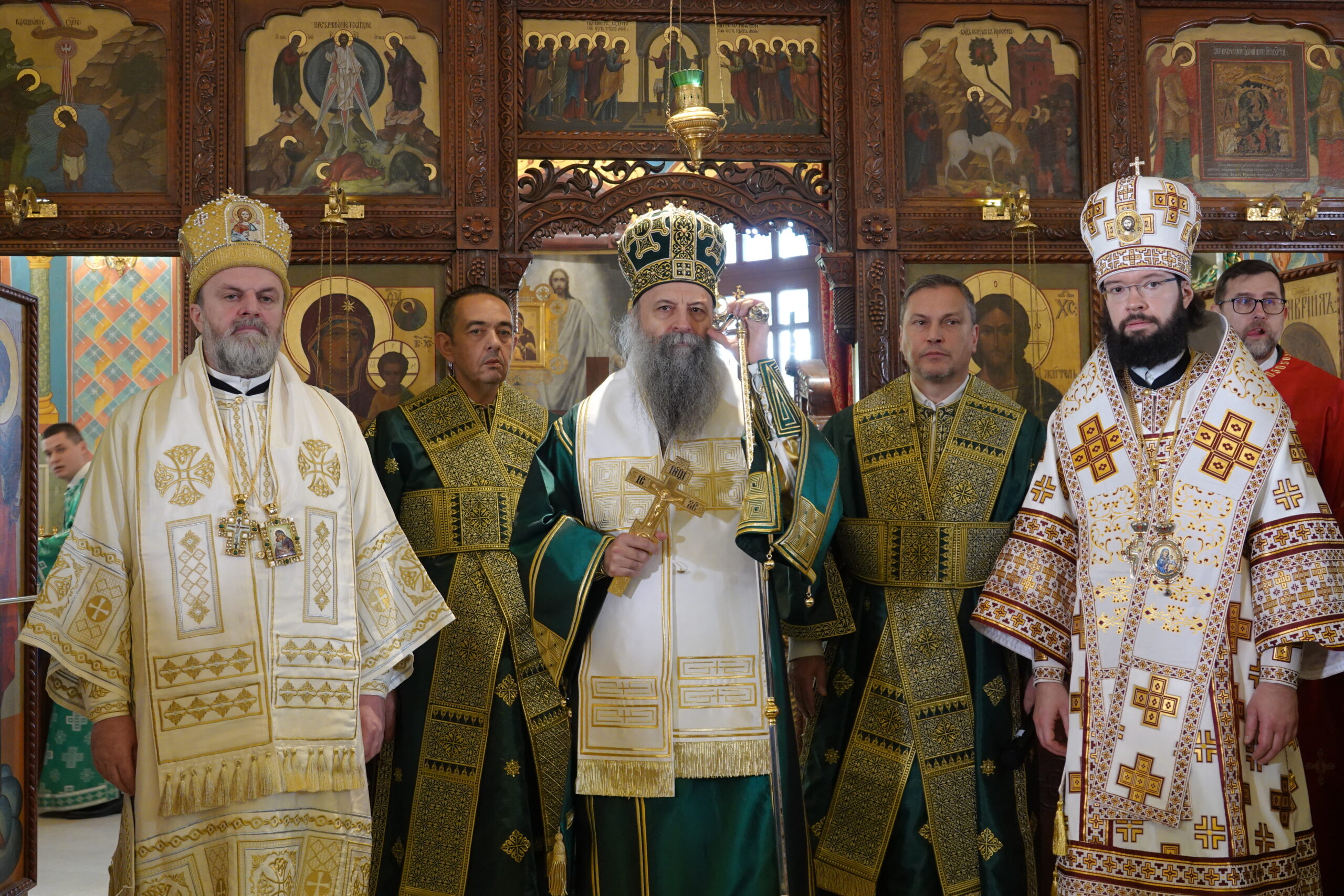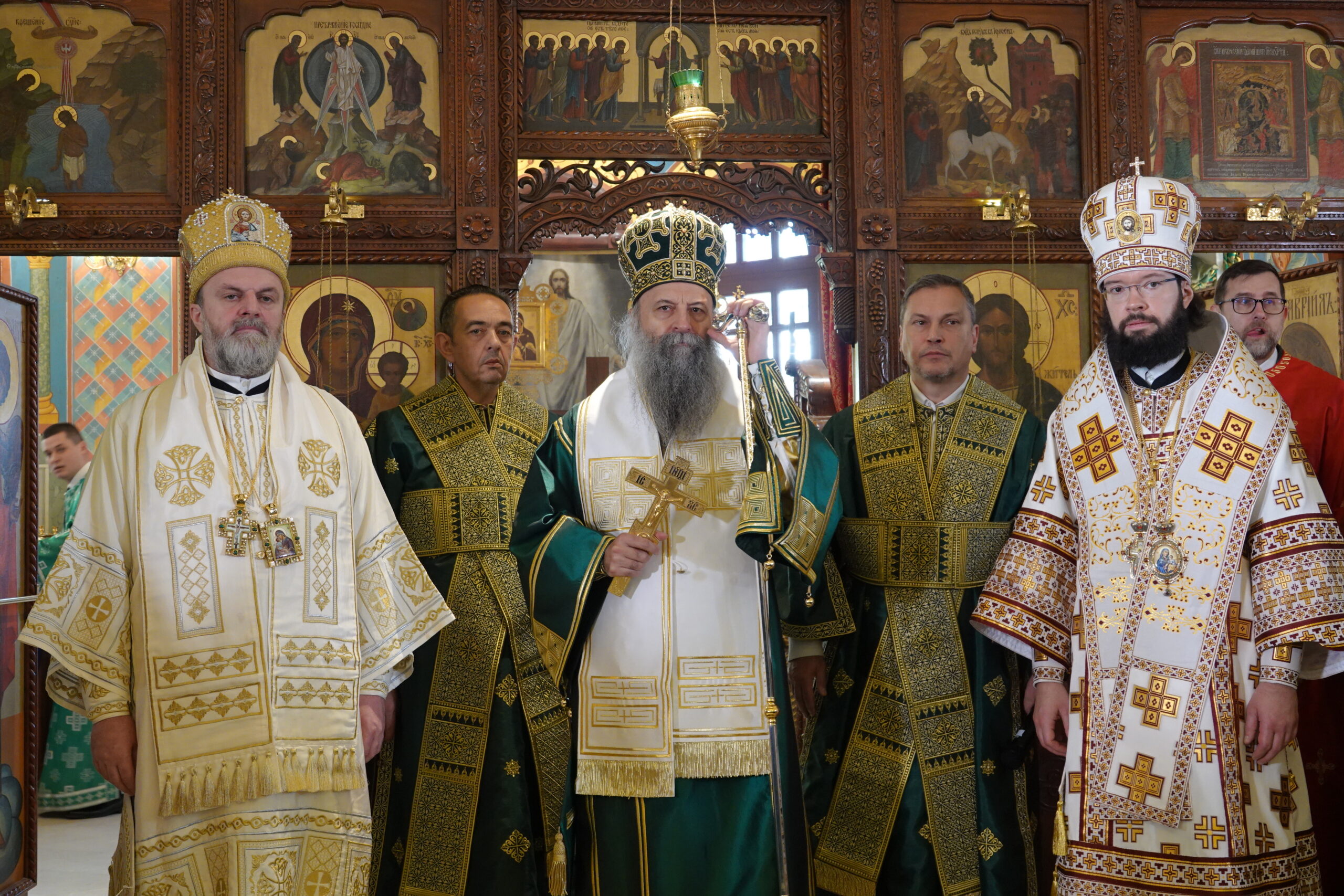
On Sunday, November 17, 2024, His Holiness Patriarch of Serbia Mr. Porfiry served the Most Holy Hierarchal Liturgy at the Russian Church of the Holy Trinity on Tašmajdan, a suburb of the Moscow Patriarchate in Belgrade.
On this occasion, His Holiness blessed the new painting of the Russian church, which has been decorating the Serbian capital for a hundred years. His Holiness was served by: Metropolitan of Volokolamsk Mr. Anthony, President of the Department for External Church Relations of the Moscow Patriarchate; His Holiness the Bishop of Remesia, Mr.. Stefan, Vicar of the Serbian Patriarch and Elder of the Podvore of the Serbian Orthodox Church in Moscow; Archimandrite Nektarius, Chief Secretary of the Holy Synod of Bishops of the Serbian Orthodox Church; Archimandrite Michael, Abbot of Jovanje Monastery; St. Sava of the Diocese of Niš; Archpriest Vitaly Tarasiev, Elder of the Podvore of the Moscow Patriarchate in Belgrade; Archpriest Nikolai Balashov, Advisor to the Patriarch of Moscow and All Russia; Archpriest Djordje Stoisavljevic, Head of the Serbian Patriarch's Cabinet; Archpriest Igor Yakimchuk, Deputy Chairman of the Department for External Church Relations of the Moscow Patriarchate; Archpriest-Stavrophor Milos Trisic; Presbyter Nikolai Vasin, Secretary to the Chairman of the Department for External Church Relations of the Moscow Patriarchate; Protodeacon Stevan Rapajic, Dragan Radić and Radomir Vručinić, as well as Deacon Nikolai Vuković.
The Holy Liturgy was attended by Dr. Nenad Popović, Minister without portfolio, responsible for international economic cooperation and the sphere of the social situation of the Church in the country and abroad; Dr. Vladimir Roganović, Director of the Directorate for Cooperation with Churches and Religious Communities of the Ministry of Justice; Academician Nikolai Mukhin, People's Artist of the Russian Federation; Mr.. Alexander Bokan Kharchenko, Ambassador of the Russian Federation in Belgrade.
Patriarch Porfiry: With the luck of the dead daughter and Jairus' faith in Christ there is a picture of the victory of life over death
After reading the Holy Gospel, His Holiness the Patriarch delivered a sermon: -In the name of the Father, and of the Son, and of the Holy Spirit. Brothers and sisters, everything in our lives, in the life of every person could have happened, and maybe it should not have happened. And the fact that we are gathered here today, thank God, happened, but it could also be that it did not happen, some of us were not present, or maybe someone planned to come and be at this meeting, and that he is not here today. However, there is only one thing that has to happen in every person's life. Everyone who is born dies. The one thing that we cannot avoid in any way is precisely the departure from this world, which is death, although, hand on heart, each of us, if we look into the inside ourselves, we live as if this moment will never come. Although everything inside us and around us assures us that we too are transient, although we see many people disappearing before us, we live as if we have the impression that this is a glass that will only pass us by and will not happen to us alone. But, alas! All who came into this world, all who were born out of this world, will pass away. All this shows that we first see death as our greatest enemy, as our greatest problem, and then apparently death is not something natural and belonging to our original being, but something outside our nature and added later.
This is why man, as well as the whole human race, since he himself knows everything he does through philosophy, art and science, he does with one ultimate goal - to find the key to unravel the mystery of death and to triumph. over death. In this way it shows that we are made for life. There is in us a deep, overwhelming and irresistible need to defeat this very first, last and greatest of our enemies. The result is obvious. Decade after decade, century after century, there has been progress, civilization has moved forward. And it may have sometimes seemed to some that they have come to the threshold of solving the mystery of death, but in all probability they have never he's not going to get there, nor has he come. In fact, he can't defeat death alone.
Today's Gospel gives us a foretaste of the unraveling of the mystery of death so that only life remains, because that is what we came into this world for, but we were created not only to live in time and space, i.e. history, but we were created so that by living here we could savor eternity in eternity. In the fellowship of mutual love and in communion with God, we live eternally in the Kingdom of God, which exists as if it were not created to be the space of our lives. So we have a dramatic picture before us, the picture of a man who has a sick daughter and seeks her healing. Meeting the Savior, encountering the Lord, recognizing in Him a power not of this world, he approaches Him with the faith that what he himself cannot do as a man and what he needs God can do for him. Indeed, the epilogue of this encounter between the dead daughter and Jairus' faith in Christ is that his daughter rises from the dead. It is an image of our needs and aspirations, of the cross and pain, but it is also an image of what Christ brings, which is life, victory over death. It is a picture of His Crucifixion, but also of His Resurrection from the dead, and this Resurrection is not a Resurrection for Himself and to Himself, but a Resurrection from the dead for us and for our sake, because He is the life and the carries life in Himself. Only if we are united to the Source of life, to Life, can the Source be imparted to us, to our persons and to the human race, and this, of course, happens as the gift of Christ, which becomes our content, our daily life and our reality through faith. Countless times, we read in the Gospel, the Lord performed miracles, but never imposed, neither as life nor as love, but gave Himself and all that was His to those who showed faith and put their trust in Him. In this sense, every miracle and the mystery of life as the greatest miracle is a reality that is the result of the cooperation of Life and human freedom, the cooperation of God, the cooperation of our Savior, who has already done everything for us, and our freedom, i.e., our feat. Freedom is not just an abstract definition. Freedom means determination, effort and endeavor to live up to that determination, in a word, to live according to the Word of Christ, according to His Gospel. Faith without works is dead, says the Apostle James. Faith as an expression of our freedom and determination to Christ, but also the effort to live in accordance with God's commandments - and not only the miracles of healing and cures have happened and are happening, but also the miracle of awakening from death - is something that ultimately depends on us, because life has already been given to us in advance Christ. However, whether He becomes our reality will depend on our determination, on our faith. In this sense, everything is always and only in our hands, because God did it, He is the Truth, the Way and the Life, and everything that is, can and must be ours. We are made for it, but it is necessary to have true and real faith. With this faith, the bleeding woman, who had been seeking her healing for years, only touched the chiton, Christ's garment, His garment, and she was already healed. This shows that the grace of God works in itself and works among us and in us. No matter how many obstacles there are in your life, physical - external and internal - spiritual, if they are not the reason for our abandonment, but the reason for greater efforts and more intense feats, we will surely touch the grace that is in us and near us. Let us grow spiritually, overcome every weakness, every infirmity, every disease, every defect and most importantly grow in love and faith, glorifying the One God in Trinity, Father, Son and Holy Spirit, now and always and forever. Amen.
Patriarch Porfiry: the Church as the body of Christ is one, unique and imperishable organism
Speaking at the end of the Holy Liturgy, His Holiness Patriarch Mr. Porphyry said: - I want to congratulate our Russian brothers on the fact that here, for a hundred years now, here, in this place, there has been this temple, where Russians who came to Serbia have gathered from the very beginning and prayed to God until today. The boundaries of the Church or the structure of the Church are arranged in such a way that the Church can be better managed for pastoral and missionary purposes. We have different Churches organized in such a way that each has its bishop at the head, then a patriarch, and in essence it is one, sobor and apostolic Church, the Church of Christ, in which the words of Christ are quite valid, that there is no Greek or barbarian, free or slave, male or female, i.e. that there are individual and personal seals. Each person is a special icon of God and has his own special seal, i.e., he has his own special, particular gifts that distinguish him from others. Thus, in every family there is something exceptional, and then even in the larger and wider family. Every people has its own specialness, its own diversity, its own special gift, in a word, a gift that has been given in order to show and manifest love to those who are different, and that this gift becomes a springboard for building unity. It is the Church as the Body of Christ that is that one, unique and imperishable organism, that is the Kingdom of God, here we have the Church of the Kingdom of God, and in fullness and eternity the Lord as King and Lord as the King. the foundation and the axis, as the vine, around which not only we all gather, but we are grafted onto this vine and from it we all become one with Him and become one with each other. I am happy that this temple has existed here for a whole century, that Liturgy is served in it, and I pray to God that the Lord will preserve it until the end of the century. May it be blessed, long live and congratulations! Our fraternal greetings and love to His Holiness Patriarch of Moscow and All Russia, our love and prayers and request that he pray for us! May God protect the Russian Church and the Russian people for many years!
The Russian Church in Belgrade is a symbol of brotherly relations between the Serbian and Russian peoples.
The Russian Church of the Holy Trinity on Tašmajdan is one of the most important spiritual and cultural symbols of the Russian emigration, which brought rich culture and Orthodox traditions to Serbia after the October Revolution and the Russian Civil War. To fulfill their spiritual needs, the Russian community, consisting of prominent archbishops, intellectuals, artists and officers, took the initiative to build the church. The church was built in 1924-1925, designed by architect V. T. Teofanov. The church is dedicated to the Holy Trinity, and its architecture is inspired by the traditional Russian Orthodox style. The Russian church in Belgrade was not only a temple, but also a cultural center of the Russian emigration, a place of gathering, spiritual comfort and preservation of Russian identity. Various cultural and educational events, concerts, lectures and exhibitions were held in the temple. The Russian Church is an important historical monument. Here is the grave of General P. N. Wrangel, commander of the Russian White Army. Believing residents of the capital with pleasure visit the Russian Church and worship its relics - miracle-working icons of St. Xenia of Petrograd and St. Matrona of Moscow. The temple keeps a part of the shawl of St. Tsarevich Alexei Romanov. The temple is a permanent symbol of brotherly relations between the Serbian and Russian peoples and a testimony to their common history and Orthodox faith.
The Russian temple has acquired a new luster thanks to the work of the famous Russian painter and iconographer Nikolai Mukhin, whose works also decorate the Church of St. Sava in Vračar. Prof. Mukhin is a member of the Russian Academy of Arts and has won a number of national and international awards for his work. His work is recognized throughout the Orthodox world and he is considered one of the leading contemporary artists continuing the traditions of Byzantine and Russian Orthodox art. Together with a group of Russian artists, Academician Mukhin in just seven months painted more than 520 square meters of frescoes under the direction of Archpriest Vitaly Tarasiev, head of the Moscow Patriarchate Podvory in Belgrade, as well as with the financial assistance of the founder. temple, Dr. Nenad Popovic, Minister responsible for international economic cooperation and the position of the Church in the country and abroad, who was addressed today by Metropolitan Volokolamsk Mr. Anthony presented the order of the Venerable icon painter Andrei Rublev. The walls of the temple are decorated with scenes from the Gospel, and next to the Lord and His favorites, the figures of Russian and Serbian new martyrs occupy a special place.
On this occasion, His Holiness blessed the new painting of the Russian church, which has been decorating the Serbian capital for a hundred years. His Holiness was served by: Metropolitan of Volokolamsk Mr. Anthony, President of the Department for External Church Relations of the Moscow Patriarchate; His Holiness the Bishop of Remesia, Mr.. Stefan, Vicar of the Serbian Patriarch and Elder of the Podvore of the Serbian Orthodox Church in Moscow; Archimandrite Nektarius, Chief Secretary of the Holy Synod of Bishops of the Serbian Orthodox Church; Archimandrite Michael, Abbot of Jovanje Monastery; St. Sava of the Diocese of Niš; Archpriest Vitaly Tarasiev, Elder of the Podvore of the Moscow Patriarchate in Belgrade; Archpriest Nikolai Balashov, Advisor to the Patriarch of Moscow and All Russia; Archpriest Djordje Stoisavljevic, Head of the Serbian Patriarch's Cabinet; Archpriest Igor Yakimchuk, Deputy Chairman of the Department for External Church Relations of the Moscow Patriarchate; Archpriest-Stavrophor Milos Trisic; Presbyter Nikolai Vasin, Secretary to the Chairman of the Department for External Church Relations of the Moscow Patriarchate; Protodeacon Stevan Rapajic, Dragan Radić and Radomir Vručinić, as well as Deacon Nikolai Vuković.
The Holy Liturgy was attended by Dr. Nenad Popović, Minister without portfolio, responsible for international economic cooperation and the sphere of the social situation of the Church in the country and abroad; Dr. Vladimir Roganović, Director of the Directorate for Cooperation with Churches and Religious Communities of the Ministry of Justice; Academician Nikolai Mukhin, People's Artist of the Russian Federation; Mr.. Alexander Bokan Kharchenko, Ambassador of the Russian Federation in Belgrade.
Patriarch Porfiry: With the luck of the dead daughter and Jairus' faith in Christ there is a picture of the victory of life over death
After reading the Holy Gospel, His Holiness the Patriarch delivered a sermon: -In the name of the Father, and of the Son, and of the Holy Spirit. Brothers and sisters, everything in our lives, in the life of every person could have happened, and maybe it should not have happened. And the fact that we are gathered here today, thank God, happened, but it could also be that it did not happen, some of us were not present, or maybe someone planned to come and be at this meeting, and that he is not here today. However, there is only one thing that has to happen in every person's life. Everyone who is born dies. The one thing that we cannot avoid in any way is precisely the departure from this world, which is death, although, hand on heart, each of us, if we look into the inside ourselves, we live as if this moment will never come. Although everything inside us and around us assures us that we too are transient, although we see many people disappearing before us, we live as if we have the impression that this is a glass that will only pass us by and will not happen to us alone. But, alas! All who came into this world, all who were born out of this world, will pass away. All this shows that we first see death as our greatest enemy, as our greatest problem, and then apparently death is not something natural and belonging to our original being, but something outside our nature and added later.
This is why man, as well as the whole human race, since he himself knows everything he does through philosophy, art and science, he does with one ultimate goal - to find the key to unravel the mystery of death and to triumph. over death. In this way it shows that we are made for life. There is in us a deep, overwhelming and irresistible need to defeat this very first, last and greatest of our enemies. The result is obvious. Decade after decade, century after century, there has been progress, civilization has moved forward. And it may have sometimes seemed to some that they have come to the threshold of solving the mystery of death, but in all probability they have never he's not going to get there, nor has he come. In fact, he can't defeat death alone.
Today's Gospel gives us a foretaste of the unraveling of the mystery of death so that only life remains, because that is what we came into this world for, but we were created not only to live in time and space, i.e. history, but we were created so that by living here we could savor eternity in eternity. In the fellowship of mutual love and in communion with God, we live eternally in the Kingdom of God, which exists as if it were not created to be the space of our lives. So we have a dramatic picture before us, the picture of a man who has a sick daughter and seeks her healing. Meeting the Savior, encountering the Lord, recognizing in Him a power not of this world, he approaches Him with the faith that what he himself cannot do as a man and what he needs God can do for him. Indeed, the epilogue of this encounter between the dead daughter and Jairus' faith in Christ is that his daughter rises from the dead. It is an image of our needs and aspirations, of the cross and pain, but it is also an image of what Christ brings, which is life, victory over death. It is a picture of His Crucifixion, but also of His Resurrection from the dead, and this Resurrection is not a Resurrection for Himself and to Himself, but a Resurrection from the dead for us and for our sake, because He is the life and the carries life in Himself. Only if we are united to the Source of life, to Life, can the Source be imparted to us, to our persons and to the human race, and this, of course, happens as the gift of Christ, which becomes our content, our daily life and our reality through faith. Countless times, we read in the Gospel, the Lord performed miracles, but never imposed, neither as life nor as love, but gave Himself and all that was His to those who showed faith and put their trust in Him. In this sense, every miracle and the mystery of life as the greatest miracle is a reality that is the result of the cooperation of Life and human freedom, the cooperation of God, the cooperation of our Savior, who has already done everything for us, and our freedom, i.e., our feat. Freedom is not just an abstract definition. Freedom means determination, effort and endeavor to live up to that determination, in a word, to live according to the Word of Christ, according to His Gospel. Faith without works is dead, says the Apostle James. Faith as an expression of our freedom and determination to Christ, but also the effort to live in accordance with God's commandments - and not only the miracles of healing and cures have happened and are happening, but also the miracle of awakening from death - is something that ultimately depends on us, because life has already been given to us in advance Christ. However, whether He becomes our reality will depend on our determination, on our faith. In this sense, everything is always and only in our hands, because God did it, He is the Truth, the Way and the Life, and everything that is, can and must be ours. We are made for it, but it is necessary to have true and real faith. With this faith, the bleeding woman, who had been seeking her healing for years, only touched the chiton, Christ's garment, His garment, and she was already healed. This shows that the grace of God works in itself and works among us and in us. No matter how many obstacles there are in your life, physical - external and internal - spiritual, if they are not the reason for our abandonment, but the reason for greater efforts and more intense feats, we will surely touch the grace that is in us and near us. Let us grow spiritually, overcome every weakness, every infirmity, every disease, every defect and most importantly grow in love and faith, glorifying the One God in Trinity, Father, Son and Holy Spirit, now and always and forever. Amen.
Patriarch Porfiry: the Church as the body of Christ is one, unique and imperishable organism
Speaking at the end of the Holy Liturgy, His Holiness Patriarch Mr. Porphyry said: - I want to congratulate our Russian brothers on the fact that here, for a hundred years now, here, in this place, there has been this temple, where Russians who came to Serbia have gathered from the very beginning and prayed to God until today. The boundaries of the Church or the structure of the Church are arranged in such a way that the Church can be better managed for pastoral and missionary purposes. We have different Churches organized in such a way that each has its bishop at the head, then a patriarch, and in essence it is one, sobor and apostolic Church, the Church of Christ, in which the words of Christ are quite valid, that there is no Greek or barbarian, free or slave, male or female, i.e. that there are individual and personal seals. Each person is a special icon of God and has his own special seal, i.e., he has his own special, particular gifts that distinguish him from others. Thus, in every family there is something exceptional, and then even in the larger and wider family. Every people has its own specialness, its own diversity, its own special gift, in a word, a gift that has been given in order to show and manifest love to those who are different, and that this gift becomes a springboard for building unity. It is the Church as the Body of Christ that is that one, unique and imperishable organism, that is the Kingdom of God, here we have the Church of the Kingdom of God, and in fullness and eternity the Lord as King and Lord as the King. the foundation and the axis, as the vine, around which not only we all gather, but we are grafted onto this vine and from it we all become one with Him and become one with each other. I am happy that this temple has existed here for a whole century, that Liturgy is served in it, and I pray to God that the Lord will preserve it until the end of the century. May it be blessed, long live and congratulations! Our fraternal greetings and love to His Holiness Patriarch of Moscow and All Russia, our love and prayers and request that he pray for us! May God protect the Russian Church and the Russian people for many years!
The Russian Church in Belgrade is a symbol of brotherly relations between the Serbian and Russian peoples.
The Russian Church of the Holy Trinity on Tašmajdan is one of the most important spiritual and cultural symbols of the Russian emigration, which brought rich culture and Orthodox traditions to Serbia after the October Revolution and the Russian Civil War. To fulfill their spiritual needs, the Russian community, consisting of prominent archbishops, intellectuals, artists and officers, took the initiative to build the church. The church was built in 1924-1925, designed by architect V. T. Teofanov. The church is dedicated to the Holy Trinity, and its architecture is inspired by the traditional Russian Orthodox style. The Russian church in Belgrade was not only a temple, but also a cultural center of the Russian emigration, a place of gathering, spiritual comfort and preservation of Russian identity. Various cultural and educational events, concerts, lectures and exhibitions were held in the temple. The Russian Church is an important historical monument. Here is the grave of General P. N. Wrangel, commander of the Russian White Army. Believing residents of the capital with pleasure visit the Russian Church and worship its relics - miracle-working icons of St. Xenia of Petrograd and St. Matrona of Moscow. The temple keeps a part of the shawl of St. Tsarevich Alexei Romanov. The temple is a permanent symbol of brotherly relations between the Serbian and Russian peoples and a testimony to their common history and Orthodox faith.
The Russian temple has acquired a new luster thanks to the work of the famous Russian painter and iconographer Nikolai Mukhin, whose works also decorate the Church of St. Sava in Vračar. Prof. Mukhin is a member of the Russian Academy of Arts and has won a number of national and international awards for his work. His work is recognized throughout the Orthodox world and he is considered one of the leading contemporary artists continuing the traditions of Byzantine and Russian Orthodox art. Together with a group of Russian artists, Academician Mukhin in just seven months painted more than 520 square meters of frescoes under the direction of Archpriest Vitaly Tarasiev, head of the Moscow Patriarchate Podvory in Belgrade, as well as with the financial assistance of the founder. temple, Dr. Nenad Popovic, Minister responsible for international economic cooperation and the position of the Church in the country and abroad, who was addressed today by Metropolitan Volokolamsk Mr. Anthony presented the order of the Venerable icon painter Andrei Rublev. The walls of the temple are decorated with scenes from the Gospel, and next to the Lord and His favorites, the figures of Russian and Serbian new martyrs occupy a special place.
Share: