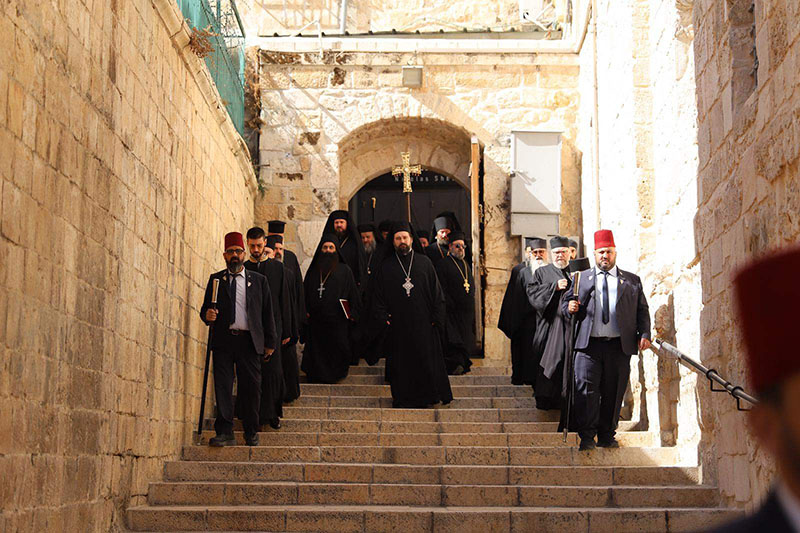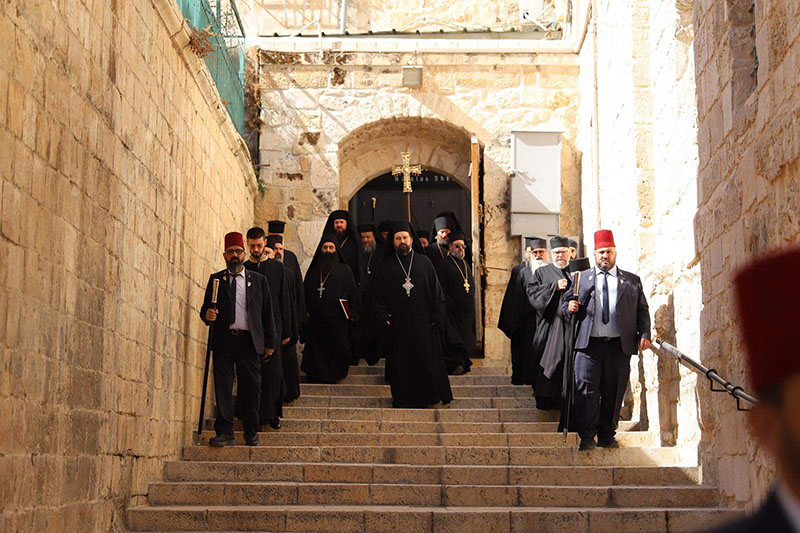
On Monday, October 15 / 28, 2024, a Lamentation was offered in the Cafolicon of the Most Holy Church of the Resurrection as thanksgiving to God for His help in liberating our race from the German and Italian occupation of World War II and as a tribute to our nation's heroes and a prayer for the repose of the souls of all the victims of this ordeal.
The Lamentation was led by His Beatitude our Father and Patriarch Theophilos of Jerusalem together with the co-serving Hierarchs, hieromonks and deacons of the Holy Sepulchre with the prayerful participation of the monks and nuns and members of the Greek community.
Mr. Dimitrios Angelosopoulos, Consul General of Greece in Jerusalem, and the staff of the Consulate General of Greece especially honored the Lamentation with their presence.
After the Lamentation in the hall of the Patriarchate, His Beatitude delivered the following speech:
"Your Excellency Mr. Dimitrios Angelosopoulos, Consul General of Greece,
Reverend Holy Fathers and Brothers,
Beloved Brothers in Christ,
Today's anniversary of "No" October 28, 1940 is a milestone not only in the history of the Greek Nation, but of all nations involved in World War II. Nations marveled at the heroism of the Greeks against the heavily armed military forces of Nazism and Fascism.
October 28, 1940 was not a simple war. It was a titanic struggle and the superhuman resistance of the Greeks against the insolent encroachers of their freedom. It was a struggle of self-sacrifice in defense of national territorial integrity, independence and moral values, whose generating cause was faith in the crucified and risen Christ. "But thanks be to God, who gave us the victory by our Lord Jesus Christ" (1 Cor. 15: 57) St. Paul preaches.
Therefore, our Moderate, accompanied by the reverend and venerable members of our Holy Sepulchre Brotherhood and also the devout children of our Christ-following flock, went to the Most Holy Shrine of the Resurrection and offered thanksgiving to our Holy Triune God, "who has done great wonders" (Psalm 135: 4) to our people.
Moreover, we prayed for the eternal memory and blessed repose of the souls of our fathers and brothers, who fought for our faith and Fatherland and fell gloriously on the battlefields.
The epic of 1940 remains indelible in the modern history of mankind, because it clearly showed, on the one hand, the exorbitant magnitude of the power of faith in the God of righteousness, according to John the Theologian: "Righteous are You, O Lord, who was and is" (Rev. 16: 5) on the other hand, the blasphemy of man, likened to unreasonable animals, according to the prophet Isaiah: "The day of the Lord of hosts is upon every vexatious and proud man, and upon every high and great" (Isaiah 2: 12).
We say this because the blasphemy of Nazism and fascism against the divine inviolable values and also the human person, reappears by the authorities of our age, transformed in the so-called progress and liberation: "Not even his ministers are transformed as ministers of righteousness" (2 Cor. 11: 15), preaches the divine Paul.
October 28, 1940 - an important voice by which the Greek-Christian and in particular the Greek Orthodox (Rum Orthodox) spirit was lifted up not only in Greek territory, but in Hellenism throughout the world. This spirit refers to the confession of faith in the God of truth and peace, the Son of God, our Lord Jesus Christ and His blessed Mother, the Theotokos, Mary, the Mother of God.
Also worthy of note is the recognized contribution of the Church to the holy struggle for our faith and homeland against the invaders of the barbarian Axis through the active participation of her high and low clergy and especially the military priests, whose fervent and patriotic preaching in Christ inspired and strengthened the fighting spirit of the Greek soldiers. Needless to say, among the heroically fallen soldiers there are countless priests who were executed by martyrdom.
Today's commemoration of the anniversary of the glorious epic of 1940 is being celebrated at a time when our region of the Near The East is subjected to the rigors of war and violent conflict at the expense of the "gospel of peace" (Eph. 6:15) Christ, who pacified by the blood of His cross, "through Him, whether earthly or heavenly" (Col. 1:20) according to the wise Paul.
We, the guardians and ministers of the holy pilgrimage sites of the testimonies of the "Gospel of Peace," pray that "the Lord of Peace himself may give us peace always in every way" (cf. 2 Thess. 3:16).
The souls of our brothers and fathers, the martyrs who fell in the war of 1940, call us to vigilance and to the preservation of the sacred heritage of our Greek Orthodox faith and sacred tradition: "Leading as ye were called to this, that ye may inherit the blessing."(cf. 1 Petr. 3:9), in the words of the Apostle Peter.
In conclusion, let us exclaim:
Long live the "No" of October 28, 1940!
Long live the pious race of the Romans of the Orthodox!
Long live Greece!
Long live our Holy Grove Brotherhood!
The Consul General also spoke in his address below:
"Your Beatitude,
Your Eminences,
Your Reverends Fathers and members of the Holy Grove Brotherhood,
Dear compatriots and friends,
I am honored to participate in today's praise at the Most Holy Church of the Resurrection in honor of the anniversary of October 28, 1940 in
honor of the those who dedicated themselves to the most noble struggle and sacrificed themselves for the freedom and ideals of the Greeks, but also for the universal values that for centuries have been linked to the greatness of the name of Greece.
On this day, 84 years ago, the flames of the terrible Second World War, which had already burned Europe, North Africa and the Far East, now reached Greece's doorstep. In the first dark hours of that day, which was inscribed in golden letters in History, Greece received an inexorable ultimatum from one of the powerful Axis powers, which had already subjugated most of continental Europe.
Looking back on those moments, as recounted by those who lived through them, one is struck by their dramatic scale. At three hours and fifty minutes in the morning of October 28, 1940, a car with diplomatic license plates stopped in front of a rather Doric residence in Kifissia. It can still be visited today. The car belonged to the Italian Ambassador and the residence belonged to the Greek Prime Minister. Startled, the sentry rang the electric bell from his observation post to warn. Everyone in the house was asleep. At last awakening, the Prime Minister, puzzled by the singularity of the hour, went down to the garden himself. Recognizing his guest, he understood. History again called on Greece to pay the bill.
The Prime Minister invited the Ambassador to come inside. They were sitting in a very simple drawing room. The short conversation that followed is described in detail and dramatically in the memoirs of the Italian ambassador. The ultimatum he issued demanded that Italian military forces be allowed to enter Greece and occupy various unspecified points of strategic importance. This was tantamount to demanding that Greece give up its independence and sovereignty. In silence the Greek Prime Minister read the message carefully. And with absolute firmness he remarked that this meant a declaration of war, refusing to consider any other option despite the insistence of his interlocutor. Finally, the prime minister escorted the ambassador to the exit and bid him farewell, saying to him only, "You are stronger," as if he were simply assessing the struggle that was about to begin. In his memoirs, the ambassador concludes that at that time he hated his profession. And he bowed respectfully to the old man who stood before him, who in the supreme hour of judgment had expressed with sobriety and dignity the will of his nation to choose the path of sacrifice over the path of dishonor.
For the political and military leadership of our country there was no doubt that if Greece were to go to war with a member of the Axis, sooner or later it would have to face the combined overwhelming power of all its members. The Greek people understood that, too. But despite the huge difference in strength, he never seriously considered giving up his independence and rights. The news of the outbreak of war was received with pride, self-confidence, and determination to defend the homeland. This atmosphere is eloquently described by Angelos Terzakis in his Greek Epic: "The nation had fallen asleep different last night, it was waking up different now... And everyone, even the humblest, felt the realization awakening in him that three thousand years were calling him by name, to justify them, to defend them. History ceased to be the words of textbooks and solemn speeches; it became an act of life...The choice of destiny was hard, but for this the honor was very great." Unbridled enthusiasm reigned in Greek communities as well. In Constantinople, in Cyprus, in Egypt, and here in Jerusalem, Greek conscripts and volunteers presented themselves to the consular authorities, asking to go to Greece to fight. The bravery with which the absolute refusal of the brutal demand for submission was expressed became a world example and changed the spirit of the war.
In a difficult time, in a period of historical crisis and naked truth that cannot be hidden by excuses and rhetorical schemes, Greece and its citizens, faced with the most unfavorable and ominous reality, did not hesitate to choose the difficult the path of dignity and honor. That is the ultimate meaning of today's commemoration. That is why in Greece, perhaps alone among all the countries of the world, we commemorate the anniversary of the day it entered World War II defending itself despite the agonizing ordeals it endured thereafter.
There is, however, another important lesson from today's anniversary. It was not only high spirit and adherence to its principles that enabled Greece to write brilliant new pages in its history and show itself worthy of its eternal example in the struggle for freedom. There was also the cold-blooded and systematic preparation that preceded it, given the approaching storm. Going into the war, Greece was smaller, poorer and weaker than the enemy, wounded by the Asia Minor catastrophe and internal political turmoil. But she was not unprepared. In the preceding period the country had prepared for danger with all the forces at its disposal, rebuilding its armed forces and preparing an exemplary plan of rapid mobilization. In the months preceding the outbreak of war, it had fought through subtle diplomatic manipulations against the escalating provocations of its adversaries, which reached their climax with the torpedoing of the Greek warship Elli in the port of Tinos on August 15, 1940, to be in the best possible position when it's time to fight.
This lesson is also important as we continue to move through a new period of international upheaval and challenge. When we marked this same day last year, the deadly conflict in Gaza was in its third week. A year later, it is not only continuing but has spread to a wider area. During this difficult time, we have been tested by danger, uncertainty and loss. In Gaza, St. Porphyrios Monastery is still blockaded, but is providing shelter, housing and food to hundreds of civilians. We will continue to go through this ordeal together and Greece's support will remain unwavering.
Faced with these difficult circumstances and until peace returns, let us continue to follow the lessons of today, unity, single-mindedness, organized cooperation and preparation, and above all, a commitment to our principles and values that remain as reliable guides today as they were on that morning of October 28, 1940.
Long live the years. Long live Greece."
General Secretariat
The Lamentation was led by His Beatitude our Father and Patriarch Theophilos of Jerusalem together with the co-serving Hierarchs, hieromonks and deacons of the Holy Sepulchre with the prayerful participation of the monks and nuns and members of the Greek community.
Mr. Dimitrios Angelosopoulos, Consul General of Greece in Jerusalem, and the staff of the Consulate General of Greece especially honored the Lamentation with their presence.
After the Lamentation in the hall of the Patriarchate, His Beatitude delivered the following speech:
"Your Excellency Mr. Dimitrios Angelosopoulos, Consul General of Greece,
Reverend Holy Fathers and Brothers,
Beloved Brothers in Christ,
Today's anniversary of "No" October 28, 1940 is a milestone not only in the history of the Greek Nation, but of all nations involved in World War II. Nations marveled at the heroism of the Greeks against the heavily armed military forces of Nazism and Fascism.
October 28, 1940 was not a simple war. It was a titanic struggle and the superhuman resistance of the Greeks against the insolent encroachers of their freedom. It was a struggle of self-sacrifice in defense of national territorial integrity, independence and moral values, whose generating cause was faith in the crucified and risen Christ. "But thanks be to God, who gave us the victory by our Lord Jesus Christ" (1 Cor. 15: 57) St. Paul preaches.
Therefore, our Moderate, accompanied by the reverend and venerable members of our Holy Sepulchre Brotherhood and also the devout children of our Christ-following flock, went to the Most Holy Shrine of the Resurrection and offered thanksgiving to our Holy Triune God, "who has done great wonders" (Psalm 135: 4) to our people.
Moreover, we prayed for the eternal memory and blessed repose of the souls of our fathers and brothers, who fought for our faith and Fatherland and fell gloriously on the battlefields.
The epic of 1940 remains indelible in the modern history of mankind, because it clearly showed, on the one hand, the exorbitant magnitude of the power of faith in the God of righteousness, according to John the Theologian: "Righteous are You, O Lord, who was and is" (Rev. 16: 5) on the other hand, the blasphemy of man, likened to unreasonable animals, according to the prophet Isaiah: "The day of the Lord of hosts is upon every vexatious and proud man, and upon every high and great" (Isaiah 2: 12).
We say this because the blasphemy of Nazism and fascism against the divine inviolable values and also the human person, reappears by the authorities of our age, transformed in the so-called progress and liberation: "Not even his ministers are transformed as ministers of righteousness" (2 Cor. 11: 15), preaches the divine Paul.
October 28, 1940 - an important voice by which the Greek-Christian and in particular the Greek Orthodox (Rum Orthodox) spirit was lifted up not only in Greek territory, but in Hellenism throughout the world. This spirit refers to the confession of faith in the God of truth and peace, the Son of God, our Lord Jesus Christ and His blessed Mother, the Theotokos, Mary, the Mother of God.
Also worthy of note is the recognized contribution of the Church to the holy struggle for our faith and homeland against the invaders of the barbarian Axis through the active participation of her high and low clergy and especially the military priests, whose fervent and patriotic preaching in Christ inspired and strengthened the fighting spirit of the Greek soldiers. Needless to say, among the heroically fallen soldiers there are countless priests who were executed by martyrdom.
Today's commemoration of the anniversary of the glorious epic of 1940 is being celebrated at a time when our region of the Near The East is subjected to the rigors of war and violent conflict at the expense of the "gospel of peace" (Eph. 6:15) Christ, who pacified by the blood of His cross, "through Him, whether earthly or heavenly" (Col. 1:20) according to the wise Paul.
We, the guardians and ministers of the holy pilgrimage sites of the testimonies of the "Gospel of Peace," pray that "the Lord of Peace himself may give us peace always in every way" (cf. 2 Thess. 3:16).
The souls of our brothers and fathers, the martyrs who fell in the war of 1940, call us to vigilance and to the preservation of the sacred heritage of our Greek Orthodox faith and sacred tradition: "Leading as ye were called to this, that ye may inherit the blessing."(cf. 1 Petr. 3:9), in the words of the Apostle Peter.
In conclusion, let us exclaim:
Long live the "No" of October 28, 1940!
Long live the pious race of the Romans of the Orthodox!
Long live Greece!
Long live our Holy Grove Brotherhood!
The Consul General also spoke in his address below:
"Your Beatitude,
Your Eminences,
Your Reverends Fathers and members of the Holy Grove Brotherhood,
Dear compatriots and friends,
I am honored to participate in today's praise at the Most Holy Church of the Resurrection in honor of the anniversary of October 28, 1940 in
honor of the those who dedicated themselves to the most noble struggle and sacrificed themselves for the freedom and ideals of the Greeks, but also for the universal values that for centuries have been linked to the greatness of the name of Greece.
On this day, 84 years ago, the flames of the terrible Second World War, which had already burned Europe, North Africa and the Far East, now reached Greece's doorstep. In the first dark hours of that day, which was inscribed in golden letters in History, Greece received an inexorable ultimatum from one of the powerful Axis powers, which had already subjugated most of continental Europe.
Looking back on those moments, as recounted by those who lived through them, one is struck by their dramatic scale. At three hours and fifty minutes in the morning of October 28, 1940, a car with diplomatic license plates stopped in front of a rather Doric residence in Kifissia. It can still be visited today. The car belonged to the Italian Ambassador and the residence belonged to the Greek Prime Minister. Startled, the sentry rang the electric bell from his observation post to warn. Everyone in the house was asleep. At last awakening, the Prime Minister, puzzled by the singularity of the hour, went down to the garden himself. Recognizing his guest, he understood. History again called on Greece to pay the bill.
The Prime Minister invited the Ambassador to come inside. They were sitting in a very simple drawing room. The short conversation that followed is described in detail and dramatically in the memoirs of the Italian ambassador. The ultimatum he issued demanded that Italian military forces be allowed to enter Greece and occupy various unspecified points of strategic importance. This was tantamount to demanding that Greece give up its independence and sovereignty. In silence the Greek Prime Minister read the message carefully. And with absolute firmness he remarked that this meant a declaration of war, refusing to consider any other option despite the insistence of his interlocutor. Finally, the prime minister escorted the ambassador to the exit and bid him farewell, saying to him only, "You are stronger," as if he were simply assessing the struggle that was about to begin. In his memoirs, the ambassador concludes that at that time he hated his profession. And he bowed respectfully to the old man who stood before him, who in the supreme hour of judgment had expressed with sobriety and dignity the will of his nation to choose the path of sacrifice over the path of dishonor.
For the political and military leadership of our country there was no doubt that if Greece were to go to war with a member of the Axis, sooner or later it would have to face the combined overwhelming power of all its members. The Greek people understood that, too. But despite the huge difference in strength, he never seriously considered giving up his independence and rights. The news of the outbreak of war was received with pride, self-confidence, and determination to defend the homeland. This atmosphere is eloquently described by Angelos Terzakis in his Greek Epic: "The nation had fallen asleep different last night, it was waking up different now... And everyone, even the humblest, felt the realization awakening in him that three thousand years were calling him by name, to justify them, to defend them. History ceased to be the words of textbooks and solemn speeches; it became an act of life...The choice of destiny was hard, but for this the honor was very great." Unbridled enthusiasm reigned in Greek communities as well. In Constantinople, in Cyprus, in Egypt, and here in Jerusalem, Greek conscripts and volunteers presented themselves to the consular authorities, asking to go to Greece to fight. The bravery with which the absolute refusal of the brutal demand for submission was expressed became a world example and changed the spirit of the war.
In a difficult time, in a period of historical crisis and naked truth that cannot be hidden by excuses and rhetorical schemes, Greece and its citizens, faced with the most unfavorable and ominous reality, did not hesitate to choose the difficult the path of dignity and honor. That is the ultimate meaning of today's commemoration. That is why in Greece, perhaps alone among all the countries of the world, we commemorate the anniversary of the day it entered World War II defending itself despite the agonizing ordeals it endured thereafter.
There is, however, another important lesson from today's anniversary. It was not only high spirit and adherence to its principles that enabled Greece to write brilliant new pages in its history and show itself worthy of its eternal example in the struggle for freedom. There was also the cold-blooded and systematic preparation that preceded it, given the approaching storm. Going into the war, Greece was smaller, poorer and weaker than the enemy, wounded by the Asia Minor catastrophe and internal political turmoil. But she was not unprepared. In the preceding period the country had prepared for danger with all the forces at its disposal, rebuilding its armed forces and preparing an exemplary plan of rapid mobilization. In the months preceding the outbreak of war, it had fought through subtle diplomatic manipulations against the escalating provocations of its adversaries, which reached their climax with the torpedoing of the Greek warship Elli in the port of Tinos on August 15, 1940, to be in the best possible position when it's time to fight.
This lesson is also important as we continue to move through a new period of international upheaval and challenge. When we marked this same day last year, the deadly conflict in Gaza was in its third week. A year later, it is not only continuing but has spread to a wider area. During this difficult time, we have been tested by danger, uncertainty and loss. In Gaza, St. Porphyrios Monastery is still blockaded, but is providing shelter, housing and food to hundreds of civilians. We will continue to go through this ordeal together and Greece's support will remain unwavering.
Faced with these difficult circumstances and until peace returns, let us continue to follow the lessons of today, unity, single-mindedness, organized cooperation and preparation, and above all, a commitment to our principles and values that remain as reliable guides today as they were on that morning of October 28, 1940.
Long live the years. Long live Greece."
General Secretariat
Share: